Species · Fishes
Peruvian Weakfish Cynoscion analis
The scientific name of the Peruvian Weakfish is Cynoscion analis. It is a species of fish in the family Sciaenidae (drums), order Perciformes. The name dates from 1842.
- Scientific name
- Cynoscion analis (Jenyns, 1842)
- Common name
- Peruvian Weakfish
- Genus
- Cynoscion
- Family
- Sciaenidae (Drums)
- Order
- Perciformes
- Class
- Teleostei
- Red List category
- LC Least Concern
- Environment
- brackish, marine
- Recorded in
- 3 countries
- Name status
- accepted in the Catalogue of Life
Overview
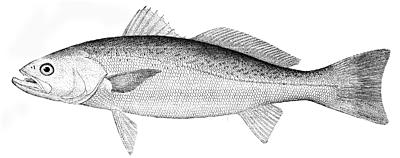
Cynoscion analis inhabits coastal marine environments. It has an elongated, compressed body, a distinctly oblique mouth and prominent canine teeth at the front of the upper jaw.
Written 28 November 2026 from the sources listed below. Each statement was checked against the passage it cites; statements that could not be supported were removed.
Appearance
The Peruvian Weakfish has an elongated, fusiform body that is compressed and oval in cross-section. Its head measures 29.2–34.5% of its standard length, and a ridge runs down the front of its snout.[1][2][3]
Its mouth is distinctly oblique, with the lower jaw projecting prominently. The upper jaw bears one pair of large, pointed canine teeth at the front, and the species has no barbels or pores on its chin.[4][5][6]
The dorsal fin has a long base and a small gap separating its two parts. The anal fin has two weak spines, each shorter than half the length of the first ray.[7][8]
The pectoral fins have 27–28 rays and reach the tips of the pelvic fins. The rear margin of the tail is slightly concave, and the lateral line is only slightly curved.[9][10][11]
The inner three-quarters of the membranes on the soft dorsal and anal fins are scaled. The species has approximately 54–63 pored lateral-line scales, which are larger than adjacent scales and have small accessory scales.[12][13][14]
The back is silvery blue and the underside is silvery. All fins except the pelvic fins are dark grey, while the pelvic fins are mid-grey, and the tip of the lower jaw is dark.[15][16][17]
Habitat
The Peruvian Weakfish inhabits coastal marine environments. Juveniles enter estuaries and shallow bays.[18][19]
Its recorded soft-bottom habitats include mud, sand, gravel, beaches, estuaries, mangroves and seagrass areas. It is recorded in bottom, midwater and water-column environments.[20][21]
Diet
The Peruvian Weakfish feeds on octopuses, squids and cuttlefish. Its diet also includes mobile benthic crustaceans such as shrimps and crabs.[22][23]
Conservation
The species has a reported moderate vulnerability score of 43 out of 100. A second vulnerability assessment gives it a score of 50 out of 100, classified as moderate to high vulnerability.[24][25]
Its estimated population doubling time is classified as medium, at 1.4–4.4 years.[26]
Classification of the Peruvian Weakfish
| Kingdom | Animalia |
|---|---|
| Phylum | Chordata |
| Subphylum | Vertebrata |
| Infraphylum | Gnathostomata |
| Parvphylum | Osteichthyes |
| Gigaclass | Actinopterygii |
| Superclass | Actinopteri |
| Class | Teleostei (Teleost) |
| Order | Perciformes |
| Suborder | Percoidei |
| Family | Sciaenidae (Drums) |
| Genus | Cynoscion (Sea Trout) |
| Species | Cynoscion analis (Jenyns, 1842) |
Where the Peruvian Weakfish is found
Checklists and occurrence records place Cynoscion analis in 3 countries. GBIF holds 105 georeferenced records of it.
Countries
Regions and cities with the most records
- Breña, Peru 13
- Callao, Peru 13
- Carmen De La Legua Reynoso, Peru 13
- Jesus Maria, Peru 13
- Lima, Peru 13
- San Francisco De Borja, Peru 8
- San Isidro, Peru 8
- Santa Anita - Los Ficus, Peru 8
- Paita, Peru 6
- Callao, Peru 5
- Piura, Peru 5
- Talara, Peru 5
- Lima Province, Peru 3
- Nuevo Imperial, Peru 3
- Villa Poeta José Gálvez Barrenechea, Peru 3
A number beside a place is its count of GBIF occurrence records. A place without a number comes from a checklist alone. Records show where a species has been observed or collected, which can include escapes and vagrants.
Common names
English
- Peruvian Weakfish
Names in 5 other languages
- Czech
- smuha chilská
- French
- Acoupa du Pérou
- Portuguese
- Corvina-peruana
- Russian
- Качема, Перуанский судачий горбыль
- Spanish
- Ayangue, Cachema, Corvina
Synonyms
2 other scientific names have been used for this species and are now treated as synonyms of Cynoscion analis.
- Otolithus analis Jenyns, 1842
- Otolithus peruanus Tschudi, 1846
Related species
-
 Spotted SeatroutCynoscion nebulosus
-
 WeakfishCynoscion regalis
-
 Sand SeatroutCynoscion arenarius
-
 Acoupa WeakfishCynoscion acoupa
-
 Silver SeatroutCynoscion nothus
-
 Striped WeakfishCynoscion striatus
- Jamaica WeakfishCynoscion jamaicensis
- Smallscale WeakfishCynoscion microlepidotus
Compare
Questions and answers
What is the scientific name of the Peruvian Weakfish?
The scientific name of the Peruvian Weakfish is Cynoscion analis. Written with its author, the full name is Cynoscion analis (Jenyns, 1842).
Which family does the Peruvian Weakfish belong to?
Cynoscion analis belongs to the family Sciaenidae, in the order Perciformes and the class Teleostei.
Where is the Peruvian Weakfish found?
Checklists and occurrence records place Cynoscion analis in 3 countries: Peru, Chile and Ecuador.
What is the conservation status of the Peruvian Weakfish?
The IUCN Red List category recorded for Cynoscion analis is Least Concern (LC).
Sources
Passages the profile rests on
- Cynoscion analis has an elongated, fusiform body that is compressed and oval in cross-section. Source passage: “Elongate, fusiform, compressed, oval cross-section” — biogeodb.stri.si.edu
- The head of Cynoscion analis measures 29.2–34.5% of its standard length. Source passage: “head deep, long, 29.2-34.5% of SL” — biogeodb.stri.si.edu
- The species has a ridge running down the front of its snout. Source passage: “ridge down front of snout” — biogeodb.stri.si.edu
- Its mouth is distinctly oblique, with the lower jaw projecting prominently. Source passage: “mouth distinctly oblique, lower jaw prominently projecting” — biogeodb.stri.si.edu
- The upper jaw bears one pair of large, pointed canine teeth at the front. Source passage: “front of top jaws with 1 pair of large pointed canines” — biogeodb.stri.si.edu
- The species has no barbels or pores on its chin. Source passage: “no barbels or pores on chin” — biogeodb.stri.si.edu
- The dorsal fin has a long base and a small gap separating its two parts. Source passage: “dorsal with long base, a small gap separating the two parts” — biogeodb.stri.si.edu
- The anal fin has two weak spines, each shorter than half the length of the first ray. Source passage: “anal fin with II small (< ½ length of 1st ray) weak spines” — biogeodb.stri.si.edu
- The pectoral fins have 27–28 rays and are relatively long, reaching the tips of the pelvic fins. Source passage: “pectoral fins 27-28, relatively long, reaching pelvic tip” — biogeodb.stri.si.edu
- The rear margin of the tail is slightly concave. Source passage: “rear margin of tail slightly concave” — biogeodb.stri.si.edu
- Its lateral line is only slightly curved. Source passage: “lateral line only slightly curved” — biogeodb.stri.si.edu
- The inner three-quarters of the membranes on the soft dorsal and anal fins are scaled. Source passage: “inner 3/4 of membranes on soft dorsal and anal fins scaled” — biogeodb.stri.si.edu
- The species has approximately 54–63 pored lateral-line scales. Source passage: “pored lateral-line scales about 54-63” — biogeodb.stri.si.edu
- Its lateral-line scales are larger than adjacent scales and have small accessory scales. Source passage: “lateral line scales larger than adjacent scales, and with small accessory scales.” — biogeodb.stri.si.edu
- The back is silvery blue and the underside is silvery. Source passage: “Back silvery blue, silvery below” — biogeodb.stri.si.edu
- All fins except the pelvic fins are dark grey, while the pelvic fins are mid-grey. Source passage: “all fins except pelvic dark grey, pelvic mid grey” — biogeodb.stri.si.edu
- The tip of the lower jaw is dark. Source passage: “tip of lower jaw dark.” — biogeodb.stri.si.edu
- Cynoscion analis inhabits coastal marine environments. Source passage: “Habitat: coastal, marine” — biogeodb.stri.si.edu
- Juveniles enter estuaries and shallow bays. Source passage: “juveniles enter estuaries and shallow bays.” — biogeodb.stri.si.edu
- Its recorded soft-bottom habitats include mud, sand, gravel, beaches, estuaries, mangroves and seagrass areas. Source passage: “Soft bottom (mud/sand/gravel/beach/estuary/mangrove/seagrass)” — biogeodb.stri.si.edu
- The species is recorded in bottom, midwater and water-column environments. Source passage: “Near Bottom Bottom + water column Mid Water Bottom” — biogeodb.stri.si.edu
- Cynoscion analis feeds on octopuses, squids and cuttlefish. Source passage: “Octopus/squid/cuttlefish” — biogeodb.stri.si.edu
- Its diet includes mobile benthic crustaceans such as shrimps and crabs. Source passage: “Mobile benthic crustacea (shrimps/crabs)” — biogeodb.stri.si.edu
- The species has a reported moderate vulnerability score of 43 out of 100. Source passage: “Moderate vulnerability (43 of 100).” — fishbase.se
- A second reported vulnerability assessment gives the species a score of 50 out of 100, classified as moderate to high vulnerability. Source passage: “Moderate to high vulnerability (50 of 100).” — fishbase.se
- The estimated population doubling time for the species is classified as medium, at 1.4–4.4 years. Source passage: “Medium, minimum population doubling time 1.4 - 4.4 years (K=0.12-0.23).” — fishbase.se
Data
- Catalogue of Life, 2026-10-16 XR cc by
- Global Biodiversity Information Facility CC BY 4.0
- Wikidata CC0
- GeoNames CC BY 4.0
- Within the Catalogue of Life, this name comes from World Register of Marine Species cc by
This species in other databases
- Catalogue of Life 6C7LF
- Wikidata Q748690
- iNaturalist 98863
- WoRMS urn:lsid:marinespecies.org:taxname:276076
- ITIS 646590
Page built on 28 November 2026. See how the catalog is made and all sources and licences.
Cite this page
ScientificNames.org. (2026). Cynoscion analis (Peruvian Weakfish). Retrieved November 28, 2026, from https://scientificnames.org/species/cynoscion-analis
“Cynoscion analis (Peruvian Weakfish).” ScientificNames.org, 2026, scientificnames.org/species/cynoscion-analis. Accessed 28 Nov. 2026.
ScientificNames.org. “Cynoscion analis (Peruvian Weakfish).” Accessed November 28, 2026. https://scientificnames.org/species/cynoscion-analis.
@misc{scientificnames_cynoscion_analis_peruvian_weakfish,
  author = {{ScientificNames.org}},
  title = {Cynoscion analis (Peruvian Weakfish)},
  year = {2026},
  url = {https://scientificnames.org/species/cynoscion-analis},
  note = {Accessed 2026-11-28}
}