Species · Fishes
Smooth Weakfish Cynoscion leiarchus
The scientific name of the Smooth Weakfish is Cynoscion leiarchus. It is a species of fish in the family Sciaenidae (drums), order Perciformes. The name dates from 1830.
- Scientific name
- Cynoscion leiarchus (Cuvier, 1830)
- Common name
- Smooth Weakfish
- Genus
- Cynoscion
- Family
- Sciaenidae (Drums)
- Order
- Perciformes
- Class
- Teleostei
- Red List category
- LC Least Concern
- Environment
- brackish, marine
- Recorded in
- 8 countries
- Name status
- accepted in the Catalogue of Life

Overview
Cynoscion leiarchus inhabits sandy bottoms in coastal waters and is common in surf zones and estuaries. It has an elongated silvery-blue body with greenish reflections along the back and tiny dark spots on its upper sides.
Written 28 November 2026 from the sources listed below. Each statement was checked against the passage it cites; statements that could not be supported were removed.
Appearance
The Smooth weakfish has an elongated, compressed, fusiform body with an oval cross-section. Its head is low and lacks a spongy crown. Its mouth is large and oblique, with the lower jaw projecting slightly.[1][2][3]
The upper jaw has one or two large canine teeth at its tip. The lower jaw has an enlarged inner row of uniformly sized, closely spaced teeth. Its gill rakers are long and slender, numbering eight to eleven.[4][5][6]
The species lacks pores and barbels on its chin and has two pores on each side of the snout. Its preopercle has a smooth margin, and the upper corner of its gill opening is notched.[7][8][9][10]
Its dorsal fin has ten spines followed by one spine and 20–24 soft rays. Its anal fin has two weak spines and ten to twelve soft rays. Its pectoral fins are shorter than its pelvic fins.[11][12][13]
In adults, the rear edge of the tail fin is doubly concave to straight. Its scales are small and entirely smooth, with 110 transverse scale rows above the lateral line. The soft dorsal fin sometimes has small scales on the lower half of its membranes, in addition to one or two rows at the base.[14][15][16][17]
Its lateral line curves upward anteriorly, becomes straight before reaching the level of the anus, and extends to the center of the tail-fin end. Its body is uniformly silvery blue with greenish reflections along the back and tiny dark spots on the upper sides.[18][19][20]
Its soft dorsal and tail fins have black edges, while its pelvic and anal fins are yellowish. The inside of its opercle is dusky and visible externally.[21][22][23]
Habitat
The Smooth weakfish inhabits sandy bottoms in coastal waters. It is common in surf zones and estuaries.[24][25]
Diet
Its recorded food category includes mobile benthic crustaceans such as shrimps and crabs.[26]
Classification of the Smooth Weakfish
| Kingdom | Animalia |
|---|---|
| Phylum | Chordata |
| Subphylum | Vertebrata |
| Infraphylum | Gnathostomata |
| Parvphylum | Osteichthyes |
| Gigaclass | Actinopterygii |
| Superclass | Actinopteri |
| Class | Teleostei (Teleost) |
| Order | Perciformes |
| Suborder | Percoidei |
| Family | Sciaenidae (Drums) |
| Genus | Cynoscion (Sea Trout) |
| Species | Cynoscion leiarchus (Cuvier, 1830) |
Where the Smooth Weakfish is found
Checklists and occurrence records place Cynoscion leiarchus in 8 countries. GBIF holds 355 georeferenced records of it.
Countries
- Belize 11
- Brazil 291
- Colombia 7
- French Guiana 6
- Guyana 5
- Panama 20
- Trinidad and Tobago 8
- Venezuela 7
Regions and cities with the most records
- Rio de Janeiro, Brazil 17
- Guarujá, Brazil 15
- Praia Grande, Brazil 15
- Santos, Brazil 15
- São Vicente, Brazil 15
- Espírito Santo, Brazil 14
- Bahia, Brazil 13
- Cubatão, Brazil 13
- Santa Catarina, Brazil 13
- São Paulo, Brazil 13
- Mangaratiba, Brazil 9
- Governador Celso Ramos, Brazil 8
- Botafogo, Brazil 7
- Cariacica, Brazil 7
- Catete, Brazil 7
- Cordovil, Brazil 7
- Estácio, Brazil 7
- Freguesia, Brazil 7
- Ipanema, Brazil 7
- Leblon, Brazil 7
- Niterói, Brazil 7
- Rio de Janeiro, Brazil 7
- Salvador, Brazil 7
- Santa Teresa, Brazil 7
- São Gonçalo, Brazil 7
- Vera Cruz, Brazil 7
- Vila Velha, Brazil 7
- Vitória, Brazil 7
- Acari, Brazil 6
- Duque de Caxias, Brazil 6
- Macaé, Brazil 6
- Paraná, Brazil 6
- Rocinha, Brazil 6
- Salinópolis, Brazil 6
- São Francisco do Sul, Brazil 6
- Cachoeira, Brazil 5
A number beside a place is its count of GBIF occurrence records. A place without a number comes from a checklist alone. Records show where a species has been observed or collected, which can include escapes and vagrants.
Common names
English
- Smooth Weakfish
Names in 5 other languages
- Czech
- smuha bělobřichá
- French
- Acoupa blanc
- Portuguese
- Cambucu, Corumbeba, Corvina Tinga, Curumbeva, Curvitinga, Marmota, Pescada, Pescada-branca
- Russian
- Бразильский судачий горбыль
- Spanish
- Corvinata Blanca, Curvina
Synonyms
One other scientific name has been used for this species and is now treated as a synonym of Cynoscion leiarchus.
- Otolithus leiarchus Cuvier, 1830
Related species
-
 Spotted SeatroutCynoscion nebulosus
-
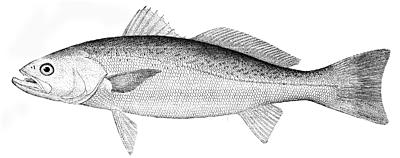 WeakfishCynoscion regalis
-
 Sand SeatroutCynoscion arenarius
-
 Acoupa WeakfishCynoscion acoupa
-
 Silver SeatroutCynoscion nothus
-
 Striped WeakfishCynoscion striatus
- Jamaica WeakfishCynoscion jamaicensis
- Smallscale WeakfishCynoscion microlepidotus
Compare
Questions and answers
What is the scientific name of the Smooth Weakfish?
The scientific name of the Smooth Weakfish is Cynoscion leiarchus. Written with its author, the full name is Cynoscion leiarchus (Cuvier, 1830).
Which family does the Smooth Weakfish belong to?
Cynoscion leiarchus belongs to the family Sciaenidae, in the order Perciformes and the class Teleostei.
Where is the Smooth Weakfish found?
Checklists and occurrence records place Cynoscion leiarchus in 8 countries, including Brazil, Panama, Belize, Trinidad and Tobago, Colombia and Venezuela.
What is the conservation status of the Smooth Weakfish?
The IUCN Red List category recorded for Cynoscion leiarchus is Least Concern (LC).
What do weak fish eat?
The Smooth weakfish feeds on mobile benthic crustaceans, including shrimps and crabs.[26]
Sources
Passages the profile rests on
- The species has an elongated, compressed, fusiform body with an oval cross-section. Source passage: “Elongate, fusiform, compressed, oval cross-section” — biogeodb.stri.si.edu
- Its head is low and lacks a spongy crown. Source passage: “head low, not spongy on top” — biogeodb.stri.si.edu
- Its mouth is large and oblique, with the lower jaw projecting slightly. Source passage: “mouth large, oblique, lower jaw slightly projecting” — biogeodb.stri.si.edu
- The upper jaw has one or two large canine teeth at its tip. Source passage: “1-2 large canines at tip of upper jaw” — biogeodb.stri.si.edu
- The lower jaw has an enlarged inner row of uniformly sized, closely spaced teeth. Source passage: “inner row of teeth on lower jaw enlarged, of uniform size, close-set” — biogeodb.stri.si.edu
- Its gill rakers are long and slender, numbering eight to eleven. Source passage: “gill rakers long and slender, 8-11” — biogeodb.stri.si.edu
- It lacks pores and barbels on its chin. Source passage: “no pores or barbels on chin” — biogeodb.stri.si.edu
- It has two pores on each side of the snout. Source passage: “2 pores on side of snout” — biogeodb.stri.si.edu
- Its preopercle has a smooth margin. Source passage: “margin of preopercle smooth” — biogeodb.stri.si.edu
- The upper corner of its gill opening is notched. Source passage: “top corner of gill opening notched” — biogeodb.stri.si.edu
- Its dorsal fin has ten spines followed by one spine and 20–24 soft rays, as reported in the source's notation. Source passage: “dorsal rays X + I, 20-24” — biogeodb.stri.si.edu
- Its anal fin has two weak spines and ten to twelve soft rays. Source passage: “anal rays II, weak spines, 10-12” — biogeodb.stri.si.edu
- Its pectoral fins are shorter than its pelvic fins. Source passage: “pectoral fins < pelvic fins” — biogeodb.stri.si.edu
- The rear edge of its tail fin is doubly concave to straight in adults. Source passage: “rear margin of tail doubly concave to straight in adult” — biogeodb.stri.si.edu
- Its scales are small and entirely smooth. Source passage: “scales small, all smooth” — biogeodb.stri.si.edu
- It has 110 transverse scale rows above the lateral line. Source passage: “110 transverse rows above lateral line” — biogeodb.stri.si.edu
- Its soft dorsal fin sometimes has small scales on the lower half of its membranes, in addition to one or two rows at the base. Source passage: “soft dorsal with 1-2 rows of small scales on base, sometimes also small scales on lower half of membranes” — biogeodb.stri.si.edu
- Its lateral line curves upward anteriorly, becomes straight before reaching the level of the anus, and extends to the center of the tail-fin end. Source passage: “lateral line arched anteriorly and straight well before level of anus, extends to the center of the end of the tail fin.” — biogeodb.stri.si.edu
- Its body is uniformly silvery blue with greenish reflections along the back. Source passage: “Body uniform silvery bluish with greenish reflections on back” — biogeodb.stri.si.edu
- Its upper sides have tiny dark spots. Source passage: “upper sides with tiny dark dots” — biogeodb.stri.si.edu
- Its soft dorsal and tail fins have black edges. Source passage: “soft dorsal and tail fin edged in black” — biogeodb.stri.si.edu
- Its pelvic and anal fins are yellowish. Source passage: “pelvic and anal fins yellowish” — biogeodb.stri.si.edu
- The inside of its opercle is dusky and visible externally. Source passage: “inside opercle dusky, visible externally.” — biogeodb.stri.si.edu
- The species inhabits sandy bottoms in coastal waters. Source passage: “Inhabits sandy bottoms of coastal waters” — biogeodb.stri.si.edu
- It is common in surf zones and estuaries. Source passage: “common in surf zones and estuaries.” — biogeodb.stri.si.edu
- Its recorded food category includes mobile benthic crustaceans such as shrimps and crabs. Source passage: “Mobile benthic crustacea (shrimps/crabs)” — biogeodb.stri.si.edu
Data
- Catalogue of Life, 2026-10-16 XR cc by
- Global Biodiversity Information Facility CC BY 4.0
- Wikidata CC0
- GeoNames CC BY 4.0
- Wikimedia Commons per image; credit shown with each image
- Within the Catalogue of Life, this name comes from World Register of Marine Species cc by
References
- Cuvier and Valenciennes, 1830 where the name was published
This species in other databases
- Catalogue of Life 6BVNB
- Wikidata Q3003750
- iNaturalist 620307
- WoRMS urn:lsid:marinespecies.org:taxname:276080
- ITIS 169245
Page built on 29 November 2026. See how the catalog is made and all sources and licences.
Cite this page
ScientificNames.org. (2026). Cynoscion leiarchus (Smooth Weakfish). Retrieved November 29, 2026, from https://scientificnames.org/species/cynoscion-leiarchus
“Cynoscion leiarchus (Smooth Weakfish).” ScientificNames.org, 2026, scientificnames.org/species/cynoscion-leiarchus. Accessed 29 Nov. 2026.
ScientificNames.org. “Cynoscion leiarchus (Smooth Weakfish).” Accessed November 29, 2026. https://scientificnames.org/species/cynoscion-leiarchus.
@misc{scientificnames_cynoscion_leiarchus_smooth_weakfish,
  author = {{ScientificNames.org}},
  title = {Cynoscion leiarchus (Smooth Weakfish)},
  year = {2026},
  url = {https://scientificnames.org/species/cynoscion-leiarchus},
  note = {Accessed 2026-11-29}
}