Species · Fishes
Dow's Toadfish Daector dowi
The scientific name of the Dow's Toadfish is Daector dowi. It is a species of fish in the family Batrachoididae (toadfishes), order Batrachoidiformes. The name dates from 1887.
- Scientific name
- Daector dowi (Jordan & Gilbert, 1887)
- Common name
- Dow's Toadfish
- Genus
- Daector
- Family
- Batrachoididae (Toadfishes)
- Order
- Batrachoidiformes
- Class
- Teleostei
- Red List category
- LC Least Concern
- Environment
- marine
- Recorded in
- 4 countries
- Name status
- accepted in the Catalogue of Life

Overview
Daector dowi is endemic to the eastern Pacific, with a recorded geographic range from Costa Rica to Ecuador, including the Galapagos Islands. It is distinguished by its dark brown upper body with white vermiculations, a prominent white lateral stripe, and hollow, venomous spines.
Written 28 November 2026 from the sources listed below. Each statement was checked against the passage it cites; statements that could not be supported were removed.
Appearance
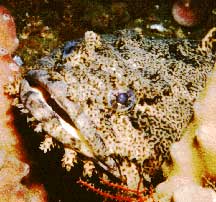
The body is elongated, laterally compressed, and tapers toward the rear. The head is robust and flattened on its upper surface, and the mouth is strongly oblique, with the lower jaw projecting forward.[1][2][3]
The operculum bears one hollow, venomous spine at its upper corner. The first dorsal fin consists of two hollow, venomous spines.[4][5]
The dorsal fin has II + 29–33 rays, usually 31, while the anal fin has 28–30 rays, usually 29, and the pectoral fin has 16–18 rays, usually 17. The soft dorsal and anal fins are long, low, and attached to the base of the tail fin.[6][7][8][9]
The species lacks light organs and scales. The upper half of the head and body is dark brown, while the lower half is whitish; the dark upper body has white vermiculations and a prominent white stripe along the lateral line.[10][11][12]
The spinous dorsal fin is black, and the outer edges of the second dorsal and caudal fins are blackish.[13][14]
Habitat
Dow's Toadfish inhabits sandy or muddy bottoms in bays and estuaries. Its recorded soft-bottom habitats include sand, gravel, beaches, estuaries, mangroves, and seagrass areas.[15][16]
Diet
Its recorded dietary categories include mobile benthic gastropods and bivalves, as well as octopuses, squids, and cuttlefish. It also feeds on mobile benthic crustaceans such as shrimps and crabs.[17][18][19]
Conservation
Dow's Toadfish was assessed as Least Concern on the IUCN Red List. The most recent IUCN Red List assessment reported was conducted in 2007.[20][21]
Classification of the Dow's Toadfish
| Kingdom | Animalia |
|---|---|
| Phylum | Chordata |
| Subphylum | Vertebrata |
| Infraphylum | Gnathostomata |
| Parvphylum | Osteichthyes |
| Gigaclass | Actinopterygii |
| Superclass | Actinopteri |
| Class | Teleostei (Teleost) |
| Order | Batrachoidiformes |
| Family | Batrachoididae (Toadfishes) |
| Subfamily | Thalassophryninae |
| Genus | Daector |
| Species | Daector dowi (Jordan & Gilbert, 1887) |
Where the Dow's Toadfish is found
Checklists and occurrence records place Daector dowi in 4 countries. GBIF holds 155 georeferenced records of it.
Countries
Regions and cities with the most records
- Ancón, Panama 15
- Curundú, Panama 15
- Panama City, Panama 15
- Veracruz, Panama 15
- Arraiján, Panama 14
- Panamá, Panama 13
- Buenaventura, Colombia 11
- Juan Díaz, Panama 11
- Tocumen, Panama 11
- Alcalde Díaz, Panama 10
- San Miguelito, Panama 10
- Valle del Cauca Department, Colombia 9
- Chocó, Colombia 8
- Nariño, Colombia 7
- Playas, Ecuador 7
- Posorja, Ecuador 7
A number beside a place is its count of GBIF occurrence records. A place without a number comes from a checklist alone. Records show where a species has been observed or collected, which can include escapes and vagrants.
Common names
English
- Dow's Toadfish
Names in 4 other languages
- Czech
- žabohlavec Dowův
- Portuguese
- Boca-de-sapo-do-sul
- Russian
- Дектор
- Spanish
- Bruja, Bruja Tres Espinas, Sapo de Dow
Synonyms
2 other scientific names have been used for this species and are now treated as synonyms of Daector dowi.
- Thalassophryne depressa Hildebrand, 1946
- Thalassophryne dowi Jordan & Gilbert, 1887
Related species
-
 Reticulated ToadfishDaector reticulata
- Schmitt's ToadfishDaector schmitti
- Daector gerringi
- Daector quadrizonatus
-
 Oyster ToadfishOpsanus tau
-
 Plainfin MidshipmanPorichthys notatus
-
 Gulf ToadfishOpsanus beta
-
 Splendid ToadfishSanopus splendidus
Compare
Questions and answers
What is the scientific name of the Dow's Toadfish?
The scientific name of the Dow's Toadfish is Daector dowi. Written with its author, the full name is Daector dowi (Jordan & Gilbert, 1887).
Which family does the Dow's Toadfish belong to?
Daector dowi belongs to the family Batrachoididae, in the order Batrachoidiformes and the class Teleostei.
Where is the Dow's Toadfish found?
Checklists and occurrence records place Daector dowi in 4 countries: Panama, Colombia, Ecuador and Peru.
What is the conservation status of the Dow's Toadfish?
The IUCN Red List category recorded for Daector dowi is Least Concern (LC).
Sources
Passages the profile rests on
- The body is elongated, laterally compressed, and tapers toward the rear. Source passage: “Body elongate, compressed, tapering to rear” — biogeodb.stri.si.edu
- The head is robust and flattened on its upper surface. Source passage: “head robust, flattened on top” — biogeodb.stri.si.edu
- The mouth is strongly oblique, with the lower jaw projecting forward. Source passage: “mouth strongly oblique, lower jaw projecting” — biogeodb.stri.si.edu
- The operculum bears one hollow, venomous spine at its upper corner. Source passage: “operculum with 1 hollow, venomous spine at upper corner” — biogeodb.stri.si.edu
- The first dorsal fin consists of two hollow, venomous spines. Source passage: “first of two hollow, venomous spines” — biogeodb.stri.si.edu
- The dorsal fin has II + 29–33 rays, usually 31. Source passage: “dorsal rays II + 29-33 (usually 31)” — biogeodb.stri.si.edu
- The anal fin has 28–30 rays, usually 29. Source passage: “anal rays 28-30 (usually 29)” — biogeodb.stri.si.edu
- The pectoral fin has 16–18 rays, usually 17. Source passage: “pectoral rays 16-18 (usually 17)” — biogeodb.stri.si.edu
- The soft dorsal and anal fins are long, low, and attached to the base of the tail fin. Source passage: “soft dorsal and anal long and low, attached to base of tail fin” — biogeodb.stri.si.edu
- The species lacks light organs and scales. Source passage: “without light organs; no scales.” — biogeodb.stri.si.edu
- The upper half of the head and body is dark brown, while the lower half is whitish. Source passage: “Dark brown on upper half of head and body, whitish below” — biogeodb.stri.si.edu
- The dark upper body has white vermiculations and a prominent white stripe along the lateral line. Source passage: “dark upper portion with white vermiculations and prominent white stripe along lateral line” — biogeodb.stri.si.edu
- The spinous dorsal fin is black. Source passage: “spinous dorsal fin black” — biogeodb.stri.si.edu
- The outer edges of the second dorsal and caudal fins are blackish. Source passage: “outer edge of second dorsal and caudal fin blackish.” — biogeodb.stri.si.edu
- The species inhabits sandy or muddy bottoms in bays and estuaries. Source passage: “Inhabits sand or mud bottoms of bays and estuaries.” — biogeodb.stri.si.edu
- Its recorded soft-bottom habitats include sand, gravel, beaches, estuaries, mangroves, and seagrass areas. Source passage: “Soft bottom (mud/sand/gravel/beach/estuary/mangrove/seagrass)” — biogeodb.stri.si.edu
- The species' recorded dietary categories include mobile benthic gastropods and bivalves. Source passage: “Mobile benthic gastropods/bivalves” — biogeodb.stri.si.edu
- The species' recorded dietary categories include octopuses, squids, and cuttlefish. Source passage: “Octopus/squid/cuttlefish” — biogeodb.stri.si.edu
- The species' recorded dietary categories include mobile benthic crustaceans such as shrimps and crabs. Source passage: “Mobile benthic crustacea (shrimps/crabs)” — biogeodb.stri.si.edu
- The species was assessed as Least Concern on the IUCN Red List. Source passage: “Daector dowi is listed as Least Concern.” — iucnredlist.org
- The most recent IUCN Red List assessment reported in the document was conducted in 2007. Source passage: “has most recently been assessed for The IUCN Red List of Threatened Species in 2007.” — iucnredlist.org
Data
- Catalogue of Life, 2026-10-16 XR cc by
- Global Biodiversity Information Facility CC BY 4.0
- Wikidata CC0
- GeoNames CC BY 4.0
- Wikimedia Commons per image; credit shown with each image
- Within the Catalogue of Life, this name comes from World Register of Marine Species cc by
This species in other databases
- Catalogue of Life 33XRL
- Wikidata Q4993092
- iNaturalist 99059
- WoRMS urn:lsid:marinespecies.org:taxname:280479
- ITIS 623115
Page built on 29 November 2026. See how the catalog is made and all sources and licences.
Cite this page
ScientificNames.org. (2026). Daector dowi (Dow's Toadfish). Retrieved November 29, 2026, from https://scientificnames.org/species/daector-dowi
“Daector dowi (Dow's Toadfish).” ScientificNames.org, 2026, scientificnames.org/species/daector-dowi. Accessed 29 Nov. 2026.
ScientificNames.org. “Daector dowi (Dow's Toadfish).” Accessed November 29, 2026. https://scientificnames.org/species/daector-dowi.
@misc{scientificnames_daector_dowi_dows_toadfish,
  author = {{ScientificNames.org}},
  title = {Daector dowi (Dow's Toadfish)},
  year = {2026},
  url = {https://scientificnames.org/species/daector-dowi},
  note = {Accessed 2026-11-29}
}