Species · Fishes
Reticulated Toadfish Daector reticulata
The scientific name of the Reticulated Toadfish is Daector reticulata. It is a species of fish in the family Batrachoididae (toadfishes), order Batrachoidiformes. The name dates from 1864.
- Scientific name
- Daector reticulata (Günther, 1864)
- Common name
- Reticulated Toadfish
- Genus
- Daector
- Family
- Batrachoididae (Toadfishes)
- Order
- Batrachoidiformes
- Class
- Teleostei
- Red List category
- VU Vulnerable
- Environment
- marine
- Recorded in
- 1 country
- Name status
- accepted in the Catalogue of Life

Overview
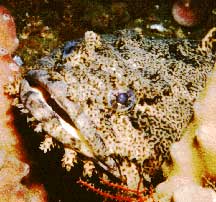
Daector reticulata inhabits sandy and muddy bottoms in bays, tidepools and estuaries. Its head and body have brown spots separated by an interconnected network of tan or whitish spaces, with three relatively large blackish saddles on the upper back.
Written 28 November 2026 from the sources listed below. Each statement was checked against the passage it cites; statements that could not be supported were removed.
Appearance
The Reticulated Toadfish has an elongated, laterally compressed body that tapers toward the rear. Its head is robust and flattened on top, and the distance between its eyes measures 4.3–6.9% of its standard length.[1][2][3]
Its head and body have fewer hair-like filaments than those of Daector schmitti. These filaments are generally absent below the under-eye canal and below the body's lateral line, while the dorsal filaments extend no farther than the second or third ray of the second dorsal fin.[4][5][6]
Its mouth is strongly oblique, with a projecting lower jaw. The operculum has one hollow, venomous spine at the upper corner.[7][8]
The distance from its snout to its pectoral fin is 29.9–31.5% of standard length. It has two dorsal fins, with the first consisting of two hollow, venomous spines; its dorsal fin has two spines and 25–28 rays, usually 26 rays.[9][10][11]
Its anal fin has 24–27 rays, usually 25, and its pectoral fins have 16–18 rays, usually 17. The last dorsal and anal fin rays are separate from the caudal fin, and its pelvic fins measure 16.2–18% of standard length.[12][13][14][15]
The species lacks light organs and scales. Its head and body are covered with brown spots separated by an interconnected network of tan or whitish spaces, and it has three relatively large blackish saddles on its upper back.[16][17][18]
Its anal fin has a blackish submarginal stripe.[19]
Habitat
The Reticulated Toadfish inhabits sandy and muddy bottoms in bays. It also occurs in tidepools and estuaries.[20][21][22]
Diet
Its recorded food categories include mobile benthic gastropods and bivalves, as well as mobile benthic crustaceans, including shrimps and crabs. Other recorded food categories include octopuses, squids and cuttlefish.[23][24][25]
Classification of the Reticulated Toadfish
| Kingdom | Animalia |
|---|---|
| Phylum | Chordata |
| Subphylum | Vertebrata |
| Infraphylum | Gnathostomata |
| Parvphylum | Osteichthyes |
| Gigaclass | Actinopterygii |
| Superclass | Actinopteri |
| Class | Teleostei (Teleost) |
| Order | Batrachoidiformes |
| Family | Batrachoididae (Toadfishes) |
| Subfamily | Thalassophryninae |
| Genus | Daector |
| Species | Daector reticulata (Günther, 1864) |
Where the Reticulated Toadfish is found
Checklists and occurrence records place Daector reticulata in 1 country. GBIF holds 84 georeferenced records of it.
Countries
Regions and cities with the most records
- Ancón, Panama 23
- Veracruz, Panama 23
- Curundú, Panama 22
- Arraiján, Panama 21
- Panama City, Panama 21
- Juan Díaz, Panama 16
- San Miguelito, Panama 16
- Alcalde Díaz, Panama 9
- Panamá, Panama 7
- Panamá Oeste Province, Panama 5
- Tocumen, Panama 3
A number beside a place is its count of GBIF occurrence records. A place without a number comes from a checklist alone. Records show where a species has been observed or collected, which can include escapes and vagrants.
Common names
English
- Reticulated Toadfish
- Toadfish
Names in 3 other languages
- Czech
- žabohlavec panamský
- Portuguese
- Boca-de-sapo-rajado
- Spanish
- Sapo Reticulado
Synonyms
One other scientific name has been used for this species and is now treated as a synonym of Daector reticulata.
- Thalassophryne reticulata Günther, 1864
Related species
-
 Dow's ToadfishDaector dowi
- Schmitt's ToadfishDaector schmitti
- Daector gerringi
- Daector quadrizonatus
-
 Oyster ToadfishOpsanus tau
-
 Plainfin MidshipmanPorichthys notatus
-
 Gulf ToadfishOpsanus beta
-
 Splendid ToadfishSanopus splendidus
Compare
Questions and answers
What is the scientific name of the Reticulated Toadfish?
The scientific name of the Reticulated Toadfish is Daector reticulata. Written with its author, the full name is Daector reticulata (Günther, 1864).
Which family does the Reticulated Toadfish belong to?
Daector reticulata belongs to the family Batrachoididae, in the order Batrachoidiformes and the class Teleostei.
Where is the Reticulated Toadfish found?
Checklists and occurrence records place Daector reticulata in 1 country: Panama.
What is the conservation status of the Reticulated Toadfish?
The IUCN Red List category recorded for Daector reticulata is Vulnerable (VU).
What other names does the Reticulated Toadfish have?
Daector reticulata is also known in English as Toadfish.
Sources
Passages the profile rests on
- The species has an elongated, laterally compressed body that tapers toward the rear. Source passage: “Body elongate, compressed, tapering to rear” — biogeodb.stri.si.edu
- Its head is robust and flattened on top. Source passage: “head robust, flattened on top” — biogeodb.stri.si.edu
- The distance between its eyes measures 4.3–6.9% of its standard length. Source passage: “relatively narrow between eyes (4.3-6.9% of SL)” — biogeodb.stri.si.edu
- Its head and body have fewer hair-like filaments than those of Daector schmitti. Source passage: “hair-like filaments on head and body less numerous than on D. schmitti” — biogeodb.stri.si.edu
- Hair-like filaments are generally absent below the under-eye canal and below the body's lateral line. Source passage: “generally not present below under-eye canal or below lateral line of body” — biogeodb.stri.si.edu
- Its dorsal hair-like filaments extend no farther than the second or third ray of the second dorsal fin. Source passage: “extending on back no farther than 2nd-3rd ray of second dorsal fin” — biogeodb.stri.si.edu
- Its mouth is strongly oblique, with a projecting lower jaw. Source passage: “mouth strongly oblique, lower jaw projecting” — biogeodb.stri.si.edu
- Its operculum has one hollow, venomous spine at the upper corner. Source passage: “operculum with 1 hollow, venomous spine at upper corner” — biogeodb.stri.si.edu
- The distance from its snout to its pectoral fin is 29.9–31.5% of standard length. Source passage: “distancia from snout to pectoral 29.9-31.5 of SL” — biogeodb.stri.si.edu
- It has two dorsal fins, with the first consisting of two hollow, venomous spines. Source passage: “2 dorsal fins, first of two hollow, venomous spines” — biogeodb.stri.si.edu
- Its dorsal fin has two spines and 25–28 rays, usually 26 rays. Source passage: “dorsal rays II + 25-28 (usually 26)” — biogeodb.stri.si.edu
- Its anal fin has 24–27 rays, usually 25. Source passage: “anal rays 24-27 (usually 25)” — biogeodb.stri.si.edu
- Its pectoral fins have 16–18 rays, usually 17. Source passage: “pectoral rays 16-18 (usually 17)” — biogeodb.stri.si.edu
- The last dorsal and anal fin rays are separate from the caudal fin. Source passage: “last dorsal and anal rays separate from caudal fin” — biogeodb.stri.si.edu
- Its pelvic fins measure 16.2–18% of standard length. Source passage: “length of pelvic fins 16.2-18% of SL” — biogeodb.stri.si.edu
- It lacks light organs and scales. Source passage: “without light organs; no scales.” — biogeodb.stri.si.edu
- Its head and body are covered with brown spots separated by an interconnected network of tan or whitish spaces. Source passage: “Head and body covered with brown spots with interconnecting network of tan or whitish spaces between them” — biogeodb.stri.si.edu
- It has three relatively large blackish saddles on its upper back. Source passage: “three relatively large blackish saddles on upper back” — biogeodb.stri.si.edu
- Its anal fin has a blackish submarginal stripe. Source passage: “anal fin with blackish submarginal stripe.” — biogeodb.stri.si.edu
- It inhabits sandy and muddy bottoms in bays. Source passage: “Inhabits sand and mud bottoms of bays” — biogeodb.stri.si.edu
- It also occurs in tidepools. Source passage: “also occurs in tidepools.” — biogeodb.stri.si.edu
- Its recorded habitats include estuaries. Source passage: “Soft bottom (mud/sand/gravel/beach/estuary/mangrove/seagrass)” — biogeodb.stri.si.edu
- Mobile benthic gastropods and bivalves are listed among its recorded food categories. Source passage: “Mobile benthic gastropods/bivalves” — biogeodb.stri.si.edu
- Mobile benthic crustaceans, including shrimps and crabs, are listed among its recorded food categories. Source passage: “Mobile benthic crustacea (shrimps/crabs)” — biogeodb.stri.si.edu
- Octopuses, squids, and cuttlefish are listed among its recorded food categories. Source passage: “Octopus/squid/cuttlefish” — biogeodb.stri.si.edu
Data
- Catalogue of Life, 2026-10-16 XR cc by
- Global Biodiversity Information Facility CC BY 4.0
- Wikidata CC0
- GeoNames CC BY 4.0
- Wikimedia Commons per image; credit shown with each image
- Within the Catalogue of Life, this name comes from World Register of Marine Species cc by
This species in other databases
- Catalogue of Life 33XRP
- Wikidata Q2709748
- iNaturalist 99060
- WoRMS urn:lsid:marinespecies.org:taxname:280480
- ITIS 623113
Page built on 29 November 2026. See how the catalog is made and all sources and licences.
Cite this page
ScientificNames.org. (2026). Daector reticulata (Reticulated Toadfish). Retrieved November 29, 2026, from https://scientificnames.org/species/daector-reticulata
“Daector reticulata (Reticulated Toadfish).” ScientificNames.org, 2026, scientificnames.org/species/daector-reticulata. Accessed 29 Nov. 2026.
ScientificNames.org. “Daector reticulata (Reticulated Toadfish).” Accessed November 29, 2026. https://scientificnames.org/species/daector-reticulata.
@misc{scientificnames_daector_reticulata_reticulated_toadfish,
  author = {{ScientificNames.org}},
  title = {Daector reticulata (Reticulated Toadfish)},
  year = {2026},
  url = {https://scientificnames.org/species/daector-reticulata},
  note = {Accessed 2026-11-29}
}