Species · Insects
Dahlbominus fuscipennis
Dahlbominus fuscipennis has no English name on record in the checklists used here. It is a species of insect in the family Eulophidae (eulophids), order Hymenoptera. The name dates from 1838.
- Scientific name
- Dahlbominus fuscipennis (Zetterstedt, 1838)
- Genus
- Dahlbominus
- Family
- Eulophidae (Eulophids)
- Order
- Hymenoptera
- Class
- Insecta
- Recorded in
- 4 countries
- Name status
- accepted in the Catalogue of Life
Overview
Dahlbominus fuscipennis is an insect in the family Eulophidae, order Hymenoptera and class Insecta. The species is native to Europe and has been introduced to the United States and Canada, where it is established in northeastern North America. It is a parasitoid of sawflies, primarily members of the family Diprionidae, and has branching male antennae and a dark-coloured body with a blue tinge.
Written 27 November 2026 from the sources listed below. Each statement was checked against the passage it cites; statements that could not be supported were removed.
Appearance
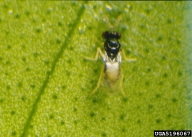
The species has a dark-coloured body with a blue tinge on its head, thorax and abdomen. Its head is noticeably wider than its thorax, and its frons has a triangular depression in the centre.[1][2][3]
Its eyes are large and lack hairs. Male antennae have branching flagellae, its forewings have shading, and its legs are dark.[4][5][6]
Its abdomen is long and oval, without a distinct waist. Females measure between 1.8 and 1.9 mm in length, while males measure between 1.4 and 1.8 mm.[7][8][9]
Habitat
Adults locate host cocoons by flying slowly through forested areas. Host cocoons occur on the soil surface and among the crowns of young trees.[10][11]
Cocoons in leaf litter experience the highest rates of parasitism.[12]
Diet
It can also act as a hyperparasitoid on parasites of ichneumonid eonymphs. It has been recorded as a parasitoid of Apanteles rubripes, which parasitises the geometrid moth Semiothisa pumila.[13][14]
The species is particularly associated with outbreaks of the European pine sawfly and Diprion similis. It has also been recorded as a parasitoid of the European spruce sawfly Gilpinia hercyniae.[15][16]
Behaviour
The species is a poor flier. Adults locate host cocoons by flying slowly through forested areas.[10][17]
The wasps recognise potential hosts by detecting volatile chemicals released through the host integument and cocoon. After recognising a potential host, the wasp drums its antennae.[18][19]
The species uses contact kairomones from host prepupae for host recognition. Volatile signals from spruce needles attract the wasps rather than signals from host pupae.[20][21]
Reproduction and life cycle
Females mate shortly after emerging as adults. They deposit white, oval eggs in groups of 10 to 50 on the cuticle of host prepupae through their cocoons, and the average clutch contains approximately 30 eggs.[22][23][24]
A female can lay up to 100 eggs during her adult life. Females are diploid and develop from fertilised eggs, whereas males are haploid and develop from unfertilised eggs.[25][26]
Females usually constitute the majority of the population, while males may account for only one-fifth. The eggs hatch approximately five days after being laid.[27][28]
Larvae pass through five instars, each lasting approximately one day. The prepupal stage lasts between two and three days, and European larval development takes approximately 11 days during summer.[29][30][31]
The pupal stage lasts between seven and twelve days. All adults in a brood emerge through a single hole in the host cocoon.[32][33]
The species normally produces four generations annually in eastern Europe, although cooler summers may result in only three. In Canada, it completes two full generations and one partial generation each summer.[34][35]
Conservation
In some regions, the species provides an important natural control on European pine sawfly populations.[36]
Uses
The Canadian Department of Agriculture began importing the species from Europe in 1933 for propagation as a biological control organism. Several hundred million descendants of imported wasps have been released to control invasive sawfly species.[37][38]
Classification of Dahlbominus fuscipennis
| Kingdom | Animalia |
|---|---|
| Phylum | Arthropoda |
| Subphylum | Hexapoda |
| Class | Insecta (Insect) |
| Order | Hymenoptera (Ants) |
| Suborder | Apocrita (Ants) |
| Infraorder | Terebrantes |
| Superfamily | Chalcidoidea |
| Family | Eulophidae (Eulophids) |
| Subfamily | Eulophinae |
| Genus | Dahlbominus |
| Species | Dahlbominus fuscipennis (Zetterstedt, 1838) |
Where Dahlbominus fuscipennis is found
Checklists and occurrence records place Dahlbominus fuscipennis in 4 countries. GBIF holds 55 georeferenced records of it.
Countries
Regions and cities with the most records
- Stockholm, Sweden 10
- Gotland, Sweden 4
- Jönköping, Sweden 3
- Norrbotten, Sweden 3
- Skåne, Sweden 3
- Värnamo, Sweden 3
A number beside a place is its count of GBIF occurrence records. A place without a number comes from a checklist alone. Records show where a species has been observed or collected, which can include escapes and vagrants.
Common names
Names in 1 other language
- Slovak
- blyštička hrebenárková
Synonyms
2 other scientific names have been used for this species and are now treated as synonyms of Dahlbominus fuscipennis.
- Eulophus fuscipennis (Zetterstedt, 1838)
- Microplectron fuscipennis (Zetterstedt, 1838)
Related species
-
 Euderus set
-
 Tamarixia radiata
- Aprostocetus hagenowii
-
 Eucalyptus Stem Gall WaspLeptocybe invasa
- Skoka femorata
-
 Eucalyptus Gall WaspOphelimus maskelli
-
 Erythrina Gall WaspQuadrastichus erythrinae
-
 Melittobia australica
Compare
Questions and answers
Where is Dahlbominus fuscipennis found?
The species is native to Europe, ranging from France to western Siberia, including Novosibirsk. Its native range extends north to Scandinavia and south to the Balkans. It has been introduced to the United States and Canada and is established in northeastern North America.[39][40][41][42]
What hosts does Dahlbominus fuscipennis parasitise?
It parasitises sawflies, primarily members of the family Diprionidae. It is particularly associated with outbreaks of the European pine sawfly and Diprion similis, and has also been recorded as a parasitoid of Gilpinia hercyniae.[43][15][16]
How long do adults live?
Adult females live for approximately one week.[44]
How long does the complete life cycle take?
The complete life cycle takes 21 to 23 days under laboratory conditions.[45]
How many generations does the species produce annually?
It normally produces four generations annually in eastern Europe, although cooler summers may result in only three. In Canada, it completes two full generations and one partial generation each summer.[34][35]
When was the species first described?
The species was originally described under the name Eulophus fuscipennis in 1838.[46]
What is the origin of the genus name Dahlbominus?
The genus name Dahlbominus honours the Swedish entomologist Anders Gustaf Dahlbom.[47]
Sources
Passages the profile rests on
- The species has a dark-coloured body with a blue tinge on its head, thorax and abdomen. Source passage: “Dahlbominus fuscipennis has a dark coloured, blue tinged head, thorax and body.” — English Wikipedia
- Its head is noticeably wider than its thorax. Source passage: “The head is noticeably wider than the thorax” — English Wikipedia
- Its frons has a triangular depression in the centre. Source passage: “there is a triangular depression in the centre of the frons.” — English Wikipedia
- Its eyes are large and lack hairs. Source passage: “the large eyes are naked.” — English Wikipedia
- The male antennae have branching flagellae. Source passage: “those of the male are branching.” — English Wikipedia
- Its forewings have shading and its legs are dark. Source passage: “The forewing shows shading and the legs are dark.” — English Wikipedia
- Its abdomen is long and oval, without a distinct waist. Source passage: “The long, oval abdomen lacks a distinct waist.” — English Wikipedia
- Females measure between 1.8 and 1.9 mm in length. Source passage: “The females are 1.8-1.9mm in length” — English Wikipedia
- Males measure between 1.4 and 1.8 mm in length. Source passage: “the males are 1.4-1.8mm.” — English Wikipedia
- Adults locate host cocoons by flying slowly through forested areas. Source passage: “search for their hosts by flying slowly through forested areas” — English Wikipedia
- Host cocoons are located on the soil surface and among the crowns of young trees. Source passage: “find their prey cocoons on the surface layer of the soil and within the crowns of young trees” — English Wikipedia
- Cocoons in leaf litter experience the highest rates of parasitism. Source passage: “cocoons in the leaf litter having the highest rates of parasitism.” — English Wikipedia
- It can also act as a hyperparasitoid on parasites of ichneumonid eonymphs. Source passage: “but it can also act as a hyperparasitoid on parasites of the eonymph of Ichneumonidae.” — English Wikipedia
- It has been recorded as a parasitoid of Apanteles rubripes, which parasitises the geometrid moth Semiothisa pumila. Source passage: “It has been recorded as being a parasitoid of Apanteles rubripes which is a parasitoid of the geometrid moth Semiothisa pumila” — English Wikipedia
- The species is particularly associated with outbreaks of the European pine sawfly and Diprion similis. Source passage: “it is most associated with outbreaks of Neodiprion certifer and Diprion similis.” — English Wikipedia
- The species has also been recorded as a parasitoid of the European spruce sawfly Gilpinia hercyniae. Source passage: “and of the European spruce sawfly Gilpinia hercyniae.” — English Wikipedia
- The species is a poor flier. Source passage: “D. fuscipennis are poor fliers” — English Wikipedia
- The wasps recognise potential hosts by detecting volatile chemicals released through the host integument and cocoon. Source passage: “The wasps detect the hosts' prepupae by detecting volatile chemicals which diffuse through the prepupal integument and the cocoon.” — English Wikipedia
- After recognising a potential host, the wasp drums its antennae. Source passage: “When the wasp detects these chemicals it drums its antennae, a sign that it has recognised a potential host.” — English Wikipedia
- The species uses contact kairomones from host prepupae for host recognition. Source passage: “Dahlbominus fuscipennis relies on contact kairomones from host prepupae for host recognition.” — academia.edu
- Volatile signals from spruce needles attract the wasps rather than signals from host pupae. Source passage: “Volatile signals from spruce needles, not host pupae, attract D.” — academia.edu
- Females mate shortly after emerging as adults. Source passage: “The adult females of D. fuscipennis mate soon after emergence” — English Wikipedia
- Females deposit white, oval eggs in groups of 10 to 50 on the cuticle of host prepupae through their cocoons. Source passage: “oviposit their white, oval eggs in groups of 10-50, the mean clutch being 30, through the cocoon and onto the cuticle of the prepupal stage of their host insects.” — English Wikipedia
- The average clutch contains approximately 30 eggs. Source passage: “the mean clutch being 30” — English Wikipedia
- A female can lay up to 100 eggs during her adult life. Source passage: “she may lay up to 100 eggs during her adult life.” — English Wikipedia
- Females are diploid and develop from fertilised eggs, whereas males are haploid and develop from unfertilised eggs. Source passage: “The females are diploid and are produced by fertilised eggs while the males are haploid and are produced from unfertilised eggs.” — English Wikipedia
- Females usually constitute the majority of the population, while males may account for only one-fifth. Source passage: “The sex ratio is usually dominated by females and males may form only one-fifth of the total population.” — English Wikipedia
- The eggs hatch approximately five days after being laid. Source passage: “The larvae hatch about 5 days after laying” — English Wikipedia
- Larvae pass through five instars, each lasting approximately one day. Source passage: “go through five instars, each lasting a day or so” — English Wikipedia
- The prepupal stage lasts between two and three days. Source passage: “a prepupal stage which lasts two to three days.” — English Wikipedia
- European larval development takes approximately 11 days during summer. Source passage: “In Europe larval development lasts 11 days in the summer months.” — English Wikipedia
- The pupal stage lasts between seven and twelve days. Source passage: “The pupal stage then lasts between seven and twelve days” — English Wikipedia
- All adults in a brood emerge through a single hole in the host cocoon. Source passage: “The entire brood of imagos emerge from the host's cocoon through a single emergence hole.” — English Wikipedia
- The species normally produces four generations annually in eastern Europe, although cooler summers may result in only three. Source passage: “in eastern Europe it normally has four generations but in cooler summers only three may occur” — English Wikipedia
- In Canada, the species completes two full generations and one partial generation each summer. Source passage: “In Canada only two full generations and a partial one are completed each summer” — English Wikipedia
- In some regions, the species provides an important natural control on European pine sawfly populations. Source passage: “In some areas this species is an important control on the populations of N. sertifer” — English Wikipedia
- The Canadian Department of Agriculture began importing the species from Europe in 1933 for propagation as a biological control organism. Source passage: “The Canadian Department of Agriculture started to import Dahlbominus fuscipennis from Europe in 1933 to be propagated in an insectary” — English Wikipedia
- Several hundred million descendants of imported wasps have been released to control invasive sawfly species. Source passage: “with several hundred million of the progeny being released since then in an attempt to control invasive European species of sawflies.” — English Wikipedia
- The species is native to Europe, ranging from France to western Siberia, including Novosibirsk. Source passage: “Dahlbominus fuscipennis is native to Europe from France to western Siberia (Novosibirsk)” — English Wikipedia
- Its native European range extends north to Scandinavia and south to the Balkans. Source passage: “north to Scandinavia and south to the Balkans.” — English Wikipedia
- The species has been introduced to the United States and Canada. Source passage: “It has been introduced to North America in the United States and Canada.” — English Wikipedia
- The species is established in northeastern North America. Source passage: “The species is now established in north-eastern North America.” — English Wikipedia
- The species parasitises sawflies, primarily members of the family Diprionidae. Source passage: “D. fuscipennis has a number of hosts, mainly sawflies of the family Diprionidae” — English Wikipedia
- Adult females live for approximately one week. Source passage: “An adult female lives for around a week” — English Wikipedia
- The complete life cycle takes 21 to 23 days under laboratory conditions. Source passage: “The life cycle of this wasp is completed, under laboratory conditions, in 21–23 days.” — English Wikipedia
- The species was originally described under the name Eulophus fuscipennis in 1838. Source passage: “Dahlbominus fuscipennis was original named Eulophus fuscipennis by the Swedish naturalist Johan Wilhelm Zetterstedt in 1838” — English Wikipedia
- The genus name Dahlbominus honours the Swedish entomologist Anders Gustaf Dahlbom. Source passage: “The name Dahlbominus honours the Swedish entomologist Anders Gustaf Dahlbom.” — English Wikipedia
Data
- Catalogue of Life, 2026-10-16 XR cc by
- Global Biodiversity Information Facility CC BY 4.0
- Wikidata CC0
- GeoNames CC BY 4.0
- Within the Catalogue of Life, this name comes from Universal Chalcidoidea Database curated in TaxonWorks cc by
References
- Zetterstedt, J.W. (1838) Hymenoptera. Insecta Lapponica, 1(2), 315–476. where the name was published
This species in other databases
Page built on 29 November 2026. See how the catalog is made and all sources and licences.
Cite this page
ScientificNames.org. (2026). Dahlbominus fuscipennis. Retrieved November 29, 2026, from https://scientificnames.org/species/dahlbominus-fuscipennis
“Dahlbominus fuscipennis.” ScientificNames.org, 2026, scientificnames.org/species/dahlbominus-fuscipennis. Accessed 29 Nov. 2026.
ScientificNames.org. “Dahlbominus fuscipennis.” Accessed November 29, 2026. https://scientificnames.org/species/dahlbominus-fuscipennis.
@misc{scientificnames_dahlbominus_fuscipennis,
  author = {{ScientificNames.org}},
  title = {Dahlbominus fuscipennis},
  year = {2026},
  url = {https://scientificnames.org/species/dahlbominus-fuscipennis},
  note = {Accessed 2026-11-29}
}