Species · Fishes
Danio annulosus
Danio annulosus has no English name on record in the checklists used here. It is a species of fish in the family Cyprinidae (carps), order Cypriniformes. The name dates from 2015.
- Scientific name
- Danio annulosus Kullander, Rahman, Norén & Mollah, 2015
- Genus
- Danio
- Family
- Cyprinidae (Carps)
- Order
- Cypriniformes
- Class
- Teleostei
- Environment
- freshwater
- Recorded in
- 1 country
- Name status
- accepted in the Catalogue of Life
Overview
Danio annulosus is a species of Chain danio fish in the family Cyprinidae in Danio genus. The species is named and described jointly by Sven O Kullander, M.D Mizanur Rahman, Michael Noren and Abdur Rob Mollah in 2015 in association with the Department of Zoology, Swedish Museum of Natural History, Sweden and the Department of Zoology, University of Dhaka, Bangladesh.
Classification of Danio annulosus
| Kingdom | Animalia |
|---|---|
| Phylum | Chordata |
| Subphylum | Vertebrata |
| Infraphylum | Gnathostomata |
| Parvphylum | Osteichthyes |
| Gigaclass | Actinopterygii |
| Superclass | Actinopteri |
| Class | Teleostei (Teleost) |
| Order | Cypriniformes |
| Family | Cyprinidae (Carps) |
| Subfamily | Danioninae |
| Genus | Danio (Danios) |
| Species | Danio annulosus Kullander, Rahman, Norén & Mollah, 2015 |
Origin of the name. Etymology. The species name, annulosus, is a Neolatin adjective meaning ringed, inspired by the colour pattern on the side, which resembles series of dark rings. FIGURE 2. Ventral aspect of a, Danio annulosus, NRM 67114, 68.2 mm SL, with unusually long pectoral fins; b, Danio concatenatus (BMNH 2011.3.24.50, 61.1 mm SL), to show difference in produced pectoral and pelvic fins between D. annulosus (pectoral fin reaching base of pelvic fin or shorter; pelvic fin not reaching vent) and other chain danios (pectoral fin reaching beyond base of pelvic fin; pelvic fin reaching vent). Comparative morphometrics. Danio annulosus has slightly shorter pectoral and pelvic fins (Fig. 6 a - b, shorter barbels (Fig. 6 c), and less deep head and body compared to other chain danios. Principal Component analysis separates D. annulosus from all other Danio with complete lateral line, except that one outlier (NRM 67114, 68.2 mm) clusters with other danios (Fig. 6 d; Table 3). The highest loadings are in head and body depth, dorsal-fin base length, and pectoral- and pelvic-fin lengths (Table 3). Genetic distance analysis. The sequences (" barcodes ") of all three sequenced specimens of D. annulosus were identical (pairwise p - distance = 0 %). In our dataset D. annulosus was most similar to D. catenatus (3.4 % pairwise p - distance). A BLAST (Altschul et al., 1990) nucleotide search of the GenBank non-redundant database (nr) found no exact matches. The closest matches were D. dangila (8 % pairwise p-distance) and Danio cf. dangila (8 %), followed by an unseparated group of different species of Danio (≥ 11 %). FIGURE 3. Collecting sites of chain danios and Danio meghalayensis; modified from Kullander (2015), with Danio annulosus added. Entering the D. annulosus barcode into the identification tool at the Barcode of Life database (BOLD) portal (www. boldsystems. org) and searching for a match at the " species " level found no matches. A search of " all barcode records on BOLD " found that the five closest matches in BOLD were Danio aff. dangila (= D. sysphigmatus and D. concatenatus) (6.6 % pairwise p - distance), D. dangila (8.1 - 8.5 %), Danio cf. dangila (= D. assamila) (8.9 %), D. meghalayensis (9.7 %) and D. erythromicron (Annandale) (11.5 %). Phylogenetic analysis. The result of the phylogenetic analysis is summarized in Figure 7. Danio is monophyletic (Bayesian posterior probability, BPP 1.00). Within Danio, there is a trichotomy comprising the monophyletic chain danios (BPP 0.89), and two clades of non-chain danios. The first clade is D. margaritatus (Roberts) + D. feegradei (BPP 0.79), in the other clade (BPP 0.87) D. albolineatus (Blyth) is the sister group to D. kyathit Fang + D. tinwini Kullander & Fang (BPP 0.69). The chain danios comprise two clades. In the first clade (BPP 0.66), D. dangila is the sister of D. meghalayensis + D. assamila (BPP 0.99). In the second clade (BPP 0.99) D. concatenatus + D. sysphigmatus (BPP 1.00) are sister group to a clade comprising D. catenatus + D. annulosus (BPP 1.00).
Where Danio annulosus is found
Checklists and occurrence records place Danio annulosus in 1 country. GBIF holds 12 georeferenced records of it.
Countries
Regions and cities with the most records
A number beside a place is its count of GBIF occurrence records. A place without a number comes from a checklist alone. Records show where a species has been observed or collected, which can include escapes and vagrants.
Related species
- ZebrafishDanio rerio
-
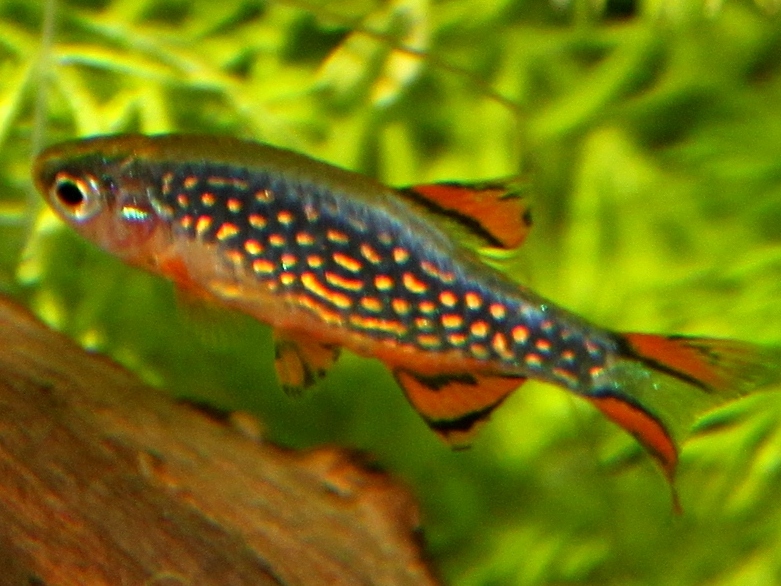 Galaxy RasboraDanio margaritatus
-
 Glowlight DanioDanio choprae
-
 Pearl DanioDanio albolineatus
- Emerald Dwarf DanioDanio erythromicron
-
 Gold Ring DanioDanio tinwini
-
 Redfin DanioDanio kyathit
-
 Blue DanioDanio kerri
Compare
Sources
Data
- Catalogue of Life, 2026-10-16 XR cc by
- Global Biodiversity Information Facility CC BY 4.0
- Wikidata CC0
- English Wikipedia CC BY-SA 4.0
- GeoNames CC BY 4.0
- Within the Catalogue of Life, this name comes from World Register of Marine Species cc by
References
- Kullander, S. O., Rahman, M. M., Norén, M., & Mollah, A. R. (2015). Danio annulosus, a new species of chain Danio from the Shuvolong Falls in Bangladesh (Teleostei: Cyprinidae: Danioninae). Zootaxa, 3994. https://doi.org/10.11646/zootaxa.3994.1.2 Link where the name was published
This species in other databases
- Catalogue of Life 343ZJ
- Wikidata Q22286725
- iNaturalist 612668
- WoRMS urn:lsid:marinespecies.org:taxname:1006932
Page built on 26 November 2026. See how the catalog is made and all sources and licences.
Cite this page
ScientificNames.org. (2026). Danio annulosus. Retrieved November 26, 2026, from https://scientificnames.org/species/danio-annulosus
“Danio annulosus.” ScientificNames.org, 2026, scientificnames.org/species/danio-annulosus. Accessed 26 Nov. 2026.
ScientificNames.org. “Danio annulosus.” Accessed November 26, 2026. https://scientificnames.org/species/danio-annulosus.
@misc{scientificnames_danio_annulosus,
  author = {{ScientificNames.org}},
  title = {Danio annulosus},
  year = {2026},
  url = {https://scientificnames.org/species/danio-annulosus},
  note = {Accessed 2026-11-26}
}