Species · Insects
Decadiomus hughesi
Decadiomus hughesi has no English name on record in the checklists used here. It is a species of insect in the family Coccinellidae (ladybird beetles), order Coleoptera. The name dates from 1990.
- Scientific name
- Decadiomus hughesi Gordon & Hilburn, 1990
- Genus
- Decadiomus
- Family
- Coccinellidae (Ladybird Beetles)
- Order
- Coleoptera
- Class
- Insecta
- Environment
- terrestrial
- Recorded in
- 2 countries
- Name status
- accepted in the Catalogue of Life
Overview
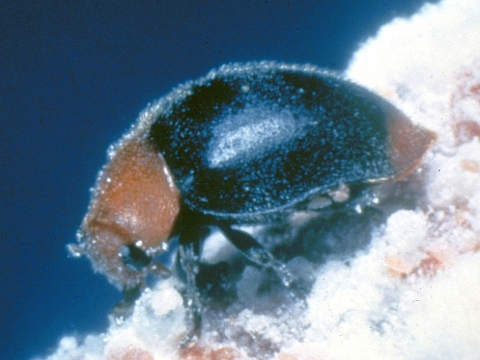
Adults are predominantly black, with a reddish-yellow pronotum bearing a black basal spot and elytra with black basal, sutural, and lateral margins.
Written 28 November 2026 from the sources listed below. Each statement was checked against the passage it cites; statements that could not be supported were removed.
Appearance
Adults are predominantly black. The pronotum is reddish-yellow with a black basal spot, while the elytra have black basal, sutural, and lateral margins.[1]
Adult beetles measure approximately 1.15–1.6 mm in length.[2]
Diet
The species preys on mealybugs, including Pseudococcus longispinus, Icerya purchasi, Coccus viridis, and Carulaspis minima.[3]
Habitat
The species was originally described from Bermuda.[4]
Classification of Decadiomus hughesi
| Kingdom | Animalia |
|---|---|
| Phylum | Arthropoda |
| Subphylum | Hexapoda |
| Class | Insecta (Insect) |
| Order | Coleoptera (Beetle) |
| Suborder | Polyphaga |
| Series | Cucujiformia |
| Superfamily | Coccinelloidea |
| Family | Coccinellidae (Ladybird Beetles) |
| Subfamily | Coccinellinae |
| Tribe | Diomini |
| Genus | Decadiomus |
| Species | Decadiomus hughesi Gordon & Hilburn, 1990 |
This name was added to the Catalogue of Life from a contributing dataset by automated merging and has not yet been reviewed by its editors.
Where Decadiomus hughesi is found
Checklists and occurrence records place Decadiomus hughesi in 2 countries. GBIF holds 6 georeferenced records of it.
Countries
Regions and cities with the most records
A number beside a place is its count of GBIF occurrence records. A place without a number comes from a checklist alone. Records show where a species has been observed or collected, which can include escapes and vagrants.
Related species
- Rubin Vase Lady BeetleDecadiomus bahamicus
- Decadiomus hubbardi
- Harmonia axyridis
-
 Seven-spot LadybirdCoccinella septempunctata
-
 Twice-stabbed Lady BeetleChilocorus stigma
-
 Pink Spotted Lady BeetleColeomegilla maculata
-
 Mealybug DestroyerCryptolaemus montrouzieri
-
 22-spot LadybirdPsyllobora vigintiduopunctata
Compare
Questions and answers
Is Decadiomus hughesi native to Bermuda?
The species is considered probably introduced rather than necessarily native to Bermuda.[6]
What does Decadiomus hughesi prey on?
It preys on mealybugs, including Pseudococcus longispinus, Icerya purchasi, Coccus viridis, and Carulaspis minima.[3]
How large are adult Decadiomus hughesi beetles?
Adults measure approximately 1.15–1.6 mm in length.[2]
Sources
Passages the profile rests on
- Adults are predominantly black, with a reddish-yellow pronotum bearing a black basal spot and black basal, sutural, and lateral margins on the elytra. Source passage: “Adults are black, although the pronotum is reddish yellow with a black basal spot. The basal, sutural and lateral margins of the elytron are black.” — English Wikipedia
- Adult beetles measure approximately 1.15–1.6 mm in length. Source passage: “Adults reach a length of about 1.15–1.6 mm.” — English Wikipedia
- The species preys on mealybugs, including Pseudococcus longispinus, Icerya purchasi, Coccus viridis, and Carulaspis minima. Source passage: “They prey on mealybugs, including Pseudococcus longispinus, Icerya purchasi, Coccus viridis and Carulaspis minima.” — English Wikipedia
- The species was originally described from Bermuda. Source passage: “It was described from Bermuda” — English Wikipedia
- Bermuda is the locality from which the species was described. Source passage: “It was described from Bermuda” — English Wikipedia
- The species is considered probably introduced rather than necessarily native to Bermuda. Source passage: “but is probably an introduced species.” — English Wikipedia
Data
- Catalogue of Life, 2026-10-16 XR cc by
- Global Biodiversity Information Facility CC BY 4.0
- Wikidata CC0
- GeoNames CC BY 4.0
- Within the Catalogue of Life, this name comes from World Register of Marine Species cc by
References
- The Coccinellidae (Coleoptera) of Bermuda. (1990). Journal of the New York Entomological Society, 98(3), 265–309. https://bionames.org/references/77ddf1e3f11e9f5da0b6d32cb966455c Link where the name was published
This species in other databases
- Catalogue of Life N2L88
- Wikidata Q118492927
- iNaturalist 1375853
- WoRMS urn:lsid:marinespecies.org:taxname:1489512
Page built on 29 November 2026. See how the catalog is made and all sources and licences.
Cite this page
ScientificNames.org. (2026). Decadiomus hughesi. Retrieved November 29, 2026, from https://scientificnames.org/species/decadiomus-hughesi
“Decadiomus hughesi.” ScientificNames.org, 2026, scientificnames.org/species/decadiomus-hughesi. Accessed 29 Nov. 2026.
ScientificNames.org. “Decadiomus hughesi.” Accessed November 29, 2026. https://scientificnames.org/species/decadiomus-hughesi.
@misc{scientificnames_decadiomus_hughesi,
  author = {{ScientificNames.org}},
  title = {Decadiomus hughesi},
  year = {2026},
  url = {https://scientificnames.org/species/decadiomus-hughesi},
  note = {Accessed 2026-11-29}
}