Species · Insects
Diaperis boleti
Diaperis boleti has no English name on record in the checklists used here. It is a species of insect in the family Tenebrionidae (darkling beetle), order Coleoptera. The name dates from 1758.
- Scientific name
- Diaperis boleti (Linnaeus, 1758)
- Genus
- Diaperis
- Family
- Tenebrionidae (Darkling Beetle)
- Order
- Coleoptera
- Class
- Insecta
- Recorded in
- 37 countries
- Name status
- accepted in the Catalogue of Life

Overview
Diaperis boleti inhabits the fruiting bodies of wood-decomposing fungi growing on trees, primarily on deciduous trees and rarely on conifers. It is capable of active and passive flight and can occupy both live mature fungal fruiting bodies and dry remnants of older fruiting bodies.
Written 27 November 2026 from the sources listed below. Each statement was checked against the passage it cites; statements that could not be supported were removed.
Habitat
Diaperis boleti inhabits the fruiting bodies (sporocarps) of wood-decomposing fungi growing on trees. It occurs primarily on deciduous trees and only rarely on conifers.[1][2]
The species can occupy both live mature fungal fruiting bodies and the dry remnants of older fruiting bodies. It has been recorded inhabiting sporocarps of Laetiporus sulphureus in fragmented agricultural landscapes.[3][4]
Diet
Diaperis boleti is fungivorous and associated with wood-decomposing fungi. Reported host fungi include Laetiporus sulphureus.[5][6]
Behaviour
The species is relatively small-bodied and capable of active and passive flight. It exhibits weaker isolation by distance than saproxylic beetles inhabiting tree hollows.[7][8]
Classification of Diaperis boleti
| Kingdom | Animalia |
|---|---|
| Phylum | Arthropoda |
| Subphylum | Hexapoda |
| Class | Insecta (Insect) |
| Order | Coleoptera (Beetle) |
| Suborder | Polyphaga |
| Series | Cucujiformia |
| Superfamily | Tenebrionoidea |
| Family | Tenebrionidae (Darkling Beetle) |
| Subfamily | Diaperinae |
| Tribe | Diaperini |
| Subtribe | Diaperina |
| Genus | Diaperis |
| Species | Diaperis boleti (Linnaeus, 1758) |
This name was added to the Catalogue of Life from a contributing dataset by automated merging and has not yet been reviewed by its editors.
Where Diaperis boleti is found
Checklists and occurrence records place Diaperis boleti in 37 countries across Europe. GBIF holds 22,114 georeferenced records of it.
Countries
- Aland Islands 17
- Albania 3
- Austria 598
- Belarus 22
- Belgium 126
- Bosnia and Herzegovina 5
- Bulgaria 51
- Croatia 39
- Cyprus 5
- Czechia 97
- Denmark 323
- Estonia 295
- Finland 444
- France 3,390
- Germany 2,784
- Greece 21
- Hungary 301
- Italy 157
- Latvia 97
- Liechtenstein 6
- Lithuania 112
- Luxembourg 37
- Montenegro 3
- Norway 289
- Poland 459
- Portugal 82
- Romania 31
- Russia 841
- Serbia 75
- Slovakia 26
- Slovenia 5
- Spain 367
- Sweden 5,452
- Switzerland 1,528
- The Netherlands 2,708
- Ukraine 454
- United Kingdom 864
Regions and cities with the most records
- Östergötland, Sweden 934
- England, United Kingdom 863
- Kalmar, Sweden 831
- Île-de-France, France 595
- Provence-Alpes-Côte d'Azur, France 593
- North Rhine-Westphalia, Germany 569
- Valais, Switzerland 524
- Stockholm, Sweden 479
- Lower Saxony, Germany 441
- Västra Götaland, Sweden 439
- Auvergne-Rhône-Alpes, France 430
- Occitanie, France 412
- Saxony, Germany 392
- Uppsala, Sweden 389
- Gelderland, The Netherlands 375
- Västmanland, Sweden 374
- Kronoberg, Sweden 370
- Skåne, Sweden 342
- Limburg, The Netherlands 328
- Goirle, The Netherlands 300
- Best, The Netherlands 294
- Tilburg, The Netherlands 292
- Grand Est, France 275
- Oisterwijk, The Netherlands 270
- Velserbroek, The Netherlands 269
- Bavaria, Germany 267
- Haarlem, The Netherlands 265
- Loon op Zand, The Netherlands 261
- Sassenheim, The Netherlands 259
- IJmuiden, The Netherlands 253
- Chur, Switzerland 249
- Noordwijk-Binnen, The Netherlands 245
- Maastricht, The Netherlands 244
- Velsen-Noord, The Netherlands 244
- Hoensbroek, The Netherlands 242
- Sierre, Switzerland 238
7 more countries have a few records outside this range
These countries hold a few records of Diaperis boleti but lie outside the range the checklists give for it. Such records are often zoo or garden specimens, museum material or vagrants, so the species is not counted as occurring there.
A number beside a place is its count of GBIF occurrence records. A place without a number comes from a checklist alone. Records show where a species has been observed or collected, which can include escapes and vagrants.
Common names
Names in 13 other languages
- Czech
- potemník houbový
- Danish
- Svampebille, Tigerskyggebille
- Dutch
- Boletenzwartlijf, Boletenzwartlijfkever, Boomzwamzwartlijfkever
- Finnish
- kirjopimikkä
- French
- Diapère du bolet, Ténébrion des bouleaux
- German
- Gelbbindiger Schwarzkäfer
- Hungarian
- poszogó taplóbogár
- Lithuanian
- Raštuotasis Juodvabalis
- Polish
- Borzewka
- Russian
- Чернотелка трутовиковая
- Slovak
- Potemník hubový
- Swedish
- brokig svampsvartbagge
- Ukrainian
- Чорнотілка трутовикова
Synonyms
One other scientific name has been used for this species and is now treated as a synonym of Diaperis boleti.
- Chrysomela boleti Linnaeus, 1758
Subspecies and varieties
- Diaperis boleti bipustulata subspecies
- Diaperis boleti boleti subspecies
Related species
-
 Two-spotted DiaperisDiaperis maculata
-
 Five-spotted DiaperisDiaperis nigronotata
- Diaperis lewisi
- Diaperis rufipes
- Diaperis niponensis
-
 MealwormTenebrio molitor
-
 Blue Death Feigning BeetleAsbolus verrucosus
-
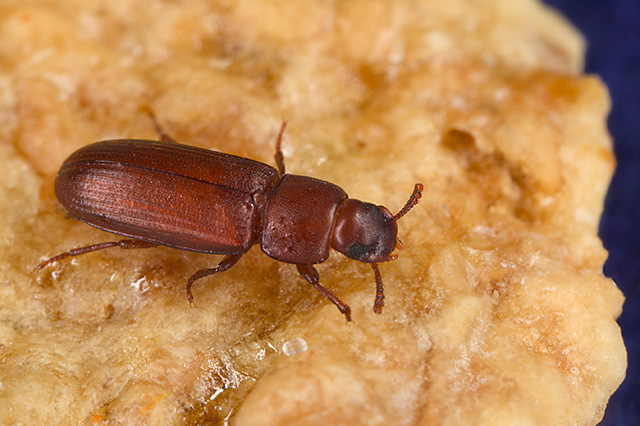 Red Flour BeetleTribolium castaneum
Compare
Questions and answers
Sources
Passages the profile rests on
- Diaperis boleti inhabits the fruiting bodies (sporocarps) of wood-decomposing fungi growing on trees. Source passage: “a beetle that inhabits fruiting bodies of wood-decomposing fungi.” — pmc.ncbi.nlm.nih.gov
- The species occurs primarily on deciduous trees and only rarely on conifers. Source passage: “The species lives in sporocarps of fungi growing on mainly deciduous trees (rarely on conifers).” — pmc.ncbi.nlm.nih.gov
- The beetle has been recorded inhabiting sporocarps of Laetiporus sulphureus in fragmented agricultural landscapes. Source passage: “inhabits sporocarps of Laetiporus sulphureus (Bulliard) Murrill (Polyporales) on trees growing in highly-fragmented agricultural landscapes.” — pmc.ncbi.nlm.nih.gov
- The species can occupy both live mature fungal fruiting bodies and the dry remnants of older fruiting bodies. Source passage: “D. boleti mostly develop in live mature fruiting bodies, but they also are able to use the dry remnants of older fruiting bodies” — pmc.ncbi.nlm.nih.gov
- The species is fungivorous and associated with wood-decomposing fungi. Source passage: “a fungivorous saproxylic beetle” — pmc.ncbi.nlm.nih.gov
- Reported host fungi include Laetiporus sulphureus. Source passage: “inhabits sporocarps of Laetiporus sulphureus (Bulliard) Murrill (Polyporales)” — pmc.ncbi.nlm.nih.gov
- The species is described as relatively small-bodied and capable of active and passive flight. Source passage: “the animals are relatively small and macropterous and potentially can disperse by passive and active flight.” — pmc.ncbi.nlm.nih.gov
- The beetle exhibits weaker isolation by distance than saproxylic beetles inhabiting tree hollows. Source passage: “species dependent on sporocarps of wood-decomposing fungi had higher variability, lower individual inbreeding, and less intensive isolation by distance pattern than saproxylic beetles living in tree hollows.” — pmc.ncbi.nlm.nih.gov
Data
- Catalogue of Life, 2026-10-16 XR cc by
- Global Biodiversity Information Facility CC BY 4.0
- Wikidata CC0
- GeoNames CC BY 4.0
- Wikimedia Commons per image; credit shown with each image
- Within the Catalogue of Life, this name comes from Swiss National Coleoptera Databank (Checklist) cc by
This species in other databases
Page built on 29 November 2026. See how the catalog is made and all sources and licences.
Cite this page
ScientificNames.org. (2026). Diaperis boleti. Retrieved November 29, 2026, from https://scientificnames.org/species/diaperis-boleti
“Diaperis boleti.” ScientificNames.org, 2026, scientificnames.org/species/diaperis-boleti. Accessed 29 Nov. 2026.
ScientificNames.org. “Diaperis boleti.” Accessed November 29, 2026. https://scientificnames.org/species/diaperis-boleti.
@misc{scientificnames_diaperis_boleti,
  author = {{ScientificNames.org}},
  title = {Diaperis boleti},
  year = {2026},
  url = {https://scientificnames.org/species/diaperis-boleti},
  note = {Accessed 2026-11-29}
}