Species · Birds
Snowy Albatross Diomedea exulans
The scientific name of the Snowy Albatross is Diomedea exulans. It is a species of bird in the family Diomedeidae (albatross), order Procellariiformes. The name dates from 1758.
- Scientific name
- Diomedea exulans Linnaeus, 1758
- Common name
- Snowy Albatross
- Genus
- Diomedea
- Family
- Diomedeidae (Albatross)
- Order
- Procellariiformes
- Class
- Aves
- Red List category
- VU Vulnerable
- Environment
- marine, terrestrial
- Recorded in
- 22 countries
- Name status
- accepted in the Catalogue of Life

Overview
Diomedea exulans occurs across the Southern Ocean between approximately 28 and 60 degrees latitude and is found almost exclusively in the Southern Hemisphere. It can reach a wingspan of 3.7 metres, the longest recorded for any living bird.
Written 26 November 2026 from the sources listed below. Each statement was checked against the passage it cites; statements that could not be supported were removed.
Appearance
The species possesses a salt gland above its nasal passage that helps remove excess salt from its body.[1]
The body length ranges from approximately 107 to 135 centimetres. Adult body mass generally ranges from 5.9 to 12.7 kilograms, and females are slightly smaller than males.[2][3][4]
Males average 9.11 kilograms and females average 7.27 kilograms in the South Georgia population reported in one study.[5]
The average wingspan of birds measured at Bird Island, South Georgia, is 3.1 metres.[6]
Habitat
Outside the breeding season, the Snowy Albatross inhabits open ocean environments. It forages mainly in open ocean waters and colder waters farther south.[7][8]
Diet
The Snowy Albatross feeds on cephalopods, small fish and crustaceans. It feeds at the ocean surface, mainly during daylight hours.[9][10]
It also forages on bait, captured fish and offal associated with fishing vessels.[11]
Behaviour
The Snowy Albatross spends most of its life flying and lands primarily for breeding and feeding. It can remain airborne for several hours without flapping its wings.[12][13]
Individuals can circumnavigate the Southern Ocean three times in a single year, covering more than 120,000 kilometres. Recorded flight speeds reach 135 kilometres per hour.[14][15]
Individuals travel in small groups while foraging at sea. Large feeding aggregations can form around fishing boats.[16][17]
Reproduction and life cycle
The Snowy Albatross generally breeds every other year in loose colonies on isolated Southern Ocean island groups. Pairs generally maintain monogamous bonds for life.[18][19][20]
Females lay a single egg per breeding attempt. Egg incubation lasts approximately 78 days on average, and both parents participate in incubating the egg.[21][22][23]
Chicks are brooded for approximately four to six weeks after hatching. They depend entirely on their parents for food for approximately nine to ten months.[24][25]
Individuals generally begin breeding at approximately 10 years of age. The nominate subspecies typically begins breeding between 11 and 15 years of age.[26][27]
Conservation
The IUCN classifies the Snowy Albatross as vulnerable. Longline fishing bycatch is a major threat because individuals are attracted to bait used by fishing vessels.[28][29]
Marine pollution, particularly plastics and abandoned fishing hooks, threatens the species.[30]
The CCAMLR introduced measures that reduced albatross bycatch around South Georgia by 99%.[31]
Uses
Māori communities in New Zealand used albatrosses as a food source. Māori also used albatross wing bones to manufacture flutes, needles, tattooing chisel blades and fish-hook barbs.[32][33]
Sailors historically used the species' long wing bones to make tobacco pipe stems.[34]
Classification of the Snowy Albatross
| Kingdom | Animalia |
|---|---|
| Phylum | Chordata |
| Subphylum | Vertebrata |
| Infraphylum | Gnathostomata |
| Parvphylum | Osteichthyes |
| Megaclass | Tetrapoda |
| Class | Aves (Bird) |
| Order | Procellariiformes (Petrels) |
| Family | Diomedeidae (Albatross) |
| Genus | Diomedea (Great Albatross) |
| Species | Diomedea exulans Linnaeus, 1758 |
Where the Snowy Albatross is found
Checklists and occurrence records place Diomedea exulans in 22 countries across Africa. GBIF holds 74,378 georeferenced records of it.
Countries
- Antarctica 4,845
- Argentina 2,188
- Australia 20,307
- Bouvet Island 6
- Brazil 452
- Chile 5,013
- Falkland Islands 3,103
- Fiji 14
- French Polynesia 11
- French Southern Territories 8,157
- Heard Island and McDonald Islands 2,347
- Madagascar 87
- Mauritius 6
- Mozambique 27
- New Caledonia 22
- New Zealand 8,179
- Norfolk Island 38
- Reunion 7
- Saint Helena 87
- South Africa 9,152
- South Georgia and the South Sandwich Islands 9,945
- Uruguay 385
Regions and cities with the most records
- Wollongong, Australia 4,898
- Sydney, Australia 2,414
- New South Wales, Australia 1,280
- Tasmania, Australia 694
- Victoria, Australia 279
- Kerguelen, French Southern Territories 178
- Hornsby, Australia 146
- Grytviken, South Georgia and the South Sandwich Islands 110
- Port-aux-Français, French Southern Territories 80
- South Australia, Australia 66
- Queensland, Australia 62
- Santa Cruz, Argentina 59
- Torquay, Australia 57
- Western Australia, Australia 49
- Central Coast, Australia 46
- Batemans Bay, Australia 44
- Southland, New Zealand 43
- Geelong, Australia 41
- Aysén, Chile 32
- Otago, New Zealand 32
- Western Cape, South Africa 30
- Stanley, Falkland Islands 27
- Canterbury, New Zealand 26
- Newcastle, Australia 25
- Warrnambool, Australia 25
- Liverpool, Australia 24
- Tierra del Fuego, Argentina 21
- Eastern Cape, South Africa 20
- Coffs Harbour, Australia 18
- Chubut, Argentina 13
- Karori, New Zealand 13
- Ushuaia, Argentina 13
- Wellington, New Zealand 13
- West Coast, New Zealand 12
- Albany, Australia 11
- Gold Coast, Australia 11
2 more countries have a few records outside this range
These countries hold a few records of Diomedea exulans but lie outside the range the checklists give for it. Such records are often zoo or garden specimens, museum material or vagrants, so the species is not counted as occurring there.
Range as the checklists state it
Antarctica/Southern Ocean
Africa
A number beside a place is its count of GBIF occurrence records. A place without a number comes from a checklist alone. Records show where a species has been observed or collected, which can include escapes and vagrants.
Common names
English
- Snowy Albatross
- Man-of-War Bird
- Toroa
- Wandering Albatross (Snowy)
- White-winged Albatross
- Wandering Albatross
Names in 45 other languages
- Afrikaans
- Grootmalmok (Grootalbatros), Grootmalmok/Grootalbatros
- Arabic
- القطرس التائه, قطرس متجول
- Belarusian
- Альбатрос вандроўны
- Bengali
- স্নোয়ি অ্যালবাট্রস
- Breton
- Albatroz kantreat
- Bulgarian
- Странстващ албатрос
- Burmese
- သမုဒ္ဒရာစင်ယော်ကြီး, သမုဒ္ဒရာစင်ယော်ကြီး-->
- Catalan
- albatros viatger
- Chinese
- 漂泊信天翁
- Czech
- albatros stěhovavý
- Danish
- Vandrealbatros
- Dutch
- Grote Albatros, reuzenalbatros
- Esperanto
- vagalbatroso
- Estonian
- rändalbatross
- Finnish
- jättiläisalbatrossi
- French
- Albatros hurleur, Grand Albatros neigeux
- German
- Wanderalbatros
- Greek
- Περιπλανόμενο άλμπατρος
- Hebrew
- אלבטרוס, אלבטרוס נודד
- Hungarian
- vándoralbatrosz
- Icelandic
- Hrímtrosi
- Indonesian
- Albatros kelana
- Irish
- Alabatras fánach
- Italian
- Albatro urlatore, Albatros urlatore
- Japanese
- ワタリアホウドリ
- Latvian
- klaidoņalbatross
- Lithuanian
- paprastasis albatrosas
- Mongolian
- Хэрмэл салхич шувуу <!--
- Northern Sami
- Stuoralbatrossa
- Norwegian
- vandrealbatross
- Persian
- آلباتروس سرگردان
- Polish
- albatros wędrowny
- Portuguese
- Albatroz-viageiro, albatroz-errante, albatroz-gigante
- Romanian
- Albatros călător
- Russian
- Странствующий альбатрос
- Serbian
- Albatros lutalica
- Slovak
- albatros sťahovavý
- Slovenian
- klateški albatros
- Spanish
- Albatros viajero, albatros errante
- Swedish
- vandringsalbatross
- Tongan
- Katafa lalahi
- Turkish
- gezgin albatros
- Ukrainian
- Альбатрос мандрівний, Мандрівний альбатрос
- Welsh
- albatros crwydrol
- pnb
- پاندھی البٹراس
Synonyms
One other scientific name has been used for this species and is now treated as a synonym of Diomedea exulans.
- Diomedea exulans exulans Linnaeus, 1758
Related species
-
 Southern Royal AlbatrossDiomedea epomophora
-
 Tristan AlbatrossDiomedea dabbenena
-
 Northern Royal AlbatrossDiomedea sanfordi
-
 Amsterdam AlbatrossDiomedea amsterdamensis
-
 Antipodean AlbatrossDiomedea antipodensis
-
 Laysan AlbatrossPhoebastria immutabilis
-
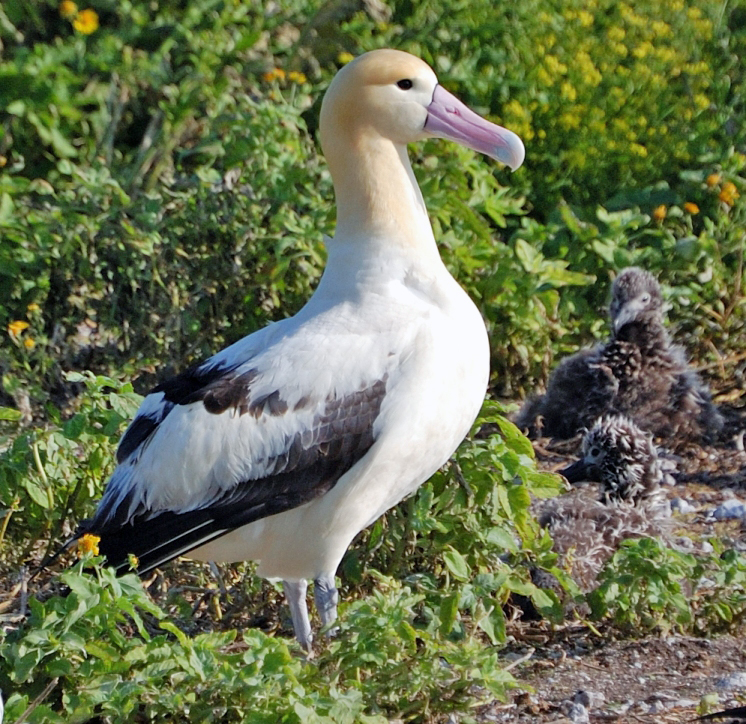 Short-tailed AlbatrossPhoebastria albatrus
-
 Black-browed AlbatrossThalassarche melanophris
Compare
Questions and answers
What is the scientific name of the Snowy Albatross?
The scientific name of the Snowy Albatross is Diomedea exulans. Written with its author, the full name is Diomedea exulans Linnaeus, 1758.
Which family does the Snowy Albatross belong to?
Diomedea exulans belongs to the family Diomedeidae, in the order Procellariiformes and the class Aves.
Where is the Snowy Albatross found?
Checklists and occurrence records place Diomedea exulans in 22 countries, including Australia, South Georgia and the South Sandwich Islands, South Africa, New Zealand, French Southern Territories and Chile.
What is the conservation status of the Snowy Albatross?
The IUCN Red List category recorded for Diomedea exulans is Vulnerable (VU).
What other names does the Snowy Albatross have?
Diomedea exulans is also known in English as Man-of-War Bird, Toroa, Wandering Albatross (Snowy), White-winged Albatross and Wandering Albatross.
What is the diet of an albatross?
The Snowy Albatross feeds on cephalopods, small fish and crustaceans. It also forages on bait, captured fish and offal associated with fishing vessels.[9][11]
What describes the habitat of an albatross?
Outside the breeding season, the Snowy Albatross inhabits open ocean environments. Its breeding habitats include sheltered plateaus, ridges, plains and valleys on subantarctic islands.[7][35]
Where do snowy albatross live?
The species occurs across the Southern Ocean between approximately 28 and 60 degrees latitude and is found almost exclusively in the Southern Hemisphere. The nominate subspecies breeds on South Georgia, Prince Edward, Marion, Crozet, Kerguelen and Macquarie islands.[36][37][38]
Sources
Passages the profile rests on
- The species possesses a salt gland above its nasal passage that helps remove excess salt from its body. Source passage: “They also have a salt gland that is situated above the nasal passage and helps desalinate their bodies” — English Wikipedia
- The body length ranges from approximately 107 to 135 centimetres. Source passage: “The length of the body is about 107 to 135 cm (3 ft 6 in to 4 ft 5 in)” — English Wikipedia
- Adult body mass generally ranges from 5.9 to 12.7 kilograms. Source passage: “Adults can weigh from 5.9 to 12.7 kg (13 to 28 lb)” — English Wikipedia
- Females are slightly smaller than males. Source passage: “with females being slightly smaller than males.” — English Wikipedia
- Males average 9.11 kilograms and females average 7.27 kilograms in the South Georgia population reported in one study. Source passage: “On South Georgia, 52 males were found to average 9.11 kg (20.1 lb) while 53 females were found to average 7.27 kg (16.0 lb).” — English Wikipedia
- The average wingspan of birds measured at Bird Island, South Georgia, is 3.1 metres. Source passage: “with a mean span of 3.1 m (10 ft 2 in) in Bird Island, South Georgia.” — English Wikipedia
- Outside the breeding season, the species inhabits open ocean environments. Source passage: “Outside of the breeding season, wandering albatrosses are found only in the open ocean, where food is abundant.” — animaldiversity.org
- The species forages mainly in open ocean waters and colder waters farther south. Source passage: “tend to feed further out in open oceans and in colder waters further south” — English Wikipedia
- The species feeds on cephalopods, small fish and crustaceans. Source passage: “They feed on cephalopods, small fish, and crustaceans.” — English Wikipedia
- The species feeds at the ocean surface, mainly during daylight hours. Source passage: “They feed at the surface, mainly during daylight hours” — English Wikipedia
- The species forages on bait, captured fish and offal associated with fishing vessels. Source passage: “foraging on bait, caught fish, and offal.” — English Wikipedia
- The species spends most of its life flying and lands primarily for breeding and feeding. Source passage: “Snowy albatrosses spend most of their life in flight, landing only to breed and feed.” — English Wikipedia
- The species can remain airborne for several hours without flapping its wings. Source passage: “it is capable of remaining in the air without flapping its wings for several hours at a time” — English Wikipedia
- Individuals can circumnavigate the Southern Ocean three times in a single year, covering more than 120,000 kilometres. Source passage: “Some individual snowy albatrosses are known to circumnavigate the Southern Ocean three times, covering more than 120,000 km (75,000 mi), in one year.” — English Wikipedia
- Recorded flight speeds reach 135 kilometres per hour. Source passage: “During flight, speeds of 135 km/h (84 mph) have been recorded.” — English Wikipedia
- Individuals travel in small groups while foraging at sea. Source passage: “While foraging at sea, wandering albatrosses travel in small groups.” — animaldiversity.org
- Large feeding aggregations can form around fishing boats. Source passage: “Large feeding frenzies may occur around fishing boats.” — animaldiversity.org
- The species generally breeds every other year. Source passage: “The snowy albatross mates for life and breeds every other year.” — English Wikipedia
- Breeding occurs in loose colonies on isolated Southern Ocean island groups. Source passage: “At breeding time they occupy loose colonies on isolated island groups in the Southern Ocean.” — English Wikipedia
- Pairs generally maintain monogamous bonds for life. Source passage: “Wandering albatrosses have a monogamous mating strategy, forming pair bonds for life.” — animaldiversity.org
- Females lay a single egg per breeding attempt. Source passage: “A single egg is laid and, if incubation or rearing fails, pairs usually wait until the following year to try again.” — animaldiversity.org
- Egg incubation lasts approximately 78 days on average. Source passage: “Both parents incubate eggs, which takes about 78 days on average.” — animaldiversity.org
- Both parents participate in incubating the egg. Source passage: “Incubation takes about 11 weeks and both parents are involved.” — English Wikipedia
- Chicks are brooded for approximately four to six weeks after hatching. Source passage: “After the chick hatches, they are brooded for about 4 to 6 weeks until they can be left alone at the nest.” — animaldiversity.org
- Chicks depend entirely on their parents for food for approximately nine to ten months. Source passage: “The chicks are entirely dependent on their parents for food for 9 to 10 months” — animaldiversity.org
- Individuals generally begin breeding at approximately 10 years of age. Source passage: “with the average age at first breeding about 10 years” — animaldiversity.org
- The nominate subspecies typically begins breeding between 11 and 15 years of age. Source passage: “however, they will not start breeding until 11 to 15 years.” — English Wikipedia
- The IUCN classifies the snowy albatross as vulnerable. Source passage: “The IUCN lists the snowy albatross as vulnerable status.” — English Wikipedia
- Longline fishing bycatch is a major threat because individuals are attracted to bait used by fishing vessels. Source passage: “The biggest threat to their survival is that they are attracted by the bait for longline fishing and get caught in the same way as the fish” — English Wikipedia
- Marine pollution, particularly plastics and abandoned fishing hooks, threatens the species. Source passage: “pollution is also taking a toll, mainly from plastics and abandoned fishing hooks.” — English Wikipedia
- The CCAMLR introduced measures that reduced albatross bycatch around South Georgia by 99%. Source passage: “The CCAMLR has introduced measures to reduce bycatch of albatrosses around South Georgia by 99%” — English Wikipedia
- Māori communities in New Zealand used albatrosses as a food source. Source passage: “The Māori of New Zealand used albatrosses as a food source.” — English Wikipedia
- Māori used albatross wing bones to manufacture flutes, needles, tattooing chisel blades and fish-hook barbs. Source passage: “Māori used them to make a number of different items including kōauau (flutes), needles, tattooing chisel blades, and barbs for fish hooks.” — English Wikipedia
- Sailors historically used the species' long wing bones to make tobacco pipe stems. Source passage: “Sailors used to capture the birds for their long wing bones, from which they made tobacco pipe stems.” — English Wikipedia
- Breeding habitats include sheltered plateaus, ridges, plains and valleys on subantarctic islands. Source passage: “Wandering albatrosses nest in sheltered areas on plateaus, ridges, plains, or valleys.” — animaldiversity.org
- The nominate subspecies breeds on South Georgia, Prince Edward, Marion, Crozet, Kerguelen and Macquarie islands. Source passage: “Diomedea exulans exulans breeds on South Georgia, Prince Edward, Marion, Crozet, Kerguelen, and Macquarie islands.” — animaldiversity.org
- The species occurs across the Southern Ocean between approximately 28 and 60 degrees latitude. Source passage: “and ranges in all the southern oceans from 28° to 60°.” — English Wikipedia
- The species is found almost exclusively in the Southern Hemisphere. Source passage: “Wandering albatrosses are found almost exclusively in the Southern Hemisphere” — animaldiversity.org
Data
- Catalogue of Life, 2026-10-16 XR cc by
- Global Biodiversity Information Facility CC BY 4.0
- Wikidata CC0
- GeoNames CC BY 4.0
- Wikimedia Commons per image; credit shown with each image
- Within the Catalogue of Life, this name comes from The Integrated Taxonomic Information System cc0
References
- Linnaeus, & Carolus. (1758). Systema Naturae per Regna Tria Naturae, Secundum Classes, Ordines, Genera, Species, Cum Characteribus, Differentiis, Synonymis, Locis, 10th Edition, Vol. 1. where the name was published
- Banks, R. C., R. W. McDiarmid, and A. L. Gardner. (1987). Checklist of Vertebrates of the United States, the U.S. Territories, and Canada. Resource Publication, No. 166.
- Gill, Frank, & and Minturn Wright. (2006). Birds of the World: Recommended English Names.
This species in other databases
- Catalogue of Life 36B3N
- Wikidata Q208682
- iNaturalist 4117
- WoRMS urn:lsid:marinespecies.org:taxname:212583
- Avibase wanalb1
Page built on 29 November 2026. See how the catalog is made and all sources and licences.
Cite this page
ScientificNames.org. (2026). Diomedea exulans (Snowy Albatross). Retrieved November 29, 2026, from https://scientificnames.org/species/diomedea-exulans
“Diomedea exulans (Snowy Albatross).” ScientificNames.org, 2026, scientificnames.org/species/diomedea-exulans. Accessed 29 Nov. 2026.
ScientificNames.org. “Diomedea exulans (Snowy Albatross).” Accessed November 29, 2026. https://scientificnames.org/species/diomedea-exulans.
@misc{scientificnames_diomedea_exulans_snowy_albatross,
  author = {{ScientificNames.org}},
  title = {Diomedea exulans (Snowy Albatross)},
  year = {2026},
  url = {https://scientificnames.org/species/diomedea-exulans},
  note = {Accessed 2026-11-29}
}