Species · Birds
Short-tailed Albatross Phoebastria albatrus
The scientific name of the Short-tailed Albatross is Phoebastria albatrus. It is a species of bird in the family Diomedeidae (albatross), order Procellariiformes. The name dates from 1769.
- Scientific name
- Phoebastria albatrus (Pallas, 1769)
- Common name
- Short-tailed Albatross
- Genus
- Phoebastria
- Family
- Diomedeidae (Albatross)
- Order
- Procellariiformes
- Class
- Aves
- Red List category
- VU Vulnerable
- Environment
- marine, terrestrial
- Recorded in
- 8 countries
- Name status
- accepted in the Catalogue of Life
Overview
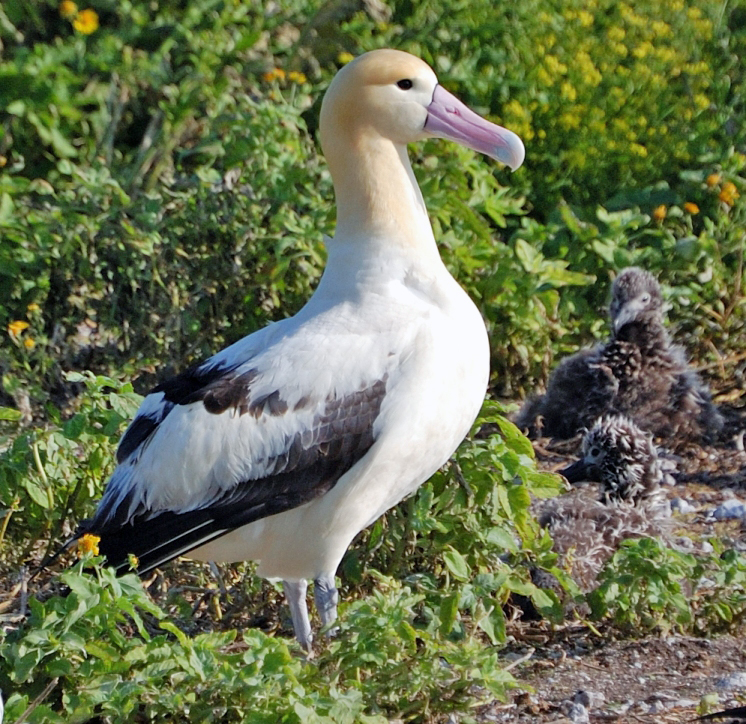
Phoebastria albatrus breeds primarily on Torishima in the Izu Islands south of Japan, with additional breeding populations on Minami-kojima, Midway Atoll and Kure Atoll. Adults have predominantly white plumage, black flight feathers and a golden-yellow head, while juveniles have chocolate-brown plumage.
Written 26 November 2026 from the sources listed below. Each statement was checked against the passage it cites; statements that could not be supported were removed.
Appearance
Juveniles have uniformly chocolate-brown plumage that gradually becomes whiter as they mature. Full adult plumage develops at approximately 12 years of age.[1][2][3]
Habitat
The Short-tailed Albatross nests on islands and atolls, using volcanic ash slopes with sparse vegetation.[4][5]
Diet
Squid is a principal food of the Short-tailed Albatross. Its target prey also includes crustaceans and fish.[6][7]
It generally hunts squid at night. In Japan, its diet includes shrimp, squid, bonita, flying fish and sardines.[8][9]
The species scavenges carrion and follows fishing boats. Parents feed older chicks squid, flying fish and crustaceans.[10][11]
Behaviour
The Short-tailed Albatross captures prey from the water surface while sitting on the water. It uses air currents to glide and soar for extended periods.[12][13]
It spends most of its time soaring over the ocean and comes ashore only to nest.[14]
Breeding pairs mate for life and typically return to the same nest in successive years.[15][16]
Reproduction and life cycle
The Short-tailed Albatross generally reaches sexual maturity at 6–8 years of age. Breeding begins in late October, and the female lays one egg per breeding attempt.[17][18][19]
The egg is dirty white with red spots concentrated near its blunt end and measures approximately 116 by 74 mm. Incubation lasts approximately 65 days, with both parents taking turns incubating the egg.[20][21][22][23][24]
Parents feed newly hatched chicks a mixture of stomach oil and regurgitated food.[25]
Conservation
The IUCN classifies the Short-tailed Albatross as Vulnerable. It is listed as endangered throughout its range under the United States Endangered Species Act.[26][27]
Commercial longline fishing is a significant threat because birds can become hooked or entangled and drown. Ingestion of plastic debris is also a documented threat.[28][29]
Volcanic eruptions threaten the species by damaging its nesting habitat. It was historically hunted extensively for its feathers, causing a severe population decline.[30][31]
Japan, Canada and the United States list the species as protected. Its population is small but increasing.[32][33]
Uses
The Short-tailed Albatross was historically hunted for its feathers for the millinery trade.[34]
Similar species
The Short-tailed Albatross is larger than the Laysan albatross and black-footed albatross.[35]
Classification of the Short-tailed Albatross
| Kingdom | Animalia |
|---|---|
| Phylum | Chordata |
| Subphylum | Vertebrata |
| Infraphylum | Gnathostomata |
| Parvphylum | Osteichthyes |
| Megaclass | Tetrapoda |
| Class | Aves (Bird) |
| Order | Procellariiformes (Petrels) |
| Family | Diomedeidae (Albatross) |
| Genus | Phoebastria (North Pacific Albatross) |
| Species | Phoebastria albatrus (Pallas, 1769) |
Where the Short-tailed Albatross is found
Checklists and occurrence records place Phoebastria albatrus in 8 countries across Asia and Oceania. GBIF holds 4,417 georeferenced records of it.
Countries
- Canada 84
- China 16
- Japan 1,185
- Mexico 10
- South Korea 6
- Taiwan 238
- United States 2,551
- United States Minor Outlying Islands 327
Regions and cities with the most records
- Alaska, United States 105
- Tokyo, Japan 67
- California, United States 43
- Monterey, United States 29
- Pacific Grove, United States 29
- Marina, United States 17
- Seaside, United States 15
- Coronado, United States 12
- National City, United States 11
- Choshi, Japan 10
- Chula Vista, United States 10
- Hasaki, Japan 10
- La Presa, United States 10
- Lemon Grove, United States 10
- Santa Cruz, United States 10
- Spring Valley, United States 10
- Taiwan, Taiwan 10
- Casa de Oro-Mount Helix, United States 9
- El Cajon, United States 9
- Imperial Beach, United States 9
- La Mesa, United States 9
- Live Oak, United States 9
- Rancho San Diego, United States 8
- Huntington Beach, United States 7
- Long Beach, United States 7
- Seal Beach, United States 7
- Miura, Japan 6
- Tateyama, Japan 6
- Tijuana, Mexico 6
- Kurihama, Japan 5
- Minamibōsō, Japan 5
- Hermosa Beach, United States 4
- Hokkaido, Japan 4
- Lawndale, United States 4
- Watsonville, United States 4
- Asahi, Japan 3
1 more country has a few records outside this range
These countries hold a few records of Phoebastria albatrus but lie outside the range the checklists give for it. Such records are often zoo or garden specimens, museum material or vagrants, so the species is not counted as occurring there.
Range as the checklists state it
Southern Asia
Oceania
A number beside a place is its count of GBIF occurrence records. A place without a number comes from a checklist alone. Records show where a species has been observed or collected, which can include escapes and vagrants.
Common names
English
- Short-tailed Albatross
- Golden Gooney
- Steller's Albatross
Names in 31 other languages
- Arabic
- قطرس قصير الذيل
- Breton
- Albatroz lost berr
- Bulgarian
- Късоопашат албатрос
- Catalan
- albatros cuacurt
- Chinese
- 短尾信天翁
- Czech
- albatros bělohřbetý
- Danish
- Korthalet Albatros
- Dutch
- Steller-albatros, Stellers Albatros
- Esperanto
- kurtvosta albatroso
- Estonian
- kuldpea-albatross
- Finnish
- japaninalbatrossi
- French
- Albatros à queue courte
- German
- Kurzschwanzalbatros
- Hebrew
- אלבטרוס שטלר
- Hungarian
- rövidfarkú albatrosz
- Italian
- Albatros codacorta
- Japanese
- アホウドリ
- Korean
- 알바트로스
- Latvian
- īsastes albatross
- Lithuanian
- baltanugaris albatrosas
- Norwegian
- gulhodealbatross
- Polish
- albatros krótkosterny
- Portuguese
- Albatroz-de-cauda-curta, albatroz-de-cabeça-amarela, albatroz-de-rabo-curto
- Russian
- Белоспинный альбатрос
- Serbian
- Žutoglavi albatros
- Slovak
- albatros bielochrbtý
- Spanish
- Albatros colicorto, Albatros rabón
- Swedish
- gulnackad albatross
- Turkish
- Alaca Albatros
- Ukrainian
- Короткохвостий альбатрос, альбатрос жовтоголовий
- chm
- Ош тупан альбатрос
Synonyms
8 other scientific names have been used for this species and are now treated as synonyms of Phoebastria albatrus.
- Campephilus albatrus (Pallas, 1769)
- Diomedea albatrus Pallas, 1769
- Diomedea albatrus albatrus Pallas, 1994
- Diomedea albatrus albatrus Pallas, Sibley & Monroe, 1769 [1990]
- Diomedea brachiura Temminck, CJ, 1828
- Diomedea derogata Swinhoe, R, 1874
- Diomedea howardae Chandler, RM, 1990
- Diomedea leptorhyncha Coues, E, 1866
Related species
-
 Laysan AlbatrossPhoebastria immutabilis
-
 Black-footed AlbatrossPhoebastria nigripes
-
 Waved AlbatrossPhoebastria irrorata
-
 Snowy AlbatrossDiomedea exulans
-
 Southern Royal AlbatrossDiomedea epomophora
-
 Black-browed AlbatrossThalassarche melanophris
-
 Shy AlbatrossThalassarche cauta
-
 Tristan AlbatrossDiomedea dabbenena
Compare
Questions and answers
What is the scientific name of the Short-tailed Albatross?
The scientific name of the Short-tailed Albatross is Phoebastria albatrus. Written with its author, the full name is Phoebastria albatrus (Pallas, 1769).
Which family does the Short-tailed Albatross belong to?
Phoebastria albatrus belongs to the family Diomedeidae, in the order Procellariiformes and the class Aves.
Where is the Short-tailed Albatross found?
Checklists and occurrence records place Phoebastria albatrus in 8 countries, including United States, Japan, United States Minor Outlying Islands, Taiwan, Canada and China.
What is the conservation status of the Short-tailed Albatross?
The IUCN Red List category recorded for Phoebastria albatrus is Vulnerable (VU).
What other names does the Short-tailed Albatross have?
Phoebastria albatrus is also known in English as Golden Gooney and Steller's Albatross.
How many short-tailed albatrosses are left?
The population is described as small but increasing.[33]
What bird spends 90% of its life in the air?
The Short-tailed Albatross spends most of its time soaring over the ocean and comes ashore only to nest.[14]
What describes the habitat of an albatross?
The Short-tailed Albatross nests on islands and atolls, on volcanic ash slopes with sparse vegetation.[4][5]
What is the diet of an albatross?
The Short-tailed Albatross feeds on squid, crustaceans and fish. It also scavenges carrion and follows fishing boats.[6][7][11]
Where do short-tailed albatross live?
The species occurs across the North Pacific, extending from Japan to the Bering Sea, Gulf of Alaska and California. It breeds primarily on Torishima in the Izu Islands south of Japan, while Minami-kojima in the Senkaku Islands hosts almost all of the remaining breeding population outside Torishima. Small numbers also nest on Midway Atoll and Kure Atoll in the Northwestern Hawaiian Islands.[36][37][38][39]
Sources
Passages the profile rests on
- Juveniles have uniformly brown plumage that gradually becomes whiter as they mature. Source passage: “The juveniles are an all-over brown colour, and they will whiten as they mature, in about 10 to 20 years.” — English Wikipedia
- Juvenile birds have chocolate-brown feathers. Source passage: “In juvenile plumage its feathers are uniformly chocolate brown.” — adfg.alaska.gov
- Full adult plumage develops at approximately 12 years of age. Source passage: “Full adult plumage is acquired at approximately 12 years of age.” — adfg.alaska.gov
- The species nests on volcanic ash slopes with sparse vegetation. Source passage: “They nest on the ground on volcanic ash slopes with sparse vegetation.” — adfg.alaska.gov
- The species nests on islands and atolls. Source passage: “Terrestrial: Nests on islands and atolls.” — dlnr.hawaii.gov
- Squid is a principal food of the short-tailed albatross. Source passage: “The short-tailed albatross feeds mainly on squid” — English Wikipedia
- Its target prey includes squid, crustaceans and fish. Source passage: “Target prey includes squid, crustaceans, and fish.” — adfg.alaska.gov
- It generally hunts squid at night. Source passage: “When hunting squid, it generally feeds at night.” — adfg.alaska.gov
- In Japan, its diet includes shrimp, squid, bonita, flying fish and sardines. Source passage: “In Japan, their diet consists primarily of shrimp, squid, and fish, including bonita, flyingfish, and sardines.” — dlnr.hawaii.gov
- Older chicks are fed squid, flying fish and crustaceans by their parents. Source passage: “When the chicks are older, their parents will bring them squid, flying fish, and crustaceans.” — adfg.alaska.gov
- The species scavenges carrion and follows fishing boats. Source passage: “Scavenges from carrion and follows fishing boats.” — dlnr.hawaii.gov
- The species feeds by capturing prey from the water surface while sitting on the water. Source passage: “feed by seizing prey from the surface while sitting on the water.” — dlnr.hawaii.gov
- It uses air currents to glide and soar for extended periods. Source passage: “they use air currents to glide and soar for long periods of time” — dlnr.hawaii.gov
- It spends most of its time soaring over the ocean and comes ashore only to nest. Source passage: “This species spends a vast majority of its time soaring over the ocean, only coming to land to nest.” — adfg.alaska.gov
- Breeding pairs mate for life. Source passage: “When short-tailed albatrosses form a pair, they mate for life.” — adfg.alaska.gov
- Breeding pairs typically return to the same nest in successive years. Source passage: “Pairs will typically return to the same nest year after year.” — adfg.alaska.gov
- The species generally reaches sexual maturity at 6–8 years of age. Source passage: “Short-tailed albatrosses generally reach sexual maturity at 6-8 years of age” — adfg.alaska.gov
- Breeding begins in late October. Source passage: “Breeding begins in late October” — adfg.alaska.gov
- The female lays one egg per breeding attempt. Source passage: “the female lays a single egg.” — adfg.alaska.gov
- The egg hatches after approximately 65 days of incubation. Source passage: “the egg hatches after about 65 days in December-January.” — adfg.alaska.gov
- Both parents take turns incubating the egg. Source passage: “Both parents take turns sitting on the nest” — adfg.alaska.gov
- The egg is dirty white with red spots concentrated near its blunt end. Source passage: “that is dirty white, with red spots, mainly at the blunt end of the egg.” — English Wikipedia
- The egg measures approximately 116 by 74 mm. Source passage: “It usually measures 116 by 74 millimetres (4.6 in × 2.9 in).” — English Wikipedia
- Both sexes participate in egg incubation. Source passage: “Both sexes incubate the eggs.” — English Wikipedia
- Parents feed newly hatched chicks a mixture of stomach oil and regurgitated food. Source passage: “After hatching, the parents feed the chick a mixture of stomach oil and regurgitated food.” — adfg.alaska.gov
- The IUCN classifies the short-tailed albatross as Vulnerable. Source passage: “The IUCN classifies this species as vulnerable” — English Wikipedia
- The species is listed as endangered throughout its range under the United States Endangered Species Act. Source passage: “It is listed as endangered throughout its range under the Endangered Species Act (ESA).” — adfg.alaska.gov
- Commercial longline fishing is a significant threat because birds can become hooked or entangled and drown. Source passage: “short-tailed albatrosses are sometimes hooked or entangled in longline fishing gear and drowned.” — adfg.alaska.gov
- Ingestion of plastic debris is a documented threat to the species. Source passage: “This species frequently ingests plastic debris.” — adfg.alaska.gov
- Volcanic eruptions threaten the species by damaging its nesting habitat. Source passage: “Previous eruptions have resulted in declines in the population and loss of suitable nesting habitat.” — adfg.alaska.gov
- The species was historically hunted extensively for its feathers, causing a severe population decline. Source passage: “They were hunted on an industrial scale for their feathers in the later half of the 19th century” — English Wikipedia
- Japan, Canada and the United States list the species as protected. Source passage: “Japan, Canada, and the United States list this bird as a protected species.” — English Wikipedia
- The species' population is small but increasing. Source passage: “The population is small but increasing.” — adfg.alaska.gov
- The species was historically hunted for its feathers for the millinery trade. Source passage: “the species’ population numbered in the millions. By the 1930s the short-tailed albatross was thought to be extinct as a result of wanton killing for their feathers (millinery trade).” — dlnr.hawaii.gov
- The short-tailed albatross is larger than the Laysan albatross and black-footed albatross. Source passage: “It can be distinguished from the other two species of albatross in its range, the Laysan albatross and the black-footed albatross by its larger size” — English Wikipedia
- The species breeds primarily on Torishima in the Izu Islands south of Japan. Source passage: “one of which breeds on Tori-shima in the Izu islands south of Japan” — English Wikipedia
- Minami-kojima in the Senkaku Islands hosts almost all of the remaining breeding population outside Torishima. Source passage: “with the majority of birds nesting on Tori-shima, and almost all of the rest on Minami-kojima in the Senkaku Islands.” — English Wikipedia
- The species occurs across the North Pacific, extending from Japan to the Bering Sea, Gulf of Alaska and California. Source passage: “The population ranges from Japan east to the Bering Sea and Gulf of Alaska and south to California.” — adfg.alaska.gov
- Small numbers of the species nest on Midway Atoll and Kure Atoll in the Northwestern Hawaiian Islands. Source passage: “Small numbers of birds nest on Midway Atoll and Kure Atoll in the Northwestern Hawaiian Islands.” — dlnr.hawaii.gov
Data
- Catalogue of Life, 2026-10-16 XR cc by
- Global Biodiversity Information Facility CC BY 4.0
- Wikidata CC0
- GeoNames CC BY 4.0
- Wikimedia Commons per image; credit shown with each image
- Within the Catalogue of Life, this name comes from The Integrated Taxonomic Information System cc0
References
- Spic. Zool. 1(5): 28. 1769 where the name was published
- Dickinson, Edward C., ed. (2003). The Howard and Moore Complete Checklist of the Birds of the World, 3rd Edition.
- Gill, Frank, & and Minturn Wright. (2006). Birds of the World: Recommended English Names.
This species in other databases
- Catalogue of Life 4GK9J
- Wikidata Q853412
- iNaturalist 4142
- WoRMS urn:lsid:marinespecies.org:taxname:344103
- Avibase shtalb
Page built on 28 November 2026. See how the catalog is made and all sources and licences.
Cite this page
ScientificNames.org. (2026). Phoebastria albatrus (Short-tailed Albatross). Retrieved November 28, 2026, from https://scientificnames.org/species/phoebastria-albatrus
“Phoebastria albatrus (Short-tailed Albatross).” ScientificNames.org, 2026, scientificnames.org/species/phoebastria-albatrus. Accessed 28 Nov. 2026.
ScientificNames.org. “Phoebastria albatrus (Short-tailed Albatross).” Accessed November 28, 2026. https://scientificnames.org/species/phoebastria-albatrus.
@misc{scientificnames_phoebastria_albatrus_short_tailed_albatross,
  author = {{ScientificNames.org}},
  title = {Phoebastria albatrus (Short-tailed Albatross)},
  year = {2026},
  url = {https://scientificnames.org/species/phoebastria-albatrus},
  note = {Accessed 2026-11-28}
}