Species · Flowering plants
Palmer's Saltgrass Distichlis palmeri
The scientific name of the Palmer's Saltgrass is Distichlis palmeri. It is a species of flowering plant in the family Poaceae (turf), order Poales.
- Scientific name
- Distichlis palmeri (Vasey) Fassett ex I.M.Johnst.
- Common name
- Palmer's Saltgrass
- Genus
- Distichlis
- Family
- Poaceae (Turf)
- Order
- Poales
- Class
- Liliopsida
- Recorded in
- 1 country
- Name status
- accepted in the Catalogue of Life
Overview
Palmer's Saltgrass is a perennial, salt-tolerant C4 grass with upright, emergent growth. It inhabits tidal marshes in the northern Gulf of California. Its leaves have specialized salt glands that excrete salts onto their surfaces.
Written 26 November 2026 from the sources listed below. Each statement was checked against the passage it cites; statements that could not be supported were removed.
Appearance
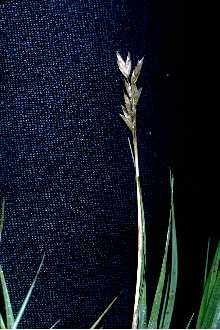
Palmer's Saltgrass has generally rigid, upright stems with short internodes. Longer stems can lie along the ground and produce young vertical stems from their nodes.[1][2]
Its stems generally grow upright to approximately 60 centimetres tall. Its leaves are needle-shaped to linear and grow upright in an alternate arrangement along the stems.[3][4]
Its male flowers release light chartreuse-colored pollen. Its female flowers have alternate spikelets with lavender-colored styles and stigmas.[5][6]
Habitat
Palmer's Saltgrass inhabits tidal marshes in the northern Gulf of California and grows in saline coastal environments.[7][8]
It can grow in open, hot, full-sun conditions with saline irrigation in subtropical zones.[9]
Behaviour
Specialized salt glands excrete salts onto the leaf surfaces, where breezes can remove them.[10][11]
Reproduction and life cycle
Palmer's Saltgrass has separate male and female plants. Its flowers are wind-pollinated and emerge in late winter.[12][13][14]
Male plants release pollen into the breeze when flowering. Its seeds mature in early spring, and each flower panicle produces approximately 20–30 mature seeds.[15][16][17]
Uses
The Cocopah people have historically harvested and eaten its seeds as a wild grain. The seeds have color and size characteristics similar to farro, and the grain has nutritional value and flavor qualities similar to those of other cultivated grains.[18][19][20]
Palmer's Saltgrass has been investigated for domestication as a saline-agriculture grain crop. It has also been used to manage agricultural drainage and proposed for remediation of saline and biosaline wastewater and land.[21][22][23]
Classification of the Palmer's Saltgrass
| Kingdom | Plantae |
|---|---|
| Subkingdom | Pteridobiotina |
| Phylum | Tracheophyta |
| Class | Liliopsida |
| Order | Poales |
| Family | Poaceae (Turf) |
| Genus | Distichlis (Saltgrass) |
| Species | Distichlis palmeri (Vasey) Fassett ex I.M.Johnst. |
Where the Palmer's Saltgrass is found
Checklists and occurrence records place Distichlis palmeri in 1 country across North America. GBIF holds 314 georeferenced records of it.
Countries
Regions and cities with the most records
- Baja California, Mexico 90
- Sonora, Mexico 70
- Puerto Peñasco, Mexico 24
- Baja California Sur, Mexico 12
- La Paz, Mexico 3
A number beside a place is its count of GBIF occurrence records. A place without a number comes from a checklist alone. Records show where a species has been observed or collected, which can include escapes and vagrants.
Common names
English
- Palmer's Saltgrass
Synonyms
One other scientific name has been used for this species and is now treated as a synonym of Distichlis palmeri.
- Uniola palmeri Vasey
Related species
-
 SaltgrassDistichlis spicata
- Australian Salt-grassDistichlis distichophylla
- Shore GrassDistichlis littoralis
- Distichlis stricta
- Distichlis scoparia
- Distichlis humilis
- Distichlis acerosa
- Distichlis australis
Compare
Questions and answers
What is the scientific name of the Palmer's Saltgrass?
The scientific name of the Palmer's Saltgrass is Distichlis palmeri. Written with its author, the full name is Distichlis palmeri (Vasey) Fassett ex I.M.Johnst..
Which family does the Palmer's Saltgrass belong to?
Distichlis palmeri belongs to the family Poaceae, in the order Poales and the class Liliopsida.
Where is the Palmer's Saltgrass found?
Checklists and occurrence records place Distichlis palmeri in 1 country: Mexico.
What is saltgrass used for?
Its seeds have historically been harvested and eaten as a wild grain by the Cocopah people. The species has been investigated as a saline-agriculture grain crop, used to manage agricultural drainage, and proposed for remediation of saline and biosaline wastewater and land.[18][21][22][23]
Why is it called salt grass?
Its leaves contain specialized salt glands that excrete salts onto their surfaces.[10]
Is saltgrass a plant?
Yes. Palmer's Saltgrass is a perennial, salt-tolerant C4 flowering grass in the family Poaceae.[24]
Sources
Passages the profile rests on
- Its stems are generally rigid and upright, with short internodes. Source passage: “Culms (stalks) are generally rigid and upright to about 60 cm (2 feet) and have short internodes.” — English Wikipedia
- Its longer stems can lie along the ground and produce young vertical stems from their nodes. Source passage: “Longer culms become recumbent (lay down) developing young vertical culms from the nodes.” — English Wikipedia
- Its leaves are needle-shaped to linear and grow upright in an alternate arrangement along the stems. Source passage: “Acicular to linear leaves are upright and positioned alternate along the culm at nodes.” — English Wikipedia
- Its stems generally grow upright to approximately 60 centimetres tall. Source passage: “Culms (stalks) are generally rigid and upright to about 60 cm (2 feet)” — English Wikipedia
- Its male flowers release light chartreuse-colored pollen. Source passage: “At anthesis, males liberate light chartreuse colored pollen in breezes.” — English Wikipedia
- Its female flowers have alternate spikelets with lavender-colored styles and stigmas. Source passage: “Female flowers are panicles of alternate spikelets that present lavender colored styles and stigmas.” — English Wikipedia
- The species inhabits tidal marshes in the northern Gulf of California. Source passage: “It is a saltwater marsh grass endemic to the tidal marshes of the northern Gulf of California in Mexico.” — English Wikipedia
- The species grows in saline coastal environments. Source passage: “Distichlis palmeri is endemic to the tidal marshes of Baja California and Sonora in the northern Gulf of California.” — English Wikipedia
- It can grow in open, hot, full-sun conditions with saline irrigation in subtropical zones. Source passage: “Distichlis palmeri can grow in open hot full sun on saline irrigation in subtropic zones;” — English Wikipedia
- Its leaves contain specialized salt glands that excrete salts onto their surfaces. Source passage: “Leaves excrete salts through specialized salt glands that are a component of D. palmeri leaf anatomy.” — English Wikipedia
- Its excreted surface salts can be removed by breezes. Source passage: “These excreted surface salts are wicked away by breezes.” — English Wikipedia
- The species has separate male and female plants. Source passage: “perennial rhizomatous dioecious halophytic C4 grass.” — English Wikipedia
- Its flowers are wind-pollinated. Source passage: “Anemophilous flowers emerge late winter.” — English Wikipedia
- Its flowers emerge in late winter. Source passage: “Anemophilous flowers emerge late winter.” — English Wikipedia
- Male plants release pollen into the breeze when flowering. Source passage: “At anthesis, males liberate light chartreuse colored pollen in breezes.” — English Wikipedia
- Its seeds mature in early spring. Source passage: “Kernels (seeds) are mature in early spring.” — English Wikipedia
- Each flower panicle produces approximately 20–30 mature seeds. Source passage: “Each panicle produces 20–30 mature caryopses.” — English Wikipedia
- Its seeds have historically been harvested and eaten as a wild grain by the Cocopah people. Source passage: “Kernels of Distichlis palmeri have an indigenous history as a wild harvest grain (Nipa) consumed by the Cocopah.” — English Wikipedia
- Its seeds have color and size characteristics similar to farro. Source passage: “Kernels are similar to those of farro in color and size.” — English Wikipedia
- Its grain has nutritional value and flavor qualities similar to those of other cultivated grains. Source passage: “Nipa grain has size, nutritional value and flavor qualities similar to other cropped grains.” — English Wikipedia
- The species has been investigated for domestication as a saline-agriculture grain crop. Source passage: “Nipa grain production through saline agriculture (agriculture that uses saline resources to farm halophytic cash crops) of D. palmeri has been the subject of domestication studies.” — English Wikipedia
- The species has been used to manage agricultural drainage. Source passage: “the species has been used to manage farm drainage” — English Wikipedia
- The species has been proposed for remediation of saline and biosaline wastewater and land. Source passage: “has been proposed as a constructive use plant in remediation of saline and biosaline wastewaters and land.” — English Wikipedia
- The species is a perennial, salt-tolerant C4 grass with upright, emergent growth. Source passage: “obligate emergent (it has aerenchyma) perennial rhizomatous dioecious halophytic C4 grass.” — English Wikipedia
- The species is native exclusively to tidal marshes in Baja California and Sonora, Mexico. Source passage: “Distichlis palmeri is endemic to the tidal marshes of Baja California and Sonora in the northern Gulf of California.” — English Wikipedia
- In Baja California, its recorded range extends from the Colorado River Delta south to Bahía de los Angeles and Isla Ángel de la Guarda. Source passage: “In Baja California, this species occurs from the Colorado River Delta south to the Bahía de los Angeles and Isla Ángel de la Guarda.” — English Wikipedia
Data
- Catalogue of Life, 2026-10-16 XR cc by
- Global Biodiversity Information Facility CC BY 4.0
- Wikidata CC0
- GeoNames CC BY 4.0
- Within the Catalogue of Life, this name comes from The World Checklist of Vascular Plants (WCVP) cc by
References
- Proc. Calif. Acad. Sci., ser. 4, 12: 984 (1924) where the name was published
This species in other databases
- Catalogue of Life 36XJN
- Wikidata Q5282938
- iNaturalist 288192
- World Flora Online wfo-0000865000
- GRIN 408506
Page built on 28 November 2026. See how the catalog is made and all sources and licences.
Cite this page
ScientificNames.org. (2026). Distichlis palmeri (Palmer's Saltgrass). Retrieved November 28, 2026, from https://scientificnames.org/species/distichlis-palmeri
“Distichlis palmeri (Palmer's Saltgrass).” ScientificNames.org, 2026, scientificnames.org/species/distichlis-palmeri. Accessed 28 Nov. 2026.
ScientificNames.org. “Distichlis palmeri (Palmer's Saltgrass).” Accessed November 28, 2026. https://scientificnames.org/species/distichlis-palmeri.
@misc{scientificnames_distichlis_palmeri_palmers_saltgrass,
  author = {{ScientificNames.org}},
  title = {Distichlis palmeri (Palmer's Saltgrass)},
  year = {2026},
  url = {https://scientificnames.org/species/distichlis-palmeri},
  note = {Accessed 2026-11-28}
}