Species · Mammals
Black Dorcopsis Dorcopsis atrata
The scientific name of the Black Dorcopsis is Dorcopsis atrata. It is a species of mammal in the family Macropodidae (kangaroos), order Diprotodontia. The name dates from 1957.
- Scientific name
- Dorcopsis atrata Van Deusen, 1957
- Common name
- Black Dorcopsis
- Genus
- Dorcopsis
- Family
- Macropodidae (Kangaroos)
- Order
- Diprotodontia
- Class
- Mammalia
- Red List category
- CR Critically Endangered
- Recorded in
- 2 countries
- Name status
- accepted in the Catalogue of Life
Overview
Dorcopsis atrata is endemic to Goodenough Island in Papua New Guinea, where it inhabits forests and some grasslands. It has blackish dorsal fur, dark brown ventral fur, and a tail whose terminal half is naked.
Written 26 November 2026 from the sources listed below. Each statement was checked against the passage it cites; statements that could not be supported were removed.
Appearance
The Black Dorcopsis has blackish dorsal fur and dark brown ventral fur. Its tail is covered with hair except for its naked terminal half, and it has a large, broad, naked nose and small, rounded ears.[1][2][3]
Its hind limbs and feet are small, while its forelimbs are robust and well developed. Many individuals have white markings resembling socks on one or both front paws and a white tail tip.[4][5]
Head-and-body length ranges from 28.9 to 39.2 inches, and tail length usually ranges from 11.2 to 15.6 inches. Adult body weight ranges from 1.8 to 2.3 kilograms.[6][7][8]
Habitat
The Black Dorcopsis occupies moist lowland and montane rainforests as well as some grasslands. On Goodenough Island, it inhabits oak forests at medium elevations in the mountains, and individuals may descend from mountain forests to sea level.[9][10][11]
Its reported general altitudinal range is 900 to 1,800 metres. It spends most of the year in oak forests between 1,000 and 1,800 metres above sea level.[12][13]
Its preferred oak forests have little undergrowth and a ground layer covered with mosses, lichens and ferns.[14]
Diet
The Black Dorcopsis is an herbivorous browser that primarily consumes soft vegetation. Its documented foods include leaves, roots, grasses and fruit, and it may occasionally consume insects.[15][16][17]
Individuals gather food with their mouths and manipulate it using their forepaws. They use their incisors to collect food before transferring it to their hands for processing with their premolars.[18][19]
Behaviour
The Black Dorcopsis is presumed to be primarily nocturnal. Individuals may move around during daylight in dense forest.[20][21]
The species is not specialized for jumping compared with most other wallaby species.[22]
Reproduction and life cycle
Females generally give birth to one offspring at a time and have four mammary glands. The female has a well-developed pouch that opens forward.[23][24][25]
Young individuals develop inside their mother's pouch.[26]
Conservation
The Black Dorcopsis is classified as Critically Endangered by the IUCN. Its overall population is declining despite the species being common in suitable habitat, and it is classified as rare in the Animal Diversity Web account.[27][28][29]
Habitat destruction is a threat because of the species' restricted geographic range. Its total extent of occurrence is less than 100 square kilometres.[30][31]
Montane forest habitat is being degraded through slash-and-burn practices and converted into grassland. Hunting is also a threat, and the species is vulnerable to hunting when it descends seasonally to gullies and lower ground.[32][33][34]
Uses
The Black Dorcopsis is considered a valuable food animal and is eaten by Indigenous people of the New Guinea islands.[35]
Similar species
The Black Dorcopsis has been suggested to represent a transitional form between tree kangaroos and other macropodids.[36]
Classification of the Black Dorcopsis
| Kingdom | Animalia |
|---|---|
| Phylum | Chordata |
| Subphylum | Vertebrata |
| Infraphylum | Gnathostomata |
| Parvphylum | Osteichthyes |
| Megaclass | Tetrapoda |
| Class | Mammalia (Mammal) |
| Subclass | Theria |
| Infraclass | Metatheria |
| Order | Diprotodontia |
| Suborder | Macropodiformes |
| Family | Macropodidae (Kangaroos) |
| Subfamily | Macropodinae |
| Genus | Dorcopsis (New Guinean Forest Wallabies) |
| Species | Dorcopsis atrata Van Deusen, 1957 |
Where the Black Dorcopsis is found
Checklists and occurrence records place Dorcopsis atrata in 2 countries across Oceania. GBIF holds 89 georeferenced records of it.
Countries
Range as the checklists state it
Australia
A number beside a place is its count of GBIF occurrence records. A place without a number comes from a checklist alone. Records show where a species has been observed or collected, which can include escapes and vagrants.
Common names
English
- Black Dorcopsis
- Black Dorcopsis Wallaby
- Black Forest Wallaby
- Black Forest-wallaby
Names in 10 other languages
- Arabic
- ولب الغابة الأسود
- Czech
- klokan černý
- Dutch
- Goodenoughwallabie
- Finnish
- mustametsäkenguru
- French
- Dorcopsis noir
- German
- Goodenough-Buschkänguru, Schwarzes Buschkänguru
- Japanese
- クロドルコプシス
- Polish
- kangurowiec czarny
- Russian
- Чёрный кустарниковый кенгуру
- Spanish
- Ualabí Forestal Negro
Related species
-
 White-striped DorcopsisDorcopsis hageni
-
 Gray DorcopsisDorcopsis luctuosa
-
 Brown DorcopsisDorcopsis muelleri
-
 QuokkaSetonix brachyurus
- Red KangarooOsphranter rufus
- TenkileDendrolagus scottae
-
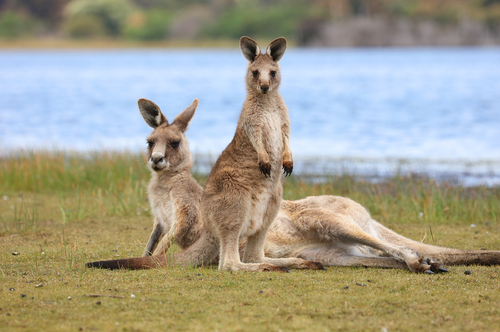 Eastern Grey KangarooMacropus giganteus
-
 Red-necked WallabyNotamacropus rufogriseus
Compare
Questions and answers
What is the scientific name of the Black Dorcopsis?
The scientific name of the Black Dorcopsis is Dorcopsis atrata. Written with its author, the full name is Dorcopsis atrata Van Deusen, 1957.
Which family does the Black Dorcopsis belong to?
Dorcopsis atrata belongs to the family Macropodidae, in the order Diprotodontia and the class Mammalia.
Where is the Black Dorcopsis found?
Checklists and occurrence records place Dorcopsis atrata in 2 countries: Papua New Guinea and Australia.
What is the conservation status of the Black Dorcopsis?
The IUCN Red List category recorded for Dorcopsis atrata is Critically Endangered (CR).
What other names does the Black Dorcopsis have?
Dorcopsis atrata is also known in English as Black Dorcopsis Wallaby, Black Forest Wallaby and Black Forest-wallaby.
Sources
Passages the profile rests on
- The species has blackish dorsal fur and dark brown ventral fur. Source passage: “The fur of black forest-wallabies is blackish on the dorsal part of their body and dark brown on the ventral side.” — animaldiversity.org
- The tail is covered with hair except for its terminal half, which is naked. Source passage: “The tail is haired except for the terminal half, where it is naked.” — animaldiversity.org
- The species has a large, broad, naked nose and small, rounded ears. Source passage: “The wallabie's nose is large, broad, and naked and its ears are small and rounded.” — animaldiversity.org
- Its hind limbs and feet are small, while its forelimbs are robust and well developed. Source passage: “The hind limbs and feet are small, while the front limbs are well-developed and robust.” — animaldiversity.org
- Many individuals have white markings resembling socks on one or both front paws and a white tail tip. Source passage: “Many of them have white 'sox' on one or both of their front paws, and a white tail tip” — English Wikipedia
- Head-and-body length ranges from 28.9 to 39.2 inches. Source passage: “The head and body length is between 28.9 and 39.2 inches.” — animaldiversity.org
- Tail length usually ranges from 11.2 to 15.6 inches. Source passage: “The tail length is usually between 11.2 and 15.6 inches” — animaldiversity.org
- Adult body weight ranges from 1.8 to 2.3 kilograms. Source passage: “an adult can weigh between 1.8 and 2.3 kg.” — animaldiversity.org
- The species occupies moist lowland and montane rainforests as well as some grasslands. Source passage: “they occupy a wide variety of niches including the moist forests of lowland and montane rain forest and some grasslands.” — animaldiversity.org
- On Goodenough Island, the species inhabits oak forests at medium elevations in the mountains. Source passage: “On Goodenough Island, they live in oak forests at medium elevations in the mountains” — animaldiversity.org
- Individuals may descend from mountain forests to sea level. Source passage: “but may also come down to sea level.” — animaldiversity.org
- The species has a reported general altitudinal range of 900 to 1,800 metres. Source passage: “The general altitudinal range is between 900 and 1,800 m. above sea level.” — animaldiversity.org
- The species spends most of the year in oak forests between 1,000 and 1,800 metres above sea level. Source passage: “It spends most of the year in oak forests at altitudes of between 1,000 and 1,800 metres” — English Wikipedia
- Its preferred oak forests have little undergrowth and a ground layer covered with mosses, lichens and ferns. Source passage: “where there is little undergrowth but the ground is carpeted with mosses, lichens and ferns.” — English Wikipedia
- The species is an herbivorous browser that primarily consumes soft vegetation. Source passage: “Dorcopsis atrata is an herbivorous browser feeding mostly on soft vegetation” — animaldiversity.org
- Its documented foods include leaves, roots, grasses and fruit. Source passage: “including leaves, roots, grasses and fruit.” — animaldiversity.org
- The species may occasionally consume insects. Source passage: “and possibly the occasional insect” — English Wikipedia
- The species uses its incisors to collect food before transferring it to its hands for processing with its premolars. Source passage: “The incisors are used to pick up food, then it is then transferred to the hands so it can be processed by the premolars on the side of the mouth.” — animaldiversity.org
- Individuals gather food with their mouths and manipulate it using their forepaws. Source passage: “which it gathers with its mouth and manipulates with its fore paws.” — English Wikipedia
- The species is presumed to be primarily nocturnal. Source passage: “Black forest-wallabies are presumed to be nocturnal” — animaldiversity.org
- Individuals may move around during daylight in dense forest. Source passage: “but may move around during the day in dense forest.” — English Wikipedia
- The species is not specialized for jumping compared with most other wallaby species. Source passage: “Unlike most other wallaby species, the black forest-wallaby is not specialized for jumping.” — animaldiversity.org
- Females generally give birth to one offspring at a time. Source passage: “Females usually give birth to one young at a time.” — animaldiversity.org
- Females have four mammary glands. Source passage: “Females of the species have four mammae” — animaldiversity.org
- The female has a well-developed pouch that opens forward. Source passage: “a pouch that opens forward.” — animaldiversity.org
- Young individuals develop inside their mother's pouch. Source passage: “A young black dorcopsis develops in its mother's pouch.” — English Wikipedia
- The species is classified as Critically Endangered by the IUCN. Source passage: “the IUCN lists its conservation status as being "Critically endangered".” — English Wikipedia
- The overall population is declining despite the species being common in suitable habitat. Source passage: “Although the black dorcopsis is common in suitable habitat, the overall population is declining” — English Wikipedia
- The species is classified as rare in the Animal Diversity Web account. Source passage: “Due to these factors, they are considered a threatened species and are classified as rare.” — animaldiversity.org
- Its total extent of occurrence is less than 100 square kilometres. Source passage: “where it has a total extent of occurrence of less than 100 square kilometres (39 sq mi).” — English Wikipedia
- Habitat destruction is a threat because of the species' restricted geographic range. Source passage: “Because of their restricted range, they are also very susceptible to habitat destruction.” — animaldiversity.org
- Hunting is a threat to the species. Source passage: “It is threatened by habitat loss and hunting” — English Wikipedia
- Montane forest habitat is being degraded through slash-and-burn practices and converted into grassland. Source passage: “The montane forest is being degraded using slash and burn techniques and is eventually being converted into grassland.” — English Wikipedia
- The species is vulnerable to hunting when it descends seasonally to gullies and lower ground. Source passage: “It descends seasonally to gullies and lower ground at which time it is vulnerable to being hunted.” — English Wikipedia
- The species is considered a valuable food animal and is eaten by Indigenous people of the New Guinea islands. Source passage: “Black forest-wallabies are considered a valuable food animal and are eaten by natives of New Guinea islands.” — animaldiversity.org
- The species has been suggested to represent a transitional form between tree kangaroos and other macropodids. Source passage: “It has been suggested that black forest-wallabies represent a transitional form between tree kangaroos and other macropodids.” — animaldiversity.org
Data
- Catalogue of Life, 2026-10-16 XR cc by
- Global Biodiversity Information Facility CC BY 4.0
- Wikidata CC0
- GeoNames CC BY 4.0
- Within the Catalogue of Life, this name comes from The Integrated Taxonomic Information System cc0
References
- Am. Mus. Novit. vol.1826 p.5 where the name was published
- Nowak, Ronald M. (1991). Walker’s Mammals of the World, Vol. 1, 5th Ed.
- Wilson, Don E., and DeeAnn M. Reeder, eds. (1993). Mammal Species of the World: A Taxonomic and Geographic Reference, 2nd Ed., 3rd Printing.
- Wilson, Don E., and DeeAnn M. Reeder, eds. (2005). Mammal Species of the World: A Taxonomic and Geographic Reference, 3rd Ed., Vols. 1 & 2.
- Wilson, Don E., and Russell A. Mittermeier, eds. (2015). Handbook of the Mammals of the World, Vol. 5. Monotremes and Marsupials.
- Burgin, Connor J., Don E. Wilson, Russell A. Mittermeier, Anthony B. Rylands, et al. (2020). Illustrated Checklist of the Mammals of the World. Vol. 1. Monotremata to Rodentia.
This species in other databases
Page built on 29 November 2026. See how the catalog is made and all sources and licences.
Cite this page
ScientificNames.org. (2026). Dorcopsis atrata (Black Dorcopsis). Retrieved November 29, 2026, from https://scientificnames.org/species/dorcopsis-atrata
“Dorcopsis atrata (Black Dorcopsis).” ScientificNames.org, 2026, scientificnames.org/species/dorcopsis-atrata. Accessed 29 Nov. 2026.
ScientificNames.org. “Dorcopsis atrata (Black Dorcopsis).” Accessed November 29, 2026. https://scientificnames.org/species/dorcopsis-atrata.
@misc{scientificnames_dorcopsis_atrata_black_dorcopsis,
  author = {{ScientificNames.org}},
  title = {Dorcopsis atrata (Black Dorcopsis)},
  year = {2026},
  url = {https://scientificnames.org/species/dorcopsis-atrata},
  note = {Accessed 2026-11-29}
}