Species · Flowering plants
Scarlet Sundew Drosera glanduligera
The scientific name of the Scarlet Sundew is Drosera glanduligera. It is a species of flowering plant in the family Droseraceae (sundew family), order Caryophyllales.
- Scientific name
- Drosera glanduligera Lehm.
- Common name
- Scarlet Sundew
- Genus
- Drosera
- Family
- Droseraceae (Sundew Family)
- Order
- Caryophyllales
- Class
- Magnoliopsida
- Red List category
- LC Least Concern
- Recorded in
- 1 country
- Name status
- accepted in the Catalogue of Life

Overview
The Scarlet sundew is a small herbaceous carnivorous plant in the family Droseraceae. It has touch-sensitive snap-tentacles around the margins of its leaves that catapult prey onto central sticky tentacles.
Written 26 November 2026 from the sources listed below. Each statement was checked against the passage it cites; statements that could not be supported were removed.
Appearance
The Scarlet sundew has 15 to 20 concave, spatula-shaped leaves arranged in a convex to nearly flat rosette. The leaves measure 8–20 mm in length.[1][2]
Its flowering stem is erect, covered with glandular hairs and reaches a maximum height of 10 mm. The stem bears several orange flowers.[3][4][5]
The plant has fibrous roots and does not possess a tuber.[6]
Its leaves have touch-sensitive glandular tentacles. Sticky tentacles occupy the centre of each leaf, while non-sticky snap-tentacles occur around the margins.[7][8]
Habitat
The Scarlet sundew grows in a wide range of habitats and soil conditions throughout its geographic range.[9]
Diet
The Scarlet sundew is an insectivorous plant.[10]
Behaviour
The Scarlet sundew uses a trapping mechanism that combines characteristics of flypaper traps and snap traps. When triggered, its outer snap-tentacles catapult prey onto the sticky tentacles in the centre of the leaf.[11][12]
The central sticky tentacles gradually draw captured prey into the concave leaf depression over approximately two minutes. Digestion begins after the prey has been drawn into the depression.[13][14]
An individual snap-tentacle cannot repeat its snapping movement after being triggered.[15]
Reproduction and life cycle
The Scarlet sundew flowers between August and November. It is an ephemeral annual plant.[16][17]
Classification of the Scarlet Sundew
| Kingdom | Plantae |
|---|---|
| Subkingdom | Pteridobiotina |
| Phylum | Tracheophyta |
| Class | Magnoliopsida |
| Order | Caryophyllales |
| Family | Droseraceae (Sundew Family) |
| Genus | Drosera (Sundew) |
| Species | Drosera glanduligera Lehm. |
Where the Scarlet Sundew is found
Checklists and occurrence records place Drosera glanduligera in 1 country across Oceania. GBIF holds 5,832 georeferenced records of it.
Countries
Regions and cities with the most records
- Western Australia, Australia 2,458
- South Australia, Australia 1,586
- Victoria, Australia 1,313
- New South Wales, Australia 272
- Adelaide Hills, Australia 213
- Adelaide, Australia 204
- Perth, Australia 177
- Mount Barker, Australia 166
- Gawler, Australia 147
- Torquay, Australia 111
- Kwinana, Australia 87
- Albany, Australia 79
- Frankston East, Australia 63
- Bendigo, Australia 41
- Rockingham, Australia 40
- Busselton, Australia 38
- Tasmania, Australia 34
- Mandurah, Australia 33
- Liverpool, Australia 30
- Parramatta, Australia 28
- Wangaratta, Australia 28
- Burwood, Australia 19
- Balwyn North, Australia 16
- Melbourne, Australia 16
- Bunbury, Australia 14
- Geelong, Australia 13
- Queensland, Australia 11
- St Albans, Australia 9
- Dubbo, Australia 8
- Horsham, Australia 7
- Wodonga, Australia 6
- Mount Gambier, Australia 4
Range as the checklists state it
Australia (Western Australia, South Australia, New South Wales, Victoria and Tasmania, including Flinders Island)
A number beside a place is its count of GBIF occurrence records. A place without a number comes from a checklist alone. Records show where a species has been observed or collected, which can include escapes and vagrants.
Common names
English
- Scarlet Sundew
- Pimpernel Sundew
Names in 1 other language
- Chinese
- 猩紅毛氈苔
Synonyms
2 other scientific names have been used for this species and are now treated as synonyms of Drosera glanduligera.
- Drosera anagallidiflora F.Muell. ex Diels
- Drosera patellifera Planch.
Related species
-
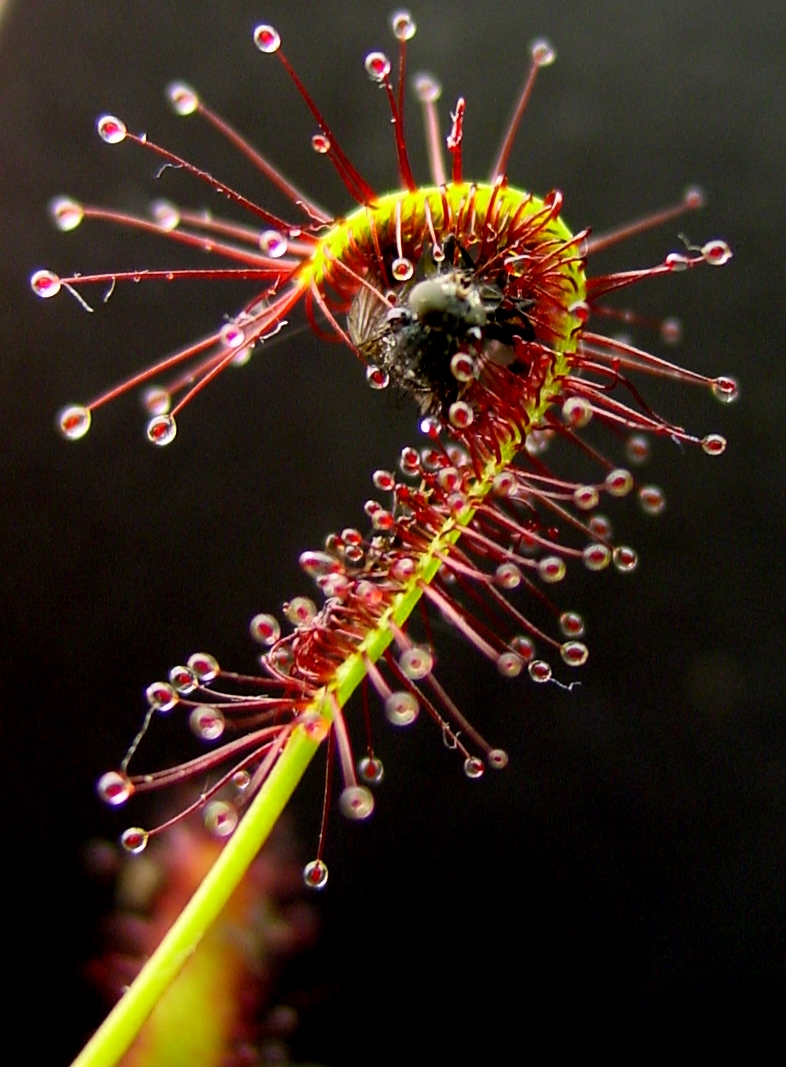 Drosera capensis
-
 Common SundewDrosera rotundifolia
-
 Rosy SundewDrosera spathulata
-
 English SundewDrosera × anglica
-
 Long-Leaved SundewDrosera intermedia
-
 Fork-leaved SundewDrosera binata
-
 Northern Threadleaf SundewDrosera filiformis
-
 King SundewDrosera regia
Compare
Questions and answers
What is the scientific name of the Scarlet Sundew?
The scientific name of the Scarlet Sundew is Drosera glanduligera. Written with its author, the full name is Drosera glanduligera Lehm..
Which family does the Scarlet Sundew belong to?
Drosera glanduligera belongs to the family Droseraceae, in the order Caryophyllales and the class Magnoliopsida.
Where is the Scarlet Sundew found?
Checklists and occurrence records place Drosera glanduligera in 1 country: Australia.
What is the conservation status of the Scarlet Sundew?
The IUCN Red List category recorded for Drosera glanduligera is Least Concern (LC).
What other names does the Scarlet Sundew have?
Drosera glanduligera is also known in English as Pimpernel Sundew.
What do sundews eat?
The Scarlet sundew is an insectivorous plant.[10]
How do Drosera obtain food?
The Scarlet sundew combines flypaper and snap-trap mechanisms. Its outer snap-tentacles catapult prey onto central sticky tentacles, which draw the prey into the leaf depression over approximately two minutes. Digestion begins after the prey has been drawn into the depression.[11][12][13][14]
Sources
Passages the profile rests on
- The plant has 15 to 20 concave, spatula-shaped leaves arranged in a convex to nearly flat rosette. Source passage: “15 to 20 concave spathulate leaves, each only 8–20 mm (0.31–0.79 in) long, arranged in a convex to nearly flat rosette.” — English Wikipedia
- The leaves measure 8–20 mm in length. Source passage: “each only 8–20 mm (0.31–0.79 in) long” — English Wikipedia
- Its flowering stem is erect and covered with glandular hairs. Source passage: “an erect glandular-hirsute stem up to 10 mm (0.39 in) tall” — English Wikipedia
- Its flowering stem bears several orange flowers. Source passage: “bearing several orange flowers.” — English Wikipedia
- The flowering stem reaches a maximum height of 10 mm. Source passage: “an erect glandular-hirsute stem up to 10 mm (0.39 in) tall” — English Wikipedia
- The plant has fibrous roots and does not possess a tuber. Source passage: “Lacking a tuber, its roots are fibrous.” — English Wikipedia
- Its leaves have touch-sensitive glandular tentacles. Source passage: “Each leaf is covered with touch-sensitive glandular tentacles” — English Wikipedia
- Sticky tentacles occupy the centre of each leaf, while non-sticky snap-tentacles occur around its margins. Source passage: “with sticky glue-tentacles at the centre of the leaf and non-sticky snap-tentacles arranged around the leaf margins.” — English Wikipedia
- The species grows in a wide range of habitats and soil conditions throughout its geographic range. Source passage: “It can be found growing in a wide range of habitats and soil conditions across its range” — English Wikipedia
- Drosera glanduligera is an insectivorous plant. Source passage: “glanduligera is an insectivorous species” — naturalvaluesatlas.tas.gov.au
- The plant uses a trapping mechanism combining characteristics of flypaper traps and snap traps. Source passage: “The trapping mechanism of this species is unique in that it combines features of both flypaper and snap traps.” — English Wikipedia
- When triggered, its outer snap-tentacles catapult prey onto the sticky tentacles in the centre of the leaf. Source passage: “When triggered, the outer snap-tentacles catapult prey onto the sticky glue-tentacles at the centre of the leaf” — English Wikipedia
- The central sticky tentacles gradually draw captured prey into the concave leaf depression over approximately two minutes. Source passage: “which slowly draw the prey into the concave depression of the leaf over a span of approximately 2 minutes” — English Wikipedia
- Digestion begins after captured prey has been drawn into the leaf depression. Source passage: “after which digestion commences.” — English Wikipedia
- An individual snap-tentacle cannot repeat its snapping movement after being triggered. Source passage: “Once a snap-tentacle has snapped, this movement is not repeatable.” — English Wikipedia
- The species flowers between August and November. Source passage: “flowers from August to November.” — English Wikipedia
- Drosera glanduligera is an ephemeral annual plant. Source passage: “It is an ephemeral annual plant” — English Wikipedia
Data
- Catalogue of Life, 2026-10-16 XR cc by
- Global Biodiversity Information Facility CC BY 4.0
- Wikidata CC0
- GeoNames CC BY 4.0
- Wikimedia Commons per image; credit shown with each image
- Within the Catalogue of Life, this name comes from Synonymic Checklists of the Vascular Plants of the World cc by
References
- Lehm. (1844). Pugill. Pl. Afr. Bor. Hispan. 8: 37 (1844). where the name was published
This species in other databases
Page built on 28 November 2026. See how the catalog is made and all sources and licences.
Cite this page
ScientificNames.org. (2026). Drosera glanduligera (Scarlet Sundew). Retrieved November 28, 2026, from https://scientificnames.org/species/drosera-glanduligera
“Drosera glanduligera (Scarlet Sundew).” ScientificNames.org, 2026, scientificnames.org/species/drosera-glanduligera. Accessed 28 Nov. 2026.
ScientificNames.org. “Drosera glanduligera (Scarlet Sundew).” Accessed November 28, 2026. https://scientificnames.org/species/drosera-glanduligera.
@misc{scientificnames_drosera_glanduligera_scarlet_sundew,
  author = {{ScientificNames.org}},
  title = {Drosera glanduligera (Scarlet Sundew)},
  year = {2026},
  url = {https://scientificnames.org/species/drosera-glanduligera},
  note = {Accessed 2026-11-28}
}