Species · Flowering plants
Rosy Sundew Drosera spathulata
The scientific name of the Rosy Sundew is Drosera spathulata. It is a species of flowering plant in the family Droseraceae (sundew family), order Caryophyllales.
- Scientific name
- Drosera spathulata Labill.
- Common name
- Rosy Sundew
- Genus
- Drosera
- Family
- Droseraceae (Sundew Family)
- Order
- Caryophyllales
- Class
- Magnoliopsida
- Recorded in
- 18 countries
- Name status
- accepted in the Catalogue of Life

Overview
The Rosy Sundew is a variable, rosette-forming sundew with spoon-shaped leaves. It occurs naturally throughout Southeast Asia, southern China, Japan, Micronesia, Papua New Guinea, eastern Australia, Tasmania and New Zealand. It produces small white or pink flowers and has leaves with glandular structures on their upper petioles.
Written 26 November 2026 from the sources listed below. Each statement was checked against the passage it cites; statements that could not be supported were removed.
Appearance
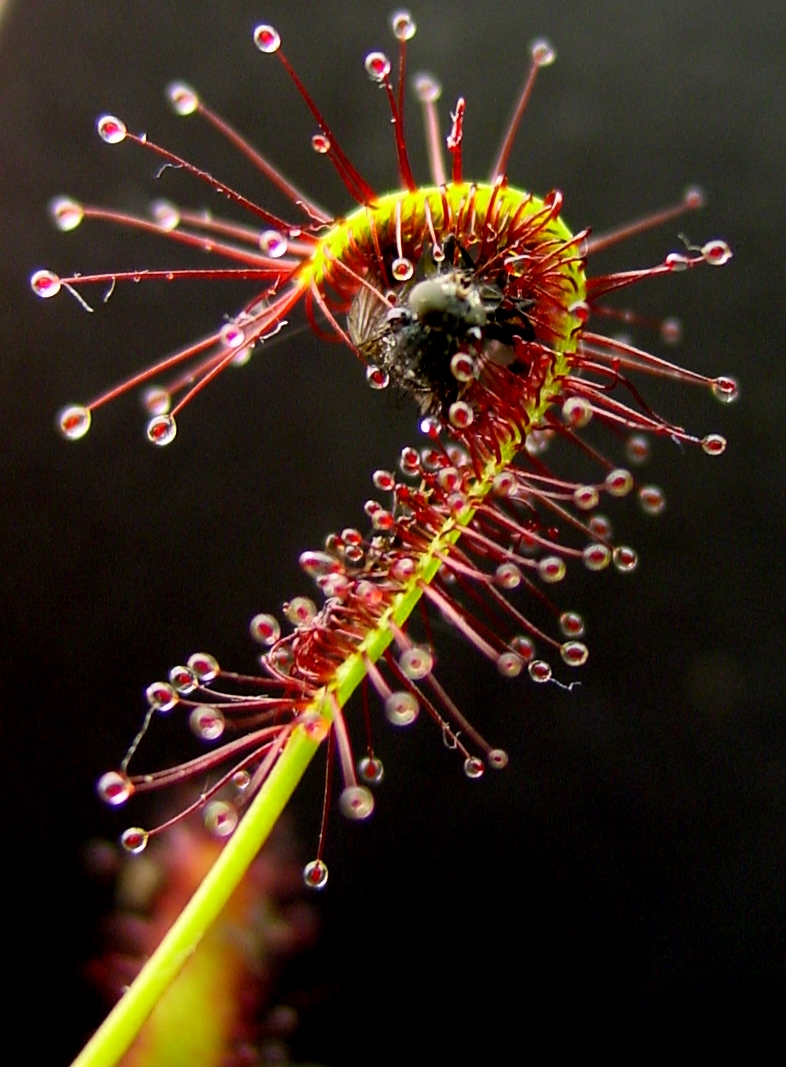
The Rosy Sundew has spoon-shaped leaves arranged in a rosette. Each leaf has a narrow petiole with glandular structures on its upper half.[1][2]
The leaf blades are typically 5 mm long and 4 mm wide. The leaf petioles measure approximately 8 mm in length.[3][4]
The species produces small white or pink flowers, each reaching up to 6 mm in diameter. Its erect flowering stalks reach approximately 8 cm in height.[5][6][7]
Habitat
The Rosy Sundew occurs naturally throughout Southeast Asia, southern China and Japan. Its natural distribution also includes Micronesia and Papua New Guinea.[8][9][10]
The species also occurs naturally in eastern Australia, Tasmania and New Zealand.[11]
Behaviour
The Rosy Sundew does not form hibernacula during winter. Carnivorous plant growers describe it as very hardy.[12][13]
Carnivorous plant growers sometimes consider the species a weed.[14]
Reproduction and life cycle
The species produces copious quantities of seeds when flowering. Its seeds germinate readily and can produce new plants in surrounding pots.[15][16]
Uses
The Rosy Sundew is cultivated by growers using the same methods as Drosera capensis.[17]
Classification of the Rosy Sundew
| Kingdom | Plantae |
|---|---|
| Subkingdom | Pteridobiotina |
| Phylum | Tracheophyta |
| Class | Magnoliopsida |
| Order | Caryophyllales |
| Family | Droseraceae (Sundew Family) |
| Genus | Drosera (Sundew) |
| Species | Drosera spathulata Labill. |
Where the Rosy Sundew is found
Checklists and occurrence records place Drosera spathulata in 18 countries across Asia and Oceania. GBIF holds 12,398 georeferenced records of it.
Countries
- Australia 8,012
- China 200
- Hong Kong 308
- India 6
- Indonesia 3
- Japan 390
- Macao 17
- Malaysia 53
- Nepal 1
- New Zealand 2,173
- Palau 14
- Papua New Guinea 11
- Philippines 14
- South Korea 7
- Sri Lanka 4
- Taiwan 1,177
- Thailand 3
- Vietnam 5
Regions and cities with the most records
- New South Wales, Australia 5,317
- Queensland, Australia 1,895
- Xizhi, Taiwan 892
- Neihu, Taiwan 868
- West Coast, New Zealand 810
- Keelung, Taiwan 794
- Hornsby, Australia 791
- Taipei, Taiwan 780
- New Taipei City, Taiwan 718
- Danshui, Taiwan 646
- Sanzhi, Taiwan 619
- Banqiao, Taiwan 593
- Taipei, Taiwan 569
- Wollongong, Australia 513
- Sydney, Australia 443
- Southland, New Zealand 417
- Victoria, Australia 328
- Central Coast, Australia 291
- Tasman District, New Zealand 270
- Caloundra, Australia 249
- Discovery Park, Hong Kong 247
- Tsuen Wan, Hong Kong 245
- Keng Hau, Hong Kong 241
- Mei Foo, Hong Kong 241
- Mei Foo Sun Chuen, Hong Kong 241
- Tai Wai, Hong Kong 241
- Tai Wo Hau, Hong Kong 241
- Ting Kau, Hong Kong 241
- Tsing Yi Town, Hong Kong 239
- San Tin, Hong Kong 237
- Hoi Lai Estate, Hong Kong 236
- Parramatta, Australia 236
- Sun Tin Wai, Hong Kong 236
- Sha Tin, Hong Kong 233
- Pok Hong, Hong Kong 232
- Sha Tin Wai, Hong Kong 232
1 more country has a few records outside this range
These countries hold a few records of Drosera spathulata but lie outside the range the checklists give for it. Such records are often zoo or garden specimens, museum material or vagrants, so the species is not counted as occurring there.
Range as the checklists state it
China (Fujian, Guangdong, Guangxi); Japan (Honshu, Shikoku, Kyushu); Ryukyu Isl.; Taiwan; Nepal; Vietnam; +peninsular Malaysia (+Kedah); Sumatera; Borneo; Palawan; Philippines (Luzon, Mindoro); New Guinea (Papua New Guinea); Australia (E-Queensland, E-New South Wales, to W-Victoria, Tasmania); New Zealand (incl. Stewart Isl.); Palau (Babeldaob)
A number beside a place is its count of GBIF occurrence records. A place without a number comes from a checklist alone. Records show where a species has been observed or collected, which can include escapes and vagrants.
Common names
English
- Rosy Sundew
- Spoon-leaved Sundew
Names in 8 other languages
- Chinese
- 匙叶茅膏菜, 寬苞茅膏菜, 小毛氈苔
- French
- Droséra spatulée, Rossolis spatulé
- Japanese
- コモウセンゴケ
- Korean
- 주걱끈끈이주걱
- Māori
- wahu
- Russian
- Росянка лопатчатая
- Slovak
- rosička lopatkolistá
- Slovenian
- žličasta rosika
Synonyms
7 other scientific names have been used for this species and are now treated as synonyms of Drosera spathulata.
- Drosera loureiroi Hook. & Arn.
- Drosera lovellae F.M.Bailey
- Drosera propinqua R.Cunn.
- Drosera spatulata var. loureiroi (Hook. & Arn.) Y.Z.Ruan
- Drosera spatulata var. spatulata
- Drosera triflora Colenso
- Drosera burmanni DC. ambiguous synonym
Subspecies and varieties
Related species
-
 Drosera capensis
-
 Common SundewDrosera rotundifolia
-
 Great SundewDrosera × anglica
-
 Water SundewDrosera intermedia
-
 SundewDrosera binata
-
 Scarlet SundewDrosera glanduligera
-
 DewthreadDrosera filiformis
-
 King SundewDrosera regia
Compare
Questions and answers
What is the scientific name of the Rosy Sundew?
The scientific name of the Rosy Sundew is Drosera spathulata. Written with its author, the full name is Drosera spathulata Labill..
Which family does the Rosy Sundew belong to?
Drosera spathulata belongs to the family Droseraceae, in the order Caryophyllales and the class Magnoliopsida.
Where is the Rosy Sundew found?
Checklists and occurrence records place Drosera spathulata in 18 countries, including Australia, New Zealand, Taiwan, Japan, Hong Kong and China.
What other names does the Rosy Sundew have?
Drosera spathulata is also known in English as Spoon-leaved Sundew.
Sources
Passages the profile rests on
- Drosera spatulata is a variable, rosette-forming sundew with spoon-shaped leaves. Source passage: “Drosera spatulata, the spoon-leaved sundew, is a variable, rosette-forming sundew with spoon-shaped leaves.” — English Wikipedia
- Each leaf has a narrow petiole with glandular structures on its upper half. Source passage: “Each leaf is attached to the central rosette by a narrow 8 mm long petiole that is only glandular on the upper half.” — English Wikipedia
- The leaf blades are typically 5 mm long and 4 mm wide. Source passage: “Individual leaf laminae are typically 5 mm long and 4 mm wide.” — English Wikipedia
- The leaf petiole measures approximately 8 mm in length. Source passage: “by a narrow 8 mm long petiole” — English Wikipedia
- The species produces small white or pink flowers. Source passage: “with around six small white or pink flowers on each one-sided racemose inflorescence.” — English Wikipedia
- Each flower can reach 6 mm in diameter. Source passage: “Each flower can be up to 6 mm across.” — English Wikipedia
- The erect flowering stalks reach approximately 8 cm in height. Source passage: “plants will produce 8 cm (3.1 in) tall erect scapes” — English Wikipedia
- The species occurs naturally throughout Southeast Asia. Source passage: “occurs naturally throughout Southeast Asia, southern China and Japan” — English Wikipedia
- The species occurs naturally in southern China and Japan. Source passage: “southern China and Japan” — English Wikipedia
- The species occurs naturally in Micronesia and Papua New Guinea. Source passage: “Micronesia, Papua New Guinea” — English Wikipedia
- The species occurs naturally in eastern Australia, Tasmania and New Zealand. Source passage: “eastern Australia, Tasmania and New Zealand.” — English Wikipedia
- The species does not form hibernacula during winter. Source passage: “The plant does not form hibernacula in winter” — English Wikipedia
- The species is described as very hardy by carnivorous plant growers. Source passage: “because it is very hardy” — English Wikipedia
- Carnivorous plant growers sometimes consider the species a weed. Source passage: “Carnivorous plant growers consider D. spatulata to be a weed” — English Wikipedia
- The species produces copious quantities of seeds when flowering. Source passage: “produces copious amounts of seed when it flowers.” — English Wikipedia
- Its seeds germinate readily and can produce new plants in surrounding pots. Source passage: “The seed also germinates without much difficulty, causing little plants to pop up in surrounding pots.” — English Wikipedia
- The species is cultivated by growers using the same methods as Drosera capensis. Source passage: “is easily grown using the same methods as Drosera capensis.” — English Wikipedia
- Individual plants generally measure approximately 4 cm in diameter. Source passage: “but generally plants are about 4 cm (1.6 in) in diameter.” — English Wikipedia
Data
- Catalogue of Life, 2026-10-16 XR cc by
- Global Biodiversity Information Facility CC BY 4.0
- Wikidata CC0
- GeoNames CC BY 4.0
- Wikimedia Commons per image; credit shown with each image
- Within the Catalogue of Life, this name comes from Synonymic Checklists of the Vascular Plants of the World cc by
References
- Labill. (1804). Nov. Holl. Pl. 1: 79, t. 106, f. 1 (1804). where the name was published
This species in other databases
- Catalogue of Life 37QWN
- Wikidata Q138176
- iNaturalist 122208
- World Flora Online wfo-0000946185
- GRIN 495749
Page built on 26 November 2026. See how the catalog is made and all sources and licences.
Cite this page
ScientificNames.org. (2026). Drosera spathulata (Rosy Sundew). Retrieved November 26, 2026, from https://scientificnames.org/species/drosera-spathulata
“Drosera spathulata (Rosy Sundew).” ScientificNames.org, 2026, scientificnames.org/species/drosera-spathulata. Accessed 26 Nov. 2026.
ScientificNames.org. “Drosera spathulata (Rosy Sundew).” Accessed November 26, 2026. https://scientificnames.org/species/drosera-spathulata.
@misc{scientificnames_drosera_spathulata_rosy_sundew,
  author = {{ScientificNames.org}},
  title = {Drosera spathulata (Rosy Sundew)},
  year = {2026},
  url = {https://scientificnames.org/species/drosera-spathulata},
  note = {Accessed 2026-11-26}
}