Species · Birds
Nuttall's Woodpecker Dryobates nuttallii
The scientific name of the Nuttall's Woodpecker is Dryobates nuttallii. It is a species of bird in the family Picidae (woodpecker), order Piciformes. The name dates from 1843.
- Scientific name
- Dryobates nuttallii (Gambel, 1843)
- Common name
- Nuttall's Woodpecker
- Genus
- Dryobates
- Family
- Picidae (Woodpecker)
- Order
- Piciformes
- Class
- Aves
- Red List category
- LC Least Concern
- Environment
- terrestrial
- Recorded in
- 2 countries
- Name status
- accepted in the Catalogue of Life

Overview
Dryobates nuttallii prefers arid to mesic woodland habitats, particularly oak woodlands, and also occupies riparian sites and chaparral in the southern part of its range. It is distinguished by its black-and-white striped wings and tail, predominantly white underparts with black markings, and unbarred black upper-back region.
Written 26 November 2026 from the sources listed below. Each statement was checked against the passage it cites; statements that could not be supported were removed.
Conservation
Nuttall's Woodpecker is not considered globally threatened. Its total global population is estimated to exceed 100,000 individuals, and surveys indicate no obvious population trends.[1][2][3]
Similar species
Nuttall's Woodpecker is closely related to the ladder-backed woodpecker. It can be distinguished by its solid black upper-back region, and hybrids between the two species are rare.[4][5][6]
Appearance
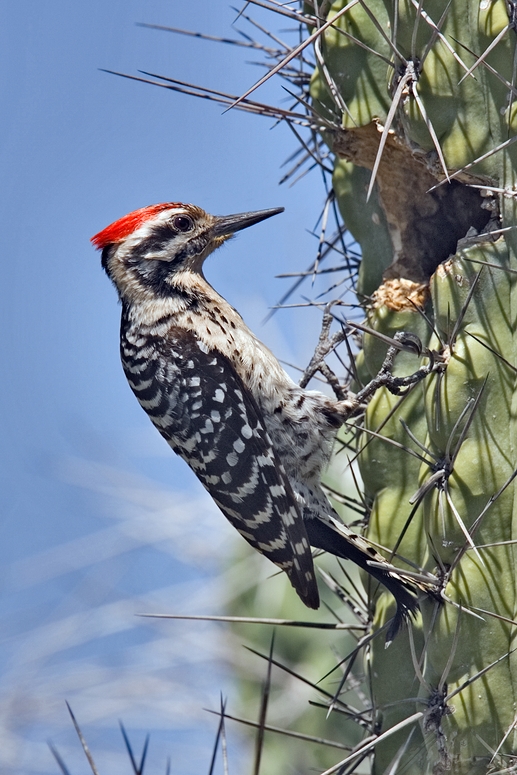
Nuttall's Woodpecker has black-and-white striped wings and tail feathers. Its underparts are predominantly white with scattered black markings, its forehead is black with white streaks along the sides, and its upper back has an unbarred black region.[7][8][9]
Adult males have a red crown, which adult females lack. Juveniles of both sexes have a red crown and generally have white streaks on their heads.[10][11][12]
Its feet are zygodactyl, with two forward-facing toes and two backward-facing toes.[13]
Its body length ranges from 16 to 18 cm, and its body mass ranges from 30 to 45 g. Its wingspan is approximately 38 to 43 cm.[14][15][16]
Habitat
Nuttall's Woodpecker prefers arid to mesic woodland habitats, particularly oak woodlands. It also occupies riparian sites and chaparral in the southern part of its range.[17][18][19]
Individuals occur from sea level to 1,250 m, with rare records reaching 2,000 m. The species is non-migratory, and its range generally lies west of the deserts and the Sierra divide.[20][21][22]
The species has adapted to suburban and human-created natural environments, including parks.[23]
Diet
Nuttall's Woodpecker primarily feeds on insect larvae, including wood borers, click beetles, and ants. Adult and larval insects, particularly beetles, account for an estimated 80% of its diet.[24][25]
It obtains insects by tapping and probing crevices in oak trees and by peeling back tree layers to expose ant colonies beneath the bark.[26][27]
Behaviour
Nuttall's Woodpecker uses its stiff tail feathers and sturdy feet to maintain stability on branches while feeding.[28]
Both sexes drum, with rolls averaging more than one second. Call notes communicate location between mated pairs, while the double call can function as a low-level threat alarm.[29][30][31]
The species uses rattle calls to establish territories while feeding. Females primarily use the kweek call before copulation.[32][33]
Reproduction and life cycle
Pair bonding occurs between late January and March, and egg-laying occurs mostly in April and May. The species is socially monogamous and exhibits biparental care.[34][35][36]
Males excavate new nesting cavities annually in dead willow, oak, and alder trees. Nesting cavities occur from ground level to approximately 18 m above the ground.[37][38]
Clutch sizes range from three to six eggs, with an average of approximately 4.6 eggs. Males incubate eggs at night, whereas females incubate them during the day, and the incubation period can last up to 14 days.[39][40][41][42]
Young leave the nest at approximately 29 days after hatching. Parental care continues for 14 days after fledging.[43][44]
Classification of the Nuttall's Woodpecker
| Kingdom | Animalia |
|---|---|
| Phylum | Chordata |
| Subphylum | Vertebrata |
| Infraphylum | Gnathostomata |
| Parvphylum | Osteichthyes |
| Megaclass | Tetrapoda |
| Class | Aves (Bird) |
| Order | Piciformes (Woodpeckers) |
| Family | Picidae (Woodpecker) |
| Subfamily | Picinae |
| Genus | Dryobates (Dryobates Woodpeckers) |
| Species | Dryobates nuttallii (Gambel, 1843) |
Where the Nuttall's Woodpecker is found
Checklists and occurrence records place Dryobates nuttallii in 2 countries across North America. GBIF holds 1,129,314 georeferenced records of it.
Countries
Regions and cities with the most records
- California, United States 1,119,514
- Sunnyvale, United States 67,283
- Oakland, United States 66,245
- Irvine, United States 65,721
- Mountain View, United States 65,273
- Cupertino, United States 63,892
- Alameda, United States 63,641
- Berkeley, United States 61,520
- Lafayette, United States 61,313
- Albany, United States 61,275
- Tustin, United States 60,650
- Garden Grove, United States 60,295
- Moraga, United States 59,979
- Rosemont, United States 59,722
- Orinda, United States 59,557
- Arden-Arcade, United States 59,478
- Los Altos, United States 58,821
- Santa Ana, United States 58,204
- Santa Clara, United States 57,789
- San Francisco, United States 56,674
- Orange, United States 56,117
- El Cerrito, United States 55,967
- East Palo Alto, United States 55,777
- West Sacramento, United States 55,401
- Palo Alto, United States 55,304
- Carmichael, United States 54,901
- North Highlands, United States 54,811
- Burbank, United States 54,707
- Foothill Farms, United States 54,498
- San Jose, United States 54,122
- Lake Forest, United States 54,020
- Antelope, United States 53,905
- Rancho Cordova, United States 53,246
- Sacramento, United States 53,178
- Glendale, United States 53,166
- Bayview-Hunters Point, United States 53,132
Range as the checklists state it
Middle America
North America
A number beside a place is its count of GBIF occurrence records. A place without a number comes from a checklist alone. Records show where a species has been observed or collected, which can include escapes and vagrants.
Common names
English
- Nuttall's Woodpecker
Names in 29 other languages
- Catalan
- picot garser de Nuttall
- Chinese
- 加利福尼亞啄木, 加州啄木鸟
- Croatian
- kalifornijski djetlić
- Czech
- strakapoud kalifornský
- Danish
- Californisk Flagspætte
- Dutch
- Nuttalls Specht
- Esperanto
- kalifornia pego
- Estonian
- kalifornia kirjurähn
- Finnish
- kaliforniantikka
- French
- Pic de Nuttall
- German
- Nuttallspecht
- Hungarian
- Nuttel-harkály
- Italian
- Picchio di Nuttall
- Japanese
- shiroharashimaakagera, シロハラシマアカゲラ
- Latvian
- Nutala dzenis
- Lithuanian
- Natalo genys
- Norwegian
- kaliforniaspett
- Polish
- dzięcioł kalifornijski
- Portuguese
- Pica-pau-de-Nutall, pica-pau-da-califórnia, pica-pau-galego-da-califórnia
- Russian
- Калифорнийский дятел, Нуталлов дятел, Нутталлов дятел
- Serbian
- Kalifornijski hrastov detlić
- Slovak
- ďateľ Nuttallov
- Spanish
- Carpintero californiano, Pico de Nuttall
- Swedish
- chaparralspett
- Turkish
- Nuttall Ağaçkakanı
- Ukrainian
- дятел каліфорнійський
- Welsh
- cnocell Nuttall
- mus
- hvnanakwuce
- nav
- Ahééháshį́į́hdę́ę́ʼ tsįįłkaałii
Synonyms
4 other scientific names have been used for this species and are now treated as synonyms of Dryobates nuttallii.
- Dendrocopos nuttalli (Gambel, 1843)
- Dendrocopos nuttallii (Gambel, 1843)
- Picoides nuttallii (Gambel, 1843)
- Picus nuttalii Gambel, W, 1843
Related species
-
 Downy WoodpeckerDryobates pubescens
-
 Lesser Spotted WoodpeckerDryobates minor
-
 Ladder-backed WoodpeckerDryobates scalaris
-
 Crimson-naped WoodpeckerDryobates cathpharius
- Northern FlickerColaptes auratus
-
 Pileated WoodpeckerDryocopus pileatus
-
 Ivory-billed WoodpeckerCampephilus principalis
-
 Red-bellied WoodpeckerMelanerpes carolinus
Compare
Questions and answers
What is the scientific name of the Nuttall's Woodpecker?
The scientific name of the Nuttall's Woodpecker is Dryobates nuttallii. Written with its author, the full name is Dryobates nuttallii (Gambel, 1843).
Which family does the Nuttall's Woodpecker belong to?
Dryobates nuttallii belongs to the family Picidae, in the order Piciformes and the class Aves.
Where is the Nuttall's Woodpecker found?
Checklists and occurrence records place Dryobates nuttallii in 2 countries: United States and Mexico.
What is the conservation status of the Nuttall's Woodpecker?
The IUCN Red List category recorded for Dryobates nuttallii is Least Concern (LC).
Are Nuttall's woodpeckers rare?
Nuttall's Woodpecker is not considered globally threatened. Its total global population is estimated to exceed 100,000 individuals, and surveys indicate no obvious population trends.[1][2][3]
How can you tell the difference between a male and female Nuttall's woodpecker?
Adult males have a red crown, whereas adult females lack a red crown. Juveniles of both sexes have a red crown.[10][11]
What do nuttall woodpeckers eat?
Nuttall's Woodpecker primarily eats insect larvae, including wood borers, click beetles, and ants. Adult and larval insects, particularly beetles, account for an estimated 80% of its diet. It also consumes tree sap and various berry seeds.[24][25][45][46][47]
Sources
Passages the profile rests on
- The species is not considered globally threatened. Source passage: “The birds are not considered globally threatened” — English Wikipedia
- Its total global population is estimated to exceed 100,000 individuals. Source passage: “a total world population estimated at over 100,000 individuals” — English Wikipedia
- Surveys indicate no obvious population trends. Source passage: “Surveys suggest no obvious population trends.” — English Wikipedia
- The species is closely related to the ladder-backed woodpecker. Source passage: “The Nuttall's woodpecker is closely related to the ladder-backed woodpecker” — English Wikipedia
- The species can be distinguished from the ladder-backed woodpecker by its solid black upper-back region. Source passage: “Nuttall’s woodpecker has a solid black area on its upper back while the Ladder-backed has barring that continues down to the nape.” — English Wikipedia
- Hybrids between Nuttall's woodpecker and the ladder-backed woodpecker are rare. Source passage: “Hybrids of the two species exist but are rare.” — English Wikipedia
- The species has black-and-white striped wings and tail feathers. Source passage: “striped black and white patterned wings and tail feathers with white.” — English Wikipedia
- Its underparts are predominantly white with scattered black markings. Source passage: “Its undercarriage is a primarily white coat with a few spotted black regions.” — English Wikipedia
- Its forehead is black with white streaks along the sides, and its upper back has an unbarred black region. Source passage: “It has a black forehead with white streaks on the sides and an unbarred black region at the top of the back.” — English Wikipedia
- Adult males have a red crown that adult females lack. Source passage: “Adult males have a distinguishable red crown which females do not.” — English Wikipedia
- Juveniles of both sexes have a red crown. Source passage: “However, this physical feature is present in the juvenile of both sexes.” — English Wikipedia
- Juveniles generally have white streaks on their heads. Source passage: “juveniles typically have some white color in the form of streaks on their heads.” — English Wikipedia
- The species has zygodactyl feet with two forward-facing toes and two backward-facing toes. Source passage: “They have zygodactyl feet, where the two toes facing forward and two facing backward” — English Wikipedia
- Its body length ranges from 16 to 18 cm. Source passage: “with a body length of 16 to 18 cm (6.3 to 7.1 in).” — English Wikipedia
- Its body mass ranges from 30 to 45 g. Source passage: “The mass of the Nuttall's woodpecker ranges from 30 to 45 g (1.1 to 1.6 oz)” — English Wikipedia
- Its wingspan is approximately 38 to 43 cm. Source passage: “a wingspan length of approximately 38 to 43 cm in length.” — English Wikipedia
- The species prefers arid to mesic woodland habitats. Source passage: “Their preferred habitat is arid to mesic woodlands.” — English Wikipedia
- Oak woodlands are its preferred habitat. Source passage: “these woodpeckers prefer oak woodlands” — English Wikipedia
- The species also occupies riparian sites and chaparral in the southern part of its range. Source passage: “they also occur in riparian sites and chaparral in the most southern parts of their range” — English Wikipedia
- Individuals occur from sea level to 1,250 m, with rare records reaching 2,000 m. Source passage: “Individuals are found from sea level to 1,250 m (4,100 ft), rarely to 2,000 m (6,600 ft).” — English Wikipedia
- The species is non-migratory. Source passage: “Nuttall's are a non-migratory species” — English Wikipedia
- Its range generally lies west of the deserts and the Sierra divide. Source passage: “It is generally west of the deserts and the Sierra divide.” — English Wikipedia
- The species has adapted to suburban and human-created natural environments, including parks. Source passage: “habitation in suburban and man-made natural areas, such as parks, have seen Nuttall’s woodpecker nesting in street trees” — English Wikipedia
- The species primarily feeds on insect larvae, including wood borers, click beetles, and ants. Source passage: “feeds primarily on insect larvae such as those of wood borers, click beetles, and ants” — English Wikipedia
- Adult and larval insects, particularly beetles, account for an estimated 80% of its diet. Source passage: “adult and larval insects, with an emphasis on beetles, construct nearly 80% of their diet.” — English Wikipedia
- The species obtains insects by tapping and probing crevices in oak trees. Source passage: “found by tapping and probing into the crevices in oak trees.” — English Wikipedia
- The species peels back tree layers to expose ant colonies beneath the bark. Source passage: “A common behavior is to peel back tree layers to expose ant colonies inhabited within bark.” — English Wikipedia
- The species uses its stiff tail feathers and sturdy feet to maintain stability on branches while feeding. Source passage: “While feeding, it uses its rigid tail and sturdy feet to stabilize itself on branches.” — English Wikipedia
- Both sexes drum, with rolls averaging more than one second. Source passage: “Both sexes drum. Rolls are relatively long, averaging over one second.” — English Wikipedia
- The species uses call notes to communicate location between mated pairs. Source passage: “Call note: used between mated pairs to communicate their location to each other.” — English Wikipedia
- The double call can function as a low-level threat alarm. Source passage: “Double call: same function as call note can but also be used as a low threat alarm call.” — English Wikipedia
- The species uses rattle calls to establish territories while feeding. Source passage: “Rattle call: used to establish territories when feeding” — English Wikipedia
- Females primarily use the kweek call before copulation. Source passage: “Kweek call: used between sexes mainly by female prior to copulation.” — English Wikipedia
- Pair bonding occurs between late January and March. Source passage: “Pair bonding occurs in late January to March” — English Wikipedia
- Egg-laying occurs mostly in April and May. Source passage: “with egg-laying mostly in April and May.” — English Wikipedia
- The species is socially monogamous and exhibits biparental care. Source passage: “Nuttall's woodpeckers are socially monogamous and show displays of bi-parental care.” — English Wikipedia
- Males excavate new nesting cavities annually in dead willow, oak, and alder trees. Source passage: “New nests are excavated each year by males in the cavities of dead trees such as willow, oak, and alder.” — English Wikipedia
- Nesting cavities occur from ground level to approximately 18 m above the ground. Source passage: “These nesting cavities are found from ground level to about 18 meters (60 feet) above ground.” — English Wikipedia
- The average clutch size is approximately 4.6 eggs. Source passage: “Average clutch size has been reported to be around 4.6 eggs.” — English Wikipedia
- Clutch sizes range from three to six eggs. Source passage: “Clutch sizes range from three to six eggs” — English Wikipedia
- Males incubate eggs at night, whereas females incubate them during the day. Source passage: “with the male partner incubating the eggs at night and the female during the day.” — English Wikipedia
- The incubation period can last up to 14 days. Source passage: “Incubation period can be up to 14 days.” — English Wikipedia
- Young leave the nest at approximately 29 days after hatching. Source passage: “Fledglings are able to leave the nest around 29 days post hatch” — English Wikipedia
- Parental care continues for 14 days after fledging. Source passage: “with parental care continuing for 14 days after that.” — English Wikipedia
- The species consumes sap from holes made by red-breasted sapsuckers in birch and willow trees. Source passage: “The bird also feeds on sap from sap holes created by red-breasted sapsuckers in birch and willow” — English Wikipedia
- The species also eats various berry seeds. Source passage: “and consumes a variety of berry seeds.” — English Wikipedia
- The species accesses tree sap, particularly from oak trees, during colder periods when insects may become dormant or less active. Source passage: “they provide a plentiful source of nutrients during colder seasons in which insects may become dormant or less active.” — English Wikipedia
Data
- Catalogue of Life, 2026-10-16 XR cc by
- Global Biodiversity Information Facility CC BY 4.0
- Wikidata CC0
- GeoNames CC BY 4.0
- Wikimedia Commons per image; credit shown with each image
- Within the Catalogue of Life, this name comes from The Integrated Taxonomic Information System cc0
This species in other databases
Page built on 28 November 2026. See how the catalog is made and all sources and licences.
Cite this page
ScientificNames.org. (2026). Dryobates nuttallii (Nuttall's Woodpecker). Retrieved November 28, 2026, from https://scientificnames.org/species/dryobates-nuttallii
“Dryobates nuttallii (Nuttall's Woodpecker).” ScientificNames.org, 2026, scientificnames.org/species/dryobates-nuttallii. Accessed 28 Nov. 2026.
ScientificNames.org. “Dryobates nuttallii (Nuttall's Woodpecker).” Accessed November 28, 2026. https://scientificnames.org/species/dryobates-nuttallii.
@misc{scientificnames_dryobates_nuttallii_nuttalls_woodpecker,
  author = {{ScientificNames.org}},
  title = {Dryobates nuttallii (Nuttall's Woodpecker)},
  year = {2026},
  url = {https://scientificnames.org/species/dryobates-nuttallii},
  note = {Accessed 2026-11-28}
}