Species · Insects
The Passenger Dysgonia algira
The scientific name of the The Passenger is Dysgonia algira. It is a species of insect in the family Erebidae (erebid moths), order Lepidoptera. The name dates from 1767.
- Scientific name
- Dysgonia algira Linnaeus, 1767
- Common name
- The Passenger
- Genus
- Dysgonia
- Family
- Erebidae (Erebid Moths)
- Order
- Lepidoptera
- Class
- Insecta
- Recorded in
- 34 countries
- Name status
- accepted in the Catalogue of Life
Overview
Dysgonia algira is recorded from the Palearctic region and occurs in the southern half of Europe, parts of North Africa, and across West, Central and South Asia. It has brownish fuscous forewings with a purplish tinge, contrasting whitish median bands and a wingspan of 40–46 mm.
Written 26 November 2026 from the sources listed below. Each statement was checked against the passage it cites; statements that could not be supported were removed.
Appearance
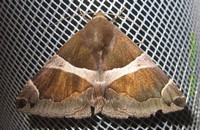
Fresh adults have brownish fuscous forewings with a purplish tinge and a whitish median band narrowed in the middle. The forewing has a black apical streak consisting of two spots, and its terminal area is violet grey.[1][2][3]
The hindwings are fuscous with a diffuse whitish median band. Their terminal area is grey at the middle.[4][5]
The wing fringe is grey and becomes whitish below the apex. The wingspan measures 40–46 mm.[6][7]
The larva is yellowish grey with a darker dorsum and fine black longitudinal lines. Its venter and feet are pale grey.[8][9]
Habitat
The species is recorded from the Palearctic region.[10]
It occurs in the southern half of Europe, parts of North Africa, and across West, Central and South Asia.[11][12][13]
Diet
Behaviour
Adult moths fly between May and August, depending on their location.[16]
Classification of the The Passenger
| Kingdom | Animalia |
|---|---|
| Phylum | Arthropoda |
| Subphylum | Hexapoda |
| Class | Insecta (Insect) |
| Order | Lepidoptera |
| Superfamily | Noctuoidea |
| Family | Erebidae (Erebid Moths) |
| Subfamily | Erebinae |
| Genus | Dysgonia (Owlet Moths) |
| Species | Dysgonia algira Linnaeus, 1767 |
Where the The Passenger is found
Checklists and occurrence records place Dysgonia algira in 34 countries. GBIF holds 19,107 georeferenced records of it.
Countries
- Albania 19
- Andorra 5
- Austria 821
- Belgium 17
- Bosnia and Herzegovina 10
- Bulgaria 194
- Croatia 151
- Cyprus 4
- Czechia 22
- Denmark 4
- Finland 6
- France 4,333
- Germany 2,183
- Greece 194
- Guernsey 3
- Hungary 700
- Italy 1,235
- Luxembourg 10
- Malta 6
- Moldova 6
- Montenegro 36
- North Macedonia 6
- Poland 3
- Portugal 2,065
- Romania 113
- Russia 66
- Serbia 321
- Slovakia 18
- Slovenia 24
- Spain 3,038
- Switzerland 3,082
- The Netherlands 65
- Ukraine 296
- United Kingdom 51
Regions and cities with the most records
- Ticino, Switzerland 1,454
- Occitanie, France 1,163
- Lugano, Switzerland 921
- Auvergne-Rhône-Alpes, France 906
- Valais, Switzerland 864
- Baden-Wurttemberg, Germany 809
- Rheinland-Pfalz, Germany 792
- Catalonia, Spain 710
- Locarno, Switzerland 701
- Provence-Alpes-Côte d'Azur, France 658
- Varese, Italy 645
- Sierre, Switzerland 622
- Sitten, Switzerland 556
- Bellinzona, Switzerland 495
- Galicia, Spain 456
- Malnate, Italy 447
- Como, Italy 429
- Paranhos, Portugal 404
- Afurada de Baixo, Portugal 400
- Lordelo do Ouro, Portugal 400
- Porto, Portugal 399
- Rio Tinto, Portugal 396
- Gondomar, Portugal 395
- Oliveira do Douro, Portugal 393
- Campanhã, Portugal 392
- Santo Ovídio, Portugal 392
- Vilar de Andorinho, Portugal 392
- Porto, Portugal 390
- Vila Nova de Gaia, Portugal 389
- Canidelo, Portugal 387
- Valadares, Portugal 387
- Valongo, Portugal 386
- São Pedro da Cova, Portugal 385
- Fânzeres, Portugal 383
- Styria, Austria 383
- Espinho, Portugal 356
15 more countries have a few records outside this range
These countries hold a few records of Dysgonia algira but lie outside the range the checklists give for it. Such records are often zoo or garden specimens, museum material or vagrants, so the species is not counted as occurring there.
A number beside a place is its count of GBIF occurrence records. A place without a number comes from a checklist alone. Records show where a species has been observed or collected, which can include escapes and vagrants.
Common names
English
- The Passenger
- Passenger
Names in 17 other languages
- Czech
- hnědopáska temnopásá
- Danish
- Algierugle
- Dutch
- Bruine prachtuil
- Finnish
- huntuyökkönen
- French
- Passagère, Passagère (La)
- German
- Brombeereule, Dunkelbraune Brombeereule
- Hungarian
- Homokórabagoly, Ibolyásbarna vándorbagoly, Ibolyásfényű vándorbagoly
- Italian
- Passeggero
- Polish
- rozdziałka algira
- Portuguese
- Borboleta-delta
- Russian
- Ленточница расписная
- Slovak
- stužkavec alžírsky
- Slovenian
- afriška sovka, klateška alžirka
- Spanish
- Pasajera
- Swedish
- ljusbandat ordensfly
- Ukrainian
- Дисгонія розмальована
- Welsh
- Teithiwr, Teithwyr
Synonyms
22 other scientific names have been used for this species and are now treated as synonyms of Dysgonia algira.
- Dysgonia albivitta Guenée, 1852
- Dysgonia algiroides Schultz, 1908
- Dysgonia defecta Stauder, 1923
- Dysgonia europa Schawerda, 1912
- Dysgonia festina Walker, 1858
- Dysgonia leptotaenia Dannehl, 1926
- Dysgonia leucotaenia Dannehl, 1926
- Dysgonia olympia Swinhoe, 1885
- Dysgonia selenitaenia Dannehl, 1926
- Dysgonia sinica Bryk, 1948
- Dysgonia triangularis Hübner
- Dysgonia triguetra Wagner
- Grammodes algira (Linnaeus, 1767)
- Noctua triangularis Hübner, 1803
- Ophiusa albivitta Guenee, 1852
- Ophiusa algira (Linnaeus, 1767)
- Paralellia algira (Linnaeus, 1767)
- Parallelia algira (Linnaeus, 1767)
- Phalaena algira Linnaeus, 1767
- Dysgonia achatina Sulzer, 1776 ambiguous synonym
- Dysgonia algirda (Pagenstecher, 1907) misapplied
- Dysgonia festiva Berio, 1965 misapplied
Related species
-
 Dysgonia stuposa
-
 JigsawDysgonia torrida
- Dysgonia rogenhoferi
- Dysgonia obscura
-
 Dysgonia latifascia
- Dysgonia dulcis
-
 Dysgonia palpalis
-
 Dysgonia mandschuriana
Compare
Questions and answers
What is the scientific name of the The Passenger?
The scientific name of the The Passenger is Dysgonia algira. Written with its author, the full name is Dysgonia algira Linnaeus, 1767.
Which family does the The Passenger belong to?
Dysgonia algira belongs to the family Erebidae, in the order Lepidoptera and the class Insecta.
Where is the The Passenger found?
Checklists and occurrence records place Dysgonia algira in 34 countries, including France, Switzerland, Spain, Germany, Portugal and Italy.
What other names does the The Passenger have?
Dysgonia algira is also known in English as Passenger.
Sources
Passages the profile rests on
- Fresh adults have brownish fuscous forewings with a purplish tinge and a whitish median band narrowed in the middle. Source passage: “Forewing brownish fuscous, with a purplish tinge when fresh; a whitish median band narrowed in middle” — English Wikipedia
- The forewing has a black apical streak consisting of two spots. Source passage: “a black apical streak of two spots” — English Wikipedia
- The forewing terminal area is violet grey. Source passage: “the terminal area violet grey” — English Wikipedia
- The hindwings are fuscous with a diffuse whitish median band. Source passage: “hindwing fuscous, with a diffuse whitish median band” — English Wikipedia
- The hindwing terminal area is grey at the middle. Source passage: “the terminal area grey at middle” — English Wikipedia
- The wing fringe is grey and becomes whitish below the apex. Source passage: “fringe grey, below apex whitish” — English Wikipedia
- The wingspan measures 40–46 mm. Source passage: “The wingspan is 40–46 mm.” — English Wikipedia
- The larva is yellowish grey with a darker dorsum and fine black longitudinal lines. Source passage: “Larva yellowish grey, darker on dorsum, with tine black longitudinal lines” — English Wikipedia
- The larval venter and feet are pale grey. Source passage: “venter and feet pale grey” — English Wikipedia
- The species is recorded from the Palearctic region. Source passage: “is found in the Palearctic” — English Wikipedia
- The species occurs in the southern half of Europe. Source passage: “from the southern half of Europe” — English Wikipedia
- The species occurs in parts of North Africa. Source passage: “and parts of North Africa” — English Wikipedia
- The species occurs across West, Central and South Asia. Source passage: “through West, Central and South Asia.” — English Wikipedia
- The larvae feed on Rubus plants. Source passage: “The larvae feed on Rubus and willow.” — English Wikipedia
- The larvae feed on willow. Source passage: “The larvae feed on Rubus and willow.” — English Wikipedia
- Adult moths fly between May and August, depending on their location. Source passage: “The moth flies from May to August depending on the location.” — English Wikipedia
Data
- Catalogue of Life, 2026-10-16 XR cc by
- Global Biodiversity Information Facility CC BY 4.0
- Wikidata CC0
- GeoNames CC BY 4.0
- Within the Catalogue of Life, this name comes from Global Lepidoptera Index cc by
References
- Linnaeus. (1767). Systema naturae per regna tria naturae, secundum classes, ordines, genera, species, cum characteribus, differentiis, synonymis, locis. 1. where the name was published
This species in other databases
Page built on 27 November 2026. See how the catalog is made and all sources and licences.
Cite this page
ScientificNames.org. (2026). Dysgonia algira (The Passenger). Retrieved November 27, 2026, from https://scientificnames.org/species/dysgonia-algira
“Dysgonia algira (The Passenger).” ScientificNames.org, 2026, scientificnames.org/species/dysgonia-algira. Accessed 27 Nov. 2026.
ScientificNames.org. “Dysgonia algira (The Passenger).” Accessed November 27, 2026. https://scientificnames.org/species/dysgonia-algira.
@misc{scientificnames_dysgonia_algira_the_passenger,
  author = {{ScientificNames.org}},
  title = {Dysgonia algira (The Passenger)},
  year = {2026},
  url = {https://scientificnames.org/species/dysgonia-algira},
  note = {Accessed 2026-11-27}
}