Species · Insects
Jigsaw Dysgonia torrida
The scientific name of the Jigsaw is Dysgonia torrida. It is a species of insect in the family Erebidae (erebid moths), order Lepidoptera. The name dates from 1852.
- Scientific name
- Dysgonia torrida (Guenée, 1852)
- Common name
- Jigsaw
- Genus
- Dysgonia
- Family
- Erebidae (Erebid Moths)
- Order
- Lepidoptera
- Class
- Insecta
- Recorded in
- 36 countries
- Name status
- accepted in the Catalogue of Life
Overview
Dysgonia torrida occurs from tropical and subtropical Africa eastward through parts of southern Europe and the Middle East to India, Sri Lanka and Myanmar. It has a red-brown body, highly variable coloration and a wingspan of 45–50 mm.
Written 27 November 2026 from the sources listed below. Each statement was checked against the passage it cites; statements that could not be supported were removed.
Appearance
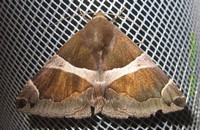
The moth has a red-brown body and highly variable coloration. Its forewing has an erect antemedial line followed by a broad, white, slightly suffused band.[1][2]
The forewing's postmedial line is angled between veins 3 and 4 and becomes sinuous toward the inner margin. The apical streak is divided into two spots.[3][4]
The hindwings have a white medial band and a greyish outer margin at the center. The species has a wingspan of 45–50 mm.[5][6]
Diet
The larvae feed on maize (Zea mays), a plant in the family Poaceae.[7]
The larvae also feed on Ricinus communis and Acalypha wilkesiana, both plants in the family Euphorbiaceae.[8][9]
Behaviour
In Europe, adult moths are active during May and June and again in September.[10]
Reproduction and life cycle
The species produces multiple generations each year.[11]
Classification of the Jigsaw
| Kingdom | Animalia |
|---|---|
| Phylum | Arthropoda |
| Subphylum | Hexapoda |
| Class | Insecta (Insect) |
| Order | Lepidoptera |
| Superfamily | Noctuoidea |
| Family | Erebidae (Erebid Moths) |
| Subfamily | Erebinae |
| Genus | Dysgonia (Owlet Moths) |
| Species | Dysgonia torrida (Guenée, 1852) |
Where the Jigsaw is found
Checklists and occurrence records place Dysgonia torrida in 36 countries. GBIF holds 1,011 georeferenced records of it.
Countries
- Albania 3
- Algeria 6
- Benin 7
- Botswana 25
- Bulgaria 7
- Cameroon 3
- Eswatini 49
- France 15
- Gambia 9
- Georgia 4
- Greece 26
- India 89
- Israel 34
- Italy 45
- Kenya 11
- Madagascar 8
- Malawi 21
- Mauritius 4
- Mayotte 6
- Montenegro 3
- Morocco 5
- Mozambique 19
- Namibia 15
- Nigeria 8
- Portugal 11
- Reunion 6
- Russia 3
- South Africa 376
- Spain 63
- Sudan 3
- Tanzania 20
- The Netherlands 6
- Turkey 14
- Uzbekistan 7
- Zambia 42
- Zimbabwe 38
Regions and cities with the most records
- Limpopo, South Africa 132
- Mpumalanga, South Africa 73
- KwaZulu-Natal, South Africa 61
- Eastern Cape, South Africa 42
- Gauteng, South Africa 34
- Mbabane, Eswatini 33
- Hhohho Region, Eswatini 32
- Karnataka, India 26
- Chisankane, Zambia 24
- Lusaka Province, Zambia 24
- Ntandabale, Zambia 24
- Scottburgh, South Africa 24
- eMuziwezinto, South Africa 24
- Bengaluru, India 22
- Madido, Zambia 21
- Grahamstown, South Africa 19
- eMkhomazi, South Africa 18
- Lusaka, Zambia 17
- Lazio, Italy 16
- Lubombo Region, Eswatini 16
- Modimolle, South Africa 16
- Or Yehuda, Israel 16
- Shoham, Israel 16
- Yehud Monosson, Israel 16
- Yehud-Monosson, Israel 16
- Yelahanka, India 16
- Be’er Ya‘aqov, Israel 15
- Ganei Tikva, Israel 15
- Giv'at Shmuel, Israel 15
- Kiryat Ono, Israel 15
- Lod, Israel 15
- Ramat HaSharon, Israel 15
- Rishon LeTsiyyon, Israel 15
- Bnei Brak, Israel 14
- Chunga, Zambia 14
- H̱olon, Israel 14
A number beside a place is its count of GBIF occurrence records. A place without a number comes from a checklist alone. Records show where a species has been observed or collected, which can include escapes and vagrants.
Common names
English
- Jigsaw
Names in 2 other languages
- French
- Fausse Passagère
- Turkish
- Yapboz Güvesi
Synonyms
One other scientific name has been used for this species and is now treated as a synonym of Dysgonia torrida.
- Ophiusa torrida Guenée, 1852
Related species
- The PassengerDysgonia algira
-
 Dysgonia stuposa
- Dysgonia rogenhoferi
- Dysgonia obscura
-
 Dysgonia latifascia
- Dysgonia dulcis
-
 Dysgonia palpalis
-
 Dysgonia mandschuriana
Compare
Questions and answers
What is the scientific name of the Jigsaw?
The scientific name of the Jigsaw is Dysgonia torrida. Written with its author, the full name is Dysgonia torrida (Guenée, 1852).
Which family does the Jigsaw belong to?
Dysgonia torrida belongs to the family Erebidae, in the order Lepidoptera and the class Insecta.
Where is the Jigsaw found?
Checklists and occurrence records place Dysgonia torrida in 36 countries, including South Africa, India, Spain, Eswatini, Italy and Zambia.
Sources
Passages the profile rests on
- The moth has a red-brown body and highly variable coloration. Source passage: “Colors highly variable. Body red-brown.” — English Wikipedia
- The forewing has an erect antemedial line followed by a broad, white, slightly suffused band. Source passage: “Antemedial line of the forewing being erect and having broad, white and slightly suffused band beyond it.” — English Wikipedia
- The forewing's postmedial line is angled between veins 3 and 4 and becomes sinuous toward the inner margin. Source passage: “Postmedial line angled also between veins 3 and 4 and sinuous towards inner margin.” — English Wikipedia
- The apical streak is divided into two spots. Source passage: “Apical streak broken up into two spots.” — English Wikipedia
- The hindwings have a white medial band and a greyish outer margin at the center. Source passage: “Hindwings with a white medial band and outer margin greyish at center.” — English Wikipedia
- The species has a wingspan of 45–50 mm. Source passage: “This species has a wingspan of 45–50 mm.” — English Wikipedia
- The larvae feed on maize (Zea mays), a plant in the family Poaceae. Source passage: “The larvae feed on Zea mays (Poaceae),” — English Wikipedia
- The larvae feed on Ricinus communis, a plant in the family Euphorbiaceae. Source passage: “Ricinus communis and Acalypha wilkesiana (Euphorbiaceae)” — English Wikipedia
- The larvae feed on Acalypha wilkesiana, a plant in the family Euphorbiaceae. Source passage: “Ricinus communis and Acalypha wilkesiana (Euphorbiaceae)” — English Wikipedia
- In Europe, adult moths are active during May and June and again in September. Source passage: “In Europe adults are on wing from May to June and September” — English Wikipedia
- The species produces multiple generations each year. Source passage: “There are multiple generations per year.” — English Wikipedia
Data
- Catalogue of Life, 2026-10-16 XR cc by
- Global Biodiversity Information Facility CC BY 4.0
- Wikidata CC0
- GeoNames CC BY 4.0
- Wikimedia Commons per image; credit shown with each image
- Within the Catalogue of Life, this name comes from Global Lepidoptera Index cc by
References
- Guenée, A. M. (1852). Histoire naturelle des Insectes. VII. Species général des Lépidoptères. Noctuélites. Tome III. https://www.biodiversitylibrary.org/page/9747241 Link where the name was published
This species in other databases
Page built on 28 November 2026. See how the catalog is made and all sources and licences.
Cite this page
ScientificNames.org. (2026). Dysgonia torrida (Jigsaw). Retrieved November 28, 2026, from https://scientificnames.org/species/dysgonia-torrida
“Dysgonia torrida (Jigsaw).” ScientificNames.org, 2026, scientificnames.org/species/dysgonia-torrida. Accessed 28 Nov. 2026.
ScientificNames.org. “Dysgonia torrida (Jigsaw).” Accessed November 28, 2026. https://scientificnames.org/species/dysgonia-torrida.
@misc{scientificnames_dysgonia_torrida_jigsaw,
  author = {{ScientificNames.org}},
  title = {Dysgonia torrida (Jigsaw)},
  year = {2026},
  url = {https://scientificnames.org/species/dysgonia-torrida},
  note = {Accessed 2026-11-28}
}