Species · Birds
Sickle-winged Nightjar Eleothreptus anomalus
The scientific name of the Sickle-winged Nightjar is Eleothreptus anomalus. It is a species of bird in the family Caprimulgidae (nightjar), order Caprimulgiformes. The name dates from 1838.
- Scientific name
- Eleothreptus anomalus (Gould, 1838)
- Common name
- Sickle-winged Nightjar
- Genus
- Eleothreptus
- Family
- Caprimulgidae (Nightjar)
- Order
- Caprimulgiformes
- Class
- Aves
- Red List category
- VU Vulnerable
- Recorded in
- 3 countries
- Name status
- accepted in the Catalogue of Life

Overview
Eleothreptus anomalus is documented in northeastern Argentina, southern Paraguay, and southern Brazil. Its primary flight feathers give its wings a distinctive hooked, sickle-like shape.
Written 26 November 2026 from the sources listed below. Each statement was checked against the passage it cites; statements that could not be supported were removed.
Appearance
The Sickle-winged Nightjar measures 18–20 cm in length. One recorded male weighed 43.7 g.[1][2]
Adult males have grayish-brown upperparts marked with dark-brown spots. Their wings are generally grayish brown with blackish-brown, cinnamon, and white markings, and the primary flight feathers produce a hooked, sickle-like shape.[3][4][5]
Adult females are browner than males and lack the modified primary flight feathers. Juveniles resemble females and have a cinnamon tinge to their upperparts.[6][7]
Habitat
The Sickle-winged Nightjar has been recorded in northeastern Argentina, southern Paraguay, and southern Brazil. It is suspected to occur in Uruguay, although no documented records from that country are available.[8][9][10]
Sightings have been reported farther north in Brazil than the documented distribution.[11]
Behaviour
The Sickle-winged Nightjar is active during twilight and at night. It captures prey by making sallies from the ground and possibly during low, continuous flight.[12][13]
Between feeding flights, individuals sit on roads and trails or perch on low branches and wire fences. Their flight consists of slow, fluttering wingbeats followed by gliding.[14][15]
The species produces repeated, very subtle chip notes. Its song has been described as a series of soft chip, tchup, or tchut notes, or as chirping sounds resembling crickets.[16][17][18]
A reported flight call is a harsh, nasal gzee-gzee sound.[19]
The species is believed to remain resident throughout most or all of its distribution. There are suggestions that individuals migrate north from Argentina after the breeding season.[20][21]
Diet
The Sickle-winged Nightjar feeds on insects, although details of its prey are unknown.[22]
Reproduction and life cycle
The breeding season appears to extend from August through November or later.[23]
The species is assumed to lay its eggs directly on the ground without constructing a nest.[24]
Conservation
The Sickle-winged Nightjar is classified as vulnerable by the IUCN. Its relatively small population is declining rapidly because of habitat loss and degradation.[25][26]
Similar species
The white-winged nightjar (Eleothreptus candicans) is the other species assigned to the genus Eleothreptus.[27]
Classification of the Sickle-winged Nightjar
| Kingdom | Animalia |
|---|---|
| Phylum | Chordata |
| Subphylum | Vertebrata |
| Infraphylum | Gnathostomata |
| Parvphylum | Osteichthyes |
| Megaclass | Tetrapoda |
| Class | Aves (Bird) |
| Order | Caprimulgiformes (Nightjar) |
| Family | Caprimulgidae (Nightjar) |
| Genus | Eleothreptus (Sickle-winged and White-winged Nightjars) |
| Species | Eleothreptus anomalus (Gould, 1838) |
Where the Sickle-winged Nightjar is found
Checklists and occurrence records place Eleothreptus anomalus in 3 countries across South America. GBIF holds 736 georeferenced records of it.
Countries
Regions and cities with the most records
- Corrientes, Argentina 197
- Minas Gerais, Brazil 139
- Ituzaingó, Argentina 135
- Paraná, Brazil 103
- Misiones Department, Paraguay 59
- Santa Catarina, Brazil 51
- Pinhais, Brazil 48
- Piraquara, Brazil 48
- São José dos Pinhais, Brazil 47
- Cruzeiro, Brazil 45
- Misiones, Argentina 45
- Guará, Brazil 43
- Núcleo Bandeirante, Brazil 43
- Recanto das Emas, Brazil 43
- Riacho Fundo, Brazil 43
- Riacho Fundo II, Brazil 43
- Águas Claras, Brazil 43
- Quatro Barras, Brazil 42
- Samambaia, Brazil 41
- Park Way, Brazil 39
- Plano Piloto, Brazil 38
- Rio Grande do Sul, Brazil 37
- Jardim Botânico, Brazil 28
- Lago Sul, Brazil 28
- São Sebastião, Brazil 28
- Cidade Ocidental, Brazil 25
- Santa Maria, Brazil 25
- Valparaíso de Goiás, Brazil 25
- Campina Grande do Sul, Brazil 24
- Curitiba, Brazil 24
- Gama, Brazil 24
- Novo Gama, Brazil 24
- Colombo, Brazil 22
- Brasília, Brazil 21
- Viamão, Brazil 21
- Setor Complementar de Indústria e Abastecimento, Brazil 19
Range as the checklists state it
South America
A number beside a place is its count of GBIF occurrence records. A place without a number comes from a checklist alone. Records show where a species has been observed or collected, which can include escapes and vagrants.
Common names
English
- Sickle-winged Nightjar
Names in 26 other languages
- Catalan
- enganyapastors d'ales romes
- Chinese
- 鐮翅夜鷹, 镰翅夜鹰
- Croatian
- kratkorepi leganj
- Czech
- lelek srpkokřídlý
- Danish
- Seglvinge
- Dutch
- Sikkelvleugelnachtzwaluw
- Esperanto
- falĉilflugila kaprimulgo
- Estonian
- kooldtiib-öösorr
- Finnish
- sirppikehrääjä
- French
- Engoulevent à faucilles
- German
- Sichelschwingen-Nachtschwalbe
- Hungarian
- sarlósszárnyú lappantyú
- Italian
- Succiacapre alifalcate
- Japanese
- カマバネヨタカ
- Lithuanian
- plačiasparnis lėlys
- Norwegian
- stumpnattravn
- Polish
- lelkowiec sierposkrzydły
- Portuguese
- curiango-do-banhado, noitibó-do-paraná
- Russian
- Серпокрылый козодой
- Serbian
- Srpokrili leganj
- Slovak
- lelek krátkochvostý
- Spanish
- Atajacaminos ala negra, Chotacabras pantanero
- Swedish
- lievingad nattskärra
- Turkish
- Orak Kanatlı Çobanaldatan
- Ukrainian
- дрімлюга-короткохвіст
- Welsh
- troellwr adeingrymanog
Synonyms
2 other scientific names have been used for this species and are now treated as synonyms of Eleothreptus anomalus.
- Amblypterus anomalus Gould, 1838
- Hydropsalis anomala Gould, J, 1838
Related species
-
 White-winged NightjarEleothreptus candicans
-
 Pennant-winged NightjarCaprimulgus vexillarius
-
 Great Eared NightjarLyncornis macrotis
-
 Eastern Whip-poor-willAntrostomus vociferus
-
 European NightjarCaprimulgus europaeus
-
 Common NighthawkChordeiles minor
-
 Standard-winged NightjarCaprimulgus longipennis
-
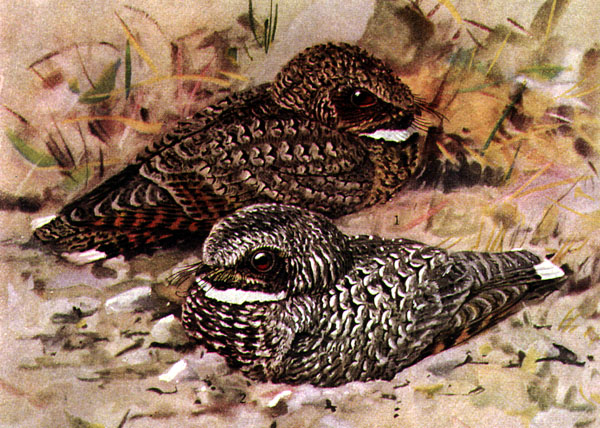 Common PoorwillPhalaenoptilus nuttallii
Compare
Questions and answers
What is the scientific name of the Sickle-winged Nightjar?
The scientific name of the Sickle-winged Nightjar is Eleothreptus anomalus. Written with its author, the full name is Eleothreptus anomalus (Gould, 1838).
Which family does the Sickle-winged Nightjar belong to?
Eleothreptus anomalus belongs to the family Caprimulgidae, in the order Caprimulgiformes and the class Aves.
Where is the Sickle-winged Nightjar found?
Checklists and occurrence records place Eleothreptus anomalus in 3 countries: Brazil, Argentina and Paraguay.
What is the conservation status of the Sickle-winged Nightjar?
The IUCN Red List category recorded for Eleothreptus anomalus is Vulnerable (VU).
Where do nightjar birds live?
The Sickle-winged Nightjar is documented in northeastern Argentina, southern Paraguay, and southern Brazil. It is suspected to occur in Uruguay, and sightings have been reported farther north in Brazil.[8][9][11]
What is a nightjar diet?
The Sickle-winged Nightjar feeds on insects, although details of its prey are unknown.[22]
What are the different species of nightjars?
The white-winged nightjar (Eleothreptus candicans) is the other species assigned to the genus Eleothreptus.[27]
Sources
Passages the profile rests on
- The species measures 18–20 cm in length. Source passage: “The sickle-winged nightjar is 18 to 20 cm (7.1 to 7.9 in) long” — English Wikipedia
- One recorded male weighed 43.7 g. Source passage: “one male weighed 43.7 g (1.5 oz).” — English Wikipedia
- Adult males have grayish-brown upperparts marked with dark-brown spots. Source passage: “The adult male's upperparts are grayish brown spotted with dark shades of brown.” — English Wikipedia
- The primary flight feathers give the species' wings a hooked, sickle-like shape. Source passage: “The wings have a hooked "sickle" appearance due to the shape of the primary flight feathers.” — English Wikipedia
- The wings are generally grayish brown with blackish-brown, cinnamon, and white markings. Source passage: “They are generally grayish brown, with blackish brown, cinnamon, and white markings.” — English Wikipedia
- Adult females are browner than males and lack the modified primary flight feathers. Source passage: “The adult female is browner than the male and does not have the modified primaries.” — English Wikipedia
- Juveniles resemble females and have a cinnamon tinge to their upperparts. Source passage: “Juveniles are similar to the female, with a cinnamon tinge to the upperparts.” — English Wikipedia
- The species is documented in northeastern Argentina, southern Paraguay, and southern Brazil. Source passage: “It is documented in northeastern Argentina, southern Paraguay, and southern Brazil.” — English Wikipedia
- The species is suspected to occur in Uruguay, although no documented records from that country are available. Source passage: “It is suspected to also inhabit Uruguay but there are no documented records there” — English Wikipedia
- The species has been recorded in northeastern Argentina, southern Paraguay, and southern Brazil. Source passage: “It is documented in northeastern Argentina, southern Paraguay, and southern Brazil.” — English Wikipedia
- Sightings have been reported farther north in Brazil than the documented distribution. Source passage: “there are sight records from further north in Brazil than the documented range.” — English Wikipedia
- The species is active during twilight and at night. Source passage: “The sickle-winged nightjar is crepuscular and nocturnal.” — English Wikipedia
- The species captures prey by making sallies from the ground and possibly during low, continuous flight. Source passage: “It forages by sallying from the ground and possibly during low continuous flight.” — English Wikipedia
- Between feeding flights, individuals sit on roads and trails or perch on low branches and wire fences. Source passage: “Between sallies it sits on roads and trails or perches on low branches or wire fence.” — English Wikipedia
- Its flight consists of slow, fluttering wingbeats followed by gliding. Source passage: “It flies " with slow, fluttering flaps and glides".” — English Wikipedia
- The species produces repeated, very subtle chip notes. Source passage: “The call is a repetition of very subtle “chip” notes.” — ebird.org
- One reported description of its song is a series of soft chip, tchup, or tchut notes. Source passage: “a series of soft chip, tchup, or tchut notes” — English Wikipedia
- Another reported song description consists of chirping sounds resembling crickets. Source passage: “some chirping, cricket-like sounds” — English Wikipedia
- A reported flight call is a harsh, nasal gzee-gzee sound. Source passage: “a harsh, nasal gzee gzee” — English Wikipedia
- The species is believed to remain resident throughout most or all of its distribution. Source passage: “It is believed to be resident in most or all of its range” — English Wikipedia
- There are suggestions that individuals migrate north from Argentina after the breeding season. Source passage: “there are suggestions that it migrates north from Argentina following the breeding season.” — English Wikipedia
- The species feeds on insects, although details of its prey are unknown. Source passage: “Its prey is insects though the details are unknown.” — English Wikipedia
- The breeding season appears to extend from August through November or later. Source passage: “The sickle-winged nightjar's breeding season appears to span from August to November or later” — English Wikipedia
- The species is assumed to lay its eggs directly on the ground without constructing a nest. Source passage: “It is assumed to lay its eggs on the ground without a nest like other nightjars.” — English Wikipedia
- The species is classified as vulnerable by the IUCN. Source passage: “The IUCN has assessed the sickle-winged nightjar as being vulnerable.” — English Wikipedia
- The species has a relatively small population that is declining rapidly because of habitat loss and degradation. Source passage: “Its fairly small population is rapidly declining due to habitat loss and degradation.” — English Wikipedia
- The white-winged nightjar (Eleothreptus candicans) is the other species assigned to the genus Eleothreptus. Source passage: “which it shares with the white-winged nightjar (E. candicans).” — English Wikipedia
Data
- Catalogue of Life, 2026-10-16 XR cc by
- Global Biodiversity Information Facility CC BY 4.0
- Wikidata CC0
- GeoNames CC BY 4.0
- Wikimedia Commons per image; credit shown with each image
- Within the Catalogue of Life, this name comes from The Integrated Taxonomic Information System cc0
References
- Gill, Frank, & and Minturn Wright. (2006). Birds of the World: Recommended English Names.
This species in other databases
Page built on 27 November 2026. See how the catalog is made and all sources and licences.
Cite this page
ScientificNames.org. (2026). Eleothreptus anomalus (Sickle-winged Nightjar). Retrieved November 27, 2026, from https://scientificnames.org/species/eleothreptus-anomalus
“Eleothreptus anomalus (Sickle-winged Nightjar).” ScientificNames.org, 2026, scientificnames.org/species/eleothreptus-anomalus. Accessed 27 Nov. 2026.
ScientificNames.org. “Eleothreptus anomalus (Sickle-winged Nightjar).” Accessed November 27, 2026. https://scientificnames.org/species/eleothreptus-anomalus.
@misc{scientificnames_eleothreptus_anomalus_sickle_winged_nightjar,
  author = {{ScientificNames.org}},
  title = {Eleothreptus anomalus (Sickle-winged Nightjar)},
  year = {2026},
  url = {https://scientificnames.org/species/eleothreptus-anomalus},
  note = {Accessed 2026-11-27}
}