Species · Mammals
Short-snouted Sengi Elephantulus brachyrhynchus
The scientific name of the Short-snouted Sengi is Elephantulus brachyrhynchus. It is a species of mammal in the family Macroscelididae (sengi), order Macroscelidea. The name dates from 1836.
- Scientific name
- Elephantulus brachyrhynchus (A. Smith, 1836)
- Common name
- Short-snouted Sengi
- Genus
- Elephantulus
- Family
- Macroscelididae (Sengi)
- Order
- Macroscelidea
- Class
- Mammalia
- Red List category
- LC Least Concern
- Recorded in
- 11 countries
- Name status
- accepted in the Catalogue of Life

Overview
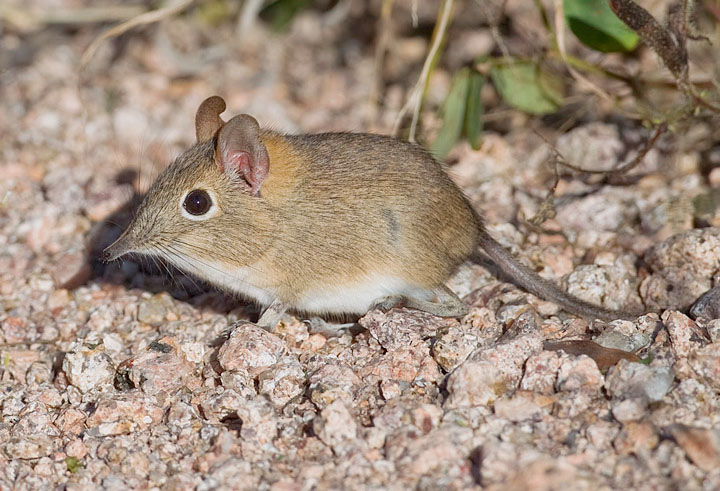
Elephantulus brachyrhynchus occurs across southern and eastern Africa, from northern South Africa and northeastern Namibia northward to the Democratic Republic of Congo. It has a relatively short, slightly tapered snout, variable brown-toned fur and pale rings around its eyes.
Written 26 November 2026 from the sources listed below. Each statement was checked against the passage it cites; statements that could not be supported were removed.
Appearance
The Short-snouted Sengi has a long, narrow snout that is shorter and slightly tapered compared with those of other elephant shrews. Its soft fur varies in brown shades and includes pale rings around the eyes and upper lip.[1][2][3]
Fur color varies geographically from reddish-yellow to yellowish-brown or grey. Individuals have brownish-yellow patches behind their ears and a faint white ring around their eyes.[4][5][6]
The average total length from head to tail is approximately 21 cm, and adults weigh approximately 40–60 g. Its tail is approximately as long as its body, and its hind feet have hairless soles.[3][7][8][9]
Habitat
The Short-snouted Sengi inhabits arid and semi-arid environments. It prefers wooded bushlands and densely covered areas, including dense grasslands and scrub.[10][11]
Its natural habitats include dry savanna and subtropical or tropical dry lowland grassland.[12]
Diet
The Short-snouted Sengi is primarily insectivorous and feeds mainly on ants and termites. Its insect diet also includes grasshoppers and crickets.[13][14]
When necessary, it supplements its insect diet with green plant material, fruits and seeds.[15]
Behaviour
The Short-snouted Sengi is diurnal and is most active during the morning. Individuals are primarily solitary but are sometimes observed in pairs.[16][17]
It moves rapidly between locations and avoids areas without protective cover. The species is highly territorial.[18][19]
Individuals sometimes excavate their own burrows but frequently occupy burrows previously made by rodents. They use rapid hind-foot tapping, known as footdrumming, in response to stressful situations and mating-related circumstances.[20][21]
Footdrumming displays regular and irregular drum patterns. Individuals communicate through chemical and tactile signals and mark their trails using scent glands located behind their ears.[22][23][24]
Reproduction and life cycle
The Short-snouted Sengi forms monogamous mating relationships. Reproduction occurs throughout the year, although conception rates decrease during cooler periods.[25][26]
Females can produce between five and six litters annually. Gestation lasts approximately 57–65 days, and litters average two offspring.[27][28][29]
Newborns weigh approximately 10 g. Young reach adult size approximately 50 days after birth.[30][31]
Conservation
The Short-snouted Sengi is classified as Least Concern by the IUCN. Potential future threats include woody plant encroachment and desertification.[32][33]
Classification of the Short-snouted Sengi
| Kingdom | Animalia |
|---|---|
| Phylum | Chordata |
| Subphylum | Vertebrata |
| Infraphylum | Gnathostomata |
| Parvphylum | Osteichthyes |
| Megaclass | Tetrapoda |
| Class | Mammalia (Mammal) |
| Subclass | Theria |
| Infraclass | Eutheria |
| Order | Macroscelidea (Sengi) |
| Family | Macroscelididae (Sengi) |
| Subfamily | Macroscelidinae (Soft-furred Sengis) |
| Genus | Elephantulus (Long-eared Elephant Shrews) |
| Species | Elephantulus brachyrhynchus (A. Smith, 1836) |
Where the Short-snouted Sengi is found
Checklists and occurrence records place Elephantulus brachyrhynchus in 11 countries across Africa. GBIF holds 871 georeferenced records of it.
Countries
- Angola 226
- Botswana 71
- Democratic Republic of the Congo 164
- Kenya 73
- Malawi 32
- Mozambique 38
- Namibia 30
- South Africa 46
- Tanzania 4
- Zambia 112
- Zimbabwe 75
Regions and cities with the most records
- North-Western, Zambia 76
- Zambezi, Zambia 75
- Limpopo, South Africa 35
- Tete, Mozambique 23
- Kweneng, Botswana 19
- North-West, Botswana 17
- Gabane, Botswana 13
- Gaborone, Botswana 13
- Mmopone, Botswana 13
- Mogoditshane, Botswana 13
- Nakuru County, Kenya 9
- Mashonaland West, Zimbabwe 8
- Kananga, Democratic Republic of the Congo 7
- Kasai-Central, Democratic Republic of the Congo 7
- Otjozondjupa Region, Namibia 7
- Central Province, Zambia 6
- Chobe, Botswana 6
- Gilgil, Kenya 6
- Janeng, Botswana 6
- Molepolole, Botswana 6
- Zambezi Region, Namibia 6
- Benguela, Angola 5
- Norton, Zimbabwe 5
- Chitipa, Malawi 4
- Haut-Katanga, Democratic Republic of the Congo 4
- Haut-Lomami, Democratic Republic of the Congo 4
- Huíla, Angola 4
- Masvingo Province, Zimbabwe 4
- Sofala, Mozambique 4
- Bíe, Angola 3
- Kiambu County, Kenya 3
- Maai Mahiu, Kenya 3
- Mai, Kenya 3
- Matabeleland South Province, Zimbabwe 3
- Mpumalanga, South Africa 3
- Naivasha, Kenya 3
Range as the checklists state it
Africa
A number beside a place is its count of GBIF occurrence records. A place without a number comes from a checklist alone. Records show where a species has been observed or collected, which can include escapes and vagrants.
Common names
English
- Short-snouted Sengi
- Short-snouted Elephant Shrew
- Short-snouted Elephant-shrew
Names in 17 other languages
- Afrikaans
- Kortneus Klaasneus
- Azerbaijani
- qısaburun atlanqaç
- Catalan
- musaranya elefant de musell curt
- Czech
- bércoun krátkonosý
- Dutch
- Kortneusolifantspitsmuis
- Finnish
- lyhytkärsäkuonokas
- French
- macroscélide à nez court
- German
- Kurznasen-Elefantenspitzmaus, Kurznasen-Rüsselspringer, Kurzrüssel-Elefantenspitzmaus
- Greek
- Κοντόρυγχο Ελεφαντομέγαιρο
- Japanese
- コバナハネジネズミ
- Maltese
- senġi ta' wiċċu qasir
- Norwegian Bokmål
- Kortsnutesengi, Kortsnutet Elefantspissmus
- Polish
- ryjoskoczek krótkonosy
- Russian
- Коротконосый прыгунчик
- Spanish
- Sengi Hociquicorto, musaraña elefante de hocico corto
- Swedish
- kortnosad elefantnäbbmus
- hts
- suntsa.ko [ID uncertain]
Synonyms
One other scientific name has been used for this species and is now treated as a synonym of Elephantulus brachyrhynchus.
- Macroscelides brachyrhynchus A. Smith, 1836
Related species
-
 Eastern Rock SengiElephantulus myurus
-
 Cape Rock SengiElephantulus edwardii
-
 Bushveld SengiElephantulus intufi
-
 Karoo Rock SengiElephantulus pilicaudus
-
 Western Rock SengiElephantulus rupestris
-
 Dusky SengiElephantulus fuscus
- Dusky-footed SengiElephantulus fuscipes
-
 Black and Rufous SengiRhynchocyon petersi
Compare
Questions and answers
What is the scientific name of the Short-snouted Sengi?
The scientific name of the Short-snouted Sengi is Elephantulus brachyrhynchus. Written with its author, the full name is Elephantulus brachyrhynchus (A. Smith, 1836).
Which family does the Short-snouted Sengi belong to?
Elephantulus brachyrhynchus belongs to the family Macroscelididae, in the order Macroscelidea and the class Mammalia.
Where is the Short-snouted Sengi found?
Checklists and occurrence records place Elephantulus brachyrhynchus in 11 countries, including Angola, Democratic Republic of the Congo, Zambia, Zimbabwe, Kenya and Botswana.
What is the conservation status of the Short-snouted Sengi?
The IUCN Red List category recorded for Elephantulus brachyrhynchus is Least Concern (LC).
What other names does the Short-snouted Sengi have?
Elephantulus brachyrhynchus is also known in English as Short-snouted Elephant Shrew and Short-snouted Elephant-shrew.
What habitat do elephant shrews live in?
The Short-snouted Sengi inhabits arid and semi-arid environments, including wooded bushlands, dense grasslands, scrub, dry savanna and subtropical or tropical dry lowland grassland.[10][11][12]
Sources
Passages the profile rests on
- The species has a long, narrow snout that is shorter and slightly tapered compared with those of other elephant shrews. Source passage: “While they have the long, narrow snout symbolic of sengis, their snouts are shorter than the snouts of other species and a bit tapered.” — English Wikipedia
- Its body fur varies in brown shades and includes pale rings around the eyes and upper lip. Source passage: “They have varied brown body fur with white, buffy or off-white rings around the eyes and upper lip.” — English Wikipedia
- The species has soft fur and hairless soles on its hind feet. Source passage: “Short-snouted elephant shrews have soft fur and lack hair on the soles of their hind feet (Smithers, 1983).” — animaldiversity.org
- The species has brownish-yellow patches behind its ears. Source passage: “They have brownish-yellow patches behind the ears.” — English Wikipedia
- Its fur color varies geographically from reddish-yellow to yellowish-brown or grey. Source passage: “Short-snouted elephant shrews vary in color depending on geographic location. They range from reddish-yellow to yellowish-brown or grey.” — animaldiversity.org
- Individuals have a faint white ring around their eyes. Source passage: “All short-snouted elephant shrews have a faint white ring around the eyes.” — animaldiversity.org
- The average total length from head to tail is approximately 21 cm. Source passage: “Short-snouted sengis have an average length of 21 cm (8.3 in) from head to tail” — English Wikipedia
- Adults weigh approximately 40–60 g. Source passage: “weigh 1.41–2.11 oz (40–60 g) on average.” — English Wikipedia
- Its tail is approximately as long as its body. Source passage: “Average body length is 21 cm and tail length is approximately the same.” — animaldiversity.org
- The species inhabits arid and semi-arid environments. Source passage: “Short-snouted elephant shrews are found in arid and semi-arid environments.” — animaldiversity.org
- It prefers wooded bushlands and densely covered areas, including dense grasslands and scrub. Source passage: “They prefer wooded bushlands and densely covered areas such as dense grasslands and scrub (Smithers, 1983).” — animaldiversity.org
- Its natural habitats include dry savanna and subtropical or tropical dry lowland grassland. Source passage: “Its natural habitats are dry savanna and subtropical or tropical dry lowland grassland.” — English Wikipedia
- The species is primarily insectivorous and feeds mainly on ants and termites. Source passage: “The short-snouted elephant shrew is primarily insectivorous, eating ants and termites (Smithers, 1983).” — animaldiversity.org
- Its primary insect diet also includes grasshoppers and crickets. Source passage: “Their primary diet consists of ants, termites, grasshoppers and crickets.” — English Wikipedia
- When necessary, it supplements its insect diet with green plant material, fruits and seeds. Source passage: “They are, however, opportunistic feeders and eat small amounts of green plant material, fruits, and seeds (Leirs et al., 1995).” — animaldiversity.org
- The species is diurnal and is most active during the morning. Source passage: “Short-snouted elephant shrews are diurnal and most active during the morning.” — animaldiversity.org
- Individuals are primarily solitary but are sometimes observed in pairs. Source passage: “They are primarily solitary but sometimes are observed in pairs.” — animaldiversity.org
- It moves rapidly between locations and avoids areas without protective cover. Source passage: “They are a fast-moving species, like most elephant shrews, and are observed scurrying from place to place, avoiding areas with no cover (Smithers, 1983).” — animaldiversity.org
- The species is highly territorial. Source passage: “Short-snouted elephant shrews are highly territorial.” — animaldiversity.org
- Individuals sometimes excavate their own burrows but frequently occupy burrows previously made by rodents. Source passage: “Short-snouted elephant shrews sometimes dig their own burrow but often they occupy rodent burrows (Nowak, 1991).” — animaldiversity.org
- The species uses rapid hind-foot tapping, known as footdrumming, in response to stressful situations and mating-related circumstances. Source passage: “This activity is called footdruming and is often a response to a stressful situation, such as encounters with a predator, or associated with mating.” — animaldiversity.org
- Its footdrumming displays regular and irregular drum patterns. Source passage: “Short-snouted elephant shrews have a regular and irregular "drum" pattern (Faurie et al.,1996).” — animaldiversity.org
- Individuals communicate through chemical and tactile signals. Source passage: “Short-snouted sengis communicated through chemical and tactile means.” — English Wikipedia
- Individuals mark their trails using scent glands located behind their ears. Source passage: “Each short-snouted sengi marks its trails with scent glands located behind its ears.” — English Wikipedia
- The species forms monogamous mating relationships. Source passage: “Short-snouted elephant shrews are monogamous.” — animaldiversity.org
- Reproduction occurs throughout the year, although conception rates decrease during cooler periods. Source passage: “Reproduction occurs throughout the year although conceptions decrease during cool periods.” — animaldiversity.org
- Females can produce between five and six litters annually. Source passage: “Females are able to produce between 5 and 6 litters a year, resulting in an average of 8 young per year (Neal, 1995).” — animaldiversity.org
- Gestation lasts approximately 57–65 days. Source passage: “The gestation period is between 57 and 65 days.” — animaldiversity.org
- Litters average two offspring. Source passage: “On average, two young are produced per litter and are precocial, which means they are fully haired and are born with their eyes open (Smithers, 1983).” — animaldiversity.org
- Newborns weigh approximately 10 g. Source passage: “Young weigh approximately 10g at birth and reach adult size by 50 days (Nowak, 1991).” — animaldiversity.org
- Young reach adult size approximately 50 days after birth. Source passage: “Young weigh approximately 10g at birth and reach adult size by 50 days (Nowak, 1991).” — animaldiversity.org
- The species is classified as Least Concern by the IUCN. Source passage: “The short-snouted sengi is listed as of least concern by the IUCN” — English Wikipedia
- Potential future threats include woody plant encroachment and desertification. Source passage: “possible future threats to the short-snouted sengis include woody plant encroachment and desertification.” — English Wikipedia
Data
- Catalogue of Life, 2026-10-16 XR cc by
- Global Biodiversity Information Facility CC BY 4.0
- Wikidata CC0
- GeoNames CC BY 4.0
- Wikimedia Commons per image; credit shown with each image
- Within the Catalogue of Life, this name comes from The Integrated Taxonomic Information System cc0
References
- Rept. Exped. Exploring Central Africa vol.1834 p.42 where the name was published
- Wilson, Don E., and DeeAnn M. Reeder, eds. (1993). Mammal Species of the World: A Taxonomic and Geographic Reference, 2nd Ed., 3rd Printing.
- Wilson, Don E., and F. Russell Cole. (2000). Common Names of Mammals of the World.
- Wilson, Don E., and DeeAnn M. Reeder, eds. (2005). Mammal Species of the World: A Taxonomic and Geographic Reference, 3rd Ed., Vols. 1 & 2.
- Heritage, S. / Don E. Wilson and Russell A. Mittermeier, eds. (2018). Family Macroscelididae (Sengis). Handbook of the Mammals of the World. Vol. 8: Insectivores, Sloths and Colugos.
This species in other databases
Page built on 27 November 2026. See how the catalog is made and all sources and licences.
Cite this page
ScientificNames.org. (2026). Elephantulus brachyrhynchus (Short-snouted Sengi). Retrieved November 27, 2026, from https://scientificnames.org/species/elephantulus-brachyrhynchus
“Elephantulus brachyrhynchus (Short-snouted Sengi).” ScientificNames.org, 2026, scientificnames.org/species/elephantulus-brachyrhynchus. Accessed 27 Nov. 2026.
ScientificNames.org. “Elephantulus brachyrhynchus (Short-snouted Sengi).” Accessed November 27, 2026. https://scientificnames.org/species/elephantulus-brachyrhynchus.
@misc{scientificnames_elephantulus_brachyrhynchus_short_snouted_sengi,
  author = {{ScientificNames.org}},
  title = {Elephantulus brachyrhynchus (Short-snouted Sengi)},
  year = {2026},
  url = {https://scientificnames.org/species/elephantulus-brachyrhynchus},
  note = {Accessed 2026-11-27}
}