Species · Amphibians
Cuban Dwarf Grassfrog Eleutherodactylus adelus
The scientific name of the Cuban Dwarf Grassfrog is Eleutherodactylus adelus. It is a species of amphibian in the family Eleutherodactylidae (rain frogs), order Anura. The name dates from 2003.
- Scientific name
- Eleutherodactylus adelus Díaz, Cádiz & Hedges, 2003
- Common name
- Cuban Dwarf Grassfrog
- Genus
- Eleutherodactylus
- Family
- Eleutherodactylidae (Rain Frogs)
- Order
- Anura
- Class
- Amphibia
- Red List category
- EN Endangered
- Recorded in
- 1 country
- Name status
- accepted in the Catalogue of Life
Overview
Eleutherodactylus adelus inhabits Pinus tropicalis pine forests in Pinar del Río Province, western Cuba. It has a beige or greenish belly, limbs with brown stripes, and reddish-brown forearms.
Written 27 November 2026 from the sources listed below. Each statement was checked against the passage it cites; statements that could not be supported were removed.
Appearance
The Cuban Dwarf Grassfrog has a beige or greenish belly. Its limbs bear light to medium-dark brown stripes, and its forearms are reddish-brown.[1][2][3]
The species is fairly small relative to other frogs in its genus.[4]
Habitat
The Cuban Dwarf Grassfrog inhabits Pinus tropicalis pine forests in Pinar del Río Province, western Cuba. Its natural habitat is subtropical or tropical moist habitat.[5][6]
Individuals are commonly found concealed in leaf litter and ground vegetation. The species has not been observed outside forested areas.[7][8]
The species is endemic to western Cuba and is recorded from three localities in the municipalities of San Juan y Martínez, Viñales, and Pinar del Río. It occurs at elevations between 130 and 220 metres.[9][10][11]
Its estimated extent of occurrence is 407 square kilometres. The locality of El Moncada in Viñales lies approximately 22 kilometres east of Loma del Espejo.[12][13]
Behaviour
Males produce vocalizations from beneath grass and leaf litter on the ground. They vocalize during both daytime and nighttime, with activity especially pronounced after rainfall.[14][15][16]
Male calls consist of three to six chirped notes. Individual notes last between 9.1 and 14.2 milliseconds, and complete vocalizations last between 236 and 682 milliseconds.[17][18][19]
Longer calls are preceded by simpler calls containing one or two notes. Males produce between 20.6 and 65.2 calls per minute.[20][21]
The frog stops vocalizing when approached by humans.[22]
Reproduction and life cycle
Clutches contain three or four eggs and are deposited on the ground. The eggs undergo direct development.[23][24][25]
Conservation
The Cuban Dwarf Grassfrog is classified as Endangered by the IUCN. Its restricted geographic range contributes to its endangered status.[26][27]
Habitat degradation caused by logging and wildfires threatens the species. Logging and pig farming are also identified as threats through habitat loss.[28][29]
The species is not recorded from any demarcated protected area in Cuba. The Cuban Red Book of Vertebrates classifies it as Vulnerable D2.[30][31]
The species can be relatively common in certain localities despite being difficult to find.[32]
Similar species
Eleutherodactylus varleyi was proposed as a close relative of the Cuban Dwarf Grassfrog in its original taxonomic placement. A 2011 mitochondrial DNA study identified Eleutherodactylus pezopetrus as its closest relative.[33][34]
Classification of the Cuban Dwarf Grassfrog
| Kingdom | Animalia |
|---|---|
| Phylum | Chordata |
| Subphylum | Vertebrata |
| Infraphylum | Gnathostomata |
| Parvphylum | Osteichthyes |
| Megaclass | Tetrapoda |
| Class | Amphibia (Amphibians) |
| Order | Anura (Frogs) |
| Superfamily | Brachycephaloidea |
| Family | Eleutherodactylidae (Rain Frogs) |
| Subfamily | Eleutherodactylinae |
| Genus | Eleutherodactylus (Coquis) |
| Species | Eleutherodactylus adelus Díaz, Cádiz & Hedges, 2003 |
Where the Cuban Dwarf Grassfrog is found
Checklists and occurrence records place Eleutherodactylus adelus in 1 country. GBIF holds 4 georeferenced records of it.
Countries
A number beside a place is its count of GBIF occurrence records. A place without a number comes from a checklist alone. Records show where a species has been observed or collected, which can include escapes and vagrants.
Common names
English
- Cuban Dwarf Grassfrog
- Robber Frog
Synonyms
One other scientific name has been used for this species and is now treated as a synonym of Eleutherodactylus adelus.
- Euhyas adela (Díaz, Cádiz & Hedges, 2003)
Related species
-
 Common CoquíEleutherodactylus coqui
-
 Greenhouse FrogEleutherodactylus planirostris
-
 Antilles CoquíEleutherodactylus johnstonei
-
 Puerto Rican Rock FrogEleutherodactylus cooki
-
 Rio Grande Chirping FrogEleutherodactylus cystignathoides
-
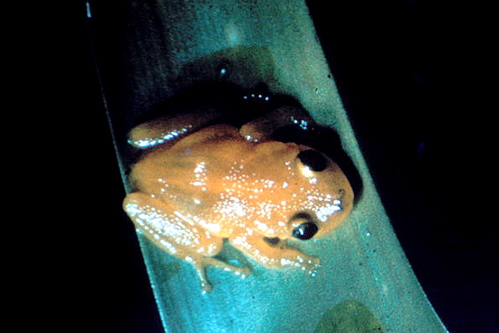 Golden CoquíEleutherodactylus jasperi
-
 Puerto Rican Wetland FrogEleutherodactylus juanariveroi
-
 Whistling CoquíEleutherodactylus cochranae
Compare
Questions and answers
What is the scientific name of the Cuban Dwarf Grassfrog?
The scientific name of the Cuban Dwarf Grassfrog is Eleutherodactylus adelus. Written with its author, the full name is Eleutherodactylus adelus Díaz, Cádiz & Hedges, 2003.
Which family does the Cuban Dwarf Grassfrog belong to?
Eleutherodactylus adelus belongs to the family Eleutherodactylidae, in the order Anura and the class Amphibia.
Where is the Cuban Dwarf Grassfrog found?
Checklists and occurrence records place Eleutherodactylus adelus in 1 country: Cuba.
What is the conservation status of the Cuban Dwarf Grassfrog?
The IUCN Red List category recorded for Eleutherodactylus adelus is Endangered (EN).
What other names does the Cuban Dwarf Grassfrog have?
Eleutherodactylus adelus is also known in English as Robber Frog.
Sources
Passages the profile rests on
- The frog has a beige or greenish belly. Source passage: “The belly is beige or greenish.” — English Wikipedia
- Its limbs bear light to medium-dark brown stripes. Source passage: “The limbs have light to medium-dark brown stripes.” — English Wikipedia
- Its forearms are reddish-brown. Source passage: “The forearms are reddish-brown.” — English Wikipedia
- The species is fairly small relative to other frogs in its genus. Source passage: “It is a fairly small frog for its genus.” — English Wikipedia
- The species inhabits Pinus tropicalis pine forests in Pinar del Río Province, western Cuba. Source passage: “where it inhabits Pinus tropicalis pine forests in the Pinar del Río Province.” — English Wikipedia
- Its natural habitat is subtropical or tropical moist habitat. Source passage: “Its natural habitat is subtropical or tropical moist ...” — inaturalist.org
- Individuals are commonly found concealed in leaf litter and ground vegetation. Source passage: “It is usually seen hidden in leaf litter and ground vegetation.” — English Wikipedia
- The species has not been observed outside forested areas. Source passage: “has never been seen outside forested areas.” — English Wikipedia
- The species is endemic to western Cuba. Source passage: “Eleutherodactylus adelus is endemic to western Cuba” — English Wikipedia
- The species is recorded from three localities in the municipalities of San Juan y Martínez, Viñales, and Pinar del Río. Source passage: “It is known from three localities in the municipalities of San Juan y Martínez, Viñales, and Pinar del Río” — English Wikipedia
- The species occurs at elevations between 130 and 220 metres. Source passage: “It is known from elevations of 130–220 m (430–720 ft).” — English Wikipedia
- The species has an estimated extent of occurrence of 407 square kilometres. Source passage: “leading to an estimated extent of occurrence of 407 km2.” — English Wikipedia
- The locality of El Moncada in Viñales lies approximately 22 kilometres east of Loma del Espejo. Source passage: “roughly 22 km (14 mi) east of Loma del Espejo.” — English Wikipedia
- Males produce vocalizations from beneath grass and leaf litter on the ground. Source passage: “Males vocalize from under grass and leaf litter on the ground” — English Wikipedia
- Males vocalize during both daytime and nighttime. Source passage: “both diurnally and nocturnally” — English Wikipedia
- Male vocal activity is especially pronounced after rainfall. Source passage: “especially after rain” — English Wikipedia
- Male calls consist of three to six chirped notes. Source passage: “Vocalizations consist of three to six chirped notes” — English Wikipedia
- Individual chirped notes last between 9.1 and 14.2 milliseconds. Source passage: “each of which lasts 9.1–14.2 milliseconds.” — English Wikipedia
- The complete vocalization lasts between 236 and 682 milliseconds. Source passage: “The total length of the call is 236–682 milliseconds.” — English Wikipedia
- Longer calls are preceded by simpler calls containing one or two notes. Source passage: “The broadcast of these longer calls is preceded by simpler, one or two note long calls.” — English Wikipedia
- Males produce between 20.6 and 65.2 calls per minute. Source passage: “making anywhere from 20.6 to 65.2 calls each minute.” — English Wikipedia
- The frog stops vocalizing when approached by humans. Source passage: “ceasing vocalizations upon being approached by humans.” — English Wikipedia
- Clutches contain three or four eggs. Source passage: “Clutches have three or four eggs” — English Wikipedia
- The eggs undergo direct development. Source passage: “which undergo direct development.” — English Wikipedia
- Egg clutches are deposited on the ground. Source passage: “These clutches are laid on the ground.” — English Wikipedia
- The species is classified as Endangered by the IUCN. Source passage: “It is classified as being endangered by the IUCN” — English Wikipedia
- The species' restricted geographic range contributes to its endangered status. Source passage: “due to its circumscribed range” — English Wikipedia
- Habitat degradation caused by logging and wildfires threatens the species. Source passage: “which is suffering from ongoing habitat degradation due to logging and wildfires.” — English Wikipedia
- Logging and pig farming are identified as threats to the species through habitat loss. Source passage: “making it vulnerable to habitat loss due to logging and pig farming.” — English Wikipedia
- The species is not recorded from any demarcated protected area in Cuba. Source passage: “It is the only frog on Cuba which does not inhabit any demarcated protected area” — English Wikipedia
- The Cuban Red Book of Vertebrates classifies the species as Vulnerable D2. Source passage: “It is classified in the category Vulnerable D2 on the Red Book of Vertebrates in Cuba.” — English Wikipedia
- The species can be relatively common in certain localities despite being difficult to find. Source passage: “It can be somewhat common in certain localities, but is hard to find” — English Wikipedia
- Eleutherodactylus varleyi was proposed as a close relative of this species in its original taxonomic placement. Source passage: “posited that it was most closely related to Eleutherodactylus varleyi.” — English Wikipedia
- A 2011 mitochondrial DNA study identified Eleutherodactylus pezopetrus as the closest relative of this species. Source passage: “instead found E. pezopetrus to be the closest relative of E. adelus.” — English Wikipedia
Data
- Catalogue of Life, 2026-10-16 XR cc by
- Global Biodiversity Information Facility CC BY 4.0
- Wikidata CC0
- GeoNames CC BY 4.0
- Within the Catalogue of Life, this name comes from The Integrated Taxonomic Information System cc0
This species in other databases
Page built on 28 November 2026. See how the catalog is made and all sources and licences.
Cite this page
ScientificNames.org. (2026). Eleutherodactylus adelus (Cuban Dwarf Grassfrog). Retrieved November 28, 2026, from https://scientificnames.org/species/eleutherodactylus-adelus
“Eleutherodactylus adelus (Cuban Dwarf Grassfrog).” ScientificNames.org, 2026, scientificnames.org/species/eleutherodactylus-adelus. Accessed 28 Nov. 2026.
ScientificNames.org. “Eleutherodactylus adelus (Cuban Dwarf Grassfrog).” Accessed November 28, 2026. https://scientificnames.org/species/eleutherodactylus-adelus.
@misc{scientificnames_eleutherodactylus_adelus_cuban_dwarf_grassfrog,
  author = {{ScientificNames.org}},
  title = {Eleutherodactylus adelus (Cuban Dwarf Grassfrog)},
  year = {2026},
  url = {https://scientificnames.org/species/eleutherodactylus-adelus},
  note = {Accessed 2026-11-28}
}