Species · Amphibians
Dominica Frog Eleutherodactylus amplinympha
The scientific name of the Dominica Frog is Eleutherodactylus amplinympha. It is a species of amphibian in the family Eleutherodactylidae (rain frogs), order Anura. The name dates from 1994.
- Scientific name
- Eleutherodactylus amplinympha Kaiser, Green & Schmid, 1994
- Common name
- Dominica Frog
- Genus
- Eleutherodactylus
- Family
- Eleutherodactylidae (Rain Frogs)
- Order
- Anura
- Class
- Amphibia
- Red List category
- EN Endangered
- Recorded in
- 1 country
- Name status
- accepted in the Catalogue of Life
Overview
The Dominica Frog is a moderately sized member of the Eleutherodactylus martinicensis species group. The species is endemic to Dominica in the Lesser Antilles. Females commonly exceed 35 millimetres in snout–vent length, while males are smaller.
Written 27 November 2026 from the sources listed below. Each statement was checked against the passage it cites; statements that could not be supported were removed.
Similar species
Eleutherodactylus martinicensis occurs together with the Dominica Frog in some parts of their ranges. The two species are mostly separated by the Dominica Frog's preference for higher elevations.[1][2]
Appearance
The Dominica Frog has large, prominent eyes and a flat-topped head that is longer than it is wide and wider than its body. Its forearms are moderately robust, with long, slender fingers, while its hind legs are long and moderately robust, with long toes.[3][4][5]
The species displays considerable colour variation, with no colour variants exclusive to either sex. Its back can be light brown, dark brown, cream, pink, orange, red or olive, and may have a pattern.[6][7][8]
The snout resembles the back in colour but is slightly lighter. The belly is cream to tan and has mottled markings.[9][10]
Female individuals commonly exceed 35 millimetres in snout–vent length, and some exceed 50 millimetres in length. Males are smaller than females, with the largest recorded male measuring 26.4 millimetres.[11][12][13]
Habitat
The Dominica Frog occurs in the interior of Dominica at elevations between 300 and 1,200 metres above sea level. It is primarily found in rainforests above 300 metres elevation.[14][15]
The species is a habitat generalist that prefers slightly open rainforests at higher elevations. Its habitat is regularly covered in dense fog.[16][17]
Its geographic range covers approximately 325 square kilometres.[18]
Behaviour
The Dominica Frog produces an advertisement call consisting of three notes. Males are frequently heard calling but are rarely seen.[19][20]
Conservation
The species was assessed as endangered by the IUCN in 2020. Its restricted geographic range makes it vulnerable to habitat loss.[21][22]
Classification of the Dominica Frog
| Kingdom | Animalia |
|---|---|
| Phylum | Chordata |
| Subphylum | Vertebrata |
| Infraphylum | Gnathostomata |
| Parvphylum | Osteichthyes |
| Megaclass | Tetrapoda |
| Class | Amphibia (Amphibians) |
| Order | Anura (Frogs) |
| Superfamily | Brachycephaloidea |
| Family | Eleutherodactylidae (Rain Frogs) |
| Subfamily | Eleutherodactylinae |
| Genus | Eleutherodactylus (Coquis) |
| Species | Eleutherodactylus amplinympha Kaiser, Green & Schmid, 1994 |
Where the Dominica Frog is found
Checklists and occurrence records place Eleutherodactylus amplinympha in 1 country. GBIF holds 27 georeferenced records of it.
Countries
A number beside a place is its count of GBIF occurrence records. A place without a number comes from a checklist alone. Records show where a species has been observed or collected, which can include escapes and vagrants.
Common names
English
- Dominica Frog
- Dominican Gounouj
- Dominican Piping Frog
- Dominican Rain Frog
- Dominican Whistling Frog
- Rainfrog
Related species
-
 Common CoquíEleutherodactylus coqui
-
 Greenhouse FrogEleutherodactylus planirostris
-
 Antilles CoquíEleutherodactylus johnstonei
-
 Puerto Rican Rock FrogEleutherodactylus cooki
-
 Rio Grande Chirping FrogEleutherodactylus cystignathoides
-
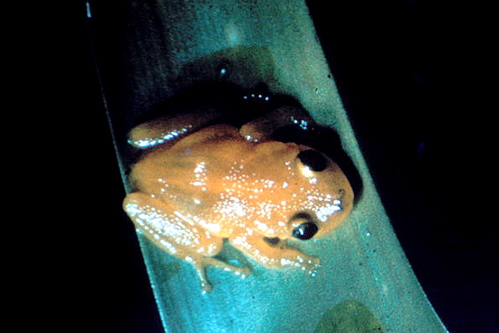 Golden CoquíEleutherodactylus jasperi
-
 Puerto Rican Wetland FrogEleutherodactylus juanariveroi
-
 Whistling CoquíEleutherodactylus cochranae
Compare
Questions and answers
What is the scientific name of the Dominica Frog?
The scientific name of the Dominica Frog is Eleutherodactylus amplinympha. Written with its author, the full name is Eleutherodactylus amplinympha Kaiser, Green & Schmid, 1994.
Which family does the Dominica Frog belong to?
Eleutherodactylus amplinympha belongs to the family Eleutherodactylidae, in the order Anura and the class Amphibia.
Where is the Dominica Frog found?
Checklists and occurrence records place Eleutherodactylus amplinympha in 1 country: Dominica.
What is the conservation status of the Dominica Frog?
The IUCN Red List category recorded for Eleutherodactylus amplinympha is Endangered (EN).
What other names does the Dominica Frog have?
Eleutherodactylus amplinympha is also known in English as Dominican Gounouj, Dominican Piping Frog, Dominican Rain Frog, Dominican Whistling Frog and Rainfrog.
What is the scientific name, genus, and species of your frog?
The scientific name is Eleutherodactylus amplinympha. Its genus is Eleutherodactylus and its species is amplinympha.[23]
Sources
Passages the profile rests on
- Eleutherodactylus amplinympha and Eleutherodactylus martinicensis occur together in some parts of their ranges. Source passage: “some areas are inhabited by both species, and there they are sympatric.” — English Wikipedia
- Eleutherodactylus martinicensis is a species from which Eleutherodactylus amplinympha is mostly separated by its preference for higher elevations. Source passage: “The preference for high elevation mostly separates it from Eleutherodactylus martinicensis” — English Wikipedia
- The species has large, prominent eyes and a flat-topped head that is longer than it is wide and wider than its body. Source passage: “The frog has large, prominent eyes on a flat-topped head that is longer than it is wide and wider than the frog's body is.” — English Wikipedia
- Its forearms are moderately robust and have long, slender fingers. Source passage: “The forearms are moderately robust, with long, slender fingers” — English Wikipedia
- Its hind legs are long and moderately robust, with long toes. Source passage: “while the hind legs are long and moderately robust, with long toes.” — English Wikipedia
- The species displays considerable colour variation, with no colour variants exclusive to either sex. Source passage: “Colouration varies greatly, with neither males nor females having any exclusive variants.” — English Wikipedia
- The frog's back can be light brown, dark brown, cream, pink, orange, red or olive. Source passage: “The frog's back may be coloured light or dark brown, cream, pink, orange, red or olive” — English Wikipedia
- The frog's back may have a pattern. Source passage: “and may have a pattern on it.” — English Wikipedia
- The snout resembles the back in colour but is slightly lighter. Source passage: “The snout is similar in colouration to the back but slightly lighter.” — English Wikipedia
- The belly is cream to tan and has mottled markings. Source passage: “The belly is cream to tan and is mottled.” — English Wikipedia
- Female individuals commonly exceed 35 millimetres in snout–vent length. Source passage: “Females of the species often reach over 35 mm (1.4 in) in snout–vent length” — English Wikipedia
- Some female individuals exceed 50 millimetres in length. Source passage: “and some reach lengths of over 50 mm (2.0 in).” — English Wikipedia
- Male individuals are smaller than females, with the largest recorded male measuring 26.4 millimetres. Source passage: “Males are smaller, with the biggest one recorded having a length of 26.4 mm (1.04 in).” — English Wikipedia
- The species occurs in the interior of Dominica at elevations between 300 and 1,200 metres above sea level. Source passage: “where it occurs in the interior of the island at elevations of 300–1,200 m (980–3,940 ft) above sea level.” — English Wikipedia
- The species is primarily found in rainforests above 300 metres elevation. Source passage: “has a preference for and is primarily found in rainforests at elevations above 300 m (980 ft).” — English Wikipedia
- The species is a habitat generalist that prefers slightly open rainforests at higher elevations. Source passage: “The species is a habitat generalist with a preference for slightly open rainforests at higher elevations.” — English Wikipedia
- The species' habitat is regularly covered in dense fog. Source passage: “because their habitat is regularly covered in dense fog.” — English Wikipedia
- The species has a geographic range covering approximately 325 square kilometres. Source passage: “Its range covers about 325 km2 (125 sq mi).” — English Wikipedia
- The species produces an advertisement call consisting of three notes. Source passage: “The advertisement call of the frog consists of three notes.” — English Wikipedia
- Males are frequently heard calling but are rarely seen. Source passage: “males, while often being heard calling, are rarely seen” — English Wikipedia
- The species was assessed as endangered by the IUCN in 2020. Source passage: “The species was listed as endangered in its 2020 assessment by the IUCN” — English Wikipedia
- Its restricted geographic range makes the species vulnerable to habitat loss. Source passage: “primarily due to the fact that the species limited range makes it vulnerable to habitat loss.” — English Wikipedia
- The first scientific description of the species was published in 1994 by Hinrich Kaiser, David M. Green and Michael Schmid. Source passage: “The first description of the species was published in 1994 by Hinrich Kaiser, David M. Green and Michael Schmid.” — English Wikipedia
Data
- Catalogue of Life, 2026-10-16 XR cc by
- Global Biodiversity Information Facility CC BY 4.0
- Wikidata CC0
- GeoNames CC BY 4.0
- Within the Catalogue of Life, this name comes from The Integrated Taxonomic Information System cc0
References
- Systematics and biogeography of eastern Caribbean frogs (Leptodactylidae: Eleutherodactylus), with the description of a new species from Dominica. (1994). Canadian Journal of Zoology, 72(12), 2217–2237. https://doi.org/10.1139/z94-297 Link where the name was published
This species in other databases
Page built on 27 November 2026. See how the catalog is made and all sources and licences.
Cite this page
ScientificNames.org. (2026). Eleutherodactylus amplinympha (Dominica Frog). Retrieved November 27, 2026, from https://scientificnames.org/species/eleutherodactylus-amplinympha
“Eleutherodactylus amplinympha (Dominica Frog).” ScientificNames.org, 2026, scientificnames.org/species/eleutherodactylus-amplinympha. Accessed 27 Nov. 2026.
ScientificNames.org. “Eleutherodactylus amplinympha (Dominica Frog).” Accessed November 27, 2026. https://scientificnames.org/species/eleutherodactylus-amplinympha.
@misc{scientificnames_eleutherodactylus_amplinympha_dominica_frog,
  author = {{ScientificNames.org}},
  title = {Eleutherodactylus amplinympha (Dominica Frog)},
  year = {2026},
  url = {https://scientificnames.org/species/eleutherodactylus-amplinympha},
  note = {Accessed 2026-11-27}
}