Species · Amphibians
La Hotte Big-legged Frog Eleutherodactylus apostates
The scientific name of the La Hotte Big-legged Frog is Eleutherodactylus apostates. It is a species of amphibian in the family Eleutherodactylidae (rain frogs), order Anura. The name dates from 1973.
- Scientific name
- Eleutherodactylus apostates Schwartz, 1973
- Common name
- La Hotte Big-legged Frog
- Genus
- Eleutherodactylus
- Family
- Eleutherodactylidae (Rain Frogs)
- Order
- Anura
- Class
- Amphibia
- Red List category
- CR Critically Endangered
- Recorded in
- 1 country
- Name status
- accepted in the Catalogue of Life
Overview
Eleutherodactylus apostates is endemic to the Massif de la Hotte in southwestern Haiti. Adult males are considerably smaller than females, measuring 21–23 mm and 37–43 mm in snout–vent length, respectively.
Written 27 November 2026 from the sources listed below. Each statement was checked against the passage it cites; statements that could not be supported were removed.
Appearance
The frog generally has pinkish-tan to grayish-brown coloration. Its dorsal coloration and patterns are variable, particularly among females.[1][2]
Adult males measure 21–23 mm in snout–vent length, while adult females measure 37–43 mm. Males are considerably smaller than females.[3][4][5]
Habitat
The species inhabits closed-canopy forests at elevations of 333–1,640 m above sea level.[6]
The type locality was a wooded ravine bordering a small creek.[7]
Behaviour
Males produce calls near streams.[8]
Conservation
The species' range is experiencing severe habitat destruction. Logging for charcoal production by local people is a major cause, while slash-and-burn agriculture also contributes to habitat destruction.[9][10][11]
Part of the species' range overlaps with Pic Macaya National Park. The park is not managed for conservation.[12][13]
The species was formerly common in suitable habitat but has not been observed since 2005. It was most recently assessed for the IUCN Red List of Threatened Species in 2021.[14][15]
Classification of the La Hotte Big-legged Frog
| Kingdom | Animalia |
|---|---|
| Phylum | Chordata |
| Subphylum | Vertebrata |
| Infraphylum | Gnathostomata |
| Parvphylum | Osteichthyes |
| Megaclass | Tetrapoda |
| Class | Amphibia (Amphibians) |
| Order | Anura (Frogs) |
| Superfamily | Brachycephaloidea |
| Family | Eleutherodactylidae (Rain Frogs) |
| Subfamily | Eleutherodactylinae |
| Genus | Eleutherodactylus (Coquis) |
| Species | Eleutherodactylus apostates Schwartz, 1973 |
Where the La Hotte Big-legged Frog is found
Checklists and occurrence records place Eleutherodactylus apostates in 1 country. GBIF holds 231 georeferenced records of it.
Countries
Regions and cities with the most records
A number beside a place is its count of GBIF occurrence records. A place without a number comes from a checklist alone. Records show where a species has been observed or collected, which can include escapes and vagrants.
Common names
English
- La Hotte Big-legged Frog
- Apostates Robber Frog
- La Hotte Big-legged Landfrog
Names in 1 other language
- Russian
- Гаитянская листовая лягушка
Synonyms
One other scientific name has been used for this species and is now treated as a synonym of Eleutherodactylus apostates.
- Euhyas apostates (Schwartz, 1973)
Related species
-
 Common CoquíEleutherodactylus coqui
-
 Greenhouse FrogEleutherodactylus planirostris
-
 Antilles CoquíEleutherodactylus johnstonei
-
 Puerto Rican Rock FrogEleutherodactylus cooki
-
 Rio Grande Chirping FrogEleutherodactylus cystignathoides
-
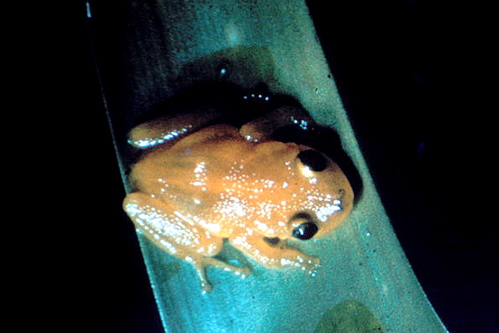 Golden CoquíEleutherodactylus jasperi
-
 Puerto Rican Wetland FrogEleutherodactylus juanariveroi
-
 Whistling CoquíEleutherodactylus cochranae
Compare
Questions and answers
What is the scientific name of the La Hotte Big-legged Frog?
The scientific name of the La Hotte Big-legged Frog is Eleutherodactylus apostates. Written with its author, the full name is Eleutherodactylus apostates Schwartz, 1973.
Which family does the La Hotte Big-legged Frog belong to?
Eleutherodactylus apostates belongs to the family Eleutherodactylidae, in the order Anura and the class Amphibia.
Where is the La Hotte Big-legged Frog found?
Checklists and occurrence records place Eleutherodactylus apostates in 1 country: Haiti.
What is the conservation status of the La Hotte Big-legged Frog?
The IUCN Red List category recorded for Eleutherodactylus apostates is Critically Endangered (CR).
What other names does the La Hotte Big-legged Frog have?
Eleutherodactylus apostates is also known in English as Apostates Robber Frog and La Hotte Big-legged Landfrog.
Sources
Passages the profile rests on
- The frog generally has pinkish-tan to grayish-brown coloration. Source passage: “generally speaking Eleutherodactylus apostates is a pinkish tan to grayish brown frog.” — English Wikipedia
- The species exhibits variable dorsal coloration and patterns, particularly among females. Source passage: “Dorsal colouration and patterns are variable, particularly in females” — English Wikipedia
- Adult males measure 21–23 mm in snout–vent length. Source passage: “only 21–23 mm (0.83–0.91 in) in snout–vent length” — English Wikipedia
- Adult females measure 37–43 mm in snout–vent length. Source passage: “37–43 mm (1.5–1.7 in) in females.” — English Wikipedia
- Males are considerably smaller than females. Source passage: “Eleutherodactylus apostates males are much smaller than females” — English Wikipedia
- The species inhabits closed-canopy forests at elevations of 333–1,640 m above sea level. Source passage: “live in closed-canopy forest at elevations of 333–1,640 m (1,093–5,381 ft) asl.” — English Wikipedia
- The type locality was a wooded ravine bordering a small creek. Source passage: “The type locality was a wooded ravine bordering a small creek.” — English Wikipedia
- Males produce calls near streams. Source passage: “Males call near streams.” — English Wikipedia
- The species' range is experiencing severe habitat destruction. Source passage: “The range of this species is suffering from severe habitat destruction” — English Wikipedia
- Logging for charcoal production by local people is a major cause of habitat destruction within the species' range. Source passage: “primarily due to logging for charcoal production by local people” — English Wikipedia
- Slash-and-burn agriculture also contributes to habitat destruction within the species' range. Source passage: “and by slash-and-burn agriculture.” — English Wikipedia
- Part of the species' range overlaps with Pic Macaya National Park. Source passage: “Part of its range overlaps with the Pic Macaya National Park” — English Wikipedia
- Pic Macaya National Park is not managed for conservation. Source passage: “the park is not managed for conservation.” — English Wikipedia
- The species was formerly common in suitable habitat but has not been observed since 2005. Source passage: “It was formerly common in suitable habitat but has not been seen after 2005.” — English Wikipedia
- The species was most recently assessed for the IUCN Red List of Threatened Species in 2021. Source passage: “La Hotte Big-legged Frog Eleutherodactylus apostates has most recently been assessed for The IUCN Red List of Threatened Species in 2021.” — iucnredlist.org
Data
- Catalogue of Life, 2026-10-16 XR cc by
- Global Biodiversity Information Facility CC BY 4.0
- Wikidata CC0
- GeoNames CC BY 4.0
- Within the Catalogue of Life, this name comes from The Integrated Taxonomic Information System cc0
References
- Six new species of Eleutherodactylus (Anura, Leptodactylidae) from Hispaniola. (1973). Journal Herpet, 7(3), 249–273. https://doi.org/10.2307/1563010 Link where the name was published
This species in other databases
Page built on 27 November 2026. See how the catalog is made and all sources and licences.
Cite this page
ScientificNames.org. (2026). Eleutherodactylus apostates (La Hotte Big-legged Frog). Retrieved November 27, 2026, from https://scientificnames.org/species/eleutherodactylus-apostates
“Eleutherodactylus apostates (La Hotte Big-legged Frog).” ScientificNames.org, 2026, scientificnames.org/species/eleutherodactylus-apostates. Accessed 27 Nov. 2026.
ScientificNames.org. “Eleutherodactylus apostates (La Hotte Big-legged Frog).” Accessed November 27, 2026. https://scientificnames.org/species/eleutherodactylus-apostates.
@misc{scientificnames_eleutherodactylus_apostates_la_hotte_big_legged_frog,
  author = {{ScientificNames.org}},
  title = {Eleutherodactylus apostates (La Hotte Big-legged Frog)},
  year = {2026},
  url = {https://scientificnames.org/species/eleutherodactylus-apostates},
  note = {Accessed 2026-11-27}
}