Species · Amphibians
Guerreran Peeping Frog Eleutherodactylus dilatus
The scientific name of the Guerreran Peeping Frog is Eleutherodactylus dilatus. It is a species of amphibian in the family Eleutherodactylidae (rain frogs), order Anura. The name dates from 1955.
- Scientific name
- Eleutherodactylus dilatus (Davis & Dixon, 1955)
- Common name
- Guerreran Peeping Frog
- Genus
- Eleutherodactylus
- Family
- Eleutherodactylidae (Rain Frogs)
- Order
- Anura
- Class
- Amphibia
- Red List category
- LC Least Concern
- Recorded in
- 1 country
- Name status
- accepted in the Catalogue of Life

Overview
Eleutherodactylus dilatus is endemic to Mexico and restricted to the Chilpancingo region of the Sierra Madre del Sur in central Guerrero. It is distinguished by its pustulate dorsal skin, dark mottling, and laterally dilated tips of the two outer fingers.
Written 27 November 2026 from the sources listed below. Each statement was checked against the passage it cites; statements that could not be supported were removed.
Appearance
Specimens in the type series measured 25–30 mm in snout–vent length. The single female in the type series was larger than the males.[1][2]
The tympanum measures up to 1 mm in males and 1.5 mm in females and is sometimes indistinct. The species has a sharply angled canthus.[3][4]
The dorsal skin is pustulate and ranges in color from lavender to brownish, with black mottling. The granular underside ranges from nearly white to heavily pigmented and bears numerous white subcircular spots.[5][6]
The species usually has a distinct dark loreal stripe extending from the nostril to the eye and continuing onto the shoulder. Large ochraceous spots occur on the anterior proximal face of the femur and at the posterior bend of the knee.[7][8]
The tibia bears two or three transverse bars. The tips of the two outer fingers are truncate and laterally dilated, reaching almost twice the width of the subterminal phalanges.[9][10]
Habitat
The Guerreran Peeping Frog inhabits pine-oak forests and crops within forests.[11]
The type-series specimens were found at an elevation of 2,400 m above sea level. They were collected at night from small shrubs and pines between 0.6 and 2 m above the ground.[12][13]
Behaviour
The male advertisement call consists of a peep and a trill, sometimes forming a five-note trill.[14]
Conservation
The species is uncommon and is threatened by the loss and disturbance of its forest habitat.[15][16]
It receives some protection in Omiltemi Park.[17]
Uses
The specific name dilatus refers to the lateral dilation of the tips of the two outer fingers.[18]
Classification of the Guerreran Peeping Frog
| Kingdom | Animalia |
|---|---|
| Phylum | Chordata |
| Subphylum | Vertebrata |
| Infraphylum | Gnathostomata |
| Parvphylum | Osteichthyes |
| Megaclass | Tetrapoda |
| Class | Amphibia (Amphibians) |
| Order | Anura (Frogs) |
| Superfamily | Brachycephaloidea |
| Family | Eleutherodactylidae (Rain Frogs) |
| Subfamily | Eleutherodactylinae |
| Genus | Eleutherodactylus (Coquis) |
| Species | Eleutherodactylus dilatus (Davis & Dixon, 1955) |
Where the Guerreran Peeping Frog is found
Checklists and occurrence records place Eleutherodactylus dilatus in 1 country across North America. GBIF holds 96 georeferenced records of it.
Countries
Regions and cities with the most records
- Guerrero, Mexico 63
- Chilpancingo, Mexico 24
- Zumpango del Río, Mexico 16
- Teloloapan, Mexico 13
- Taxco de Alarcón, Mexico 5
- Tixtla de Guerrero, Mexico 5
Range as the checklists state it
Middle America
A number beside a place is its count of GBIF occurrence records. A place without a number comes from a checklist alone. Records show where a species has been observed or collected, which can include escapes and vagrants.
Common names
English
- Guerreran Peeping Frog
Names in 1 other language
- Spanish
- Rana-fisgona guerrerense, rana fisgona guerrerense
Synonyms
3 other scientific names have been used for this species and are now treated as synonyms of Eleutherodactylus dilatus.
- Syrrhophus dilatus (Davis & Dixon, 1955)
- Syrrhophus dilautus (Davis & Dixon, 1955)
- Tomodactylus dilatus Davis & Dixon, 1955
Related species
-
 Common CoquíEleutherodactylus coqui
-
 Greenhouse FrogEleutherodactylus planirostris
-
 Antilles CoquíEleutherodactylus johnstonei
-
 Puerto Rican Rock FrogEleutherodactylus cooki
-
 Rio Grande Chirping FrogEleutherodactylus cystignathoides
-
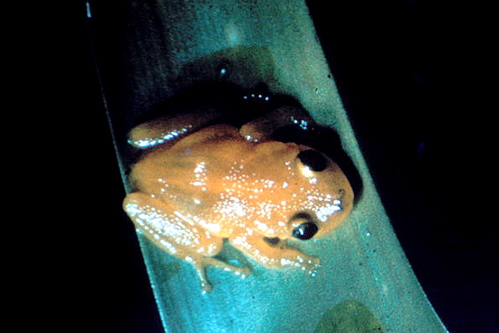 Golden CoquíEleutherodactylus jasperi
-
 Puerto Rican Wetland FrogEleutherodactylus juanariveroi
-
 Whistling CoquíEleutherodactylus cochranae
Compare
Questions and answers
What is the scientific name of the Guerreran Peeping Frog?
The scientific name of the Guerreran Peeping Frog is Eleutherodactylus dilatus. Written with its author, the full name is Eleutherodactylus dilatus (Davis & Dixon, 1955).
Which family does the Guerreran Peeping Frog belong to?
Eleutherodactylus dilatus belongs to the family Eleutherodactylidae, in the order Anura and the class Amphibia.
Where is the Guerreran Peeping Frog found?
Checklists and occurrence records place Eleutherodactylus dilatus in 1 country: Mexico.
What is the conservation status of the Guerreran Peeping Frog?
The IUCN Red List category recorded for Eleutherodactylus dilatus is Least Concern (LC).
Sources
Passages the profile rests on
- Specimens in the type series measured 25–30 mm in snout–vent length. Source passage: “Specimens in the type series measured 25–30 mm (0.98–1.18 in) in snout–vent length” — English Wikipedia
- The single female in the type series was larger than the males. Source passage: “with the single female being larger than the males.” — English Wikipedia
- The tympanum measures up to 1 mm in males and 1.5 mm in females and is sometimes indistinct. Source passage: “The tympanum is small, up to 1 mm in males and 1.5 mm the female, and sometimes indistinct.” — English Wikipedia
- The species has a sharply angled canthus. Source passage: “The canthus appears sharply angled.” — English Wikipedia
- Its dorsal skin is pustulate and ranges in color from lavender to brownish, with black mottling. Source passage: “The dorsum is pustulate and lavender to brownish in color, with black mottling.” — English Wikipedia
- Its granular underside ranges from nearly white to heavily pigmented and bears numerous white subcircular spots. Source passage: “The venter is granular and varies from nearly white to heavily pigmented and with numerous white subcircular spots.” — English Wikipedia
- The species usually has a distinct dark loreal stripe extending from the nostril to the eye and continuing onto the shoulder. Source passage: “There is usually a distinct, dark loreal stripe running from the nostril to the eye and continuing posteriorly onto the shoulder.” — English Wikipedia
- Large ochraceous spots occur on the anterior proximal face of the femur and at the posterior bend of the knee. Source passage: “There are large ochraceous spots anterior proximal face of the femur as well as posteriorly in the bend of the knee.” — English Wikipedia
- The tibia bears two or three transverse bars. Source passage: “The tibia have three, sometimes two transverse bars.” — English Wikipedia
- The tips of the two outer fingers are truncate and laterally dilated, reaching almost twice the width of the subterminal phalanges. Source passage: “The tips of the two outer fingers are truncate and laterally dilated (having almost twice the width of the subterminal phalanges” — English Wikipedia
- The species inhabits pine-oak forests and crops within forests. Source passage: “The species' natural habitats are pine-oak forests and crops in the forests.” — English Wikipedia
- The type-series specimens were found at an elevation of 2,400 m above sea level. Source passage: “The specimens in the type series were found at an elevation of 2,400 m (7,800 ft) above sea level.” — English Wikipedia
- The type-series specimens were collected at night from small shrubs and pines between 0.6 and 2 m above the ground. Source passage: “They were collected at night from small shrubs and pines some 0.6–2 m (2–7 ft) above ground.” — English Wikipedia
- The male advertisement call consists of a peep and a trill, sometimes forming a five-note trill. Source passage: “Male advertisement call is a "peep" and "trill", sometimes a five-note trill.” — English Wikipedia
- The species is uncommon. Source passage: “Eleutherodactylus dilatus is an uncommon species.” — English Wikipedia
- The species is threatened by the loss and disturbance of its forest habitat. Source passage: “It is threatened by loss and disturbance of its forest habitat.” — English Wikipedia
- The species receives some protection in Omiltemi Park. Source passage: “It receives a degree of protection in the Omiltemi Park” — English Wikipedia
- The specific name dilatus refers to the lateral dilation of the tips of the two outer fingers. Source passage: “The tips of the two outer fingers are truncate and laterally dilated (having almost twice the width of the subterminal phalanges—hence the specific name dilatus).” — English Wikipedia
Data
- Catalogue of Life, 2026-10-16 XR cc by
- Global Biodiversity Information Facility CC BY 4.0
- Wikidata CC0
- GeoNames CC BY 4.0
- Wikimedia Commons per image; credit shown with each image
- Within the Catalogue of Life, this name comes from The Integrated Taxonomic Information System cc0
References
- Flores-Villela, Oscar / McCoy, C. J., ed. (1993). Herpetofauna Mexicana: Lista anotada de las especies de anfibios y reptiles de México, cambios taxonómicos recientes, y nuevas especies. Carnegie Museum of Natural History Special Publication, No. 17.
- Frost, Darrel R. (1997). Amphibian Species of the World, A Taxonomic and Geographic Reference. Second Edition.
This species in other databases
Page built on 29 November 2026. See how the catalog is made and all sources and licences.
Cite this page
ScientificNames.org. (2026). Eleutherodactylus dilatus (Guerreran Peeping Frog). Retrieved November 29, 2026, from https://scientificnames.org/species/eleutherodactylus-dilatus
“Eleutherodactylus dilatus (Guerreran Peeping Frog).” ScientificNames.org, 2026, scientificnames.org/species/eleutherodactylus-dilatus. Accessed 29 Nov. 2026.
ScientificNames.org. “Eleutherodactylus dilatus (Guerreran Peeping Frog).” Accessed November 29, 2026. https://scientificnames.org/species/eleutherodactylus-dilatus.
@misc{scientificnames_eleutherodactylus_dilatus_guerreran_peeping_frog,
  author = {{ScientificNames.org}},
  title = {Eleutherodactylus dilatus (Guerreran Peeping Frog)},
  year = {2026},
  url = {https://scientificnames.org/species/eleutherodactylus-dilatus},
  note = {Accessed 2026-11-29}
}