Species · Amphibians
Blue Mountain Rockfrog Eleutherodactylus glaucoreius
The scientific name of the Blue Mountain Rockfrog is Eleutherodactylus glaucoreius. It is a species of amphibian in the family Eleutherodactylidae (rain frogs), order Anura. The name dates from 1973.
- Scientific name
- Eleutherodactylus glaucoreius Schwartz & Fowler, 1973
- Common name
- Blue Mountain Rockfrog
- Genus
- Eleutherodactylus
- Family
- Eleutherodactylidae (Rain Frogs)
- Order
- Anura
- Class
- Amphibia
- Red List category
- EN Endangered
- Recorded in
- 1 country
- Name status
- accepted in the Catalogue of Life
Overview
Eleutherodactylus glaucoreius is endemic to eastern Jamaica, where it inhabits rainforest rocky formations and secondary forest. It has variable dorsal coloration and patterning, with an almost always present W-shaped scapular marking.
Written 27 November 2026 from the sources listed below. Each statement was checked against the passage it cites; statements that could not be supported were removed.
Appearance
The head is as wide as it is long. The snout is acuminate and sharply truncate, and the tympanum is small but visible.[1][2][3]
The digital discs are moderately sized, and the toes are not webbed. Dorsal coloration ranges from tan to gray, sometimes with red or orange hints.[4][5]
The dorsal pattern is variable, with most individuals having dark brown mottling or tan or reddish tan dorsolateral stripes. A W-shaped scapular marking is almost always present, sometimes accompanied by a second W-shaped marking in the middle of the back.[6][7]
Many individuals have spots along their sides. The underside is pale yellow and often has brown or black pigmentation, while the throat is heavily pigmented.[8][9][10]
Adult males reach 28 mm in snout–vent length, while adult females reach 32 mm.[11][12]
Habitat
The species inhabits rainforest rocky formations and is frequently found on or inside rocks. It also occurs in secondary forest and inside piles of coconut husks.[13][14][15]
It has been recorded from sea level to 1,650 m above sea level. Its natural habitats include subtropical or tropical environments.[16][17]
Reproduction and life cycle
Females lay their eggs on the ground. The species reproduces through direct development without a free-living larval stage.[18][19]
Conservation
The species has a small geographic range but appears to be relatively common locally. It appears able to tolerate some habitat disturbance when closed canopy is retained.[20][21]
Agriculture, human settlement and logging threaten the species through the loss of forest habitat. Forest habitat loss also threatens it within protected areas and national parks.[22][23]
The species' population is inferred to be decreasing.[24]
Classification of the Blue Mountain Rockfrog
| Kingdom | Animalia |
|---|---|
| Phylum | Chordata |
| Subphylum | Vertebrata |
| Infraphylum | Gnathostomata |
| Parvphylum | Osteichthyes |
| Megaclass | Tetrapoda |
| Class | Amphibia (Amphibians) |
| Order | Anura (Frogs) |
| Superfamily | Brachycephaloidea |
| Family | Eleutherodactylidae (Rain Frogs) |
| Subfamily | Eleutherodactylinae |
| Genus | Eleutherodactylus (Coquis) |
| Species | Eleutherodactylus glaucoreius Schwartz & Fowler, 1973 |
Where the Blue Mountain Rockfrog is found
Checklists and occurrence records place Eleutherodactylus glaucoreius in 1 country. GBIF holds 364 georeferenced records of it.
Countries
A number beside a place is its count of GBIF occurrence records. A place without a number comes from a checklist alone. Records show where a species has been observed or collected, which can include escapes and vagrants.
Common names
English
- Blue Mountain Rockfrog
- Portland Parish Robber Frog
Synonyms
2 other scientific names have been used for this species and are now treated as synonyms of Eleutherodactylus glaucoreius.
- Eleutherodactylus cundalli glaucoreius Schwartz & Fowler, 1973
- Euhyas glaucoreia (Schwartz & Fowler, 1973)
Related species
-
 Common CoquíEleutherodactylus coqui
-
 Greenhouse FrogEleutherodactylus planirostris
-
 Antilles CoquíEleutherodactylus johnstonei
-
 Puerto Rican Rock FrogEleutherodactylus cooki
-
 Rio Grande Chirping FrogEleutherodactylus cystignathoides
-
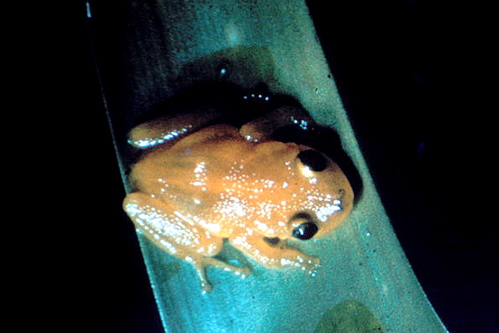 Golden CoquíEleutherodactylus jasperi
-
 Puerto Rican Wetland FrogEleutherodactylus juanariveroi
-
 Whistling CoquíEleutherodactylus cochranae
Compare
Questions and answers
What is the scientific name of the Blue Mountain Rockfrog?
The scientific name of the Blue Mountain Rockfrog is Eleutherodactylus glaucoreius. Written with its author, the full name is Eleutherodactylus glaucoreius Schwartz & Fowler, 1973.
Which family does the Blue Mountain Rockfrog belong to?
Eleutherodactylus glaucoreius belongs to the family Eleutherodactylidae, in the order Anura and the class Amphibia.
Where is the Blue Mountain Rockfrog found?
Checklists and occurrence records place Eleutherodactylus glaucoreius in 1 country: Jamaica.
What is the conservation status of the Blue Mountain Rockfrog?
The IUCN Red List category recorded for Eleutherodactylus glaucoreius is Endangered (EN).
What other names does the Blue Mountain Rockfrog have?
Eleutherodactylus glaucoreius is also known in English as Portland Parish Robber Frog.
Sources
Passages the profile rests on
- The species has a head that is as wide as it is long. Source passage: “The head is as wide as it is long.” — English Wikipedia
- Its snout is acuminate and sharply truncate. Source passage: “The snout is acuminate but sharply truncate.” — English Wikipedia
- Its tympanum is small but visible. Source passage: “The tympanum is small but visible.” — English Wikipedia
- Its digital discs are moderately sized and its toes are not webbed. Source passage: “The digital discs are moderately sized. No webbing is present.” — English Wikipedia
- Its dorsal coloration ranges from tan to gray, sometimes with red or orange hints. Source passage: “Dorsal coloration is tan to gray, with some individuals having hint of red or orange.” — English Wikipedia
- Its dorsal pattern is variable, with most individuals having dark brown mottling or tan or reddish tan dorsolateral stripes. Source passage: “Dorsal patterns are variable; most individuals are either mottled with dark brown or have tan or reddish tan dorsolateral stripes.” — English Wikipedia
- A W-shaped scapular marking is almost always present, sometimes accompanied by a second W-shaped marking in the middle of the back. Source passage: “Scapular W-shaped marking is almost always present, often followed by another W in mid-dorsum.” — English Wikipedia
- Many individuals have spots along their sides. Source passage: “Many individuals have lateral spotting.” — English Wikipedia
- Its underside is pale yellow and often has brown or black pigmentation. Source passage: “Ventral coloration is pale yellow, often with brown or back pigmenting.” — English Wikipedia
- Its throat is heavily pigmented. Source passage: “The throat is heavily pigmented.” — English Wikipedia
- Adult males reach 28 mm in snout–vent length. Source passage: “Males grow to 28 mm (1.1 in) and females to 32 mm (1.3 in) in snout–vent length.” — English Wikipedia
- Adult females reach 32 mm in snout–vent length. Source passage: “Males grow to 28 mm (1.1 in) and females to 32 mm (1.3 in) in snout–vent length.” — English Wikipedia
- The species inhabits rainforest rocky formations, where it is frequently found on or inside rocks. Source passage: “It is a terrestrial frog that is often found on and inside rocky formations in rainforest” — English Wikipedia
- It also occurs in secondary forest. Source passage: “but also in secondary forest.” — English Wikipedia
- It can occur inside piles of coconut husks. Source passage: “It can also occurs inside piles of coconut husks.” — English Wikipedia
- The species has been recorded from sea level to 1,650 m above sea level. Source passage: “It is found from sea level to 1,650 m (5,410 ft) asl.” — English Wikipedia
- Its natural habitats include subtropical or tropical environments. Source passage: “Its natural habitats are subtropical or tropical ...” — inaturalist.org
- Females lay their eggs on the ground. Source passage: “Eggs are laid on the ground” — English Wikipedia
- The species reproduces through direct development without a free-living larval stage. Source passage: “it breeds by direct development (i.e., there is no free-living larval stage).” — English Wikipedia
- The species has a small geographic range but appears to be relatively common locally. Source passage: “Eleutherodactylus glaucoreius has a small range but appears to be locally relatively common.” — English Wikipedia
- The species appears able to tolerate some habitat disturbance when closed canopy is retained. Source passage: “It seems to tolerate some habitat disturbance as long as closed canopy remains.” — English Wikipedia
- Agriculture, human settlement and logging threaten the species through the loss of forest habitat. Source passage: “However, it is still threatened by loss of its forest habitat caused by agriculture, human settlement, and logging” — English Wikipedia
- Forest habitat loss also threatens the species within protected areas and national parks. Source passage: “also in protected areas and national parks.” — English Wikipedia
- The species' population is inferred to be decreasing. Source passage: “The population is inferred to be decreasing.” — English Wikipedia
- The specific name glaucoreius derives from Greek words meaning pale blue and mountain. Source passage: “The specific name glaucoreius is derived from Greek glaucos ("pale blue") and oreios ("mountain")” — English Wikipedia
- The species' scientific name alludes to its occurrence in the Blue Mountains. Source passage: “in allusion to the occurrence of this taxon in the Blue Mountains.” — English Wikipedia
Data
- Catalogue of Life, 2026-10-16 XR cc by
- Global Biodiversity Information Facility CC BY 4.0
- Wikidata CC0
- GeoNames CC BY 4.0
- Within the Catalogue of Life, this name comes from The Integrated Taxonomic Information System cc0
This species in other databases
Page built on 28 November 2026. See how the catalog is made and all sources and licences.
Cite this page
ScientificNames.org. (2026). Eleutherodactylus glaucoreius (Blue Mountain Rockfrog). Retrieved November 28, 2026, from https://scientificnames.org/species/eleutherodactylus-glaucoreius
“Eleutherodactylus glaucoreius (Blue Mountain Rockfrog).” ScientificNames.org, 2026, scientificnames.org/species/eleutherodactylus-glaucoreius. Accessed 28 Nov. 2026.
ScientificNames.org. “Eleutherodactylus glaucoreius (Blue Mountain Rockfrog).” Accessed November 28, 2026. https://scientificnames.org/species/eleutherodactylus-glaucoreius.
@misc{scientificnames_eleutherodactylus_glaucoreius_blue_mountain_rockfrog,
  author = {{ScientificNames.org}},
  title = {Eleutherodactylus glaucoreius (Blue Mountain Rockfrog)},
  year = {2026},
  url = {https://scientificnames.org/species/eleutherodactylus-glaucoreius},
  note = {Accessed 2026-11-28}
}