Species · Amphibians
Hedrick's Coquí Eleutherodactylus hedricki
The scientific name of the Hedrick's Coquí is Eleutherodactylus hedricki. It is a species of amphibian in the family Eleutherodactylidae (rain frogs), order Anura. The name dates from 1963.
- Scientific name
- Eleutherodactylus hedricki Rivero, 1963
- Common name
- Hedrick's Coquí
- Genus
- Eleutherodactylus
- Family
- Eleutherodactylidae (Rain Frogs)
- Order
- Anura
- Class
- Amphibia
- Red List category
- EN Endangered
- Recorded in
- 1 country
- Name status
- accepted in the Catalogue of Life
Overview
Eleutherodactylus hedricki is endemic to Puerto Rico, where it occurs in mountain forests and interior uplands. It has a pronounced constriction at the back of its head, a short rounded snout, and a shallow furrow along the middle of its back.
Written 27 November 2026 from the sources listed below. Each statement was checked against the passage it cites; statements that could not be supported were removed.
Appearance
Hedrick's Coquí has a pronounced constriction at the back of its head and a short, rounded snout. A shallow furrow runs along the middle of its back from between the eyes toward the sacral hump. Its eyes are small, with narrow upper eyelids.[1][2][3][4]
The dorsal surface is uniformly granular and has a pair of light, externally concave lines. The dorsal coloration ranges from brown to dark gray and may be nearly uniform or show indistinct lighter-gray variegations or vermiculations. The species lacks dark streaks along the sides of its snout.[5][6][7][8][9]
Males have a blackish throat. Adult males average 32.8 mm in length, while adult females average 34.6 mm.[10][11][12]
Habitat
Hedrick's Coquí inhabits subtropical or tropical moist lowland forests and subtropical or tropical moist montane forests. It is associated with mountain habitats.[13][14][15]
The species is arboreal and occupies holes and crevices in tree trunks and branches. These sites may be as high as 20 or 30 feet above the ground.[16][17]
Behaviour
Hedrick's Coquí produces a resonant call described as repeated pings. Individuals can be heard calling during daylight hours, and most calling individuals have become silent by midnight.[18][19][20]
The species' call has not been heard below approximately 1,000 feet.[21]
Conservation
Hedrick's Coquí was assessed as Endangered in the 2020 IUCN Red List assessment.[22]
Classification of the Hedrick's Coquí
| Kingdom | Animalia |
|---|---|
| Phylum | Chordata |
| Subphylum | Vertebrata |
| Infraphylum | Gnathostomata |
| Parvphylum | Osteichthyes |
| Megaclass | Tetrapoda |
| Class | Amphibia (Amphibians) |
| Order | Anura (Frogs) |
| Superfamily | Brachycephaloidea |
| Family | Eleutherodactylidae (Rain Frogs) |
| Subfamily | Eleutherodactylinae |
| Genus | Eleutherodactylus (Coquis) |
| Species | Eleutherodactylus hedricki Rivero, 1963 |
Where the Hedrick's Coquí is found
Checklists and occurrence records place Eleutherodactylus hedricki in 1 country across North America. GBIF holds 19 georeferenced records of it.
Countries
Regions and cities with the most records
- Fajardo, Puerto Rico 10
- Carolina, Puerto Rico 8
- Río Grande, Puerto Rico 8
- Humacao, Puerto Rico 6
- Trujillo Alto, Puerto Rico 6
Range as the checklists state it
Caribbean
A number beside a place is its count of GBIF occurrence records. A place without a number comes from a checklist alone. Records show where a species has been observed or collected, which can include escapes and vagrants.
Common names
English
- Hedrick's Coqui
- Hedrick's Robber Frog
- Hedrick’s Robber Frog
- Tree-hole Coqui
- Tree-hole Frog
- Treehole Coqui
Names in 3 other languages
- Czech
- bezblanka Hedrickova
- Russian
- Дупляная листовая лягушка
- Spanish
- Coqui De Hedrick, Coquí de Hedrick
Related species
-
 Common CoquíEleutherodactylus coqui
-
 Greenhouse FrogEleutherodactylus planirostris
-
 Antilles CoquíEleutherodactylus johnstonei
-
 Puerto Rican Rock FrogEleutherodactylus cooki
-
 Rio Grande Chirping FrogEleutherodactylus cystignathoides
-
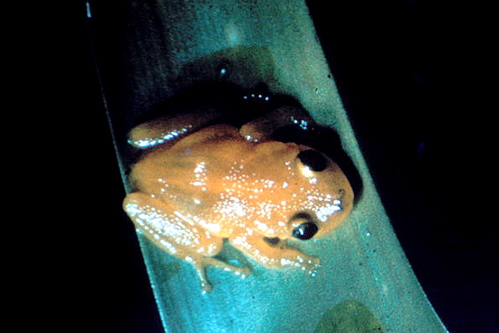 Golden CoquíEleutherodactylus jasperi
-
 Puerto Rican Wetland FrogEleutherodactylus juanariveroi
-
 Whistling CoquíEleutherodactylus cochranae
Compare
Questions and answers
What is the scientific name of the Hedrick's Coquí?
The scientific name of the Hedrick's Coquí is Eleutherodactylus hedricki. Written with its author, the full name is Eleutherodactylus hedricki Rivero, 1963.
Which family does the Hedrick's Coquí belong to?
Eleutherodactylus hedricki belongs to the family Eleutherodactylidae, in the order Anura and the class Amphibia.
Where is the Hedrick's Coquí found?
Checklists and occurrence records place Eleutherodactylus hedricki in 1 country: Puerto Rico.
What is the conservation status of the Hedrick's Coquí?
The IUCN Red List category recorded for Eleutherodactylus hedricki is Endangered (EN).
What other names does the Hedrick's Coquí have?
Eleutherodactylus hedricki is also known in English as Hedrick's Coqui, Hedrick's Robber Frog, Hedrick’s Robber Frog, Tree-hole Coqui, Tree-hole Frog and Treehole Coqui.
What is coqui and where is it found?
Hedrick's Coquí is an amphibian in the family Eleutherodactylidae. It is endemic to Puerto Rico and occurs in the Luquillo Mountains, including El Yunque, the Cayey Mountain Range, the Central Mountain Range, and the interior uplands, including Reserva Forestal de Toro Negro and its vicinity.[23][24][25][26][27][28]
Sources
Passages the profile rests on
- The species has a pronounced constriction at the back of its head. Source passage: “the pronounced constriction in the back of the head” — English Wikipedia
- The species has a shallow furrow running along the middle of its back from between the eyes toward the sacral hump. Source passage: “a shallow furrow along the middle of the back from between the eyes to near the sacral hump” — English Wikipedia
- The species has a short, rounded snout. Source passage: “the short, rounded snout” — English Wikipedia
- The species has small eyes with narrow upper eyelids. Source passage: “the small eyes, with narrow upper eyelids” — English Wikipedia
- The species has a uniformly granular dorsal surface. Source passage: “the uniformerly granular dorsum” — English Wikipedia
- The species has a pair of light, externally concave lines on its back. Source passage: “the pair of light, externally concave lines on the back” — English Wikipedia
- The species lacks dark streaks along the sides of its snout. Source passage: “the absence of dark streaks along the sides of the snout” — English Wikipedia
- The dorsal coloration ranges from brown to dark gray. Source passage: “The basic dorsal color may be brown or dark gray” — English Wikipedia
- The dorsal coloration may be nearly uniform or show indistinct lighter-gray variegations or vermiculations. Source passage: “almost uniform or with obscure variegation or vermiculations of lighter gray.” — English Wikipedia
- Males have a blackish throat. Source passage: “the blackish throat of males” — English Wikipedia
- Adult males average 32.8 mm in length. Source passage: “The males average 32.8 mm in length” — English Wikipedia
- Adult females average 34.6 mm in length. Source passage: “females average 34.6 mm.” — English Wikipedia
- The species inhabits subtropical or tropical moist lowland forests. Source passage: “Its natural habitats are subtropical or tropical moist lowland forest” — English Wikipedia
- The species inhabits subtropical or tropical moist montane forests. Source passage: “subtropical or tropical moist montane forest.” — English Wikipedia
- The species is associated with mountain habitats. Source passage: “The treehole coqui is a mountain-dwelling, arboreal species” — English Wikipedia
- The species is arboreal and occupies holes and crevices in tree trunks and branches. Source passage: “rests in and calls from holes and crevices in tree trunks and branches” — English Wikipedia
- The species may occupy tree holes and crevices as high as 20 or 30 feet above the ground. Source passage: “often as high 20 or 30 ft from ground.” — English Wikipedia
- The species produces a resonant call described as repeated pings. Source passage: “The call of E. hedricki is a resonant "ping, ping, ping".” — English Wikipedia
- The species can be heard calling during daylight hours. Source passage: “The species may be heard during the day” — English Wikipedia
- Most calling individuals have become silent by midnight. Source passage: “by midnight, most of the callers have become silent.” — English Wikipedia
- The species' call has not been heard below approximately 1,000 feet. Source passage: “The call has not been heard below about 1,000 ft.” — English Wikipedia
- The species was assessed as Endangered in the 2020 IUCN Red List assessment. Source passage: “most recently been assessed for The IUCN Red List of Threatened Species in 2020. listed as Endangered” — iucnredlist.org
- The species is endemic to Puerto Rico. Source passage: “is a species of frog in the family Eleutherodactylidae endemic to Puerto Rico.” — English Wikipedia
- The species occurs in lower-elevation forests of the Luquillo Mountains, including El Yunque. Source passage: “The species is found in lower-elevation forest in the Luquillo Mountains (El Yunque)” — English Wikipedia
- The species occurs in the Cayey Mountain Range of Puerto Rico. Source passage: “Cayey Mountain Range” — English Wikipedia
- The species occurs in the Central Mountain Range of Puerto Rico. Source passage: “Central Mountain Range.” — English Wikipedia
- The species has been recorded in the interior uplands of Puerto Rico. Source passage: “Found in the interior uplands of Puerto Rico” — efotg.sc.egov.usda.gov
- The species has been recorded in Reserva Forestal de Toro Negro and its vicinity in Puerto Rico. Source passage: “Reserva Forestal de Toro. Negro and vicinity” — efotg.sc.egov.usda.gov
Data
- Catalogue of Life, 2026-10-16 XR cc by
- Global Biodiversity Information Facility CC BY 4.0
- Wikidata CC0
- GeoNames CC BY 4.0
- Within the Catalogue of Life, this name comes from The Integrated Taxonomic Information System cc0
References
- Banks, R. C., R. W. McDiarmid, and A. L. Gardner. (1987). Checklist of Vertebrates of the United States, the U.S. Territories, and Canada. Resource Publication, No. 166.
- Frost, Darrel R. (1997). Amphibian Species of the World, A Taxonomic and Geographic Reference. Second Edition.
This species in other databases
Page built on 27 November 2026. See how the catalog is made and all sources and licences.
Cite this page
ScientificNames.org. (2026). Eleutherodactylus hedricki (Hedrick's Coquí). Retrieved November 27, 2026, from https://scientificnames.org/species/eleutherodactylus-hedricki
“Eleutherodactylus hedricki (Hedrick's Coquí).” ScientificNames.org, 2026, scientificnames.org/species/eleutherodactylus-hedricki. Accessed 27 Nov. 2026.
ScientificNames.org. “Eleutherodactylus hedricki (Hedrick's Coquí).” Accessed November 27, 2026. https://scientificnames.org/species/eleutherodactylus-hedricki.
@misc{scientificnames_eleutherodactylus_hedricki_hedricks_coqui,
  author = {{ScientificNames.org}},
  title = {Eleutherodactylus hedricki (Hedrick's Coquí)},
  year = {2026},
  url = {https://scientificnames.org/species/eleutherodactylus-hedricki},
  note = {Accessed 2026-11-27}
}