Species · Amphibians
Yellow Mottled Coqui Eleutherodactylus lentus
The scientific name of the Yellow Mottled Coqui is Eleutherodactylus lentus. It is a species of amphibian in the family Eleutherodactylidae (rain frogs), order Anura. The name dates from 1862.
- Scientific name
- Eleutherodactylus lentus (Cope, 1862)
- Common name
- Yellow Mottled Coqui
- Genus
- Eleutherodactylus
- Family
- Eleutherodactylidae (Rain Frogs)
- Order
- Anura
- Class
- Amphibia
- Red List category
- EN Endangered
- Recorded in
- 3 countries
- Name status
- accepted in the Catalogue of Life

Overview
The species is endemic to the Virgin Islands and occurs on St. Thomas, St. John, St. Croix, Hassel Island, and Jost Van Dyke. Despite its common name, the species occasionally produces vocalizations, including while sheltering beneath ground debris.
Written 27 November 2026 from the sources listed below. Each statement was checked against the passage it cites; statements that could not be supported were removed.
Habitat
Yellow Mottled Coqui inhabits subtropical or tropical dry forests, often near streams or other moist environments. It prefers semi-xeric habitats and shelters beneath debris.[1][2]
On Jost Van Dyke, individuals have been found beneath wooden boards and other objects in backyards, and in freshwater puddles in garbage.[3][4]
The species has also been recorded in agricultural areas on St. Thomas. It occurs from sea level to an elevation of 10 metres.[5][6]
Behaviour
Despite its common name, Yellow Mottled Coqui occasionally produces vocalizations. It sometimes vocalizes while sheltering beneath ground debris.[7][8]
Reproduction and life cycle
Yellow Mottled Coqui lays its eggs on the ground. It is thought to reproduce through direct development.[9][10]
Conservation
Yellow Mottled Coqui is classified as endangered on the IUCN Red List and has an estimated distribution area of 2,315 square kilometres. Its population is currently decreasing because of habitat degradation.[11][12][13]
Ongoing habitat degradation in the US Virgin Islands is identified as a threat to the species. Despite previously being considered rare, it is locally common in some locations.[14][15]
The species occurs within Virgin Islands National Park, which protects approximately two-thirds of St. John and nearly all of Hassel Island. Additional conservation measures are considered necessary on St. Thomas and St. Croix.[16][17]
The population on Jost Van Dyke was first recorded in 2007. Whether it was introduced or previously overlooked remains uncertain, and if it is invasive, its removal from the island has been suggested to protect native frogs.[18][19][20][21]
Classification of the Yellow Mottled Coqui
| Kingdom | Animalia |
|---|---|
| Phylum | Chordata |
| Subphylum | Vertebrata |
| Infraphylum | Gnathostomata |
| Parvphylum | Osteichthyes |
| Megaclass | Tetrapoda |
| Class | Amphibia (Amphibians) |
| Order | Anura (Frogs) |
| Superfamily | Brachycephaloidea |
| Family | Eleutherodactylidae (Rain Frogs) |
| Subfamily | Eleutherodactylinae |
| Genus | Eleutherodactylus (Coquis) |
| Species | Eleutherodactylus lentus (Cope, 1862) |
Where the Yellow Mottled Coqui is found
Checklists and occurrence records place Eleutherodactylus lentus in 3 countries across North America. GBIF holds 369 georeferenced records of it.
Countries
Regions and cities with the most records
- Saint Croix, U.S. Virgin Islands 127
- Charlotte Amalie, U.S. Virgin Islands 121
- Road Town, British Virgin Islands 15
- Marigot, Saint Martin 3
1 more country has a few records outside this range
These countries hold a few records of Eleutherodactylus lentus but lie outside the range the checklists give for it. Such records are often zoo or garden specimens, museum material or vagrants, so the species is not counted as occurring there.
Range as the checklists state it
Caribbean
A number beside a place is its count of GBIF occurrence records. A place without a number comes from a checklist alone. Records show where a species has been observed or collected, which can include escapes and vagrants.
Common names
English
- Yellow Mottled Coqui
- Mute Coqui
- Mute Frog
- Virgin Islands Robber Frog
- Virgin Islands Yellow Frog
Names in 3 other languages
- Czech
- bezblanka panenská
- French
- Euhyas des îles Vierges, Éleuthérodactyle des îles Vierges
- Russian
- Виргинская листовая лягушка, Листовая жаба
Synonyms
3 other scientific names have been used for this species and are now treated as synonyms of Eleutherodactylus lentus.
- Euhyas lenta (Cope, 1862)
- Hylodes lentus Cope, 1862
- Hylodes riisei Reinhardt & Lütken, 1863
Related species
-
 Common CoquíEleutherodactylus coqui
-
 Greenhouse FrogEleutherodactylus planirostris
-
 Antilles CoquíEleutherodactylus johnstonei
-
 Puerto Rican Rock FrogEleutherodactylus cooki
-
 Rio Grande Chirping FrogEleutherodactylus cystignathoides
-
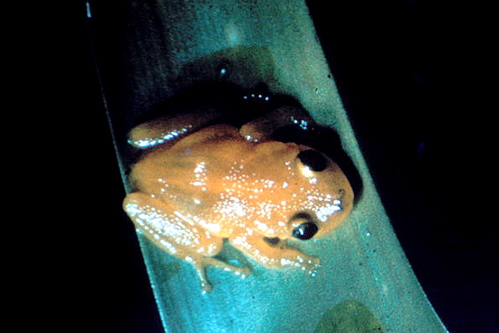 Golden CoquíEleutherodactylus jasperi
-
 Puerto Rican Wetland FrogEleutherodactylus juanariveroi
-
 Whistling CoquíEleutherodactylus cochranae
Compare
Questions and answers
What is the scientific name of the Yellow Mottled Coqui?
The scientific name of the Yellow Mottled Coqui is Eleutherodactylus lentus. Written with its author, the full name is Eleutherodactylus lentus (Cope, 1862).
Which family does the Yellow Mottled Coqui belong to?
Eleutherodactylus lentus belongs to the family Eleutherodactylidae, in the order Anura and the class Amphibia.
Where is the Yellow Mottled Coqui found?
Checklists and occurrence records place Eleutherodactylus lentus in 3 countries: U.S. Virgin Islands, British Virgin Islands and Bahamas.
What is the conservation status of the Yellow Mottled Coqui?
The IUCN Red List category recorded for Eleutherodactylus lentus is Endangered (EN).
What other names does the Yellow Mottled Coqui have?
Eleutherodactylus lentus is also known in English as Mute Coqui, Mute Frog, Virgin Islands Robber Frog and Virgin Islands Yellow Frog.
Sources
Passages the profile rests on
- The species inhabits subtropical or tropical dry forests, often near streams or other moist environments. Source passage: “Its natural habitat is subtropical or tropical dry forests, often near streams or other moist habitats.” — English Wikipedia
- The species prefers semi-xeric habitats and shelters beneath debris. Source passage: “The yellow-mottled coqui prefers semi-xeric habitats, where it hides under debris.” — English Wikipedia
- On Jost Van Dyke, individuals have been found sheltering beneath wooden boards and other objects in backyards. Source passage: “On Jost Van Dyke, it has been encountered in backyards sheltering under wooden boards and other objects” — English Wikipedia
- On Jost Van Dyke, individuals have also been encountered in freshwater puddles in garbage. Source passage: “as well as freshwater puddles in garbage.” — English Wikipedia
- The species has been recorded in agricultural areas on St. Thomas. Source passage: “On St. Thomas, it is known from agricultural areas.” — English Wikipedia
- The species occurs from sea level to an elevation of 10 metres. Source passage: “It is found from sea level up to an elevation of 10 m (33 ft).” — English Wikipedia
- Despite its common name, the species occasionally produces vocalizations. Source passage: “Despite its common name, it can be heard calling occasionally” — English Wikipedia
- The species sometimes vocalizes while sheltering beneath ground debris. Source passage: “with vocalizing sometimes performed from under debris on the ground.” — English Wikipedia
- The species lays its eggs on the ground. Source passage: “It lays its eggs on the ground” — English Wikipedia
- The species is thought to reproduce through direct development. Source passage: “and is thought to reproduce via direct development.” — English Wikipedia
- The species is classified as endangered on the IUCN Red List. Source passage: “The yellow-mottled coqui is classified as being endangered by the IUCN Red List” — English Wikipedia
- The species has an estimated distribution area of 2,315 square kilometres. Source passage: “limited distribution (estimated to be 2,315 km2)” — English Wikipedia
- The species' population is currently decreasing because of habitat degradation. Source passage: “Its population is currently decreasing due to habitat degradation.” — English Wikipedia
- Ongoing habitat degradation in the US Virgin Islands is identified as a threat to the species. Source passage: “ongoing habitat degradation in the US Virgin Islands.” — English Wikipedia
- The species is locally common in some locations despite previously being considered rare. Source passage: “It was previously thought to be rare, but better knowledge of its ecology has increased encounter rates and it is known to be locally common in some places.” — English Wikipedia
- The species occurs within Virgin Islands National Park, which protects approximately two-thirds of St. John and nearly all of Hassel Island. Source passage: “The species is known from the Virgin Islands National Park, which protects around two-thirds of St. John and nearly all of Hassel Island” — English Wikipedia
- Additional conservation measures are considered necessary on St. Thomas and St. Croix. Source passage: “but requires increased conservation on St. Thomas and St. Croix.” — English Wikipedia
- The species has also been recorded on Jost Van Dyke in the British Virgin Islands. Source passage: “and on the island of Jost Van Dyke in the British Virgin Islands.” — English Wikipedia
- The Jost Van Dyke population was first recorded in 2007. Source passage: “The population on Jost Van Dyke was first recorded in 2007” — English Wikipedia
- Whether the Jost Van Dyke population was introduced or previously overlooked remains uncertain. Source passage: “it is unclear whether it is introduced or was simply previously overlooked.” — English Wikipedia
- If the Jost Van Dyke population is invasive, its removal from the island has been suggested to protect native frogs. Source passage: “if that population is invasive, it has been suggested that the species be extirpated from the island to protect native frogs.” — English Wikipedia
Data
- Catalogue of Life, 2026-10-16 XR cc by
- Global Biodiversity Information Facility CC BY 4.0
- Wikidata CC0
- GeoNames CC BY 4.0
- Wikimedia Commons per image; credit shown with each image
- Within the Catalogue of Life, this name comes from The Integrated Taxonomic Information System cc0
References
- Banks, R. C., R. W. McDiarmid, and A. L. Gardner. (1987). Checklist of Vertebrates of the United States, the U.S. Territories, and Canada. Resource Publication, No. 166.
- Frost, Darrel R. (1997). Amphibian Species of the World, A Taxonomic and Geographic Reference. Second Edition.
This species in other databases
Page built on 29 November 2026. See how the catalog is made and all sources and licences.
Cite this page
ScientificNames.org. (2026). Eleutherodactylus lentus (Yellow Mottled Coqui). Retrieved November 29, 2026, from https://scientificnames.org/species/eleutherodactylus-lentus
“Eleutherodactylus lentus (Yellow Mottled Coqui).” ScientificNames.org, 2026, scientificnames.org/species/eleutherodactylus-lentus. Accessed 29 Nov. 2026.
ScientificNames.org. “Eleutherodactylus lentus (Yellow Mottled Coqui).” Accessed November 29, 2026. https://scientificnames.org/species/eleutherodactylus-lentus.
@misc{scientificnames_eleutherodactylus_lentus_yellow_mottled_coqui,
  author = {{ScientificNames.org}},
  title = {Eleutherodactylus lentus (Yellow Mottled Coqui)},
  year = {2026},
  url = {https://scientificnames.org/species/eleutherodactylus-lentus},
  note = {Accessed 2026-11-29}
}