Species · Amphibians
Yellow-striped Pygmy Eleuth Eleutherodactylus limbatus
The scientific name of the Yellow-striped Pygmy Eleuth is Eleutherodactylus limbatus. It is a species of amphibian in the family Eleutherodactylidae (rain frogs), order Anura. The name dates from 1862.
- Scientific name
- Eleutherodactylus limbatus (Cope, 1862)
- Common name
- Yellow-striped Pygmy Eleuth
- Genus
- Eleutherodactylus
- Family
- Eleutherodactylidae (Rain Frogs)
- Order
- Anura
- Class
- Amphibia
- Red List category
- LC Least Concern
- Recorded in
- 1 country
- Name status
- accepted in the Catalogue of Life

Overview
The Yellow-striped Pygmy Eleuth is an amphibian classified in the Eleutherodactylus limbatus group within the subgenus Euhyas. It inhabits closed-canopy mesic and xeric forests in Cuba at elevations of 50–1,150 m. It measures approximately 8.5–12 mm in length.
Written 27 November 2026 from the sources listed below. Each statement was checked against the passage it cites; statements that could not be supported were removed.
Appearance
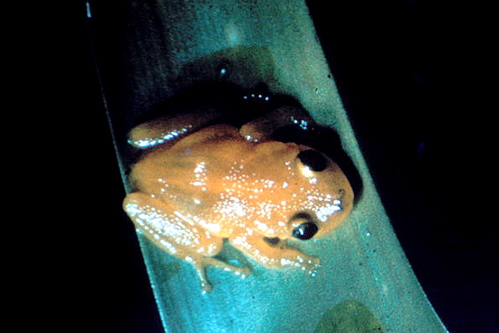
The species has relatively bright orange-yellow markings.[1]
Habitat
The species inhabits closed-canopy mesic forests and closed-canopy xeric forests.[2][3]
It occurs at elevations reaching 1,150 m above sea level. Its distribution in Cuba is patchy and highly fragmented, covering approximately 20,000 km².[4][5][6]
Behaviour
The species produces mating calls at a rate of 278 per minute.[7]
Reproduction and life cycle
Females possess a single ovary and lay one egg at a time.[8][9]
Females bury their eggs in the ground after laying them. The eggs develop quickly after burial.[10][11]
Similar species
The species belongs to a closely related Cuban group containing five additional described species: Eleutherodactylus cubanus, E. etheridgei, E. iberia, E. jaumei and E. orientalis.[12][13]
The original scientific name Phyllobates limbatus was published by Cope in 1862.[14]
The type locality of the species is eastern Cuba.[15]
A study of molecular phylogenetics suggested that the Gran Piedra population may not belong to the same species as the remaining nominal Eleutherodactylus limbatus populations.[16]
Classification of the Yellow-striped Pygmy Eleuth
| Kingdom | Animalia |
|---|---|
| Phylum | Chordata |
| Subphylum | Vertebrata |
| Infraphylum | Gnathostomata |
| Parvphylum | Osteichthyes |
| Megaclass | Tetrapoda |
| Class | Amphibia (Amphibians) |
| Order | Anura (Frogs) |
| Superfamily | Brachycephaloidea |
| Family | Eleutherodactylidae (Rain Frogs) |
| Subfamily | Eleutherodactylinae |
| Genus | Eleutherodactylus (Coquis) |
| Species | Eleutherodactylus limbatus (Cope, 1862) |
Where the Yellow-striped Pygmy Eleuth is found
Checklists and occurrence records place Eleutherodactylus limbatus in 1 country. GBIF holds 240 georeferenced records of it.
Countries
Regions and cities with the most records
- Cienfuegos Province, Cuba 76
- Santiago de Cuba Province, Cuba 65
- Lajas, Cuba 51
- Rodas, Cuba 51
- Pinar del Río, Cuba 34
- Cienfuegos, Cuba 25
- Palmira, Cuba 25
- Santiago de Cuba, Cuba 25
- Cumanayagua, Cuba 22
- Pinar del Río, Cuba 12
- San Cristobal, Cuba 12
- Guantánamo Province, Cuba 11
- Los Palacios, Cuba 10
- Minas de Matahambre, Cuba 10
- Viñales, Cuba 10
- Guantánamo, Cuba 6
- Río Guayabal de Yateras, Cuba 6
- Holguín Province, Cuba 5
- Bahía Honda, Cuba 4
- Maisí, Cuba 4
- Cruces, Cuba 3
- Jaruco, Cuba 3
- Mayabeque, Cuba 3
- San José de las Lajas, Cuba 3
1 more country has a few records outside this range
These countries hold a few records of Eleutherodactylus limbatus but lie outside the range the checklists give for it. Such records are often zoo or garden specimens, museum material or vagrants, so the species is not counted as occurring there.
A number beside a place is its count of GBIF occurrence records. A place without a number comes from a checklist alone. Records show where a species has been observed or collected, which can include escapes and vagrants.
Common names
English
- Yellow-striped Pygmy Eleuth
- Habana Robber Frog
- Robber Frog
- Yellow-striped Dwarf Frog
Names in 3 other languages
- Czech
- bezblanka nejmenší
- Hebrew
- קרפדה גמדית
- Russian
- Кубинский карлик, Кубинский свистун
Synonyms
4 other scientific names have been used for this species and are now treated as synonyms of Eleutherodactylus limbatus.
- Euhyas limbata (Cope, 1862)
- Phyllobates limbatus Cope, 1862
- Sminthillus limbatus (Cope, 1862)
- Sminthillus limbatus limbatus (Cope, 1862)
Related species
-
 Common CoquíEleutherodactylus coqui
-
 Greenhouse FrogEleutherodactylus planirostris
-
 Antilles CoquíEleutherodactylus johnstonei
-
 Puerto Rican Rock FrogEleutherodactylus cooki
-
 Rio Grande Chirping FrogEleutherodactylus cystignathoides
-
 Golden CoquíEleutherodactylus jasperi
-
 Puerto Rican Wetland FrogEleutherodactylus juanariveroi
-
 Whistling CoquíEleutherodactylus cochranae
Compare
Questions and answers
What is the scientific name of the Yellow-striped Pygmy Eleuth?
The scientific name of the Yellow-striped Pygmy Eleuth is Eleutherodactylus limbatus. Written with its author, the full name is Eleutherodactylus limbatus (Cope, 1862).
Which family does the Yellow-striped Pygmy Eleuth belong to?
Eleutherodactylus limbatus belongs to the family Eleutherodactylidae, in the order Anura and the class Amphibia.
Where is the Yellow-striped Pygmy Eleuth found?
Checklists and occurrence records place Eleutherodactylus limbatus in 1 country: Cuba.
What is the conservation status of the Yellow-striped Pygmy Eleuth?
The IUCN Red List category recorded for Eleutherodactylus limbatus is Least Concern (LC).
What other names does the Yellow-striped Pygmy Eleuth have?
Eleutherodactylus limbatus is also known in English as Habana Robber Frog, Robber Frog and Yellow-striped Dwarf Frog.
Sources
Passages the profile rests on
- The species has relatively bright orange-yellow markings. Source passage: “The yellow-striped pygmy eleuth is relatively brightly marked in orange-yellow” — English Wikipedia
- The species inhabits closed-canopy mesic forests. Source passage: “in closed-canopy mesic and xeric forests.” — English Wikipedia
- The species inhabits closed-canopy xeric forests. Source passage: “in closed-canopy mesic and xeric forests.” — English Wikipedia
- The species occurs at elevations reaching 1,150 m above sea level. Source passage: “These frogs are found in Cuba at elevations up to 1,150 m above sea level” — English Wikipedia
- The species has a patchy distribution throughout Cuba. Source passage: “Patchy distribution throughout Cuba, 50–1150 m elevation.” — amphibiansoftheworld.amnh.org
- The species has a highly fragmented distribution covering approximately 20,000 km². Source passage: “Their distribution is highly fragmented, with the total land area equaling 7,700 mi2 (20,000 km2).” — English Wikipedia
- The species produces mating calls at a rate of 278 per minute. Source passage: “at a rate of 278 per minute.” — English Wikipedia
- Females possess a single ovary. Source passage: “Female frogs have a single ovary” — English Wikipedia
- Females lay one egg at a time. Source passage: “lay one egg at a time” — English Wikipedia
- Females bury their eggs in the ground after laying them. Source passage: “which is subsequently buried in the ground” — English Wikipedia
- Eggs develop quickly after being buried in the ground. Source passage: “where it develops quickly.” — English Wikipedia
- The species belongs to a closely related Cuban group containing five additional described species. Source passage: “a closely related Cuban group that contains five additional described species” — English Wikipedia
- The closely related Cuban group includes Eleutherodactylus cubanus, E. etheridgei, E. iberia, E. jaumei and E. orientalis. Source passage: “(E. cubanus, E. etheridgei, E. iberia, E. jaumei and E. orientalis)” — English Wikipedia
- The original scientific name Phyllobates limbatus was published by Cope in 1862. Source passage: “Phyllobates limbatus Cope, 1862, Proc. Acad. Nat. Sci. Philadelphia, 14: 154.” — amphibiansoftheworld.amnh.org
- The type locality of the species is eastern Cuba. Source passage: “Type locality: "Eastern Cuba".” — amphibiansoftheworld.amnh.org
- A study of molecular phylogenetics suggested that the Gran Piedra population may not belong to the same species as the remaining nominal Eleutherodactylus limbatus populations. Source passage: “provided evidence that suggests that the Gran Piedra population is not conspecific with the rest of nominal Eleutherodactylus limbatus.” — amphibiansoftheworld.amnh.org
Data
- Catalogue of Life, 2026-10-16 XR cc by
- Global Biodiversity Information Facility CC BY 4.0
- Wikidata CC0
- GeoNames CC BY 4.0
- Wikimedia Commons per image; credit shown with each image
- Within the Catalogue of Life, this name comes from The Integrated Taxonomic Information System cc0
References
- Frost, Darrel R. (1997). Amphibian Species of the World, A Taxonomic and Geographic Reference. Second Edition.
This species in other databases
Page built on 29 November 2026. See how the catalog is made and all sources and licences.
Cite this page
ScientificNames.org. (2026). Eleutherodactylus limbatus (Yellow-striped Pygmy Eleuth). Retrieved November 29, 2026, from https://scientificnames.org/species/eleutherodactylus-limbatus
“Eleutherodactylus limbatus (Yellow-striped Pygmy Eleuth).” ScientificNames.org, 2026, scientificnames.org/species/eleutherodactylus-limbatus. Accessed 29 Nov. 2026.
ScientificNames.org. “Eleutherodactylus limbatus (Yellow-striped Pygmy Eleuth).” Accessed November 29, 2026. https://scientificnames.org/species/eleutherodactylus-limbatus.
@misc{scientificnames_eleutherodactylus_limbatus_yellow_striped_pygmy_eleuth,
  author = {{ScientificNames.org}},
  title = {Eleutherodactylus limbatus (Yellow-striped Pygmy Eleuth)},
  year = {2026},
  url = {https://scientificnames.org/species/eleutherodactylus-limbatus},
  note = {Accessed 2026-11-29}
}