Species · Amphibians
Locust Coquí Eleutherodactylus locustus
The scientific name of the Locust Coquí is Eleutherodactylus locustus. It is a species of amphibian in the family Eleutherodactylidae (rain frogs), order Anura. The name dates from 1920.
- Scientific name
- Eleutherodactylus locustus Schmidt, 1920
- Common name
- Locust Coquí
- Genus
- Eleutherodactylus
- Family
- Eleutherodactylidae (Rain Frogs)
- Order
- Anura
- Class
- Amphibia
- Red List category
- EN Endangered
- Recorded in
- 2 countries
- Name status
- accepted in the Catalogue of Life
Overview
Eleutherodactylus locustus is endemic to Puerto Rico and restricted to the interior uplands of eastern Puerto Rico. Adults measure approximately 20 mm in snout-vent length.
Written 27 November 2026 from the sources listed below. Each statement was checked against the passage it cites; statements that could not be supported were removed.
Appearance
The Locust Coquí is predominantly brown, with fine variegation and lighter brown or cream coloration. Its back usually has a pair of externally concave lines, while a vertebral line of variable width may or may not be present.[1][2][3]
It has large, protruding eyes and rounded, indistinct snout angles.[4]
Habitat
The Locust Coquí is restricted to the interior uplands of eastern Puerto Rico. It inhabits subtropical or tropical moist lowland forests, moist montane forests, and mesic broadleaf forests.[5][6][7]
It occurs at elevations between 273 and 1,050 metres above sea level and is terrestrial.[8][7]
Behaviour
The Locust Coquí lacks interdigital membranes and is poorly adapted to swimming. Its toe pads allow it to adhere to leaves and branches.[9][10]
Reproduction and life cycle
The Locust Coquí reproduces through internal fertilization. Fertilized eggs undergo direct development without a free-living tadpole stage, and hatchlings emerge as fully functional froglets.[11][12][13]
Females produce four to six clutches of approximately 28 eggs each year. Egg deposition occurs mostly during the rainy season, and egg development takes approximately 26 days.[14][15][16]
Males guard the eggs to maintain their moisture and remain in the nest for several days after the froglets emerge.[17][18]
Conservation
The Locust Coquí has experienced a population decline exceeding 80%. Introduced predators and amphibian chytrid disease have contributed to the decline.[19][20]
The species has undergone a major unexplained decline in abundance over the last two decades, including in relatively undisturbed forests.[21]
Classification of the Locust Coquí
| Kingdom | Animalia |
|---|---|
| Phylum | Chordata |
| Subphylum | Vertebrata |
| Infraphylum | Gnathostomata |
| Parvphylum | Osteichthyes |
| Megaclass | Tetrapoda |
| Class | Amphibia (Amphibians) |
| Order | Anura (Frogs) |
| Superfamily | Brachycephaloidea |
| Family | Eleutherodactylidae (Rain Frogs) |
| Subfamily | Eleutherodactylinae |
| Genus | Eleutherodactylus (Coquis) |
| Species | Eleutherodactylus locustus Schmidt, 1920 |
Where the Locust Coquí is found
Checklists and occurrence records place Eleutherodactylus locustus in 2 countries across North America. GBIF holds 360 georeferenced records of it.
Countries
Regions and cities with the most records
- Fajardo, Puerto Rico 265
- Humacao, Puerto Rico 246
- Río Grande, Puerto Rico 243
- Carolina, Puerto Rico 129
- Peñuelas, Puerto Rico 33
- Ponce, Puerto Rico 33
- Yauco, Puerto Rico 33
- Cayey, Puerto Rico 28
- Caguas, Puerto Rico 26
- Caguas, Puerto Rico 23
- Trujillo Alto, Puerto Rico 13
- Luquillo, Puerto Rico 12
- Guayama, Puerto Rico 10
- Naguabo, Puerto Rico 8
- Ciales, Puerto Rico 4
- Manatí, Puerto Rico 4
- Yabucoa, Puerto Rico 3
Range as the checklists state it
Caribbean
A number beside a place is its count of GBIF occurrence records. A place without a number comes from a checklist alone. Records show where a species has been observed or collected, which can include escapes and vagrants.
Common names
English
- Locust Coqui
- Interior Robber Frog
- Warty Coqui
Names in 2 other languages
- Russian
- Саранчовая листовая лягушка
- Spanish
- Coqui Martillito
Synonyms
One other scientific name has been used for this species and is now treated as a synonym of Eleutherodactylus locustus.
- Eleutherodactylus cramptoni Schmidt, 1920
Related species
-
 Common CoquíEleutherodactylus coqui
-
 Greenhouse FrogEleutherodactylus planirostris
-
 Antilles CoquíEleutherodactylus johnstonei
-
 Puerto Rican Rock FrogEleutherodactylus cooki
-
 Rio Grande Chirping FrogEleutherodactylus cystignathoides
-
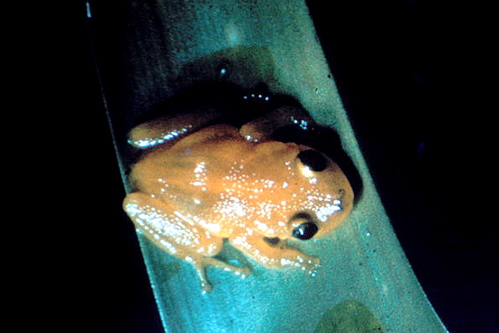 Golden CoquíEleutherodactylus jasperi
-
 Puerto Rican Wetland FrogEleutherodactylus juanariveroi
-
 Whistling CoquíEleutherodactylus cochranae
Compare
Questions and answers
What is the scientific name of the Locust Coquí?
The scientific name of the Locust Coquí is Eleutherodactylus locustus. Written with its author, the full name is Eleutherodactylus locustus Schmidt, 1920.
Which family does the Locust Coquí belong to?
Eleutherodactylus locustus belongs to the family Eleutherodactylidae, in the order Anura and the class Amphibia.
Where is the Locust Coquí found?
Checklists and occurrence records place Eleutherodactylus locustus in 2 countries: Puerto Rico and United States.
What is the conservation status of the Locust Coquí?
The IUCN Red List category recorded for Eleutherodactylus locustus is Endangered (EN).
What other names does the Locust Coquí have?
Eleutherodactylus locustus is also known in English as Locust Coqui, Interior Robber Frog and Warty Coqui.
Where do coquí frogs typically live?
The Locust Coquí is endemic to Puerto Rico and restricted to the interior uplands of eastern Puerto Rico. It inhabits subtropical or tropical moist lowland forests, moist montane forests, and mesic broadleaf forests at elevations between 273 and 1,050 metres above sea level.[22][5][6][8][7]
Sources
Passages the profile rests on
- The species is predominantly brown with fine variegation and lighter brown or cream coloration. Source passage: “It is brown overall, minutely variegated, with lighter brown or cream colors.” — English Wikipedia
- Its back usually has a pair of externally concave lines. Source passage: “A pair of externally concave lines is almost always visible on the back” — English Wikipedia
- A vertebral line of variable width may or may not be present. Source passage: “a variable-width line along the vertebrae may or may not be present.” — English Wikipedia
- The species has large, protruding eyes and rounded, indistinct snout angles. Source passage: “The eyes are large and protuberant, and the angles at the side of the snout are rounded and indistinct.” — English Wikipedia
- The species inhabits subtropical or tropical moist lowland forests and moist montane forests. Source passage: “Its natural habitats are subtropical or tropical moist lowland forests and subtropical or tropical moist montane forests.” — English Wikipedia
- The species is restricted to the interior uplands of eastern Puerto Rico. Source passage: “restricted to the interior uplands of eastern Puerto Rico” — English Wikipedia
- The species is terrestrial and occurs in mesic broadleaf forests. Source passage: “A terrestrial species, it occurs in mesic broadleaf” — English Wikipedia
- The species occurs at elevations between 273 and 1,050 metres above sea level. Source passage: “at elevations of 895 to 3,444 ft (273 to 1,050 m) above sea level.” — English Wikipedia
- The species lacks interdigital membranes and is poorly adapted to swimming. Source passage: “E. locustus does not have interdigital membranes, so is not well adapted to swimming;” — English Wikipedia
- Toe pads allow the species to adhere to leaves and branches. Source passage: “it has pads on its toes that allow it to adhere to leaves and branches.” — English Wikipedia
- The species reproduces through internal fertilization. Source passage: “The species uses internal fertilization” — English Wikipedia
- Fertilized eggs undergo direct development without a free-living tadpole stage. Source passage: “The tadpole stage occurs entirely within the egg, rather than as a free-living tadpole.” — English Wikipedia
- Hatchlings emerge from eggs as fully functional froglets. Source passage: “a tiny but fully functional froglet hatches directly from the egg.” — English Wikipedia
- Females produce four to six clutches of approximately 28 eggs each year. Source passage: “E. locustus females deposit four to six clutches of about 28 eggs each per year” — English Wikipedia
- Egg deposition occurs mostly during the rainy season. Source passage: “mostly during the rainy season” — English Wikipedia
- Egg development takes approximately 26 days. Source passage: “with a development period of 26 days.” — English Wikipedia
- Males guard the eggs to maintain their moisture. Source passage: “Males guard the eggs to keep them moist” — English Wikipedia
- Males remain in the nest for several days after the froglets emerge. Source passage: “remain in the nest for a few days after they emerge.” — English Wikipedia
- The species has experienced a population decline exceeding 80%. Source passage: “E. locustus has suffered a population decline of more than 80%” — English Wikipedia
- Introduced predators and amphibian chytrid disease have contributed to the population decline. Source passage: “due to introduced predators and amphibian chytrid disease.” — English Wikipedia
- The species has undergone a major unexplained decline in abundance over the last two decades, including in relatively undisturbed forests. Source passage: “an unexplained major decline in the abundance of this species has occurred in the last two decades, even in relatively undisturbed forests” — English Wikipedia
- The species is endemic to Puerto Rico. Source passage: “endemic to Puerto Rico.” — English Wikipedia
Data
- Catalogue of Life, 2026-10-16 XR cc by
- Global Biodiversity Information Facility CC BY 4.0
- Wikidata CC0
- GeoNames CC BY 4.0
- Within the Catalogue of Life, this name comes from The Integrated Taxonomic Information System cc0
References
- Frost, Darrel R. (1997). Amphibian Species of the World, A Taxonomic and Geographic Reference. Second Edition.
This species in other databases
Page built on 29 November 2026. See how the catalog is made and all sources and licences.
Cite this page
ScientificNames.org. (2026). Eleutherodactylus locustus (Locust Coquí). Retrieved November 29, 2026, from https://scientificnames.org/species/eleutherodactylus-locustus
“Eleutherodactylus locustus (Locust Coquí).” ScientificNames.org, 2026, scientificnames.org/species/eleutherodactylus-locustus. Accessed 29 Nov. 2026.
ScientificNames.org. “Eleutherodactylus locustus (Locust Coquí).” Accessed November 29, 2026. https://scientificnames.org/species/eleutherodactylus-locustus.
@misc{scientificnames_eleutherodactylus_locustus_locust_coqui,
  author = {{ScientificNames.org}},
  title = {Eleutherodactylus locustus (Locust Coquí)},
  year = {2026},
  url = {https://scientificnames.org/species/eleutherodactylus-locustus},
  note = {Accessed 2026-11-29}
}