Species · Amphibians
Neiba Whistling Frog Eleutherodactylus parabates
The scientific name of the Neiba Whistling Frog is Eleutherodactylus parabates. It is a species of amphibian in the family Eleutherodactylidae (rain frogs), order Anura. The name dates from 1964.
- Scientific name
- Eleutherodactylus parabates Schwartz, 1964
- Common name
- Neiba Whistling Frog
- Genus
- Eleutherodactylus
- Family
- Eleutherodactylidae (Rain Frogs)
- Order
- Anura
- Class
- Amphibia
- Red List category
- EN Endangered
- Recorded in
- 1 country
- Name status
- accepted in the Catalogue of Life
Overview
Eleutherodactylus parabates is endemic to Hispaniola and occurs along the crest of the Sierra de Neiba near the Dominican Republic–Haiti border. It has a pointed snout, a relatively large tympanum, and a brown longitudinal band extending from the snout to the groin.
Written 27 November 2026 from the sources listed below. Each statement was checked against the passage it cites; statements that could not be supported were removed.
Appearance
The Neiba Whistling Frog has a rather pointed snout and a relatively large tympanum. Its fingers and toes have moderately developed discs and no webbing.[1][2][3]
Its dorsal coloration includes a brown longitudinal band extending from the snout to the groin. Some individuals have a median tan line along the back, and a faint tan dorsolateral stripe separates the brown dorsal band from the darker brown sides.[4][5][6]
The lips are mottled. The throat and belly are yellowish tan with heavy brown mottling.[7][8]
Adult females measure 22–24 mm in snout–vent length. Adult males have a recorded snout–vent length of 18 mm, based on one specimen.[9][10]
Habitat
The Neiba Whistling Frog inhabits dense, closed hardwood forests at elevations of 1,455–1,870 m above sea level.[11]
It can be found beneath rocks and logs and also occurs in low-arboreal bromeliads.[12][13]
Reproduction and life cycle
The Neiba Whistling Frog deposits its eggs on the ground. It has direct development without a free-living larval stage.[14][15]
Conservation
The Neiba Whistling Frog can be moderately common in suitable habitat. It was last recorded in 2019.[16][17]
The species occurs within Parque Nacional Sierra de Neiba, where habitat loss also occurs. Its forest habitat is declining rapidly, and its natural habitat is declining extremely rapidly.[18][19][20][21]
The species was most recently assessed for the IUCN Red List in 2020.[22]
Classification of the Neiba Whistling Frog
| Kingdom | Animalia |
|---|---|
| Phylum | Chordata |
| Subphylum | Vertebrata |
| Infraphylum | Gnathostomata |
| Parvphylum | Osteichthyes |
| Megaclass | Tetrapoda |
| Class | Amphibia (Amphibians) |
| Order | Anura (Frogs) |
| Superfamily | Brachycephaloidea |
| Family | Eleutherodactylidae (Rain Frogs) |
| Subfamily | Eleutherodactylinae |
| Genus | Eleutherodactylus (Coquis) |
| Species | Eleutherodactylus parabates Schwartz, 1964 |
Where the Neiba Whistling Frog is found
Checklists and occurrence records place Eleutherodactylus parabates in 1 country. GBIF holds 114 georeferenced records of it.
Countries
Regions and cities with the most records
A number beside a place is its count of GBIF occurrence records. A place without a number comes from a checklist alone. Records show where a species has been observed or collected, which can include escapes and vagrants.
Common names
English
- Neiba Whistling Frog
- Independencia Robber Frog
Names in 1 other language
- Spanish
- Rana Silbadora de Neiba
Synonyms
One other scientific name has been used for this species and is now treated as a synonym of Eleutherodactylus parabates.
- Euhyas parabates (Schwartz, 1964)
Related species
-
 Common CoquíEleutherodactylus coqui
-
 Greenhouse FrogEleutherodactylus planirostris
-
 Antilles CoquíEleutherodactylus johnstonei
-
 Puerto Rican Rock FrogEleutherodactylus cooki
-
 Rio Grande Chirping FrogEleutherodactylus cystignathoides
-
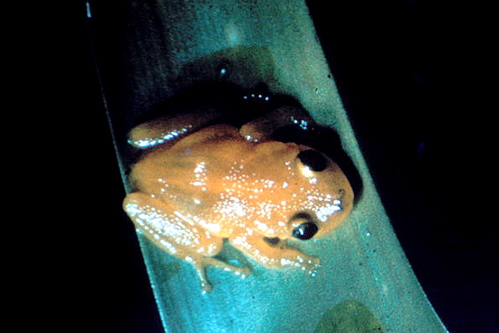 Golden CoquíEleutherodactylus jasperi
-
 Puerto Rican Wetland FrogEleutherodactylus juanariveroi
-
 Whistling CoquíEleutherodactylus cochranae
Compare
Questions and answers
What is the scientific name of the Neiba Whistling Frog?
The scientific name of the Neiba Whistling Frog is Eleutherodactylus parabates. Written with its author, the full name is Eleutherodactylus parabates Schwartz, 1964.
Which family does the Neiba Whistling Frog belong to?
Eleutherodactylus parabates belongs to the family Eleutherodactylidae, in the order Anura and the class Amphibia.
Where is the Neiba Whistling Frog found?
Checklists and occurrence records place Eleutherodactylus parabates in 1 country: Dominican Republic.
What is the conservation status of the Neiba Whistling Frog?
The IUCN Red List category recorded for Eleutherodactylus parabates is Endangered (EN).
What other names does the Neiba Whistling Frog have?
Eleutherodactylus parabates is also known in English as Independencia Robber Frog.
Where does the Neiba Whistling Frog occur?
It is endemic to Hispaniola and occurs along the crest of the Sierra de Neiba near the Dominican Republic–Haiti border.[23]
What does the specific name parabates mean?
The specific name parabates derives from the Greek word for transgressor.[24]
Why was the species named parabates?
It was named for being the first Hispaniolan member of the Eleutherodactylus dimidiatus species group recorded north of the Plain of the Cul-de-Sac–Valle de Neiba.[25]
Where does the Neiba Whistling Frog shelter?
It can be found beneath rocks and logs and in low-arboreal bromeliads.[12][13]
When was the Neiba Whistling Frog described?
The species was described by Schwartz in 1964.[26]
Sources
Passages the profile rests on
- The species has a rather pointed snout. Source passage: “The snout is rather pointed.” — English Wikipedia
- The species has a relatively large tympanum. Source passage: “The tympanum is relatively large.” — English Wikipedia
- Its fingers and toes have moderately developed discs and no webbing. Source passage: “The fingers and toes have moderately well-developed discs but lack webbing.” — English Wikipedia
- Its dorsal coloration includes a brown longitudinal band extending from the snout to the groin. Source passage: “The dorsal coloration consists of a brown longitudinal band running from the snout to the groin;” — English Wikipedia
- Some individuals have a median tan line along the back. Source passage: “some individuals have a median tan dorsal line.” — English Wikipedia
- A faint tan dorsolateral stripe separates the brown dorsal band from the darker brown sides. Source passage: “The dorsal band is separated from the darker brown sides by a faint tan dorsolateral stripe.” — English Wikipedia
- The lips are mottled. Source passage: “The lips are mottled.” — English Wikipedia
- The throat and belly are yellowish tan with heavy brown mottling. Source passage: “The throat and belly are yellowish tan with heavy brown mottling.” — English Wikipedia
- Adult females measure 22–24 mm in snout–vent length. Source passage: “Adult females measure 22–24 mm (0.87–0.94 in)” — English Wikipedia
- Adult males have a recorded snout–vent length of 18 mm, based on one specimen. Source passage: “adult males, based on a single specimen, 18 mm (0.7 in) in snout–vent length.” — English Wikipedia
- The species inhabits dense, closed hardwood forests at elevations of 1,455–1,870 m above sea level. Source passage: “inhabits high-elevation (1,455–1,870 m (4,774–6,135 ft) a.s.l.) dense, closed hardwood forest” — English Wikipedia
- The species can be found beneath rocks and logs. Source passage: “where it can be found under rocks and logs” — English Wikipedia
- The species also occurs in low-arboreal bromeliads. Source passage: “and in low-arboreal bromeliads.” — English Wikipedia
- The species deposits its eggs on the ground. Source passage: “Eggs are deposited on the ground” — English Wikipedia
- The species has direct development without a free-living larval stage. Source passage: “have direct development (i.e., there is no free-living larval stage).” — English Wikipedia
- The species can be moderately common in suitable habitat. Source passage: “Eleutherodactylus parabates can be moderately common in suitable habitat” — English Wikipedia
- The species was last recorded in 2019. Source passage: “was last recorded in 2019.” — English Wikipedia
- The forest habitat on which the species depends is declining rapidly. Source passage: “the forest habitat this species depends on is declining rapidly.” — English Wikipedia
- The species occurs within Parque Nacional Sierra de Neiba. Source passage: “It is present in the Parque Nacional Sierra de Neiba” — English Wikipedia
- Habitat loss also occurs within Parque Nacional Sierra de Neiba. Source passage: “but habitat loss occurs also in the park.” — English Wikipedia
- The species' natural habitat is declining extremely rapidly. Source passage: “This habitat is declining extremely rapidly.” — inaturalist.org
- The species was most recently assessed for the IUCN Red List in 2020. Source passage: “Neiba Whistling Frog Eleutherodactylus parabates has most recently been assessed for The IUCN Red List of Threatened Species in 2020.” — iucnredlist.org
- The species is endemic to Hispaniola and occurs along the crest of the Sierra de Neiba near the Dominican Republic–Haiti border. Source passage: “It is endemic to Hispaniola and found along the crest of the Sierra de Neiba, near the border between the Dominican Republic and Haiti.” — English Wikipedia
- The specific name parabates derives from the Greek word for transgressor. Source passage: “The specific name parabates is Greek for "transgressor"” — English Wikipedia
- The species was named for being the first Hispaniolan member of the Eleutherodactylus dimidiatus species group recorded north of the Plain of the Cul-de-Sac–Valle de Neiba. Source passage: “refers to this species being the first Hispaniolan member of the "Eleutherodactylus dimidiatus species group" recorded north of the Plain of the Cul-de-Sac–Valle de Neiba” — English Wikipedia
- The species was described by Schwartz in 1964. Source passage: “Eleutherodactylus parabates Schwartz, 1964.” — amphibiaweb.org
Data
- Catalogue of Life, 2026-10-16 XR cc by
- Global Biodiversity Information Facility CC BY 4.0
- Wikidata CC0
- GeoNames CC BY 4.0
- Within the Catalogue of Life, this name comes from The Integrated Taxonomic Information System cc0
References
- Frost, Darrel R. (1997). Amphibian Species of the World, A Taxonomic and Geographic Reference. Second Edition.
This species in other databases
Page built on 27 November 2026. See how the catalog is made and all sources and licences.
Cite this page
ScientificNames.org. (2026). Eleutherodactylus parabates (Neiba Whistling Frog). Retrieved November 27, 2026, from https://scientificnames.org/species/eleutherodactylus-parabates
“Eleutherodactylus parabates (Neiba Whistling Frog).” ScientificNames.org, 2026, scientificnames.org/species/eleutherodactylus-parabates. Accessed 27 Nov. 2026.
ScientificNames.org. “Eleutherodactylus parabates (Neiba Whistling Frog).” Accessed November 27, 2026. https://scientificnames.org/species/eleutherodactylus-parabates.
@misc{scientificnames_eleutherodactylus_parabates_neiba_whistling_frog,
  author = {{ScientificNames.org}},
  title = {Eleutherodactylus parabates (Neiba Whistling Frog)},
  year = {2026},
  url = {https://scientificnames.org/species/eleutherodactylus-parabates},
  note = {Accessed 2026-11-27}
}