Species · Amphibians
Macaya Burrowing Frog Eleutherodactylus parapelates
The scientific name of the Macaya Burrowing Frog is Eleutherodactylus parapelates. It is a species of amphibian in the family Eleutherodactylidae (rain frogs), order Anura. The name dates from 1987.
- Scientific name
- Eleutherodactylus parapelates Hedges & Thomas, 1987
- Common name
- Macaya Burrowing Frog
- Genus
- Eleutherodactylus
- Family
- Eleutherodactylidae (Rain Frogs)
- Order
- Anura
- Class
- Amphibia
- Red List category
- CR Critically Endangered
- Recorded in
- 1 country
- Name status
- accepted in the Catalogue of Life
Overview
The Macaya Burrowing Frog belongs to the subfamily Eleutherodactylinae. The species is endemic to the Massif de la Hotte in southwestern Haiti. It has expanded finger and toe tips, black supra-tympanic markings, and dorsal coloration ranging from dark brown to nearly tan with darker spotting.
Written 27 November 2026 from the sources listed below. Each statement was checked against the passage it cites; statements that could not be supported were removed.
Habitat
The Macaya Burrowing Frog inhabits tropical closed forests. Its documented habitat elevations range from 950 to 1,050 m above sea level.[1][2]
Appearance
The snout protrudes when viewed in profile, and the canthus rostralis is well defined. A prominent supra-tympanic fold conceals the upper edge of the tympanum.[3][4][5]
The fingers and toes have expanded tips. The toes lack webbing, while the fingers have indistinct lateral ridges.[6][7]
Dorsal coloration ranges from dark brown to pale brown, nearly tan, with darker spotting. The species has black supra-tympanic markings.[8][9]
Adult males average 48.9 mm in snout–vent length and can reach 52 mm.[10][11]
Behaviour
The species is fossorial, and males call from shallow underground chambers. Calling males have been observed approximately 1 m apart.[12][13][14]
At least one individual has been observed on herbaceous vegetation approximately 1 m above the ground.[15]
Reproduction and life cycle
The species lays its eggs underground.[16]
Conservation
Habitat loss threatens the Macaya Burrowing Frog. Severe habitat destruction within its range is primarily associated with charcoal-production logging and slash-and-burn agriculture.[17][18]
Part of the species' range overlaps with Pic Macaya National Park, which is not managed for conservation.[19][20]
The species was formerly moderately common in suitable habitat but has largely disappeared.[21]
Classification of the Macaya Burrowing Frog
| Kingdom | Animalia |
|---|---|
| Phylum | Chordata |
| Subphylum | Vertebrata |
| Infraphylum | Gnathostomata |
| Parvphylum | Osteichthyes |
| Megaclass | Tetrapoda |
| Class | Amphibia (Amphibians) |
| Order | Anura (Frogs) |
| Superfamily | Brachycephaloidea |
| Family | Eleutherodactylidae (Rain Frogs) |
| Subfamily | Eleutherodactylinae |
| Genus | Eleutherodactylus (Coquis) |
| Species | Eleutherodactylus parapelates Hedges & Thomas, 1987 |
Where the Macaya Burrowing Frog is found
Checklists and occurrence records place Eleutherodactylus parapelates in 1 country. GBIF holds 18 georeferenced records of it.
Countries
Regions and cities with the most records
A number beside a place is its count of GBIF occurrence records. A place without a number comes from a checklist alone. Records show where a species has been observed or collected, which can include escapes and vagrants.
Common names
English
- Macaya Burrowing Frog
- Casillon Robber Frog
Synonyms
One other scientific name has been used for this species and is now treated as a synonym of Eleutherodactylus parapelates.
- Pelorius parapelates (Hedges & Thomas, 1987)
Related species
-
 Common CoquíEleutherodactylus coqui
-
 Greenhouse FrogEleutherodactylus planirostris
-
 Antilles CoquíEleutherodactylus johnstonei
-
 Puerto Rican Rock FrogEleutherodactylus cooki
-
 Rio Grande Chirping FrogEleutherodactylus cystignathoides
-
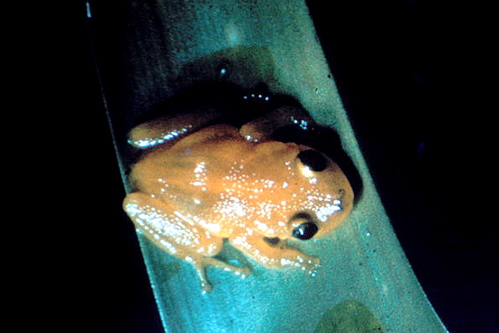 Golden CoquíEleutherodactylus jasperi
-
 Puerto Rican Wetland FrogEleutherodactylus juanariveroi
-
 Whistling CoquíEleutherodactylus cochranae
Compare
Questions and answers
What is the scientific name of the Macaya Burrowing Frog?
The scientific name of the Macaya Burrowing Frog is Eleutherodactylus parapelates. Written with its author, the full name is Eleutherodactylus parapelates Hedges & Thomas, 1987.
Which family does the Macaya Burrowing Frog belong to?
Eleutherodactylus parapelates belongs to the family Eleutherodactylidae, in the order Anura and the class Amphibia.
Where is the Macaya Burrowing Frog found?
Checklists and occurrence records place Eleutherodactylus parapelates in 1 country: Haiti.
What is the conservation status of the Macaya Burrowing Frog?
The IUCN Red List category recorded for Eleutherodactylus parapelates is Critically Endangered (CR).
What other names does the Macaya Burrowing Frog have?
Eleutherodactylus parapelates is also known in English as Casillon Robber Frog.
Sources
Passages the profile rests on
- The species inhabits tropical closed forests. Source passage: “Its natural habitats are tropical closed forests” — English Wikipedia
- Its documented habitat elevations range from 950 to 1,050 m above sea level. Source passage: “at elevations of 950–1,050 m (3,120–3,440 ft) above sea level.” — English Wikipedia
- The snout protrudes when viewed in profile. Source passage: “The snout is protruding in profile.” — English Wikipedia
- The species has a well-defined canthus rostralis. Source passage: “The canthus rostralis is well defined.” — English Wikipedia
- Its prominent supra-tympanic fold conceals the upper edge of the tympanum. Source passage: “The supra-tympanic fold is prominent and hides the upper edge of the tympanum.” — English Wikipedia
- Its fingers and toes have expanded tips. Source passage: “The fingers and toes have expanded tips;” — English Wikipedia
- Its toes lack webbing, while its fingers have indistinct lateral ridges. Source passage: “toes are unwebbed but fingers have indistinct lateral ridges.” — English Wikipedia
- Its dorsal coloration ranges from dark brown to pale brown, nearly tan, with darker spotting. Source passage: “The dorsum is dark brown to pale brown, almost tan, and has darker spotting.” — English Wikipedia
- The species has black supra-tympanic markings. Source passage: “There are black supra-tympanic markings.” — English Wikipedia
- Adult males average 48.9 mm in snout–vent length. Source passage: “Adult males measure on average 48.9 mm (1.93 in) in snout–vent length” — English Wikipedia
- Adult males can reach 52 mm in snout–vent length. Source passage: “can reach 52 mm (2.0 in);” — English Wikipedia
- The species is fossorial. Source passage: “It is a fossorial species.” — English Wikipedia
- Males call from shallow underground chambers. Source passage: “Males call from shallow, underground chambers,” — English Wikipedia
- Calling males have been observed approximately 1 m apart. Source passage: “Calling males can be found quite close to each other (about 1 m apart).” — English Wikipedia
- At least one individual has been observed on herbaceous vegetation approximately 1 m above the ground. Source passage: “However, one individual was found on herbaceous vegetation about 1 m above the ground.” — English Wikipedia
- The species lays its eggs underground. Source passage: “and also the eggs are laid underground.” — English Wikipedia
- Habitat loss threatens the species. Source passage: “Eleutherodactylus parapelates is threatened by habitat loss:” — English Wikipedia
- Severe habitat destruction within its range is primarily associated with charcoal-production logging and slash-and-burn agriculture. Source passage: “primarily due to logging for charcoal production by local people and by slash-and-burn agriculture.” — English Wikipedia
- Part of the species' range overlaps with Pic Macaya National Park. Source passage: “Part of its range overlaps with the Pic Macaya National Park,” — English Wikipedia
- Pic Macaya National Park is not managed for conservation. Source passage: “but the park is not managed for conservation.” — English Wikipedia
- The species was formerly moderately common in suitable habitat but has largely disappeared. Source passage: “It was formerly moderately common in suitable habitat but has now largely disappeared.” — English Wikipedia
Data
- Catalogue of Life, 2026-10-16 XR cc by
- Global Biodiversity Information Facility CC BY 4.0
- Wikidata CC0
- GeoNames CC BY 4.0
- Within the Catalogue of Life, this name comes from The Integrated Taxonomic Information System cc0
This species in other databases
Page built on 29 November 2026. See how the catalog is made and all sources and licences.
Cite this page
ScientificNames.org. (2026). Eleutherodactylus parapelates (Macaya Burrowing Frog). Retrieved November 29, 2026, from https://scientificnames.org/species/eleutherodactylus-parapelates
“Eleutherodactylus parapelates (Macaya Burrowing Frog).” ScientificNames.org, 2026, scientificnames.org/species/eleutherodactylus-parapelates. Accessed 29 Nov. 2026.
ScientificNames.org. “Eleutherodactylus parapelates (Macaya Burrowing Frog).” Accessed November 29, 2026. https://scientificnames.org/species/eleutherodactylus-parapelates.
@misc{scientificnames_eleutherodactylus_parapelates_macaya_burrowing_frog,
  author = {{ScientificNames.org}},
  title = {Eleutherodactylus parapelates (Macaya Burrowing Frog)},
  year = {2026},
  url = {https://scientificnames.org/species/eleutherodactylus-parapelates},
  note = {Accessed 2026-11-29}
}