Species · Amphibians
Ruth's Robber Frog Eleutherodactylus ruthae
The scientific name of the Ruth's Robber Frog is Eleutherodactylus ruthae. It is a species of amphibian in the family Eleutherodactylidae (rain frogs), order Anura. The name dates from 1923.
- Scientific name
- Eleutherodactylus ruthae Noble, 1923
- Common name
- Ruth's Robber Frog
- Genus
- Eleutherodactylus
- Family
- Eleutherodactylidae (Rain Frogs)
- Order
- Anura
- Class
- Amphibia
- Red List category
- EN Endangered
- Recorded in
- 2 countries
- Name status
- accepted in the Catalogue of Life

Overview
Ruth's Robber Frog is an amphibian in the family Eleutherodactylidae, order Anura, class Amphibia, and subfamily Eleutherodactylinae. It is endemic to Hispaniola and occurs at scattered locations in Haiti and the Dominican Republic. It is distinguished by a distinctly shovel-shaped snout and glandular, finely warty upper skin.
Written 27 November 2026 from the sources listed below. Each statement was checked against the passage it cites; statements that could not be supported were removed.
Appearance
Ruth's Robber Frog has a distinctly shovel-shaped snout. Its upper skin is glandular and finely warty, with the warts most developed along the sides of the body.[1][2][3]
The adult male holotype measured 49 mm in snout–vent length.[4]
Habitat
Ruth's Robber Frog inhabits xeric pine forest and mesic forest. It occurs from sea level to 900 m above sea level.[5][6][7]
Behaviour
Males call from enclosed chambers located underground.[8]
Reproduction and life cycle
Eggs are laid in closed underground chambers.[9]
Conservation
Ruth's Robber Frog is rarely encountered and is believed to be declining. It has declined even in habitats considered suitable.[10][11][12]
Habitat loss resulting from logging and agriculture threatens the species. Invasive predators, climate change and chytridiomycosis might also contribute to its decline.[13][14][15][16]
Similar species
Eleutherodactylus aporostegus, Eleutherodactylus bothroboans and Eleutherodactylus tychaethrous were originally described as subspecies of Eleutherodactylus ruthae before being elevated to species status.[17][18][19]
Classification of the Ruth's Robber Frog
| Kingdom | Animalia |
|---|---|
| Phylum | Chordata |
| Subphylum | Vertebrata |
| Infraphylum | Gnathostomata |
| Parvphylum | Osteichthyes |
| Megaclass | Tetrapoda |
| Class | Amphibia (Amphibians) |
| Order | Anura (Frogs) |
| Superfamily | Brachycephaloidea |
| Family | Eleutherodactylidae (Rain Frogs) |
| Subfamily | Eleutherodactylinae |
| Genus | Eleutherodactylus (Coquis) |
| Species | Eleutherodactylus ruthae Noble, 1923 |
Where the Ruth's Robber Frog is found
Checklists and occurrence records place Eleutherodactylus ruthae in 2 countries. GBIF holds 75 georeferenced records of it.
Countries
Regions and cities with the most records
- La Altagracia Province, Dominican Republic 10
- El Seíbo, Dominican Republic 7
- Samaná, Dominican Republic 7
- Jarabacoa, Dominican Republic 5
- La Vega, Dominican Republic 5
- La Vega, Dominican Republic 5
- Sud, Haiti 4
A number beside a place is its count of GBIF occurrence records. A place without a number comes from a checklist alone. Records show where a species has been observed or collected, which can include escapes and vagrants.
Common names
English
- Ruth's Robber Frog
- Eastern Burrowing Frog
Names in 2 other languages
- French
- Grenouille Voleuse de Ruth
- Spanish
- Rana Excavadora Oriental, Rana Roja de Ruth
Synonyms
2 other scientific names have been used for this species and are now treated as synonyms of Eleutherodactylus ruthae.
- Eleutherodactylus ruthae ruthae Noble, 1923
- Pelorius ruthae (Noble, 1923)
Related species
-
 Common CoquíEleutherodactylus coqui
-
 Greenhouse FrogEleutherodactylus planirostris
-
 Antilles CoquíEleutherodactylus johnstonei
-
 Puerto Rican Rock FrogEleutherodactylus cooki
-
 Rio Grande Chirping FrogEleutherodactylus cystignathoides
-
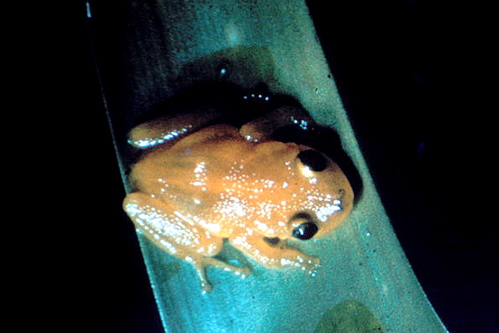 Golden CoquíEleutherodactylus jasperi
-
 Puerto Rican Wetland FrogEleutherodactylus juanariveroi
-
 Whistling CoquíEleutherodactylus cochranae
Compare
Questions and answers
What is the scientific name of the Ruth's Robber Frog?
The scientific name of the Ruth's Robber Frog is Eleutherodactylus ruthae. Written with its author, the full name is Eleutherodactylus ruthae Noble, 1923.
Which family does the Ruth's Robber Frog belong to?
Eleutherodactylus ruthae belongs to the family Eleutherodactylidae, in the order Anura and the class Amphibia.
Where is the Ruth's Robber Frog found?
Checklists and occurrence records place Eleutherodactylus ruthae in 2 countries: Dominican Republic and Haiti.
What is the conservation status of the Ruth's Robber Frog?
The IUCN Red List category recorded for Eleutherodactylus ruthae is Endangered (EN).
What other names does the Ruth's Robber Frog have?
Eleutherodactylus ruthae is also known in English as Eastern Burrowing Frog.
Sources
Passages the profile rests on
- The species has a distinctly shovel-shaped snout. Source passage: “The snout is distinctly shovel-shaped.” — English Wikipedia
- The skin is glandular and finely warty on the upper surface. Source passage: “Skin is glandular and finely warty above” — English Wikipedia
- The warts are most developed along the sides of the body. Source passage: “with best developed warts on sides of body.” — English Wikipedia
- The adult male holotype measured 49 mm in snout–vent length. Source passage: “The holotype, an adult male, measured 49 mm (1.9 in) in snout–vent length.” — English Wikipedia
- The species inhabits xeric pine forest. Source passage: “The natural habitats of Eleutherodactylus ruthae are xeric pine forest and mesic forest.” — English Wikipedia
- The species inhabits mesic forest. Source passage: “The natural habitats of Eleutherodactylus ruthae are xeric pine forest and mesic forest.” — English Wikipedia
- The species occurs from sea level to 900 m above sea level. Source passage: “Its altitudinal range is from sea level 900 m (3,000 ft) asl.” — English Wikipedia
- Males call from enclosed chambers located underground. Source passage: “Males call from closed underground chambers where the eggs are also laid.” — English Wikipedia
- Eggs are laid in closed underground chambers. Source passage: “Males call from closed underground chambers where the eggs are also laid.” — English Wikipedia
- The species is rarely encountered. Source passage: “This rarely encountered frog is believed to be declining.” — English Wikipedia
- The species is believed to be declining. Source passage: “This rarely encountered frog is believed to be declining.” — English Wikipedia
- The species has declined even in habitats considered suitable. Source passage: “However, it has declined even in suitable habitats” — English Wikipedia
- Habitat loss resulting from logging and agriculture threatens the species. Source passage: “It is threatened by habitat loss caused by logging and agriculture.” — English Wikipedia
- Invasive predators might contribute to the species' decline. Source passage: “factors such as invasive predators, climate change, and chytridiomycosis might also play a role.” — English Wikipedia
- Climate change might contribute to the species' decline. Source passage: “factors such as invasive predators, climate change, and chytridiomycosis might also play a role.” — English Wikipedia
- Chytridiomycosis might contribute to the species' decline. Source passage: “factors such as invasive predators, climate change, and chytridiomycosis might also play a role.” — English Wikipedia
- Eleutherodactylus aporostegus was originally described as a subspecies of Eleutherodactylus ruthae before being elevated to species status. Source passage: “Eleutherodactylus aporostegus, Eleutherodactylus bothroboans, Eleutherodactylus tychaethrous were first described as subspecies of Eleutherodactylus ruthae, but have later been elevated to full species status.” — English Wikipedia
- Eleutherodactylus bothroboans was originally described as a subspecies of Eleutherodactylus ruthae before being elevated to species status. Source passage: “Eleutherodactylus aporostegus, Eleutherodactylus bothroboans, Eleutherodactylus tychaethrous were first described as subspecies of Eleutherodactylus ruthae, but have later been elevated to full species status.” — English Wikipedia
- Eleutherodactylus tychaethrous was originally described as a subspecies of Eleutherodactylus ruthae before being elevated to species status. Source passage: “Eleutherodactylus aporostegus, Eleutherodactylus bothroboans, Eleutherodactylus tychaethrous were first described as subspecies of Eleutherodactylus ruthae, but have later been elevated to full species status.” — English Wikipedia
- The species is endemic to Hispaniola and occurs at scattered locations in Haiti and the Dominican Republic. Source passage: “It is endemic to Hispaniola and known from scattered locations in both Haiti and the Dominican Republic.” — English Wikipedia
Data
- Catalogue of Life, 2026-10-16 XR cc by
- Global Biodiversity Information Facility CC BY 4.0
- Wikidata CC0
- GeoNames CC BY 4.0
- Wikimedia Commons per image; credit shown with each image
- Within the Catalogue of Life, this name comes from The Integrated Taxonomic Information System cc0
References
- Frost, Darrel R. (1997). Amphibian Species of the World, A Taxonomic and Geographic Reference. Second Edition.
This species in other databases
Page built on 28 November 2026. See how the catalog is made and all sources and licences.
Cite this page
ScientificNames.org. (2026). Eleutherodactylus ruthae (Ruth's Robber Frog). Retrieved November 28, 2026, from https://scientificnames.org/species/eleutherodactylus-ruthae
“Eleutherodactylus ruthae (Ruth's Robber Frog).” ScientificNames.org, 2026, scientificnames.org/species/eleutherodactylus-ruthae. Accessed 28 Nov. 2026.
ScientificNames.org. “Eleutherodactylus ruthae (Ruth's Robber Frog).” Accessed November 28, 2026. https://scientificnames.org/species/eleutherodactylus-ruthae.
@misc{scientificnames_eleutherodactylus_ruthae_ruths_robber_frog,
  author = {{ScientificNames.org}},
  title = {Eleutherodactylus ruthae (Ruth's Robber Frog)},
  year = {2026},
  url = {https://scientificnames.org/species/eleutherodactylus-ruthae},
  note = {Accessed 2026-11-28}
}