Species · Amphibians
Macaya Breast-spot Frog Eleutherodactylus thorectes
The scientific name of the Macaya Breast-spot Frog is Eleutherodactylus thorectes. It is a species of amphibian in the family Eleutherodactylidae (rain frogs), order Anura. The name dates from 1988.
- Scientific name
- Eleutherodactylus thorectes Hedges, 1988
- Common name
- Macaya Breast-spot Frog
- Genus
- Eleutherodactylus
- Family
- Eleutherodactylidae (Rain Frogs)
- Order
- Anura
- Class
- Amphibia
- Red List category
- CR Critically Endangered
- Recorded in
- 1 country
- Name status
- accepted in the Catalogue of Life
Overview
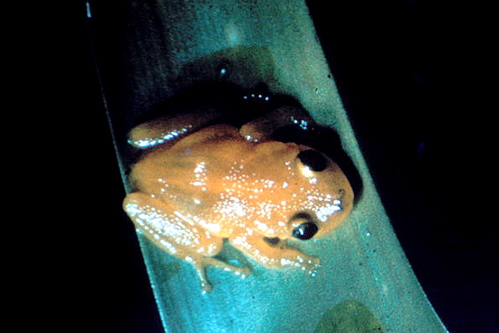
Eleutherodactylus thorectes is endemic to Haiti and occurs on Pic Macaya and Pic Formon in the Massif de la Hotte. Adults measure approximately 12–15 mm in snout-to-vent length and have brown and orange coloration with dark spotted patterns on the head, back and breast.
Written 27 November 2026 from the sources listed below. Each statement was checked against the passage it cites; statements that could not be supported were removed.
Conservation
The species is known from Pic Macaya National Park, where habitat degradation is occurring. Researchers estimated that more than 80% of the species had become extinct since 1990.[1][2]
A 2016 statistical prediction estimated an 80% decline in the population over the following decade.[3]
Uses
The species attracts ecotourists interested in experiencing its natural habitat.[4]
Appearance
The Macaya breast-spot frog has brown and orange coloration that helps it blend into its terrestrial surroundings. Dark spotted patterns occur on its head, back and breast.[5][6]
Its body is slimmer than its head and longer than it is wide. Males and females appear to share most physical characteristics.[7][8]
Habitat
The species is endemic to Haiti and is restricted to the peaks of Forman and Macaya in the Massif de la Hotte. It inhabits elevations between 1,700 and 2,340 metres above sea level.[9][10][11]
Its habitat includes closed pine montane forests and cloud forests in the Massif de la Hotte. The cloud forest contains shrubs, tree ferns, bromeliads and climbing bamboo.[12][13][14]
The species primarily lives on land rather than in aquatic environments.[15]
Diet
The Macaya breast-spot frog primarily feeds on small insects found in the Massif de la Hotte region.[16]
Behaviour
The species forages nocturnally, and individuals move to safer locations at night. During the day, they hide on land and rest.[17][18][19]
Reproduction and life cycle
The species has separate male and female sexes, with sex determined during the early stages of development through a homomorphic process. Its mating system is polygynandrous, with both sexes having multiple mates.[20][21][22]
Females deposit their eggs on the damp forest floor. The species undergoes direct development, and hatchlings resemble miniature adults.[23][24]
Newly hatched individuals are independent immediately after birth. There is no parental investment after females lay their eggs.[25][26]
Males are responsible for producing mating calls.[27]
Classification of the Macaya Breast-spot Frog
| Kingdom | Animalia |
|---|---|
| Phylum | Chordata |
| Subphylum | Vertebrata |
| Infraphylum | Gnathostomata |
| Parvphylum | Osteichthyes |
| Megaclass | Tetrapoda |
| Class | Amphibia (Amphibians) |
| Order | Anura (Frogs) |
| Superfamily | Brachycephaloidea |
| Family | Eleutherodactylidae (Rain Frogs) |
| Subfamily | Eleutherodactylinae |
| Genus | Eleutherodactylus (Coquis) |
| Species | Eleutherodactylus thorectes Hedges, 1988 |
Where the Macaya Breast-spot Frog is found
Checklists and occurrence records place Eleutherodactylus thorectes in 1 country. GBIF holds 60 georeferenced records of it.
Countries
Regions and cities with the most records
A number beside a place is its count of GBIF occurrence records. A place without a number comes from a checklist alone. Records show where a species has been observed or collected, which can include escapes and vagrants.
Common names
English
- Macaya Breast-spot Frog
- Macaya Breast-spotted Frog
Synonyms
One other scientific name has been used for this species and is now treated as a synonym of Eleutherodactylus thorectes.
- Euhyas thorectes (Hedges, 1988)
Related species
-
 Common CoquíEleutherodactylus coqui
-
 Greenhouse FrogEleutherodactylus planirostris
-
 Antilles CoquíEleutherodactylus johnstonei
-
 Puerto Rican Rock FrogEleutherodactylus cooki
-
 Rio Grande Chirping FrogEleutherodactylus cystignathoides
-
 Golden CoquíEleutherodactylus jasperi
-
 Puerto Rican Wetland FrogEleutherodactylus juanariveroi
-
 Whistling CoquíEleutherodactylus cochranae
Compare
Questions and answers
What is the scientific name of the Macaya Breast-spot Frog?
The scientific name of the Macaya Breast-spot Frog is Eleutherodactylus thorectes. Written with its author, the full name is Eleutherodactylus thorectes Hedges, 1988.
Which family does the Macaya Breast-spot Frog belong to?
Eleutherodactylus thorectes belongs to the family Eleutherodactylidae, in the order Anura and the class Amphibia.
Where is the Macaya Breast-spot Frog found?
Checklists and occurrence records place Eleutherodactylus thorectes in 1 country: Haiti.
What is the conservation status of the Macaya Breast-spot Frog?
The IUCN Red List category recorded for Eleutherodactylus thorectes is Critically Endangered (CR).
What other names does the Macaya Breast-spot Frog have?
Eleutherodactylus thorectes is also known in English as Macaya Breast-spotted Frog.
Sources
Passages the profile rests on
- The species is known from Pic Macaya National Park, where habitat degradation is also occurring. Source passage: “It is known from the Pic Macaya National Park, but habitat degradation is occurring in the park too.” — English Wikipedia
- Researchers estimated that more than 80% of the species had become extinct since 1990. Source passage: “Scientists think that more than 80% of the Macaya breast-spot frog has become extinct since 1990.” — animaldiversity.org
- A 2016 statistical prediction estimated an 80% decline in the population over the following decade. Source passage: “Statistical data from 2016 stated that there would be an 80% decline in the Macaya breast-spot frog population in the next 10 years.” — animaldiversity.org
- The species attracts ecotourists interested in experiencing its natural habitat. Source passage: “They bring in eco-tourists from all over the world looking for an experience in the natural habitat.” — animaldiversity.org
- The species has brown and orange coloration that helps it blend into its terrestrial surroundings. Source passage: “Macaya breast-spot frogs have brown and orange coloring to blend into their terrestrial surroundings.” — animaldiversity.org
- The species has dark spotted patterns on its head, back and breast. Source passage: “Macaya breast-spot frogs have dark, spotted patterns on their heads, backs, and even their breasts” — animaldiversity.org
- Individuals have bodies that are slimmer than their heads and longer than they are wide. Source passage: “Their bodies are slimmer than their heads, and they are longer in length than they are in width.” — animaldiversity.org
- Males and females appear to share most physical characteristics. Source passage: “female and males seem to share most of the same characteristics.” — animaldiversity.org
- The species is endemic to Haiti. Source passage: “It is endemic to Haiti and known from the Massif de la Hotte at high elevations.” — English Wikipedia
- The species is restricted to the peaks of Forman and Macaya in Haiti. Source passage: “They are endemic to the Massif de la Hotte mountain range, on the peaks of Forman and Macaya.” — animaldiversity.org
- The species inhabits elevations between 1,700 and 2,340 metres above sea level. Source passage: “at elevations of 1,700–2,340 m (5,580–7,680 ft) asl.” — English Wikipedia
- The species inhabits closed pine montane forests and cloud forests. Source passage: “Its natural habitats are closed pine montane forest and cloud forest” — English Wikipedia
- Its cloud forest habitat contains shrubs, tree ferns, bromeliads and climbing bamboo. Source passage: “with shrubs, tree ferns, bromeliads, and climbing bamboo.” — English Wikipedia
- The species inhabits a subtropical cloud forest in the Massif de la Hotte. Source passage: “Macaya breast-spot frogs inhabit the subtropical climate of the Massif de la Hotte mountain range. This habitat is referred to as a cloud forest” — animaldiversity.org
- The species primarily lives on land rather than in aquatic environments. Source passage: “They are primarily terrestrial and do not need large bodies of water in which to lay their eggs.” — animaldiversity.org
- The species primarily feeds on small insects found in the Massif de la Hotte region. Source passage: “The diet of Macaya breast-spot frogs mainly consists of small insects that also reside in the Massif de la Hotte region of Haiti.” — animaldiversity.org
- Individuals forage and move to safer locations at night. Source passage: “At night they forage, move to safer grounds, or lay eggs.” — animaldiversity.org
- The species forages nocturnally. Source passage: “They forage nocturnally” — animaldiversity.org
- Individuals hide on land and rest during the day. Source passage: “During the day, Macaya breast-spot frogs use their surroundings to hide on land and rest” — animaldiversity.org
- The species has a polygynandrous mating system in which both sexes have multiple mates. Source passage: “Macaya breast-spot frogs are polygynandrous, meaning both males and females have multiple different mates within one lifetime.” — animaldiversity.org
- Sex is determined during the early stages of development through a homomorphic process. Source passage: “Sex is determined in a homomorphic process, which means that sex is determined in the early stages of development.” — animaldiversity.org
- The species has separate male and female sexes. Source passage: “gonochoric/gonochoristic/dioecious (sexes separate)” — animaldiversity.org
- The species undergoes direct development, with hatchlings resembling miniature adults. Source passage: “They hatch from eggs looking like a smaller version of adults” — animaldiversity.org
- Females deposit their eggs on the damp forest floor. Source passage: “Females lay their eggs on the damp forest floor.” — animaldiversity.org
- Newly hatched individuals are independent immediately after birth. Source passage: “Upon birth, young are immediately independent.” — animaldiversity.org
- The species exhibits no parental investment after females lay their eggs. Source passage: “Macaya breast-spot frogs do not exhibit any parental investment.” — animaldiversity.org
- Males are responsible for producing mating calls. Source passage: “These mating calls can only be produced by males” — animaldiversity.org
Data
- Catalogue of Life, 2026-10-16 XR cc by
- Global Biodiversity Information Facility CC BY 4.0
- Wikidata CC0
- GeoNames CC BY 4.0
- Within the Catalogue of Life, this name comes from The Integrated Taxonomic Information System cc0
References
- A new diminutive frog from Hispaniola (Leptodactylidae: Eleutherodactylus). (1988). Copeia, 1988(3), 636–641. https://doi.org/10.2307/1445381 Link where the name was published
This species in other databases
Page built on 28 November 2026. See how the catalog is made and all sources and licences.
Cite this page
ScientificNames.org. (2026). Eleutherodactylus thorectes (Macaya Breast-spot Frog). Retrieved November 28, 2026, from https://scientificnames.org/species/eleutherodactylus-thorectes
“Eleutherodactylus thorectes (Macaya Breast-spot Frog).” ScientificNames.org, 2026, scientificnames.org/species/eleutherodactylus-thorectes. Accessed 28 Nov. 2026.
ScientificNames.org. “Eleutherodactylus thorectes (Macaya Breast-spot Frog).” Accessed November 28, 2026. https://scientificnames.org/species/eleutherodactylus-thorectes.
@misc{scientificnames_eleutherodactylus_thorectes_macaya_breast_spot_frog,
  author = {{ScientificNames.org}},
  title = {Eleutherodactylus thorectes (Macaya Breast-spot Frog)},
  year = {2026},
  url = {https://scientificnames.org/species/eleutherodactylus-thorectes},
  note = {Accessed 2026-11-28}
}