Species · Spiders and other arachnids
Episinus angulatus
Episinus angulatus has no English name on record in the checklists used here. It is a species of arachnid in the family Theridiidae (cobweb weavers), order Araneae. The name dates from 1836.
- Scientific name
- Episinus angulatus (Blackwall, 1836)
- Genus
- Episinus
- Family
- Theridiidae (Cobweb Weavers)
- Order
- Araneae
- Class
- Arachnida
- Environment
- terrestrial
- Recorded in
- 30 countries
- Name status
- accepted in the Catalogue of Life

Overview
Episinus angulatus occurs in low vegetation, bushes and forest clearings. It constructs an approximately H-shaped web with sticky globules in its lower sections.
Written 27 November 2026 from the sources listed below. Each statement was checked against the passage it cites; statements that could not be supported were removed.
Similar species
Episinus angulatus closely resembles Episinus truncatus.[1]
Appearance
The species can reach a maximum body length of 5.5 mm.[2]
Habitat
The species occurs in low vegetation and bushes. It also inhabits forest clearings.[3][4]
Behaviour
The spider often rests with its legs extended both forward and backward. This resting posture resembles that of spiders in the family Tetragnathidae.[5][6]
The species constructs a web consisting of only a few threads extending from lower bush branches to the ground. The web has an approximately H-shaped structure, with sticky globules in its lower sections.[7][8][9]
Reproduction and life cycle
Females suspend their cocoons from a thread.[10]
Classification of Episinus angulatus
| Kingdom | Animalia |
|---|---|
| Phylum | Arthropoda |
| Subphylum | Chelicerata |
| Class | Arachnida (Arachnid) |
| Order | Araneae (Spider) |
| Family | Theridiidae (Cobweb Weavers) |
| Genus | Episinus (Square-ended Cobweb Spiders) |
| Species | Episinus angulatus (Blackwall, 1836) |
Where Episinus angulatus is found
Checklists and occurrence records place Episinus angulatus in 30 countries across Asia and Europe. GBIF holds 4,113 georeferenced records of it.
Countries
- Aland Islands 3
- Austria 83
- Belarus 9
- Belgium 246
- Czechia 7
- Denmark 192
- Estonia 8
- Finland 210
- France 745
- Germany 294
- Hungary 20
- Isle of Man 8
- Italy 9
- Kazakhstan
- Latvia 3
- Lithuania 5
- Luxembourg 5
- Norway 179
- Poland 127
- Portugal 9
- Russia 193
- Slovakia 4
- Slovenia 7
- Spain 9
- Sweden 648
- Switzerland 81
- The Netherlands 296
- Turkey 5
- Ukraine 13
- United Kingdom 695
Regions and cities with the most records
- England, United Kingdom 489
- Wales, United Kingdom 153
- Hauts-de-France, France 140
- Occitanie, France 113
- Skåne, Sweden 85
- Gelderland, The Netherlands 83
- Baden-Wurttemberg, Germany 76
- Winsford, United Kingdom 76
- Northwich, United Kingdom 75
- Runcorn, United Kingdom 71
- Västra Götaland, Sweden 68
- Moscow Oblast, Russia 67
- Chester, United Kingdom 66
- Nantwich, United Kingdom 66
- Pays de la Loire, France 65
- Auvergne-Rhône-Alpes, France 64
- Crewe, United Kingdom 64
- Sandbach, United Kingdom 64
- Västernorrland, Sweden 60
- Halland, Sweden 57
- Barneveld, The Netherlands 53
- Houthalen, Belgium 51
- Koksijde, Belgium 51
- Zonhoven, Belgium 49
- Genk, Belgium 48
- Vostochnoe Degunino, Russia 48
- Île-de-France, France 47
- Helchteren, Belgium 46
- Capital Region, Denmark 45
- Coudekerque-Branche, France 45
- Dunkirk, France 45
- Widnes, United Kingdom 45
- Apeldoorn, The Netherlands 44
- Rogaland, Norway 44
- Stockholm, Sweden 44
- Brasschaat, Belgium 42
Range as the checklists state it
Europe, Turkey, Russia (Europe to West Siberia), Kazakhstan, Central Asia
A number beside a place is its count of GBIF occurrence records. A place without a number comes from a checklist alone. Records show where a species has been observed or collected, which can include escapes and vagrants.
Common names
Names in 9 other languages
- Danish
- Balalajkaedderkop
- Dutch
- gewone kabelspin
- Finnish
- kulmalangakki
- German
- Gewöhnliche Kabelspinne
- Lithuanian
- Kampuotasis lynvoris
- Norwegian Bokmål
- lystrekantedderkopp
- Russian
- Эпизинус угловатый
- Slovak
- snovačka hranatá
- Swedish
- skogsbalalajkaspindel
Synonyms
2 other scientific names have been used for this species and are now treated as synonyms of Episinus angulatus.
- Episinus truncatus Bösenberg, 1902
- Theridion angulatum Blackwall, 1836
Related species
-
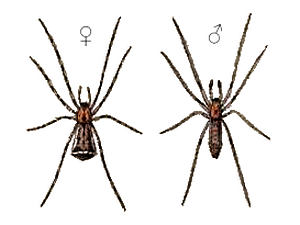 Episinus truncatus
-
 Episinus maculipes
- Episinus bilineatus
- Episinus amoenus
- Episinus antipodianus
- Episinus bishopi
- Episinus marignaci
- Episinus similanus
Compare
Sources
Passages the profile rests on
- Episinus angulatus closely resembles Episinus truncatus. Source passage: “It is very similar to Episinus truncatus.” — English Wikipedia
- The species can reach a maximum body length of 5.5 mm. Source passage: “It can grow up to 5.5mm.” — English Wikipedia
- The species occurs in low vegetation and bushes. Source passage: “Episinus angulatus is found in low vegetation, bushes” — English Wikipedia
- The species inhabits forest clearings. Source passage: “It lives on forest clearings” — English Wikipedia
- The spider often rests with its legs extended both forward and backward. Source passage: “It often rests with its legs stretched in front and behind” — English Wikipedia
- Its resting posture resembles that of spiders in the family Tetragnathidae. Source passage: “resembling a tetragnathid.” — English Wikipedia
- The species constructs a web consisting of only a few threads extending from lower bush branches to the ground. Source passage: “The web only consists of a few threads that reach from the lower branches of a bush down to the ground.” — English Wikipedia
- The web has an approximately H-shaped structure. Source passage: “The web has roughly an 'H' form.” — English Wikipedia
- Sticky globules occur in the lower sections of the web. Source passage: “The lower parts of the web contain sticky globules.” — English Wikipedia
- Females suspend their cocoons from a thread. Source passage: “Females hang the cocoon from a thread.” — English Wikipedia
Data
- Catalogue of Life, 2026-10-16 XR cc by
- Global Biodiversity Information Facility CC BY 4.0
- Wikidata CC0
- GeoNames CC BY 4.0
- Wikimedia Commons per image; credit shown with each image
- Within the Catalogue of Life, this name comes from The World Spider Catalog cc by
References
- Blackwall, J. (1836). Characters of some undescribed species of Araneidae. London and Edinburgh Philosophical Magazine and Journal of Science (3) 8(49): 481-491. doi: <a href="https://doi.org/10.1080/14786443208647870" target="_blank">10.1080/14786443208647870 Link where the name was published
This species in other databases
- Catalogue of Life 6FVPT
- Wikidata Q1313230
- iNaturalist 318916
- WoRMS urn:lsid:marinespecies.org:taxname:231933
- ITIS 855916
Page built on 27 November 2026. See how the catalog is made and all sources and licences.
Cite this page
ScientificNames.org. (2026). Episinus angulatus. Retrieved November 27, 2026, from https://scientificnames.org/species/episinus-angulatus
“Episinus angulatus.” ScientificNames.org, 2026, scientificnames.org/species/episinus-angulatus. Accessed 27 Nov. 2026.
ScientificNames.org. “Episinus angulatus.” Accessed November 27, 2026. https://scientificnames.org/species/episinus-angulatus.
@misc{scientificnames_episinus_angulatus,
  author = {{ScientificNames.org}},
  title = {Episinus angulatus},
  year = {2026},
  url = {https://scientificnames.org/species/episinus-angulatus},
  note = {Accessed 2026-11-27}
}