Species · Spiders and other arachnids
Episinus bilineatus
Episinus bilineatus has no English name on record in the checklists used here. It is a species of arachnid in the family Theridiidae (cobweb weavers), order Araneae. The name dates from 1894.
- Scientific name
- Episinus bilineatus Simon, 1894
- Genus
- Episinus
- Family
- Theridiidae (Cobweb Weavers)
- Order
- Araneae
- Class
- Arachnida
- Recorded in
- 3 countries
- Name status
- accepted in the Catalogue of Life
Overview
Episinus bilineatus Simon, 1894 is an arachnid in the family Theridiidae, order Araneae, and class Arachnida. The species occurs in Botswana, Lesotho, and South Africa, where it has been recorded in all nine provinces. It constructs simple H-shaped or Y-shaped webs close to the ground.
Written 27 November 2026 from the sources listed below. Each statement was checked against the passage it cites; statements that could not be supported were removed.
Habitat
Episinus bilineatus occurs at ground level among low vegetation. It has been sampled in the Fynbos biome and the Indian Ocean Coastal Belt biome.[1][2][3]
Recorded sampling elevations for the species range from 4 to 1703 metres.[4]
Behaviour
The species constructs simple H-shaped or Y-shaped webs close to the ground.[5]
Reproduction and life cycle
Courtship takes place during summer.[6]
The species produces white, spherical egg sacs surrounded by a coarse loop of silk.[7][8]
Conservation
Episinus bilineatus is classified as Least Concern by the South African National Biodiversity Institute. This classification is attributed to its wide geographical range.[9][10]
No significant threats to the species have been identified. It is protected in more than ten protected areas.[11][12]
Classification of Episinus bilineatus
| Kingdom | Animalia |
|---|---|
| Phylum | Arthropoda |
| Subphylum | Chelicerata |
| Class | Arachnida (Arachnid) |
| Order | Araneae (Spider) |
| Family | Theridiidae (Cobweb Weavers) |
| Genus | Episinus (Square-ended Cobweb Spiders) |
| Species | Episinus bilineatus Simon, 1894 |
Where Episinus bilineatus is found
Checklists and occurrence records place Episinus bilineatus in 3 countries across Africa.
Countries
Range as the checklists state it
Botswana, South Africa, Lesotho
A number beside a place is its count of GBIF occurrence records. A place without a number comes from a checklist alone. Records show where a species has been observed or collected, which can include escapes and vagrants.
Related species
-
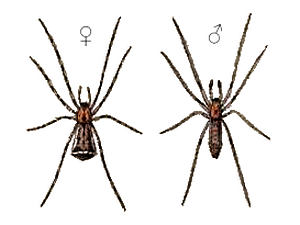 Episinus truncatus
-
 Episinus maculipes
-
 Episinus angulatus
- Episinus amoenus
- Episinus antipodianus
- Episinus bishopi
- Episinus marignaci
- Episinus similanus
Compare
Sources
Passages the profile rests on
- The species occurs at ground level among low vegetation. Source passage: “Episinus bilineatus is found at ground level between low vegetation” — English Wikipedia
- The species has been sampled in the Fynbos biome. Source passage: “It was sampled from the Fynbos” — English Wikipedia
- The species has been sampled in the Indian Ocean Coastal Belt biome. Source passage: “Indian Ocean Coastal Belt” — English Wikipedia
- Recorded sampling elevations for the species range from 4 to 1703 metres. Source passage: “at altitudes ranging from 4 to 1703 m.” — English Wikipedia
- The species constructs simple H-shaped or Y-shaped webs close to the ground. Source passage: “making a very simple H or Y-shaped web near ground level.” — English Wikipedia
- Courtship in this species takes place during summer. Source passage: “Courtship takes place in summer.” — English Wikipedia
- The species produces white, spherical egg sacs. Source passage: “The egg-sac is white and spherical” — English Wikipedia
- The egg sac is surrounded by a coarse loop of silk. Source passage: “has a coarse loop of silk around it.” — English Wikipedia
- Episinus bilineatus is classified as Least Concern by the South African National Biodiversity Institute. Source passage: “Episinus bilineatus is listed as Least Concern by the South African National Biodiversity Institute” — English Wikipedia
- Its Least Concern classification is attributed to its wide geographical range. Source passage: “due to its wide geographical range.” — English Wikipedia
- No significant threats to the species have been identified in the document. Source passage: “There are no significant threats to this species.” — English Wikipedia
- The species is protected in more than ten protected areas. Source passage: “It is protected in more than ten protected areas.” — English Wikipedia
Data
- Catalogue of Life, 2026-10-16 XR cc by
- Wikidata CC0
- GeoNames CC BY 4.0
- Within the Catalogue of Life, this name comes from The World Spider Catalog cc by
References
- Simon, E. (1894a). Histoire naturelle des araignées. Deuxième édition, tome premier. Roret, Paris, pp. 489-760. doi: <a href="https://doi.org/10.5962/bhl.title.51973" target="_blank">10.5962/bhl.title.51973 Link where the name was published
This species in other databases
Page built on 28 November 2026. See how the catalog is made and all sources and licences.
Cite this page
ScientificNames.org. (2026). Episinus bilineatus. Retrieved November 28, 2026, from https://scientificnames.org/species/episinus-bilineatus
“Episinus bilineatus.” ScientificNames.org, 2026, scientificnames.org/species/episinus-bilineatus. Accessed 28 Nov. 2026.
ScientificNames.org. “Episinus bilineatus.” Accessed November 28, 2026. https://scientificnames.org/species/episinus-bilineatus.
@misc{scientificnames_episinus_bilineatus,
  author = {{ScientificNames.org}},
  title = {Episinus bilineatus},
  year = {2026},
  url = {https://scientificnames.org/species/episinus-bilineatus},
  note = {Accessed 2026-11-28}
}