Species · Fishes
Slender Ponyfish Equulites elongatus
The scientific name of the Slender Ponyfish is Equulites elongatus. It is a species of fish in the family Leiognathidae (slimys), order Acanthuriformes. The name dates from 1874.
- Scientific name
- Equulites elongatus (Günther, 1874)
- Common name
- Slender Ponyfish
- Genus
- Equulites
- Family
- Leiognathidae (Slimys)
- Order
- Acanthuriformes
- Class
- Teleostei
- Environment
- marine
- Recorded in
- 13 countries
- Name status
- accepted in the Catalogue of Life

Overview
Equulites elongatus occurs in the Indo-West Pacific, with recorded locations including northern Australia, Indonesia and Myanmar. It is gregarious, occurs in schools near the sea bed and produces light through a symbiotic association with Photobacterium leiognathi.
Written 27 November 2026 from the sources listed below. Each statement was checked against the passage it cites; statements that could not be supported were removed.
Appearance
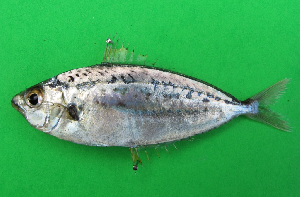
The slender ponyfish has an elongated body and a downward-pointing, protractile mouth beneath its pointed snout. Its upper body is dark grey with irregular dark spots, while its underside is silver-grey.[1][2]
The dorsal fin has 8 spines and 16 soft rays, while the anal fin has 3 spines and 14 soft rays. The pectoral fin has 16 soft rays, and the pelvic fin has one spine and five soft rays.[3][4][5][6]
The head is scaleless, while the cheek and breast have small scales and the nape bears spines. The iris is silver-grey and the pupil is black.[7][8]
The maximum reported length is 12 centimetres, and its normal length is approximately 8 centimetres.[9][10]
Habitat
The slender ponyfish inhabits shallow waters down to depths of 30 metres.[11]
Diet
The slender ponyfish feeds mainly on benthic invertebrates, including small crustaceans and polychaete worms, as well as algae.[12]
Behaviour
The slender ponyfish is gregarious and normally occurs in schools near the sea bed.[13]
The species is bioluminescent through a symbiotic association with Photobacterium leiognathi in its light organ. It modulates its light output for communication between individuals of the same species.[14][15]
Similar species
In the proposed species-group division, Equulites aethopos is associated with the southern Red Sea. Equulites popei is reported from the Red Sea and eastern Africa east to the Andaman Sea.[16][17]
The proposed division places Equulites elongatus in south-east Asia and northern Australia.[18]
Classification of the Slender Ponyfish
| Kingdom | Animalia |
|---|---|
| Phylum | Chordata |
| Subphylum | Vertebrata |
| Infraphylum | Gnathostomata |
| Parvphylum | Osteichthyes |
| Gigaclass | Actinopterygii |
| Superclass | Actinopteri |
| Class | Teleostei (Teleost) |
| Order | Acanthuriformes |
| Family | Leiognathidae (Slimys) |
| Genus | Equulites |
| Species | Equulites elongatus (Günther, 1874) |
Where the Slender Ponyfish is found
Checklists and occurrence records place Equulites elongatus in 13 countries. GBIF holds 1,329 georeferenced records of it.
Countries
- Australia 826
- China 4
- India 3
- Indonesia 29
- Israel 6
- Japan 346
- Malaysia 15
- Marshall Islands 4
- Philippines 40
- Taiwan 33
- Thailand 7
- Turkey 9
- Vietnam 7
Regions and cities with the most records
- Ibusuki, Japan 48
- Kagoshima, Japan 17
- Taiwan, Taiwan 13
- Kaseda-shirakame, Japan 11
- Minamisatsuma, Japan 11
- Iloilo, Philippines 8
- Atami, Japan 7
- Erdemli, Turkey 7
- Minamiashigara, Japan 7
- Odawara, Japan 7
- Yugawara, Japan 7
- Chiba, Japan 6
- Kamizawa, Japan 6
- Minamibōsō, Japan 6
- Tateyama, Japan 6
- Kanagawa, Japan 5
- Magong, Taiwan 5
- Fushimi, Japan 4
- Gotemba, Japan 4
- Kanaishima, Japan 4
- Maizuru, Japan 4
- Mishima, Japan 4
- Miyazu, Japan 4
- Nakatogari, Japan 4
- Oyama, Japan 4
- Susono, Japan 4
- Ashkelon, Israel 3
- Baclaran, Philippines 3
- Bacoor, Philippines 3
- Bagong Barrio, Philippines 3
- Bagong Pagasa, Philippines 3
- Bel Air, Philippines 3
- Caloocan, Philippines 3
- Cavite City, Philippines 3
- Ijūin, Japan 3
- Imus, Philippines 3
4 more countries have a few records outside this range
These countries hold a few records of Equulites elongatus but lie outside the range the checklists give for it. Such records are often zoo or garden specimens, museum material or vagrants, so the species is not counted as occurring there.
A number beside a place is its count of GBIF occurrence records. A place without a number comes from a checklist alone. Records show where a species has been observed or collected, which can include escapes and vagrants.
Common names
English
- Slender Ponyfish
- Elongate Ponyfish
- Ponyfish
Names in 8 other languages
- Arabic
- سمك المهر المستطيل
- Chinese
- 金錢仔, 長身馬鰏, 長身鰏, 長鰏
- Czech
- plošák štíhlý
- Japanese
- ヒメヒイラギ
- Korean
- 왜주둥치
- Portuguese
- Peixe-pônei-alongado
- Russian
- Низкотелая сребробрюшка
- Thai
- ปลาแป้นกระสวย, ปลาแป้นยาว
Synonyms
7 other scientific names have been used for this species and are now treated as synonyms of Equulites elongatus.
- Equula elongata Günther, 1874
- Leiognathus elongatus Smith & Pope, 1906
- Leiognathus elongatus (Günther, 1874)
- Leiognathus elongus (Günther, 1874)
- Leiognathus popei (Whitley, 1932)
- Macilentichthys elongatus (Günther, 1874)
- Photoplagios elongatus (Günther, 1874)
Related species
-
 Equulites BerbisEquulites klunzingeri
-
 Pope’s PonyfishEquulites popei
-
 Whipfin PonyfishEquulites leuciscus
-
 Offshore PonyfishEquulites rivulatus
-
 Ornate PonyfishEquulites lineolatus
- Equulites laterofenestra
- SilverbellyEquulites berbis
- Oblong PonyfishEquulites oblongus
Compare
Questions and answers
What is the scientific name of the Slender Ponyfish?
The scientific name of the Slender Ponyfish is Equulites elongatus. Written with its author, the full name is Equulites elongatus (Günther, 1874).
Which family does the Slender Ponyfish belong to?
Equulites elongatus belongs to the family Leiognathidae, in the order Acanthuriformes and the class Teleostei.
Where is the Slender Ponyfish found?
Checklists and occurrence records place Equulites elongatus in 13 countries, including Australia, Japan, Philippines, Taiwan, Indonesia and Malaysia.
What other names does the Slender Ponyfish have?
Equulites elongatus is also known in English as Elongate Ponyfish and Ponyfish.
Sources
Passages the profile rests on
- The species has an elongated body and a downward-pointing, protractile mouth beneath its pointed snout. Source passage: “Equulites elongatus has an elongated body compared to its congeners but has the downward pointing, protractile mouth typical of the family Leiognathidae situated underneath the pointed snout.” — English Wikipedia
- The upper body is dark grey with irregular dark spots, while the underside is silver-grey. Source passage: “The upper body is dark grey in colour with irregular dark spots and the underside is silver-grey.” — English Wikipedia
- The dorsal fin has 8 spines and 16 soft rays. Source passage: “The single dorsal fin has 8 spines and 16 soft rays.” — English Wikipedia
- The anal fin has 3 spines and 14 soft rays. Source passage: “The anal fin has 3 spines and 14 soft rays” — English Wikipedia
- The pectoral fin has 16 soft rays. Source passage: “The pectoral fin has 16 soft rays” — English Wikipedia
- The pelvic fin has one spine and five soft rays. Source passage: “the small pelvic fin a single spine and five soft rays” — English Wikipedia
- The head is scaleless, while the cheek and breast have small scales and the nape bears spines. Source passage: “The head lacks any scales, while the cheek and breast are covered in small scales and there are spines on the nape.” — English Wikipedia
- The iris is silver-grey and the pupil is black. Source passage: “The iris is silver-grey and the pupil is black.” — English Wikipedia
- The species reaches a maximum reported length of 12 centimetres. Source passage: “They grow up to 12 centimetres (4+1⁄2 in) in length” — English Wikipedia
- Its normal length is approximately 8 centimetres. Source passage: “the normal length is 8 centimetres (3 in).” — English Wikipedia
- The species inhabits shallow waters down to depths of 30 metres. Source passage: “found in shallow waters to depths of 30 metres (98 ft)” — English Wikipedia
- The species feeds mainly on benthic invertebrates, including small crustaceans and polychaete worms, as well as algae. Source passage: “It feeds mainly on benthic invertebrates such as small crustaceans and polychaete worms as well as algae.” — English Wikipedia
- The species is gregarious and normally occurs in schools near the sea bed. Source passage: “is a gregarious species which is normally encountered inschools near the sea bed.” — English Wikipedia
- The species is bioluminescent through a symbiotic association with Photobacterium leiognathi in its light organ. Source passage: “Light is produced by its symbiosis with Photobacterium leiognathi living in its light organ.” — English Wikipedia
- The species modulates its light output for communication between individuals of the same species. Source passage: “They find E. elongatus modulating light output for intraspecific signaling.” — English Wikipedia
- Equulites aethopos is associated with the southern Red Sea in the proposed species-group division. Source passage: “Equulites aethopos from the southern Red Sea;” — English Wikipedia
- Equulites popei is reported from the Red Sea and eastern Africa east to the Andaman Sea in the proposed species-group division. Source passage: “Equulites popei from the Red Sea and eastern Africa east to the Andaman Sea.” — English Wikipedia
- The proposed division places Equulites elongatus in south-east Asia and northern Australia. Source passage: “Equulites elongatus from the south-east Asia and northern Australia;” — English Wikipedia
Data
- Catalogue of Life, 2026-10-16 XR cc by
- Global Biodiversity Information Facility CC BY 4.0
- Wikidata CC0
- GeoNames CC BY 4.0
- Wikimedia Commons per image; credit shown with each image
- Within the Catalogue of Life, this name comes from World Register of Marine Species cc by
This species in other databases
- Catalogue of Life 6FYN2
- Wikidata Q2026253
- iNaturalist 347810
- WoRMS urn:lsid:marinespecies.org:taxname:398517
Page built on 28 November 2026. See how the catalog is made and all sources and licences.
Cite this page
ScientificNames.org. (2026). Equulites elongatus (Slender Ponyfish). Retrieved November 28, 2026, from https://scientificnames.org/species/equulites-elongatus
“Equulites elongatus (Slender Ponyfish).” ScientificNames.org, 2026, scientificnames.org/species/equulites-elongatus. Accessed 28 Nov. 2026.
ScientificNames.org. “Equulites elongatus (Slender Ponyfish).” Accessed November 28, 2026. https://scientificnames.org/species/equulites-elongatus.
@misc{scientificnames_equulites_elongatus_slender_ponyfish,
  author = {{ScientificNames.org}},
  title = {Equulites elongatus (Slender Ponyfish)},
  year = {2026},
  url = {https://scientificnames.org/species/equulites-elongatus},
  note = {Accessed 2026-11-28}
}