Species · Fishes
Equulites Berbis Equulites klunzingeri
The scientific name of the Equulites Berbis is Equulites klunzingeri. It is a species of fish in the family Leiognathidae (slimys), order Acanthuriformes. The name dates from 1898.
- Scientific name
- Equulites klunzingeri (Steindachner, 1898)
- Common name
- Equulites Berbis
- Genus
- Equulites
- Family
- Leiognathidae (Slimys)
- Order
- Acanthuriformes
- Class
- Teleostei
- Environment
- marine
- Recorded in
- 11 countries
- Name status
- accepted in the Catalogue of Life

Overview
Equulites klunzingeri inhabits coastal waters over sandy or muddy substrates, at depths of up to 70 m. It has a laterally compressed body, a downward-pointing protrusible mouth and a mottled grey upper body with pink blotches.
Written 27 November 2026 from the sources listed below. Each statement was checked against the passage it cites; statements that could not be supported were removed.
Appearance
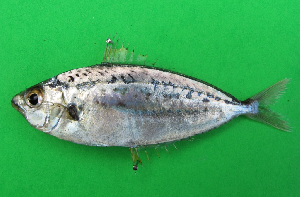
The species has a laterally compressed, oblong body with large eyes and a downward-pointing, protrusible mouth. Its upper body is mottled grey with pink blotches, while its belly is silvery white.[1][2]
It has seven dorsal-fin spines, with the second spine particularly long. Its anal fin has three spines and 15–16 soft rays.[3][4]
Its skin is covered with small cycloid scales. A black line runs along either side of the dorsal-fin base.[5][6]
The species reaches 11 cm in standard length.[7]
Habitat
The species inhabits coastal waters over sandy or muddy substrates and occurs at depths of up to 70 m.[8][9]
It tolerates a range of salinities and can enter estuarine environments.[10]
Diet
The species feeds on benthic invertebrates. Equulites klunzingeri has also been identified among the fish prey of pufferfish in a study of Israeli waters.[11][12]
Behaviour
The species is gregarious and forms schools of varying sizes.[13]
It uses bioluminescence for counter-illumination camouflage. Its bioluminescence is produced by symbiotic Photobacterium leiognathi bacteria.[14][15]
Reproduction and life cycle
The species spawns during the summer months. Its eggs and larvae are planktonic.[16][17]
Females reach sexual maturity at 5.5 cm in length, while males reach sexual maturity at 5.8 cm. Sexual maturity corresponds to an estimated age of approximately 2–3 years.[18][19][20]
The species has a normal lifespan of six years.[21]
Conservation
FishBase reports a low to moderate vulnerability score of 32 out of 100. Its reported population doubling time is medium, at 1.4–4.4 years.[22][23]
Uses
The species is not a target species for fisheries. It is caught incidentally in trawl and seine fisheries.[24][25]
Classification of the Equulites Berbis
| Kingdom | Animalia |
|---|---|
| Phylum | Chordata |
| Subphylum | Vertebrata |
| Infraphylum | Gnathostomata |
| Parvphylum | Osteichthyes |
| Gigaclass | Actinopterygii |
| Superclass | Actinopteri |
| Class | Teleostei (Teleost) |
| Order | Acanthuriformes |
| Family | Leiognathidae (Slimys) |
| Genus | Equulites |
| Species | Equulites klunzingeri (Steindachner, 1898) |
Where the Equulites Berbis is found
Checklists and occurrence records place Equulites klunzingeri in 11 countries. GBIF holds 895 georeferenced records of it.
Countries
- Egypt 11
- Israel 661
- Lebanon 8
- Madagascar 3
- Malaysia 7
- Oman 114
- Palestinian Territory 6
- Sudan 3
- Tanzania 39
- Turkey 36
- Vietnam 7
Regions and cities with the most records
- Bat Yam, Israel 321
- Tel Aviv, Israel 311
- H̱olon, Israel 307
- Givatayim, Israel 288
- Rishon LeTsiyyon, Israel 268
- Ramat Gan, Israel 260
- Bnei Brak, Israel 239
- Or Yehuda, Israel 237
- Giv'at Shmuel, Israel 236
- Herzliya, Israel 234
- Ramat HaSharon, Israel 233
- Ness Ziona, Israel 214
- Kiryat Ono, Israel 213
- Yavné, Israel 213
- Ra'anana, Israel 198
- Be’er Ya‘aqov, Israel 196
- Hod HaSharon, Israel 192
- Ganei Tikva, Israel 190
- Yehud-Monosson, Israel 178
- Reẖovot, Israel 175
- Petaẖ Tiqva, Israel 167
- Yehud Monosson, Israel 162
- Ashdod, Israel 142
- Kfar Saba, Israel 136
- Acre, Israel 126
- Ramla, Israel 123
- Qiryat Yam, Israel 119
- Gan Yavne, Israel 118
- Qiryat Motsqin, Israel 117
- Haifa, Israel 113
- Qiryat Bialik, Israel 113
- Even Yehuda, Israel 106
- Nesher, Israel 104
- Tirat Karmel, Israel 103
- Qiryat Ata, Israel 102
- Daliyat al Karmel, Israel 96
A number beside a place is its count of GBIF occurrence records. A place without a number comes from a checklist alone. Records show where a species has been observed or collected, which can include escapes and vagrants.
Common names
English
- Equulites Berbis
Names in 4 other languages
- French
- Sapsap de Mer Rouge
- Greek
- Σαπουνόψαρο
- Hebrew
- שרבובון מאיר
- Turkish
- eksi baligi
Synonyms
4 other scientific names have been used for this species and are now treated as synonyms of Equulites klunzingeri.
- Equula klunzingeri Steindachner, 1898
- Leiognathus klunzingeri (Steindachner, 1898)
- Leiognathus mediterraneus Rhasis Erazi, 1943
- Photoplagios klunzingeri (Steindachner, 1898)
Related species
-
 Slender PonyfishEquulites elongatus
-
 Pope’s PonyfishEquulites popei
-
 Whipfin PonyfishEquulites leuciscus
-
 Offshore PonyfishEquulites rivulatus
-
 Ornate PonyfishEquulites lineolatus
- Equulites laterofenestra
- SilverbellyEquulites berbis
- Oblong PonyfishEquulites oblongus
Compare
Questions and answers
What is the scientific name of the Equulites Berbis?
The scientific name of the Equulites Berbis is Equulites klunzingeri. Written with its author, the full name is Equulites klunzingeri (Steindachner, 1898).
Which family does the Equulites Berbis belong to?
Equulites klunzingeri belongs to the family Leiognathidae, in the order Acanthuriformes and the class Teleostei.
Where is the Equulites Berbis found?
Checklists and occurrence records place Equulites klunzingeri in 11 countries, including Israel, Oman, Tanzania, Turkey, Egypt and Lebanon.
Where is Equulites berbis distributed?
The species is native to the Red Sea and has been recorded in the Sea of Oman. It was first recorded in the Mediterranean Sea off Syria in 1931 and has spread through the eastern Mediterranean Sea via the Suez Canal, with its Mediterranean distribution extending as far as the coast of Croatia.[26][27][28][29][30]
What was its original distribution?
The species was originally restricted to the Red Sea.[31]
When was the species described?
It was formally described in 1898 under the name Equula klunzingeri. Its type locality is the Gulf of Suez in Egypt.[32][33]
What does the specific name klunzingeri commemorate?
The specific name klunzingeri commemorates the German physician and zoologist Carl Benjamin Klunzinger.[34]
Sources
Passages the profile rests on
- The species has a laterally compressed, oblong body with large eyes and a downward-pointing, protrusible mouth. Source passage: “has a laterally compressed, oblong body, large eyes and a downward pointing, protractile mouth” — English Wikipedia
- Its upper body is mottled grey with pink blotches, while its belly is silvery white. Source passage: “The upper part of the body is mottled grey marked with pink blotches while the belly is silvery white” — English Wikipedia
- The species has seven dorsal-fin spines, with the second spine being particularly long. Source passage: “which has seven spines, the second of which is very long” — English Wikipedia
- Its anal fin has three spines and 15–16 soft rays. Source passage: “The anal fin has three spines and 15-16 soft rays.” — English Wikipedia
- Its skin is covered with small cycloid scales. Source passage: “The skin is covered in small cycloid scales.” — English Wikipedia
- A black line runs along either side of the dorsal-fin base. Source passage: “there is a black line along either side of the base of the dorsal fin.” — English Wikipedia
- The species reaches 11 cm in standard length. Source passage: “It grows to 11 cm (4.3 in) standard length.” — English Wikipedia
- The species inhabits coastal waters over sandy or muddy substrates. Source passage: “inhabiting inshore waters over sandy or muddy substrates” — English Wikipedia
- The species occurs at depths of up to 70 m. Source passage: “occurs down to a depth of 70m” — English Wikipedia
- The species can enter estuarine environments because it tolerates a range of salinities. Source passage: “It is euryhaline and can enter estuarine environments.” — English Wikipedia
- The species feeds on benthic invertebrates. Source passage: “where it feeds on benthic invertebrates” — English Wikipedia
- Equulites klunzingeri has been identified among the fish prey of pufferfish in a study of Israeli waters. Source passage: “Identified fish prey was two species of goatfish (Upeneus pori, U. moluccensis), pony fish (Equulites klunzingeri)” — pmc.ncbi.nlm.nih.gov
- The species is gregarious and forms schools of varying sizes. Source passage: “It is gregarious and forms schools, which can be large or small.” — English Wikipedia
- The species uses bioluminescence for counter-illumination camouflage. Source passage: “uses a bioluminescent organ situated around its oesophagus to camouflage the fish from below by counter-illumination” — English Wikipedia
- Its bioluminescence is produced by symbiotic Photobacterium leiognathi bacteria. Source passage: “the bioluminescence is produced by symbiotic bacteria Photobacterium leiognathi.” — English Wikipedia
- The species spawns during the summer months. Source passage: “It spawns in the summer months” — English Wikipedia
- Its eggs and larvae are planktonic. Source passage: “the eggs and larvae are planktonic.” — English Wikipedia
- Females reach sexual maturity at 5.5 cm in length. Source passage: “The females attain sexual maturity at 5.5 cm” — English Wikipedia
- Males reach sexual maturity at 5.8 cm in length. Source passage: “and the males at 5.8 cm” — English Wikipedia
- Sexual maturity corresponds to an estimated age of approximately 2–3 years. Source passage: “this equates to an age of about 2–3 years” — English Wikipedia
- The species has a normal lifespan of six years. Source passage: “the normal lifespan is 6 years.” — English Wikipedia
- FishBase reports a low to moderate vulnerability score of 32 out of 100. Source passage: “Low to moderate vulnerability (32 of 100).” — fishbase.se
- FishBase reports a medium population doubling time of 1.4–4.4 years. Source passage: “Medium, minimum population doubling time 1.4 - 4.4 years” — fishbase.se
- The species is not a target species for fisheries. Source passage: “is not a quarry species for fisheries” — English Wikipedia
- The species is caught incidentally in trawl and seine fisheries. Source passage: “but it is taken as a bycatch in fisheries using trawls and seines.” — English Wikipedia
- The species is native to the Red Sea. Source passage: “Equulites klunzingeri is native to the Red Sea” — English Wikipedia
- The species has been recorded in the Sea of Oman. Source passage: “it has been recorded in the Sea of Oman” — English Wikipedia
- The species was first recorded in the Mediterranean Sea off Syria in 1931. Source passage: “First recorded in the Mediterranean Sea off Syria in 1931” — English Wikipedia
- The species has spread through the eastern Mediterranean Sea via the Suez Canal. Source passage: “it has since invaded the eastern basin of the Mediterranean Sea by migrating through the Suez Canal” — English Wikipedia
- Its Mediterranean distribution extends as far as the coast of Croatia. Source passage: “and now reaches up to the coast of Croatia” — English Wikipedia
- The species was originally restricted to the Red Sea. Source passage: “which was originally found only in the Red Sea.” — English Wikipedia
- The species was formally described in 1898 under the name Equula klunzingeri. Source passage: “was first formally described as Equula klunzingeri in 1898” — English Wikipedia
- The type locality of the species is the Gulf of Suez in Egypt. Source passage: “with the type locality given as the Gulf of Suez in Egypt.” — English Wikipedia
- The specific name klunzingeri commemorates the German physician and zoologist Carl Benjamin Klunzinger. Source passage: “it is clearly the German physician and zoologist Carl Benjamin Klunzinger (1834-1914).” — English Wikipedia
Data
- Catalogue of Life, 2026-10-16 XR cc by
- Global Biodiversity Information Facility CC BY 4.0
- Wikidata CC0
- GeoNames CC BY 4.0
- Wikimedia Commons per image; credit shown with each image
- Within the Catalogue of Life, this name comes from World Register of Marine Species cc by
This species in other databases
Page built on 28 November 2026. See how the catalog is made and all sources and licences.
Cite this page
ScientificNames.org. (2026). Equulites klunzingeri (Equulites Berbis). Retrieved November 28, 2026, from https://scientificnames.org/species/equulites-klunzingeri
“Equulites klunzingeri (Equulites Berbis).” ScientificNames.org, 2026, scientificnames.org/species/equulites-klunzingeri. Accessed 28 Nov. 2026.
ScientificNames.org. “Equulites klunzingeri (Equulites Berbis).” Accessed November 28, 2026. https://scientificnames.org/species/equulites-klunzingeri.
@misc{scientificnames_equulites_klunzingeri_equulites_berbis,
  author = {{ScientificNames.org}},
  title = {Equulites klunzingeri (Equulites Berbis)},
  year = {2026},
  url = {https://scientificnames.org/species/equulites-klunzingeri},
  note = {Accessed 2026-11-28}
}