Species · Fishes
Desert Dace Eremichthys acros
The scientific name of the Desert Dace is Eremichthys acros. It is a species of fish in the family Cyprinidae (carps), order Cypriniformes. The name dates from 1948.
- Scientific name
- Eremichthys acros Hubbs & Miller, 1948
- Common name
- Desert Dace
- Genus
- Eremichthys
- Family
- Cyprinidae (Carps)
- Order
- Cypriniformes
- Class
- Teleostei
- Red List category
- VU Vulnerable
- Environment
- freshwater
- Recorded in
- 1 country
- Name status
- accepted in the Catalogue of Life
Overview
Eremichthys acros lives in warm springs and creeks in Soldier Meadow, western Humboldt County, Nevada. It has an olive-green back, mottled sides with yellow reflections, a silvery belly, and a deep green streak along and above its lateral line.
Written 27 November 2026 from the sources listed below. Each statement was checked against the passage it cites; statements that could not be supported were removed.
Appearance
The species has an olive-green back, yellow-reflecting mottled sides, blackish spots, and a silvery belly. A deep green streak runs along and above its lateral line.[1][2]
Its dorsal and anal fins usually have eight rays each. It has a horny sheath on both jaws and an elongated intestine.[3][4]
Adult individuals have brighter coloration than juveniles.[5]
Habitat
The species inhabits warm springs and creeks in Soldier Meadow, western Humboldt County, Nevada. It occupies spring pools, outflow streams, and alkaline marshy soils.[6][7]
Its habitat includes thermal waters ranging from 18 to 40 °C. It can survive in water temperatures as high as 38 °C, while the highest population densities occur in cooler lower spring areas with temperatures of 21–24 °C.[8][9][10]
The spring systems it occupies are artesian and draw on thermally recharged groundwater.[11]
Diet
The species is omnivorous and primarily feeds on small invertebrates and algae. Its diet includes periphyton, filamentous algae, small insects, and other invertebrates.[12][13][14]
Behaviour
The species migrates downstream toward cooler water during summer and upstream during winter.[15][16]
Juveniles initially occupy shallow water in spring outflows before moving into deeper areas as they develop.[17]
Reproduction and life cycle
The species breeds throughout the year, with spawning recorded in March, May, and November. Females deposit sticky eggs in the substrate of thermal spring habitats.[18][19]
Parents do not actively supervise the eggs. Young fish emerge after several days, with development time depending on water temperature.[20][21]
Sexual maturity is reached at approximately 13 months. Females are more prevalent than males.[22][23]
Conservation
The species was declared threatened under the Endangered Species Act in 1985 and is classified as Vulnerable under the IUCN classification system.[24][25]
Habitat loss and degradation caused by human activities contributed to its threatened status. Water diversion for agriculture, recreational spring use, and livestock and wild-horse overgrazing contribute to habitat destruction.[26][27]
Introduced non-native fish threaten its habitat. Climate change also threatens the species by affecting spring direction and water temperature.[28][29]
The U.S. Fish and Wildlife Service established critical habitat areas that include the Soldier Meadows thermal spring system.[30]
Fencing was installed at Fly Canyon springheads in 2015 to reduce habitat impacts from feral horses and burros. In August 2021, the Bureau of Land Management recontoured road crossings to reduce the risk of fish becoming stranded in pools.[31][32]
Classification of the Desert Dace
| Kingdom | Animalia |
|---|---|
| Phylum | Chordata |
| Subphylum | Vertebrata |
| Infraphylum | Gnathostomata |
| Parvphylum | Osteichthyes |
| Gigaclass | Actinopterygii |
| Superclass | Actinopteri |
| Class | Teleostei (Teleost) |
| Order | Cypriniformes |
| Family | Cyprinidae (Carps) |
| Subfamily | Leuciscinae |
| Genus | Eremichthys (Desert Dace) |
| Species | Eremichthys acros Hubbs & Miller, 1948 |
Where the Desert Dace is found
Checklists and occurrence records place Eremichthys acros in 1 country. GBIF holds 46 georeferenced records of it.
Countries
Regions and cities with the most records
A number beside a place is its count of GBIF occurrence records. A place without a number comes from a checklist alone. Records show where a species has been observed or collected, which can include escapes and vagrants.
Common names
English
- Desert Dace
Names in 4 other languages
- Czech
- jelčík pouštní
- Lithuanian
- Amerikiniai strepečiai
- Mandarin Chinese
- 漠魚
- Russian
- Эремихт
Related species
-
 GoldfishCarassius auratus
-
 Common CarpCyprinus carpio
- ZebrafishDanio rerio
-
 Grass CarpCtenopharyngodon idella
-
 Common RoachRutilus rutilus
-
 Silver CarpHypophthalmichthys molitrix
-
 Crucian CarpCarassius carassius
-
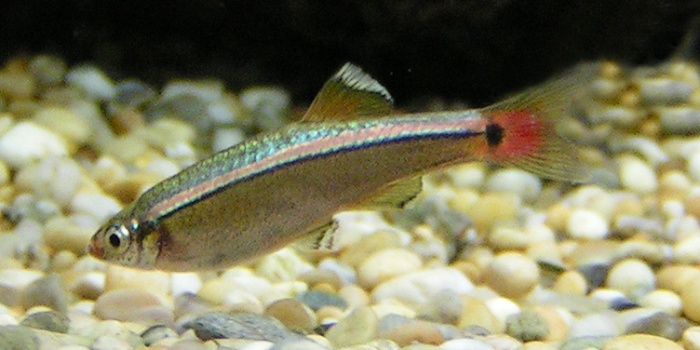 White Cloud Mountain MinnowTanichthys albonubes
Compare
Questions and answers
What is the scientific name of the Desert Dace?
The scientific name of the Desert Dace is Eremichthys acros. Written with its author, the full name is Eremichthys acros Hubbs & Miller, 1948.
Which family does the Desert Dace belong to?
Eremichthys acros belongs to the family Cyprinidae, in the order Cypriniformes and the class Teleostei.
Where is the Desert Dace found?
Checklists and occurrence records place Eremichthys acros in 1 country: United States.
What is the conservation status of the Desert Dace?
The IUCN Red List category recorded for Eremichthys acros is Vulnerable (VU).
How big can dace fish get?
Desert Dace reaches a maximum length of approximately 60 mm.[33]
Sources
Passages the profile rests on
- The species has an olive-green back, yellow-reflecting mottled sides, and a silvery belly. Source passage: “Its coloration is olive green on the back and silvery below, with vaguely mottled sides that flash with yellow reflections.” — English Wikipedia
- The species has blackish spots and a deep green streak along and above its lateral line. Source passage: “There is some blackish spotting and a deep green streak along and above the lateral line.” — English Wikipedia
- Its dorsal and anal fins usually have eight rays each. Source passage: “Dorsal and anal fins are usually eight-rayed.” — English Wikipedia
- The species has a horny sheath on both jaws and an elongated intestine. Source passage: “It is recognizable by the horny sheath, similar on both jaws as well as elongated intestine compatible with omnivorous feeding.” — English Wikipedia
- Adult individuals have brighter coloration than juveniles. Source passage: “It can be difficult to tell juvenile dace apart from adults, but adults have brighter colors.” — English Wikipedia
- The species inhabits warm springs and creeks in Soldier Meadow, western Humboldt County, Nevada. Source passage: “This fish is restricted to the warm springs and creeks of Soldier Meadow in western Humboldt County, Nevada, USA.” — English Wikipedia
- The species occupies spring pools, outflow streams, and alkaline marshy soils. Source passage: “As for the habitat, desert dace has been found mostly in spring pools, outflow streams and alkaline marshy soils.” — English Wikipedia
- Its habitat includes thermal waters ranging from 18 to 40 °C. Source passage: “These spring systems are characterized by thermal ranges between 18 and 40 °C (64 and 104 °F)” — English Wikipedia
- The species can survive in water temperatures as high as 38 °C. Source passage: “The species is also notable for its ability to live in waters as warm as 38 °C (100 °F).” — English Wikipedia
- The highest population densities occur in cooler lower spring areas with temperatures of 21–24 °C. Source passage: “Desert dace populations are highest in the lower cool areas of the spring, where water temperatures range from 21 to 24 °C (70 to 75 °F)” — English Wikipedia
- The spring systems occupied by the species are artesian and draw on thermally recharged groundwater. Source passage: “All these springs are completely artesian and tap water that is thermally recharged and is situated at very deep depths before resurfacing.” — English Wikipedia
- The species is omnivorous and primarily feeds on small invertebrates and algae. Source passage: “The desert dace is omnivorous, and its main food sources include small invertebrates and algae.” — English Wikipedia
- Its diet includes periphyton and filamentous algae. Source passage: “Its other food sources include periphyton, an algal layer attached to the bottom surfaces and filamentous algae.” — English Wikipedia
- The species consumes small insects and other invertebrates. Source passage: “Small insects or invertebrates of different sorts are frequently eaten” — English Wikipedia
- The species migrates downstream toward cooler water during summer. Source passage: “In summer seasons, dace migrate downstream in search of cooler areas” — English Wikipedia
- The species migrates upstream during winter. Source passage: “whereas in winter, heater temperatures force them to migrate upstream.” — English Wikipedia
- Juveniles initially occupy shallow water in spring outflows before moving into deeper areas as they develop. Source passage: “Juveniles are found in shallow water within the spring outflows, and later, when they are more developed, they migrate to deeper regions.” — English Wikipedia
- The species breeds throughout the year, with spawning recorded in March, May, and November. Source passage: “The desert dace breeds throughout the year, and spawning activity is recorded in March, May and November.” — English Wikipedia
- Females deposit sticky eggs in the substrate of thermal spring habitats. Source passage: “Such spawning occurs when females deposit sticky eggs into the substrate in the thermal spring habitats.” — English Wikipedia
- Parents do not actively supervise the eggs. Source passage: “These eggs are not kept under active supervision by the parents” — English Wikipedia
- Young fish emerge from the eggs after several days, with development time depending on water temperature. Source passage: “and a young dace appears after several days, depending on water temperature.” — English Wikipedia
- Sexual maturity is reached at approximately 13 months. Source passage: “Desert dace requires sexual maturity around 13 months” — English Wikipedia
- Females are more prevalent than males in the species. Source passage: “with a noticeable prevalence of females over males.” — English Wikipedia
- The species was declared threatened under the Endangered Species Act in 1985. Source passage: “The desert dace (Eremichthys acros) was declared a threatened species in 1985 under the Endangered Species Act” — English Wikipedia
- The species is classified as Vulnerable under the IUCN classification system. Source passage: “The species is still vulnerable under the IUCN classification system (IUCN 3.1).” — English Wikipedia
- Habitat loss and degradation caused by human activities contributed to the species' threatened status. Source passage: “due to habitat loss, degradation, and other human-related activities.” — English Wikipedia
- Water diversion for agriculture, recreational spring use, and livestock and wild-horse overgrazing contribute to habitat destruction. Source passage: “Water diversion for agriculture, recreational use of springs, and overgrazing by livestock and wild horses have contributed to habitat destruction in Soldier Meadows.” — English Wikipedia
- Introduced non-native fish threaten the species' habitat. Source passage: “Introducing non-native fishes, such as those brought into the nearby reservoirs, constantly threatens the desert dace habitat.” — English Wikipedia
- Climate change threatens the species by affecting spring direction and water temperature. Source passage: “These threats are aggravated by climate change, which affects the direction and temperature of the springs, which are important for the dace.” — English Wikipedia
- The U.S. Fish and Wildlife Service established critical habitat areas that include the Soldier Meadows thermal spring system. Source passage: “The U.S. Fish and Wildlife Service developed critical habitat areas for the species' conservation, including the Soldier Meadows thermal spring system” — English Wikipedia
- Fencing was installed at Fly Canyon springheads in 2015 to reduce habitat impacts from feral horses and burros. Source passage: “In 2015, the Nevada Department of Wildlife (NDOW) and federal partners fenced springheads in Fly Canyon to reduce the impacts of feral horses and burros on the habitat.” — English Wikipedia
- In August 2021, the Bureau of Land Management recontoured road crossings to reduce the risk of fish becoming stranded in pools. Source passage: “in August 2021, the Bureau of Land Management (BLM) carried out temporary works to recontour road crossings that created pools of water in the dace's habitat and threatened to strand the fish.” — English Wikipedia
- The species reaches a maximum length of approximately 60 mm. Source passage: “The desert dace reaches a maximum size of about 60 mm (2.4 inches).” — English Wikipedia
- The species is restricted to thermal springs and streams emerging from Soldier Meadows in Humboldt County, Nevada, USA. Source passage: “The desert dace species is only found in the thermal springs and the streams that emerge from Soldier Meadows in Humboldt County, Nevada.” — English Wikipedia
- The species is endemic to the thermal spring system of Soldier Meadows in western Humboldt County, Nevada. Source passage: “The desert dace species is endemic to the thermal spring system of Soldier Meadows, in western Humboldt County, Nevada.” — English Wikipedia
- The species is known only from the warm springs and creeks of Soldier Meadow in western Humboldt County. Source passage: “The desert dace (Eremichthys acros) is a rare cyprinid fish known only from the warm springs and creeks of Soldier Meadow in western Humboldt County,” — inaturalist.org
Data
- Catalogue of Life, 2026-10-16 XR cc by
- Global Biodiversity Information Facility CC BY 4.0
- Wikidata CC0
- GeoNames CC BY 4.0
- Within the Catalogue of Life, this name comes from World Register of Marine Species cc by
References
- Hubbs, C. L., & Miller, R. R. (1948). Two new, relict genera of cyprinid fishes from Nevada. Occasional Papers of the Museum of Zoology University of Michigan, 507: 1–30, Pls. 1–3. where the name was published
This species in other databases
- Catalogue of Life 6GDLJ
- Wikidata Q585850
- iNaturalist 100327
- WoRMS urn:lsid:marinespecies.org:taxname:1014302
- ITIS 163540
Page built on 28 November 2026. See how the catalog is made and all sources and licences.
Cite this page
ScientificNames.org. (2026). Eremichthys acros (Desert Dace). Retrieved November 28, 2026, from https://scientificnames.org/species/eremichthys-acros
“Eremichthys acros (Desert Dace).” ScientificNames.org, 2026, scientificnames.org/species/eremichthys-acros. Accessed 28 Nov. 2026.
ScientificNames.org. “Eremichthys acros (Desert Dace).” Accessed November 28, 2026. https://scientificnames.org/species/eremichthys-acros.
@misc{scientificnames_eremichthys_acros_desert_dace,
  author = {{ScientificNames.org}},
  title = {Eremichthys acros (Desert Dace)},
  year = {2026},
  url = {https://scientificnames.org/species/eremichthys-acros},
  note = {Accessed 2026-11-28}
}