Species · Fishes
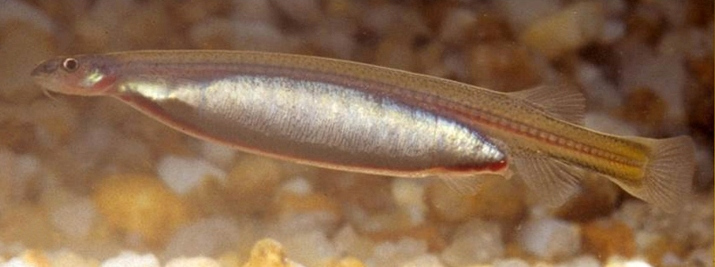
Eremophilus Eremophilus mutisii
The scientific name of the Eremophilus is Eremophilus mutisii. It is a species of fish in the family Trichomycteridae (pencil catfish), order Siluriformes. The name dates from 1805.
- Scientific name
- Eremophilus mutisii Humboldt, 1805
- Common name
- Eremophilus
- Genus
- Eremophilus
- Family
- Trichomycteridae (Pencil Catfish)
- Order
- Siluriformes
- Class
- Teleostei
- Red List category
- LC Least Concern
- Environment
- freshwater
- Recorded in
- 1 country
- Name status
- accepted in the Catalogue of Life

Overview
Eremophilus inhabits freshwater environments and originates from the Bogotá River basin, which drains into the Magdalena River. Eremophilus can breathe air using the vascularized central portion of its stomach.
Written 27 November 2026 from the sources listed below. Each statement was checked against the passage it cites; statements that could not be supported were removed.
Appearance
Eremophilus grows to approximately 30 centimetres in length.[1]
Habitat
Eremophilus inhabits freshwater environments. It originates from the Bogotá River basin, which drains into the Magdalena River.[2][3]
The species has probably been introduced into the Ubaté, Chiquinquirá, and Tundama valleys in Colombia.[4]
Behaviour
Eremophilus can breathe air using the vascularized central portion of its stomach. During aerial respiration, it rapidly swims to the surface and expels old air before inhaling new air.[5][6]
Eremophilus breathes air in both hypoxic and normoxic water, but air breathing is not obligatory.[7]
Eremophilus has a reduced swimbladder associated with its benthic lifestyle.[8]
Uses
Eremophilus is considered an excellent food fish. It is the only food fish in its region reported to have survived competition from introduced trout and carp.[9][10]
Classification of the Eremophilus
| Kingdom | Animalia |
|---|---|
| Phylum | Chordata |
| Subphylum | Vertebrata |
| Infraphylum | Gnathostomata |
| Parvphylum | Osteichthyes |
| Gigaclass | Actinopterygii |
| Superclass | Actinopteri |
| Class | Teleostei (Teleost) |
| Order | Siluriformes (Catfish) |
| Family | Trichomycteridae (Pencil Catfish) |
| Subfamily | Trichomycterinae |
| Genus | Eremophilus |
| Species | Eremophilus mutisii Humboldt, 1805 |
Where the Eremophilus is found
Checklists and occurrence records place Eremophilus mutisii in 1 country. GBIF holds 307 georeferenced records of it.
Countries
Regions and cities with the most records
- Cundinamarca, Colombia 244
- Zipaquirá, Colombia 79
- Chiquinquirá, Colombia 58
- Villa de San Diego de Ubaté, Colombia 57
- La Mesa, Colombia 47
- Pacho, Colombia 39
- Tocancipá, Colombia 36
- Funza, Colombia 29
- Soacha, Colombia 29
- Cajicá, Colombia 24
- Bogotá, Colombia 22
- Bogota D.C., Colombia 20
- Mosquera, Colombia 20
- Cota, Colombia 19
- Madrid, Colombia 18
- Boyacá, Colombia 13
- Chía, Colombia 12
- Bosconia, Colombia 11
- Facatativá, Colombia 8
- Sibaté, Colombia 7
- Silvania, Colombia 6
- Sogamoso, Colombia 6
- Fusagasugá, Colombia 4
- Nariño, Colombia 4
A number beside a place is its count of GBIF occurrence records. A place without a number comes from a checklist alone. Records show where a species has been observed or collected, which can include escapes and vagrants.
Common names
English
- Eremophilus
Names in 2 other languages
- Czech
- kandiru Mutisův, kandiru západoandský
- Spanish
- Capitán de la Sabana
Synonyms
One other scientific name has been used for this species and is now treated as a synonym of Eremophilus mutisii.
- Trachypoma marmoratum Giebel, 1871
Related species
-
 CandiruVandellia cirrhosa
-
 GreasefishRhizosomichthys totae
-
 Trichomycterus rivulatus
-
 Trichogenes claviger
- Trichomycterus maracaiboensis
-
 Pareiodon microps
- Paracanthopoma parva
-
 Hatcheria macraei
Compare
Questions and answers
What is the scientific name of the Eremophilus?
The scientific name of the Eremophilus is Eremophilus mutisii. Written with its author, the full name is Eremophilus mutisii Humboldt, 1805.
Which family does the Eremophilus belong to?
Eremophilus mutisii belongs to the family Trichomycteridae, in the order Siluriformes and the class Teleostei.
Where is the Eremophilus found?
Checklists and occurrence records place Eremophilus mutisii in 1 country: Colombia.
What is the conservation status of the Eremophilus?
The IUCN Red List category recorded for Eremophilus mutisii is Least Concern (LC).
How large does Eremophilus grow?
Eremophilus grows to approximately 30 centimetres in length.[1]
How does Eremophilus breathe air?
It uses the vascularized central portion of its stomach. It rapidly swims to the surface, expels old air, and inhales new air.[5][6]
Is aerial respiration obligatory in Eremophilus?
No. It breathes air in both hypoxic and normoxic water, but air breathing is not obligatory.[7]
Where has Eremophilus been cultured?
It has been cultured at different stocking densities in artificial rainfall reservoirs in Caldas, Boyacá, Colombia.[11]
Sources
Passages the profile rests on
- The species grows to approximately 30 centimetres in length. Source passage: “This fish grows to about 30 centimetres (12 in)” — English Wikipedia
- The species inhabits freshwater environments. Source passage: “freshwater ray-finned fish” — English Wikipedia
- The species originates from the Bogotá River basin, which drains into the Magdalena River. Source passage: “originates from the Bogotá River basin, which is a tributary of the Magdalena River.” — English Wikipedia
- The species has probably been introduced into the Ubaté, Chiquinquirá, and Tundama valleys in Colombia. Source passage: “It has probably been introduced to Ubaté, Chiquinquirá, and Tundama valleys, Colombia.” — English Wikipedia
- The species can breathe air using the vascularized central portion of its stomach. Source passage: “uses the vascularized central portion of its stomach for aerial respiration.” — English Wikipedia
- During aerial respiration, the species rapidly swims to the surface and expels old air before inhaling new air. Source passage: “Air ventilation takes place during a rapid dash to the surface with the expiration of old air preceding inspiration.” — English Wikipedia
- The species breathes air in both hypoxic and normoxic water, but air breathing is not obligatory. Source passage: “Air-breathing occurs in hypoxic and normoxic water, but is not obligatory.” — English Wikipedia
- The species has a reduced swimbladder associated with its benthic lifestyle. Source passage: “The evolution of a reduced swimbladder is associated with a benthic mode of life in E. mutisii.” — English Wikipedia
- The species is considered an excellent food fish. Source passage: “This fish species is an excellent food fish.” — English Wikipedia
- The species is the only food fish in its region reported to have survived competition from introduced trout and carp. Source passage: “It is the only species of food fish which has been able to survive competition from introduced trout and carp species into the region.” — English Wikipedia
- The species has been cultured at different stocking densities in artificial rainfall reservoirs in Caldas, Boyacá, Colombia. Source passage: “The catfish, Eremophilus mutisii, was cultured under different densities in artificial rainfall reservoirs at Caldas, Boyacá, Colombia.” — academia.edu
Data
- Catalogue of Life, 2026-10-16 XR cc by
- Global Biodiversity Information Facility CC BY 4.0
- Wikidata CC0
- GeoNames CC BY 4.0
- Wikimedia Commons per image; credit shown with each image
- Within the Catalogue of Life, this name comes from World Register of Marine Species cc by
References
- Humboldt, F. H. A. von. (1805). Mémoire sur l’Eremophilus et Astroblepus, deux nouveaux genres de l’ordre des apodes. In: Voyage de Humboldt et Bonpland, Deuxième Partie. Observations de Zoologie et d’Anatomie Comparée. Paris., v. 1: 17–20, Pls. 6–7. [Date from Sherborn 1899, Ann. Mag. Nat. Hist. (Ser. 7) v. 3:428.]. where the name was published
This species in other databases
- Catalogue of Life 6GFSV
- Wikidata Q309083
- iNaturalist 100328
- WoRMS urn:lsid:marinespecies.org:taxname:1022920
- ITIS 682102
Page built on 28 November 2026. See how the catalog is made and all sources and licences.
Cite this page
ScientificNames.org. (2026). Eremophilus mutisii (Eremophilus). Retrieved November 28, 2026, from https://scientificnames.org/species/eremophilus-mutisii
“Eremophilus mutisii (Eremophilus).” ScientificNames.org, 2026, scientificnames.org/species/eremophilus-mutisii. Accessed 28 Nov. 2026.
ScientificNames.org. “Eremophilus mutisii (Eremophilus).” Accessed November 28, 2026. https://scientificnames.org/species/eremophilus-mutisii.
@misc{scientificnames_eremophilus_mutisii_eremophilus,
  author = {{ScientificNames.org}},
  title = {Eremophilus mutisii (Eremophilus)},
  year = {2026},
  url = {https://scientificnames.org/species/eremophilus-mutisii},
  note = {Accessed 2026-11-28}
}