Species · Flowering plants
Berry Heath Erica baccans
The scientific name of the Berry Heath is Erica baccans. It is a species of flowering plant in the family Ericaceae (ericaceous), order Ericales.
- Scientific name
- Erica baccans L.
- Common name
- Berry Heath
- Genus
- Erica
- Family
- Ericaceae (Ericaceous)
- Order
- Ericales
- Class
- Magnoliopsida
- Recorded in
- 3 countries
- Name status
- accepted in the Catalogue of Life

Overview
The species grows on mountain slopes and in moist locations at lower elevations, and is naturally restricted to Cape Town, South Africa. It produces numerous small, pink, berry-shaped flowers in groups of four at the ends of the branches.
Written 27 November 2026 from the sources listed below. Each statement was checked against the passage it cites; statements that could not be supported were removed.
Appearance
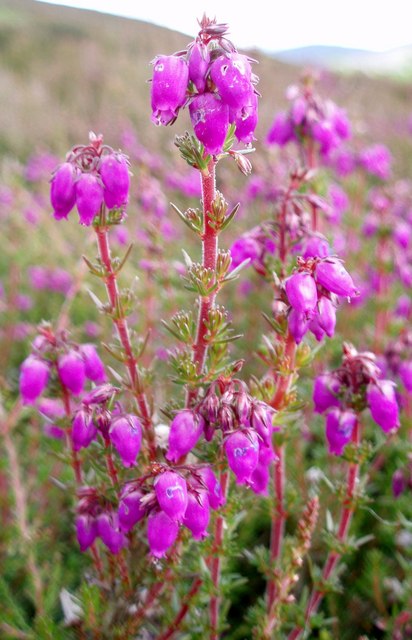
The plant produces numerous small, pink, berry-shaped flowers. The flowers grow in groups of four at the ends of the branches.[1][2]
The plant can reach a height of 2 metres.[3]
Habitat
The species grows on medium and lower mountain slopes between Signal Hill and Simonstown. It occurs in Peninsula Sandstone Fynbos.[4][5]
The plant grows in groups on warm mountain slopes and in moist locations at lower elevations.[6]
Behaviour
The species was naturally restricted to Cape Town, South Africa, and is endemic to Table Mountain. It has become naturalised in parts of Australia.[7][8][9][10]
In parts of Australia where it has become naturalised, the species colonises disturbed sites. It can invade grassland, heathland, forests and woodland.[11][12]
Uses
The species is increasingly popular as an ornamental plant in Cape Town gardens.[13]
Classification of the Berry Heath
| Kingdom | Plantae |
|---|---|
| Subkingdom | Pteridobiotina |
| Phylum | Tracheophyta |
| Class | Magnoliopsida |
| Order | Ericales |
| Family | Ericaceae (Ericaceous) |
| Subfamily | Ericoideae |
| Tribe | Ericeae |
| Genus | Erica (Heath) |
| Species | Erica baccans L. |
Where the Berry Heath is found
Checklists and occurrence records place Erica baccans in 3 countries across Africa and Oceania. GBIF holds 1,393 georeferenced records of it.
Countries where it is native or its origin is not stated
Countries where it has been introduced
Regions and cities with the most records
- Western Cape, South Africa 815
- Retreat, South Africa 765
- Muizenberg, South Africa 749
- Rondebosch, South Africa 727
- Cape Town, South Africa 721
- Victoria, Australia 162
- Northland, New Zealand 54
- South Australia, Australia 54
- Auckland, New Zealand 51
- Tasmania, Australia 49
- Adelaide Hills, Australia 36
- Adelaide, Australia 33
- Frankston East, Australia 33
- Kraaifontein, South Africa 18
- Kuils River, South Africa 18
- Durbanville, South Africa 15
- Western Australia, Australia 15
- Mount Barker, Australia 14
- Hobart, Australia 8
- Free State, South Africa 6
- Somerset West, South Africa 6
- Paarl, South Africa 5
- Wellington, South Africa 5
- Hermanus, South Africa 4
- Stellenbosch, South Africa 4
- Albany, Australia 3
- Le Roux, South Africa 3
- Queensland, Australia
4 more countries have a few records outside this range
These countries hold a few records of Erica baccans but lie outside the range the checklists give for it. Such records are often zoo or garden specimens, museum material or vagrants, so the species is not counted as occurring there.
Range as the checklists state it
South Africa (W-Cape Prov.); Australia [I] (Queensland [I], Tasmania [I]); New Zealand [I]
A number beside a place is its count of GBIF occurrence records. A place without a number comes from a checklist alone. Records show where a species has been observed or collected, which can include escapes and vagrants.
Common names
English
- Berry Heath
- Berry-Heath
Names in 3 other languages
- Afrikaans
- bessieheid
- Estonian
- Mari-eerika
- Swedish
- boll-ljung
Synonyms
4 other scientific names have been used for this species and are now treated as synonyms of Erica baccans.
- Erica bacciformis Salisb.
- Erica moniliformis Salisb.
- Ericoides baccans (L.) Kuntze
- Pachysa baccans (L.) D.Don
Related species
-
 Graceful HeathErica gracilis
-
 Tree HeathErica arborea
-
 Winter HeathErica carnea
-
 Darley Dale HeathErica darleyensis
-
 Cross-leaved HeathErica tetralix
-
 Bell HeatherErica cinerea
-
 Whorled HeathErica verticillata
-
 Cornish HeathErica vagans
Compare
Questions and answers
What is the scientific name of the Berry Heath?
The scientific name of the Berry Heath is Erica baccans. Written with its author, the full name is Erica baccans L..
Which family does the Berry Heath belong to?
Erica baccans belongs to the family Ericaceae, in the order Ericales and the class Magnoliopsida.
Where is the Berry Heath found?
Checklists and occurrence records place Erica baccans in 3 countries, including South Africa.
What other names does the Berry Heath have?
Erica baccans is also known in English as Berry-Heath.
Sources
Passages the profile rests on
- The plant produces numerous small, pink, berry-shaped flowers. Source passage: “produces masses of tiny, pink, berry-shaped flowers.” — English Wikipedia
- The flowers grow in groups of four at the ends of the branches. Source passage: “These are produced in groups of four at the ends of the branches” — English Wikipedia
- The plant can reach a height of 2 metres. Source passage: “The plant grows up to 2 metres (6+1⁄2 feet) in height” — English Wikipedia
- The species grows on medium and lower mountain slopes between Signal Hill and Simonstown. Source passage: “E. baccans grows on medium or lower slopes from Signal Hill to Simonstown.” — English Wikipedia
- The species occurs in Peninsula Sandstone Fynbos. Source passage: “It can be found in Peninsula Sandstone Fynbos” — English Wikipedia
- The plant grows in groups on warm mountain slopes and in moist locations at lower elevations. Source passage: “grows in groups on warm mountain slopes or in moist places at lower altitudes.” — English Wikipedia
- The species was naturally restricted to Cape Town, South Africa. Source passage: “was naturally restricted to the city of Cape Town, South Africa.” — English Wikipedia
- The species is endemic to Table Mountain. Source passage: “is endemic to Table Mountain” — English Wikipedia
- The species has become naturalised in parts of Australia. Source passage: “The species is naturalised in parts of Australia” — English Wikipedia
- The species is described as naturally restricted to Cape Town, South Africa. Source passage: “was naturally restricted to the city of Cape Town, South Africa.” — inaturalist.org
- The species colonises disturbed sites in parts of Australia where it has become naturalised. Source passage: “where it colonises disturbed sites.” — English Wikipedia
- The species can invade grassland, heathland, forests and woodland. Source passage: “Can invade grassland, heathland, forests and woodland” — soilhealth.ccmaknowledgebase.vic.gov.au
- The species is increasingly popular as an ornamental plant in Cape Town gardens. Source passage: “It is becoming increasingly popular as an ornamental plant in Cape Town gardens.” — English Wikipedia
Data
- Catalogue of Life, 2026-10-16 XR cc by
- Global Biodiversity Information Facility CC BY 4.0
- Wikidata CC0
- GeoNames CC BY 4.0
- Wikimedia Commons per image; credit shown with each image
- Within the Catalogue of Life, this name comes from Synonymic Checklists of the Vascular Plants of the World cc by
References
- L. Mant. Pl. Altera [Linnaeus] 233 (1771). where the name was published
This species in other databases
- Catalogue of Life 6GKWS
- Wikidata Q5387939
- iNaturalist 410256
- World Flora Online wfo-0000671460
- GRIN 15445
Page built on 27 November 2026. See how the catalog is made and all sources and licences.
Cite this page
ScientificNames.org. (2026). Erica baccans (Berry Heath). Retrieved November 27, 2026, from https://scientificnames.org/species/erica-baccans
“Erica baccans (Berry Heath).” ScientificNames.org, 2026, scientificnames.org/species/erica-baccans. Accessed 27 Nov. 2026.
ScientificNames.org. “Erica baccans (Berry Heath).” Accessed November 27, 2026. https://scientificnames.org/species/erica-baccans.
@misc{scientificnames_erica_baccans_berry_heath,
  author = {{ScientificNames.org}},
  title = {Erica baccans (Berry Heath)},
  year = {2026},
  url = {https://scientificnames.org/species/erica-baccans},
  note = {Accessed 2026-11-27}
}