Species · Flowering plants
Fire Heath Erica cerinthoides
The scientific name of the Fire Heath is Erica cerinthoides. It is a species of flowering plant in the family Ericaceae (ericaceous), order Ericales.
- Scientific name
- Erica cerinthoides L.
- Common name
- Fire Heath
- Genus
- Erica
- Family
- Ericaceae (Ericaceous)
- Order
- Ericales
- Class
- Magnoliopsida
- Recorded in
- 3 countries
- Name status
- accepted in the Catalogue of Life

Overview
Erica cerinthoides is native to South Africa, Lesotho and Eswatini. It varies in growth habit and flower characteristics, and resprouts from its woody rootstock after fire.
Written 27 November 2026 from the sources listed below. Each statement was checked against the passage it cites; statements that could not be supported were removed.
Appearance
Fire heath varies in growth habit, leaf and flower hairiness, and flower colour, size and shape. Unburnt plants can develop into straggly bushes exceeding one metre in height, with few flowers and leaves concentrated near their extremities.[1][2][3]
The species can also grow as a compact, small plant covered in flowers. A white-flowered form occurs in Eswatini and Mpumalanga, South Africa.[4][5]
The variety Erica cerinthoides var. barbertona has shorter flowers than other forms. Its flowers superficially resemble those of the genus Cerinthe.[6][7]
Habitat
Fire heath grows in habitats ranging from sea level to high mountains.[8]
Behaviour
Fire heath resprouts from its woody rootstock after fires. Fire enables the species to thrive after other vegetation has been destroyed.[9][10]
Fire appears to stimulate flowering in this species. Bushy plants can flower in landscapes blackened by fire.[11][12]
Reproduction and life cycle
Fire heath can be propagated using current-season cuttings that include a heel of older wood. It can also be propagated from seed.[13][14]
Uses
Fire heath can be cultivated in full sun with well-drained acidic soil. It has received the Royal Horticultural Society's Award of Garden Merit in the United Kingdom.[15][16]
The species is sensitive to frost but can regrow after frost damage.[17]
Similar species
The flowers of fire heath superficially resemble those of the genus Cerinthe, but the species is only distantly related to that genus.[7][18]
Classification of the Fire Heath
| Kingdom | Plantae |
|---|---|
| Subkingdom | Pteridobiotina |
| Phylum | Tracheophyta |
| Class | Magnoliopsida |
| Order | Ericales |
| Family | Ericaceae (Ericaceous) |
| Subfamily | Ericoideae |
| Tribe | Ericeae |
| Genus | Erica (Heath) |
| Species | Erica cerinthoides L. |
Where the Fire Heath is found
Checklists and occurrence records place Erica cerinthoides in 3 countries across Africa. GBIF holds 5,453 georeferenced records of it.
Countries
Regions and cities with the most records
- Western Cape, South Africa 4,403
- Muizenberg, South Africa 1,322
- Retreat, South Africa 1,210
- Rondebosch, South Africa 964
- Cape Town, South Africa 859
- Grabouw, South Africa 519
- Hermanus, South Africa 359
- Eastern Cape, South Africa 326
- Somerset West, South Africa 325
- Le Roux, South Africa 293
- Franschhoek, South Africa 289
- Stellenbosch, South Africa 282
- KwaZulu-Natal, South Africa 212
- Gqeberha, South Africa 181
- Despatch, South Africa 151
- Bredasdorp, South Africa 150
- Paarl, South Africa 135
- Mpumalanga, South Africa 110
- Wellington, South Africa 101
- Motherwell, South Africa 100
- Kuils River, South Africa 84
- Gansbaai, South Africa 74
- Grahamstown, South Africa 71
- George, South Africa 68
- Durbanville, South Africa 52
- Free State, South Africa 51
- Swellendam, South Africa 45
- Caledon, South Africa 40
- Kraaifontein, South Africa 38
- Mossel Bay, South Africa 28
- Riversdale, South Africa 28
- Ceres, South Africa 26
- Knysna, South Africa 25
- Plettenberg Bay, South Africa 21
- Hhohho Region, Eswatini 20
- Kariega, South Africa 18
1 more country has a few records outside this range
These countries hold a few records of Erica cerinthoides but lie outside the range the checklists give for it. Such records are often zoo or garden specimens, museum material or vagrants, so the species is not counted as occurring there.
Range as the checklists state it
South Africa (Limpopo, Gauteng, Mpulamanga, Free State, KwaZulu-Natal, W-Cape Prov., E-Cape Prov.); Lesotho; Eswatini [Swaziland]
A number beside a place is its count of GBIF occurrence records. A place without a number comes from a checklist alone. Records show where a species has been observed or collected, which can include escapes and vagrants.
Common names
English
- Fire Heath
Names in 1 other language
- Afrikaans
- rooihaartjie
Synonyms
3 other scientific names have been used for this species and are now treated as synonyms of Erica cerinthoides.
- Erica crinifolia Salisb.
- Ericoides cerinthodes (L.) Kuntze
- Ericoides cerinthoides (L.) Kuntze
Subspecies and varieties
- Erica cerinthoides var. barbertona (Barberton Fire Heath) variety
- Erica cerinthoides var. cerinthoides (Erica Heath) variety
Related species
-
 Graceful HeathErica gracilis
-
 Tree HeathErica arborea
-
 Winter HeathErica carnea
-
 Darley Dale HeathErica darleyensis
-
 Cross-leaved HeathErica tetralix
-
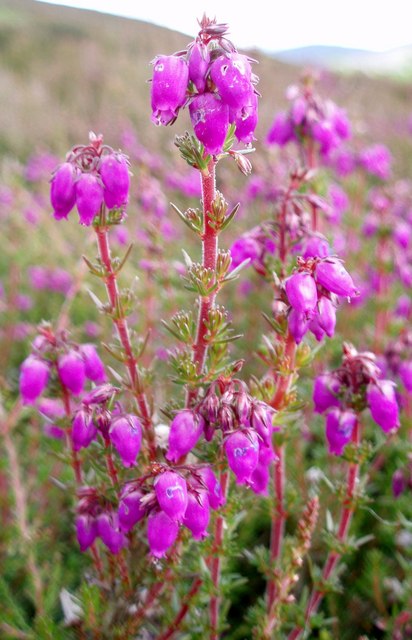 Bell HeatherErica cinerea
-
 Whorled HeathErica verticillata
-
 Cornish HeathErica vagans
Compare
Questions and answers
What is the scientific name of the Fire Heath?
The scientific name of the Fire Heath is Erica cerinthoides. Written with its author, the full name is Erica cerinthoides L..
Which family does the Fire Heath belong to?
Erica cerinthoides belongs to the family Ericaceae, in the order Ericales and the class Magnoliopsida.
Where is the Fire Heath found?
Checklists and occurrence records place Erica cerinthoides in 3 countries: South Africa, Eswatini and Lesotho.
Why is heather called Erica?
The specific epithet cerinthoides means resembling honeywort. The flowers superficially resemble those of the genus Cerinthe, although fire heath is only distantly related to that genus.[19][7][18]
Where to plant Erica heather?
Fire heath can be cultivated in full sun with well-drained acidic soil.[15]
Sources
Passages the profile rests on
- The species varies in growth habit, leaf and flower hairiness, and flower colour, size and shape. Source passage: “varying in habit of growth, the hairiness of the leaves and the flowers, and the colour, size and shape of the flowers.” — English Wikipedia
- Unburnt plants can develop into straggly bushes exceeding one metre in height. Source passage: “Where it remains unburnt it can be a straggly bush over 1 metre (3+1⁄2 feet) tall” — English Wikipedia
- Unburnt plants may have few flowers and leaves concentrated near their extremities. Source passage: “bare of leaves apart from a few extremities, and producing few flowers.” — English Wikipedia
- The species can also grow as a compact, small plant covered in flowers. Source passage: “Elsewhere it can be a compact small plant covered in blooms.” — English Wikipedia
- A white-flowered form occurs in Eswatini and Mpumalanga, South Africa. Source passage: “A form with white flowers is found in Eswatini and the South African province of Mpumalanga” — English Wikipedia
- The variety Erica cerinthoides var. barbertona has shorter flowers than other forms. Source passage: “the variety E. cerinthoides var. barbertona has shorter flowers.” — English Wikipedia
- The flowers superficially resemble those of the genus Cerinthe. Source passage: “The flowers bear a superficial resemblance to flowers of that genus in the family Boraginaceae” — English Wikipedia
- The species grows in habitats ranging from sea level to high mountains. Source passage: “It grows in various habitats, from sea level to high mountains.” — English Wikipedia
- The species resprouts from its woody rootstock after fires. Source passage: “It sprouts readily from the woody rootstock after fires” — English Wikipedia
- Fire enables the species to thrive after other vegetation has been destroyed. Source passage: “which enables it to thrive when other vegetation is destroyed.” — English Wikipedia
- Fire appears to stimulate flowering in this species. Source passage: “Fire seems to stimulate flowering” — English Wikipedia
- Bushy plants of this species can flower in landscapes blackened by fire. Source passage: “bushy plants of E. cerinthoides can be seen in flower against a blackened landscape.” — English Wikipedia
- The species can be propagated using current-season cuttings that include a heel of older wood. Source passage: “Plants can be propagated from cuttings of current season's growth with a heel of older wood.” — English Wikipedia
- The species can also be propagated from seed. Source passage: “They can also be grown from seed.” — English Wikipedia
- The species can be cultivated in full sun with well-drained acidic soil. Source passage: “E. cerinthoides requires a position in full sun with good drainage, and acidic soil.” — English Wikipedia
- The species has received the Royal Horticultural Society's Award of Garden Merit in the United Kingdom. Source passage: “In the UK it has gained the Royal Horticultural Society's Award of Garden Merit.” — English Wikipedia
- The species is sensitive to frost but can regrow after frost damage. Source passage: “It is frost sensitive, but can regrow following damage.” — English Wikipedia
- The species is only distantly related to the genus Cerinthe despite the floral resemblance. Source passage: “though it is only distantly related.” — English Wikipedia
- The specific epithet cerinthoides means resembling honeywort. Source passage: “The Latin specific epithet cerinthoides means "resembling honeywort (Cerinthe)".” — English Wikipedia
Data
- Catalogue of Life, 2026-10-16 XR cc by
- Global Biodiversity Information Facility CC BY 4.0
- Wikidata CC0
- GeoNames CC BY 4.0
- Wikimedia Commons per image; credit shown with each image
- Within the Catalogue of Life, this name comes from Synonymic Checklists of the Vascular Plants of the World cc by
References
- L. (1762). Sp. Pl. [Linnaeus], ed. 2: 505 (1762). where the name was published
This species in other databases
Page built on 29 November 2026. See how the catalog is made and all sources and licences.
Cite this page
ScientificNames.org. (2026). Erica cerinthoides (Fire Heath). Retrieved November 29, 2026, from https://scientificnames.org/species/erica-cerinthoides
“Erica cerinthoides (Fire Heath).” ScientificNames.org, 2026, scientificnames.org/species/erica-cerinthoides. Accessed 29 Nov. 2026.
ScientificNames.org. “Erica cerinthoides (Fire Heath).” Accessed November 29, 2026. https://scientificnames.org/species/erica-cerinthoides.
@misc{scientificnames_erica_cerinthoides_fire_heath,
  author = {{ScientificNames.org}},
  title = {Erica cerinthoides (Fire Heath)},
  year = {2026},
  url = {https://scientificnames.org/species/erica-cerinthoides},
  note = {Accessed 2026-11-29}
}