Species · Flowering plants
Dorset Heath Erica ciliaris
The scientific name of the Dorset Heath is Erica ciliaris. It is a species of flowering plant in the family Ericaceae (ericaceous), order Ericales.
- Scientific name
- Erica ciliaris L.
- Common name
- Dorset Heath
- Genus
- Erica
- Family
- Ericaceae (Ericaceous)
- Order
- Ericales
- Class
- Magnoliopsida
- Recorded in
- 10 countries
- Name status
- accepted in the Catalogue of Life

Overview
In the British Isles, it grows in bogs and wet heaths. It has bright pink flowers arranged in long racemes and leaves bearing long glandular hairs.
Written 26 November 2026 from the sources listed below. Each statement was checked against the passage it cites; statements that could not be supported were removed.
Appearance
Dorset Heath has bright pink flowers arranged in long racemes. Its leaves bear long glandular hairs.[1][2]
The plant grows to a height of 60 centimetres. Its flowers measure 8–12 millimetres in length.[3][4]
Habitat
The species has a Lusitanian distribution extending from Morocco through the Atlantic coasts of Portugal, Spain and France to the south-western British Isles.[5]
Within the British Isles, it is native to Dorset, Devon, Cornwall and one location in County Galway. It has been introduced to Hampshire.[6][7]
Uses
Dorset Heath was voted the county flower of Dorset in 2002.[8]
Classification of the Dorset Heath
| Kingdom | Plantae |
|---|---|
| Subkingdom | Pteridobiotina |
| Phylum | Tracheophyta |
| Class | Magnoliopsida |
| Order | Ericales |
| Family | Ericaceae (Ericaceous) |
| Subfamily | Ericoideae |
| Tribe | Ericeae |
| Genus | Erica (Heath) |
| Species | Erica ciliaris L. |
Where the Dorset Heath is found
Checklists and occurrence records place Erica ciliaris in 10 countries across Africa and Europe. GBIF holds 22,710 georeferenced records of it.
Countries where it is native or its origin is not stated
- France 12,283
- Germany 4
- Morocco 47
- Portugal 2,507
- South Africa 4
- Spain 2,335
- Switzerland 5
- The Netherlands 15
- United Kingdom 5,488
Countries where it has been introduced
Regions and cities with the most records
- England, United Kingdom 5,174
- Poole, United Kingdom 4,137
- Wimborne Minster, United Kingdom 4,121
- Bournemouth, United Kingdom 4,074
- Ferndown, United Kingdom 3,102
- Christchurch, United Kingdom 1,883
- Pays de la Loire, France 1,215
- Coimbra, Portugal 1,124
- Santo António dos Olivais, Portugal 997
- Coimbra, Portugal 977
- São Paulo de Frades, Portugal 959
- Redruth, United Kingdom 943
- Truro, United Kingdom 936
- Newquay, United Kingdom 892
- Eiras, Portugal 818
- Falmouth, United Kingdom 791
- Camborne, United Kingdom 782
- Irun, Spain 745
- Hondarribia, Spain 722
- Biarritz, France 720
- São Martinho do Bispo, Portugal 703
- Centre-Val de Loire, France 699
- Ribeira de Frades, Portugal 631
- Condeixa-a-Nova, Portugal 628
- Anglet, France 585
- Galicia, Spain 572
- Asturias, Spain 524
- Bayonne, France 483
- Saint-Médard-en-Jalles, France 399
- La Flèche, France 355
- Errenteria, Spain 346
- Morlaix, France 312
- Pasaia, Spain 309
- Mérignac, France 301
- Eysines, France 296
- Cestas, France 294
1 more country has a few records outside this range
These countries hold a few records of Erica ciliaris but lie outside the range the checklists give for it. Such records are often zoo or garden specimens, museum material or vagrants, so the species is not counted as occurring there.
Range as the checklists state it
England (SW- & S-England); Ireland [I] (W-Ireland [I]); Portugal; Spain; France; Morocco
A number beside a place is its count of GBIF occurrence records. A place without a number comes from a checklist alone. Records show where a species has been observed or collected, which can include escapes and vagrants.
Common names
English
- Dorset Heath
- Ciliate Heath
Names in 12 other languages
- Asturian
- gorbiza, gurbizu
- Czech
- vřesovec brvitý
- Dutch
- Wimperdophei
- Estonian
- Ripsmeline eerika
- French
- Bruyère ciliée
- Japanese
- ケエリカ
- Polish
- wrzosiec orzęsiony
- Portuguese
- Urze-Lameira, urze-ciliado
- Slovak
- vresovec brvitý
- Spanish
- carroncha
- Swedish
- dorsetljung
- Welsh
- Grug Dorset
Synonyms
8 other scientific names have been used for this species and are now treated as synonyms of Erica ciliaris.
- Erica ciliaris subvar. rosea Neyraut
- Erica ciliaris var. ciliaris
- Erica ciliaris var. genuina Neyraut
- Erica ciliaris var. maweana (Backh.) Bean
- Erica ciliata Bubani
- Erica maweana Backh.
- Ericodes ciliare (L.) Kuntze
- Ericoides ciliare (L.) Kuntze
Related species
-
 Graceful HeathErica gracilis
-
 Tree HeathErica arborea
-
 Winter HeathErica carnea
-
 Darley Dale HeathErica darleyensis
-
 Cross-leaved HeathErica tetralix
-
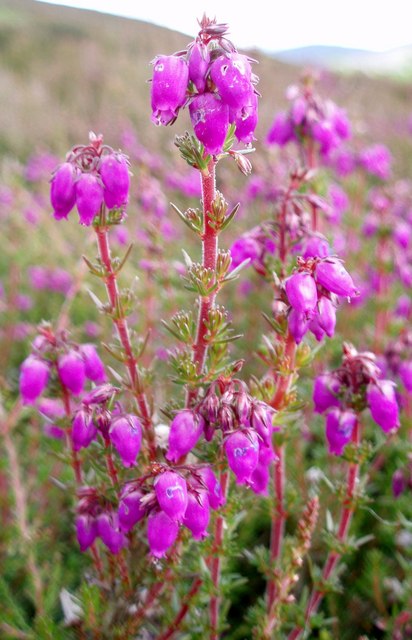 Bell HeatherErica cinerea
-
 Whorled HeathErica verticillata
-
 Cornish HeathErica vagans
Compare
Questions and answers
What is the scientific name of the Dorset Heath?
The scientific name of the Dorset Heath is Erica ciliaris. Written with its author, the full name is Erica ciliaris L..
Which family does the Dorset Heath belong to?
Erica ciliaris belongs to the family Ericaceae, in the order Ericales and the class Magnoliopsida.
Where is the Dorset Heath found?
Checklists and occurrence records place Erica ciliaris in 10 countries, including France, United Kingdom, Portugal, Spain, Morocco and The Netherlands.
What other names does the Dorset Heath have?
Erica ciliaris is also known in English as Ciliate Heath.
Sources
Passages the profile rests on
- The plant has bright pink flowers arranged in long racemes. Source passage: “The flowers are 8–12 mm (3⁄8–1⁄2 in) long, bright pink, and arranged in long racemes.” — English Wikipedia
- The leaves bear long glandular hairs. Source passage: “with long, glandular hairs.” — English Wikipedia
- The plant grows to a height of 60 centimetres. Source passage: “It grows to 60 centimetres (24 inches)” — English Wikipedia
- The flowers measure 8–12 millimetres in length. Source passage: “The flowers are 8–12 mm (3⁄8–1⁄2 in) long” — English Wikipedia
- The species has a Lusitanian distribution extending from Morocco through the Atlantic coasts of Portugal, Spain and France to the south-western British Isles. Source passage: “Erica ciliaris has a Lusitanian distribution, stretching from Morocco in the south, along the Atlantic coasts of Portugal, Spain and France to south-western parts of the British Isles in the north.” — English Wikipedia
- Within the British Isles, the species is native to Dorset, Devon, Cornwall and one location in County Galway. Source passage: “In the British Isles, it is only found natively in Dorset, Devon, Cornwall and one location in County Galway” — English Wikipedia
- The species has been introduced to Hampshire. Source passage: “It has also been introduced to Hampshire.” — English Wikipedia
- The species was voted the county flower of Dorset in 2002. Source passage: “E. ciliaris was voted the county flower of Dorset in 2002” — English Wikipedia
Data
- Catalogue of Life, 2026-10-16 XR cc by
- Global Biodiversity Information Facility CC BY 4.0
- Wikidata CC0
- GeoNames CC BY 4.0
- Wikimedia Commons per image; credit shown with each image
- Within the Catalogue of Life, this name comes from Synonymic Checklists of the Vascular Plants of the World cc by
References
- L. (1753). Sp. Pl. [Linnaeus] 1: 354 (1753). where the name was published
This species in other databases
- Catalogue of Life 6GKN2
- Wikidata Q386739
- iNaturalist 118551
- World Flora Online wfo-0000671673
- GRIN 15450
Page built on 28 November 2026. See how the catalog is made and all sources and licences.
Cite this page
ScientificNames.org. (2026). Erica ciliaris (Dorset Heath). Retrieved November 28, 2026, from https://scientificnames.org/species/erica-ciliaris
“Erica ciliaris (Dorset Heath).” ScientificNames.org, 2026, scientificnames.org/species/erica-ciliaris. Accessed 28 Nov. 2026.
ScientificNames.org. “Erica ciliaris (Dorset Heath).” Accessed November 28, 2026. https://scientificnames.org/species/erica-ciliaris.
@misc{scientificnames_erica_ciliaris_dorset_heath,
  author = {{ScientificNames.org}},
  title = {Erica ciliaris (Dorset Heath)},
  year = {2026},
  url = {https://scientificnames.org/species/erica-ciliaris},
  note = {Accessed 2026-11-28}
}