Species · Fishes
Deepwater Red Snapper Etelis carbunculus
The scientific name of the Deepwater Red Snapper is Etelis carbunculus. It is a species of fish in the family Lutjanidae (fusiliers), order Perciformes. The name dates from 1828.
- Scientific name
- Etelis carbunculus Cuvier, 1828
- Common name
- Deepwater Red Snapper
- Genus
- Etelis
- Family
- Lutjanidae (Fusiliers)
- Order
- Perciformes
- Class
- Teleostei
- Red List category
- LC Least Concern
- Environment
- marine
- Recorded in
- 21 countries
- Name status
- accepted in the Catalogue of Life

Overview
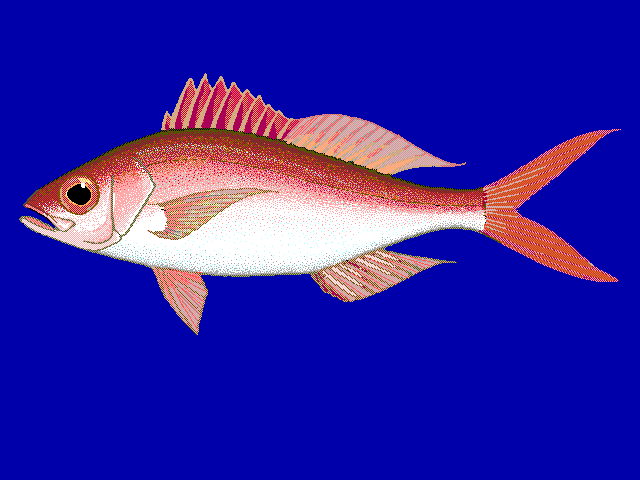
Etelis carbunculus occurs throughout the Indian and Pacific Oceans, including rocky reefs and substrates at depths between 90 and 400 metres. It has reddish to pinkish coloration, a whitish abdomen and a forked caudal fin with relatively short lobes.
Written 26 November 2026 from the sources listed below. Each statement was checked against the passage it cites; statements that could not be supported were removed.
Appearance
The Deepwater Red Snapper has an elongated body, a small head and a large eye. The space between the eyes is flat, and the mouth extends backward to the middle of the eye.[1][2][3]
Each jaw has a single row of conical teeth and one or two pairs of enlarged front canines. Its vomerine teeth form a slender V-shaped patch.[4][5]
Its continuous dorsal fin has a deep notch where the spiny and soft-ray sections meet. The dorsal fin has 10 spines and 11 soft rays, while the anal fin has 3 spines and 8 soft rays; both fins lack scales.[6][7][8][9]
The ultimate soft rays of the dorsal and anal fins extend beyond the membrane and are longer than the penultimate rays. Its pectoral fins are long and almost equal to the length of its head.[10][11]
Its overall coloration ranges from reddish to pinkish, with a whitish abdomen. The dorsal and caudal fins have red margins, and the lower caudal-fin lobe has a white tip.[12][13]
The maximum recorded fork length is 127 cm, while a total length of 65 cm is more typical.[14][15]
Habitat
The Deepwater Red Snapper occurs over rocky substrates and rocky reefs at depths between 90 and 400 metres. It occurs in or around the benthos.[16][17][18]
Its distribution extends throughout the Indian and Pacific Oceans, from the Red Sea south to Mozambique along the East African coast and to the Persian Gulf. Its range continues across the Indian Ocean into the Pacific Ocean, where it extends north to Japan, south to Australia and east to Hawaii.[19][20][21][22]
The species has been recorded around Manawatāwhi (Three Kings Islands) off northern New Zealand. In Western Australia, it occurs from Geraldton eastward, and its Australian range extends into the Arafura Sea northeast of Darwin in the Northern Territory.[23][24][25]
In Queensland, the species occurs on the outer Great Barrier Reef. It also occurs at Lord Howe Island in the Tasman Sea, around Christmas Island and the Cocos (Keeling) Islands.[26][27][28]
Behaviour
The Deepwater Red Snapper has been reported forming aggregations.[29]
Diet
The Deepwater Red Snapper feeds on fishes, squid, crustaceans and zooplankton.[30][31]
Reproduction and life cycle
In Vanuatu, the Deepwater Red Snapper breeds throughout the year, with spawning peaking in November.[32][33]
Conservation
Stocks of the Deepwater Red Snapper have been reported declining in some regions.[34]
Uses
The Deepwater Red Snapper is an important food fish and is targeted by fisheries throughout its distribution range. It is caught using bottom longlines and deep handlines.[35][36][37]
Caught specimens are sold fresh or frozen. In Australia, the species' stock is managed under the Western Deep Water Fishery.[38][39]
Classification of the Deepwater Red Snapper
| Kingdom | Animalia |
|---|---|
| Phylum | Chordata |
| Subphylum | Vertebrata |
| Infraphylum | Gnathostomata |
| Parvphylum | Osteichthyes |
| Gigaclass | Actinopterygii |
| Superclass | Actinopteri |
| Class | Teleostei (Teleost) |
| Order | Perciformes |
| Suborder | Percoidei |
| Family | Lutjanidae (Fusiliers) |
| Genus | Etelis (Ruby Snappers) |
| Species | Etelis carbunculus Cuvier, 1828 |
Where the Deepwater Red Snapper is found
Checklists and occurrence records place Etelis carbunculus in 21 countries. GBIF holds 888 georeferenced records of it.
Countries
- Australia 118
- Comoros 3
- French Polynesia 13
- India 4
- Indonesia 9
- Japan 86
- Kenya 3
- Mauritius 8
- Mayotte 206
- Mozambique 17
- New Caledonia 113
- Northern Mariana Islands 4
- Philippines 11
- Reunion 5
- Seychelles 7
- Solomon Islands 106
- South Africa 6
- Taiwan 10
- United States 152
- United States Minor Outlying Islands 4
- Wallis and Futuna 3
Regions and cities with the most records
- Temotu Province, Solomon Islands 106
- Koungou, Mayotte 52
- Diamond Head / Kapahulu / Saint Louis Heights, United States 31
- Honolulu, United States 31
- Makiki / Lower Punchbowl / Tantalus, United States 31
- Waikīkī, United States 31
- ʻEwa Beach-Iroquois Point, United States 31
- Aliamanu / Salt Lakes / Foster Village, United States 30
- East Honolulu, United States 30
- Joint Base Pearl Harbor Hickam, United States 30
- Kalihi Valley, United States 30
- Kaneohe, United States 30
- Kuliouou - Kalani Iki, United States 30
- Manoa, United States 30
- Niu Valley, United States 30
- ‘Ewa Beach, United States 30
- Pearl City, United States 29
- Waipahu, United States 29
- ʻEwa Gentry-West Loch, United States 29
- ‘Ewa Gentry, United States 29
- Dzaoudzi, Mayotte 17
- Kaouéni, Mayotte 17
- Labattoir, Mayotte 17
- Mamoudzou, Mayotte 17
- Kailua, United States 15
- Taiwan, Taiwan 7
- Amami, Japan 4
- Ambon, Indonesia 4
- Hengchun, Taiwan 4
- Naze, Japan 4
- Port Shepstone, South Africa 4
- Batac City, Philippines 3
- Laoag, Philippines 3
- Ouangani, Mayotte 3
- San Nicolas, Philippines 3
1 more country has a few records outside this range
These countries hold a few records of Etelis carbunculus but lie outside the range the checklists give for it. Such records are often zoo or garden specimens, museum material or vagrants, so the species is not counted as occurring there.
A number beside a place is its count of GBIF occurrence records. A place without a number comes from a checklist alone. Records show where a species has been observed or collected, which can include escapes and vagrants.
Common names
English
- Deepwater Red Snapper
- Deepwater Snapper
- Jobfish
- Long-tailed Snapper
- Queen Snapper
- Red Snapper
- Ruby-colored Snapper Fish
- Shorttailed Ruby Snapper
- Snapper
- Squirrelfish Snapper
- Deep-water Red Snapper
- Ruby Snapper
Names in 13 other languages
- Arabic
- Faris, نهاش الأعماق الأحمر, نهاش طويل الذيل, نهاش ياقوتي, نهاش ياقوتي قصير الذيل
- Chinese
- 濱鯛, 紅肉鑽, 紅鑽魚, 紅雞仔, 红钻鱼, 红鸡仔
- Czech
- chňapal růžový
- Danish
- Rubinsnapper
- French
- Perche rouget, Vivaneau rouge, vivaneau rubis
- German
- Schnapper
- Japanese
- Hachijô-akamutsu, Hamadai, ハチジョウアカムツ
- Malay
- Kerisi bali
- Portuguese
- Caranha-vermelha-de-águas-profundas, Pargo rubi
- Russian
- Рубиновый этелис
- Spanish
- Cachudo, Salmonete de lo Alto, pargo rubí
- Tagalog
- Tikwi
- pon
- lol
Synonyms
3 other scientific names have been used for this species and are now treated as synonyms of Etelis carbunculus.
- Etelis carbonculus Cuvier, 1828
- Etelis marshi (Jenkins, 1903)
- Eteliscus marshi Jenkins, 1903
Related species
-
 Queen SnapperEtelis oculatus
-
 Longtail Red SnapperEtelis coruscans
- Bowen's SnapperEtelis boweni
-
 Pale SnapperEtelis radiosus
-
 Northern Red SnapperLutjanus campechanus
-
 Mangrove SnapperLutjanus griseus
-
 Mangrove Red SnapperLutjanus argentimaculatus
-
 Cubera SnapperLutjanus cyanopterus
Compare
Questions and answers
What is the scientific name of the Deepwater Red Snapper?
The scientific name of the Deepwater Red Snapper is Etelis carbunculus. Written with its author, the full name is Etelis carbunculus Cuvier, 1828.
Which family does the Deepwater Red Snapper belong to?
Etelis carbunculus belongs to the family Lutjanidae, in the order Perciformes and the class Teleostei.
Where is the Deepwater Red Snapper found?
Checklists and occurrence records place Etelis carbunculus in 21 countries, including Mayotte, United States, Australia, New Caledonia, Solomon Islands and Japan.
What is the conservation status of the Deepwater Red Snapper?
The IUCN Red List category recorded for Etelis carbunculus is Least Concern (LC).
What other names does the Deepwater Red Snapper have?
Etelis carbunculus is also known in English as Deepwater Snapper, Jobfish, Long-tailed Snapper, Queen Snapper, Red Snapper and Ruby-colored Snapper Fish.
Sources
Passages the profile rests on
- Etelis carbunculus has an elongated body, a small head, and a large eye. Source passage: “Etelis carbunculus is an elongated fish with a small head and a large eye” — English Wikipedia
- The space between the eyes is flat. Source passage: “the space between the eyes is flat.” — English Wikipedia
- The mouth extends backward to the middle of the eye. Source passage: “The mouth extends back as far as the middle of the eye” — English Wikipedia
- Each jaw has a single row of conical teeth and one or two pairs of enlarged front canines. Source passage: “the jaws are each equipped with a single row of conical teeth with one or two pairs of enlarged canines at the front.” — English Wikipedia
- Its vomerine teeth form a slender V-shaped patch. Source passage: “The vomerine teeth are arranged in a slender V-shaped patch.” — English Wikipedia
- The species has a continuous dorsal fin with a deep notch where its spiny and soft-ray sections meet. Source passage: “It has a continuous dorsal fin which has a deep notch at the junction of its spiny part” — English Wikipedia
- The dorsal fin has 10 spines and 11 soft rays. Source passage: “The dorsal fin contains 10 spines and 11 soft rays” — English Wikipedia
- The anal fin has 3 spines and 8 soft rays. Source passage: “the anal fin has 3 spines and 8 soft rays” — English Wikipedia
- Both the dorsal and anal fins lack scales. Source passage: “both fins lacking scales.” — English Wikipedia
- The ultimate soft rays of the dorsal and anal fins extend beyond the membrane and are longer than the penultimate rays. Source passage: “the ultimate soft ray of both the dorsal and anal fins extends beyond the membrane, being longer than the penultimate ray.” — English Wikipedia
- Its pectoral fins are long and almost equal to the length of its head. Source passage: “The pectoral fins are long, almost equal to the head length.” — English Wikipedia
- Its overall coloration ranges from reddish to pinkish, with a whitish abdomen. Source passage: “The overall colour of this species is reddish to pinkish with a whitish abdomen.” — English Wikipedia
- Its dorsal and caudal fins have red margins, and the lower caudal-fin lobe has a white tip. Source passage: “There are red margins to the dorsal fin and the caudal fin which has a white tip to its lower lobe.” — English Wikipedia
- The maximum recorded fork length is 127 cm. Source passage: “The maximum recorded fork length is 127 cm (50 in)” — English Wikipedia
- A total length of 65 cm is more typical for this species. Source passage: “although a total length of 65 cm (26 in) is more typical.” — English Wikipedia
- The species occurs over rocky substrates and rocky reefs. Source passage: “Etelis carbunculus is found over rock substrates and rocky reefs” — English Wikipedia
- It inhabits depths between 90 and 400 metres. Source passage: “at depths between 90 and 400 m (300 and 1,310 ft)” — English Wikipedia
- It occurs in or around the benthos. Source passage: “in or around the benthos.” — English Wikipedia
- The species occurs throughout the Indian and Pacific Oceans. Source passage: “Etelis carbunculus has a wide distribution and can be found throughout the Indian and Pacific Oceans.” — English Wikipedia
- Its distribution extends from the Red Sea south to Mozambique along the East African coast and reaches the Persian Gulf. Source passage: “It occurs from the Red Sea south to Mozambique on the coast of East Africa to the Persian Gulf” — English Wikipedia
- Its range extends across the Indian Ocean into the Pacific Ocean. Source passage: “across the Indian Ocean into the Pacific Ocean.” — English Wikipedia
- In the Pacific Ocean, its range extends north to Japan, south to Australia, and east to Hawaii. Source passage: “In the Pacific its range extends north to Japan, south to Australia and east to Hawaii.” — English Wikipedia
- The species has been recorded around Manawatāwhi (Three Kings Islands) off northern New Zealand. Source passage: “It has also been found around Manawatāwhi / Three Kings Islands off northern New Zealand.” — English Wikipedia
- In Western Australia, the species occurs from Geraldton eastward. Source passage: “In Australia it is found from Geraldton in Western Australia east” — English Wikipedia
- Its Australian range extends into the Arafura Sea northeast of Darwin in the Northern Territory. Source passage: “into the Arafura Sea to the northeast of Darwin in the Northern Territory” — English Wikipedia
- In Queensland, the species occurs on the outer Great Barrier Reef. Source passage: “onto the outer Great Barrier Reef off Queensland” — English Wikipedia
- The species also occurs at Lord Howe Island in the Tasman Sea. Source passage: “It also occurs at Lord Howe Island in the Tasman Sea” — English Wikipedia
- The species occurs around Christmas Island and the Cocos (Keeling) Islands. Source passage: “as well as at Christmas Island and Cocos (Keeling) Islands.” — English Wikipedia
- The species has been reported forming aggregations. Source passage: “It has been reported forming aggregations.” — English Wikipedia
- The species feeds on fishes, squid, crustaceans, and zooplankton. Source passage: “It is a predatory species feeding on fishes, squid, crustaceans and zooplankton.” — English Wikipedia
- The species feeds on squid, fishes, and crustaceans. Source passage: “The species feeds on squid, fishes and crustaceans.” — australian.museum
- The species breeds throughout the year in Vanuatu. Source passage: “They breed all year round in Vanuatu” — English Wikipedia
- Spawning in Vanuatu peaks in November. Source passage: “spawning peaking there in November.” — English Wikipedia
- Stocks of the species have been reported declining in some regions. Source passage: “the stocks have been reported to be declining in some regions.” — English Wikipedia
- The species is an important food fish. Source passage: “is an important food fish.” — English Wikipedia
- The species is targeted by fisheries throughout its distribution range. Source passage: “Etelis carbunculus is a target for fisheries throughout its range” — English Wikipedia
- The species is caught using bottom longlines and deep handlines. Source passage: “It is caught using bottom longlines and deep handlines” — English Wikipedia
- Caught specimens are sold fresh or frozen. Source passage: “The caught fish are sold fresh or frozen.” — English Wikipedia
- In Australia, the species' stock is managed under the Western Deep Water Fishery. Source passage: “In Australia its stock is managed under the Western Deep Water Fishery.” — English Wikipedia
Data
- Catalogue of Life, 2026-10-16 XR cc by
- Global Biodiversity Information Facility CC BY 4.0
- Wikidata CC0
- GeoNames CC BY 4.0
- Wikimedia Commons per image; credit shown with each image
- Within the Catalogue of Life, this name comes from World Register of Marine Species cc by
References
- Cuvier, G., & Valenciennes, A. (1828). Histoire naturelle des poissons. Tome second. Livre Troisième. Des poissons de la famille des perches, ou des percoïdes. 2: i–xxi + 2 pp + 1–490, Pls. 9–40. https://doi.org/10.5962/bhl.title.7339 Link where the name was published
This species in other databases
- Catalogue of Life 6GT48
- Wikidata Q1042554
- iNaturalist 100430
- WoRMS urn:lsid:marinespecies.org:taxname:212545
- ITIS 168903
Page built on 27 November 2026. See how the catalog is made and all sources and licences.
Cite this page
ScientificNames.org. (2026). Etelis carbunculus (Deepwater Red Snapper). Retrieved November 27, 2026, from https://scientificnames.org/species/etelis-carbunculus
“Etelis carbunculus (Deepwater Red Snapper).” ScientificNames.org, 2026, scientificnames.org/species/etelis-carbunculus. Accessed 27 Nov. 2026.
ScientificNames.org. “Etelis carbunculus (Deepwater Red Snapper).” Accessed November 27, 2026. https://scientificnames.org/species/etelis-carbunculus.
@misc{scientificnames_etelis_carbunculus_deepwater_red_snapper,
  author = {{ScientificNames.org}},
  title = {Etelis carbunculus (Deepwater Red Snapper)},
  year = {2026},
  url = {https://scientificnames.org/species/etelis-carbunculus},
  note = {Accessed 2026-11-27}
}