Species · Fishes
Queen Snapper Etelis oculatus
The scientific name of the Queen Snapper is Etelis oculatus. It is a species of fish in the family Lutjanidae (fusiliers), order Perciformes. The name dates from 1828.
- Scientific name
- Etelis oculatus (Valenciennes, 1828)
- Common name
- Queen Snapper
- Genus
- Etelis
- Family
- Lutjanidae (Fusiliers)
- Order
- Perciformes
- Class
- Teleostei
- Red List category
- DD Data Deficient
- Environment
- marine
- Recorded in
- 17 countries
- Name status
- accepted in the Catalogue of Life
Overview
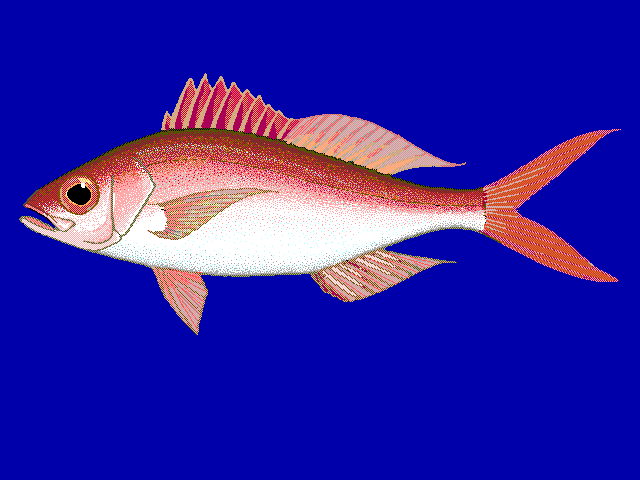
Etelis oculatus is native to the western Atlantic Ocean, ranging from North Carolina to São Paulo, Brazil, and also occurs around Bermuda and the Brazilian islands of Fernando de Noronha and Atol das Rocas. It has an elongated, slender body, large yellow eyes with red irises, and reddish deep pink coloration that fades toward the abdomen.
Written 26 November 2026 from the sources listed below. Each statement was checked against the passage it cites; statements that could not be supported were removed.
Appearance
The Queen Snapper has an elongated, slender, fusiform body, large eyes, a short snout and a slightly protruding lower jaw. Its jaws contain bands of small conical teeth, with larger, more widely spaced teeth in the outer row and one or two pairs of canine teeth at the front.[1][2][3][4]
Its vomerine teeth form a V-shaped patch that can be very triangular. The dorsal fin has 10 spines and 11 soft rays, while the anal fin has 3 spines and 8 soft rays; neither fin has scales.[5][6][7]
Its caudal fin is deeply forked, with lobes that lengthen as the fish grows. Its pointed pectoral fins contain either 17 or 19 rays, and its medium-sized body scales have dorsal rows running parallel to the lateral line.[8][9][10]
The back and upper flanks are reddish deep pink, fading toward the abdomen. The fins are pink except for the spiny portion of the dorsal fin and the caudal fin, which are brilliant red; the large eyes are yellow with red irises.[11][12][13]
The maximum recorded total length is 100 cm, while 67 cm is more typical.[14][15]
Habitat
The Queen Snapper is a bathydemersal fish inhabiting depths of 100–450 m. A remotely operated vehicle observation established a maximum recorded depth of 534 m.[16][17]
Adults occur over rocky substrates, while juveniles occur in mid-water. Abundance is highest in areas with rocky bottom habitat near oceanic islands.[18][19][20]
In Puerto Rico distribution models, bathymetry was consistently among the strongest predictors of suitable habitat. Positive detections were concentrated around large underwater features such as seamounts and ridges.[21][22]
Diet
Adult Queen Snappers feed mainly on fish and squid. Juveniles feed on crustaceans.[23][24]
Reproduction and life cycle
Spawning occurs during most of the year, with activity peaking toward the end of the year. Queen Snappers appear to be reproductively inactive during spring.[25][26]
Conservation
The species is subjected to severe fishing pressure, and some populations are considered almost certainly to be declining. It is vulnerable to fishing pressure and is likely to recover slowly.[27][28]
Within the U.S. Caribbean Exclusive Economic Zone, the Queen Snapper has been identified as undergoing overfishing or having unknown stock status. In Puerto Rico commercial landings from 2010 to 2019, it was the second most landed finfish species by total pounds and the fourth most landed species according to NOAA Trip Interview Program data.[29][30][31]
Uses
The Queen Snapper is commercially harvested throughout its geographic range. It is caught using hand lines, longlines and traps.[32][33]
It is regarded as an excellent food fish, and commercial catches are sold fresh or frozen. It is a targeted component of the commercially important deepwater snapper-grouper fishery in Puerto Rico and the Caribbean.[34][35]
Classification of the Queen Snapper
| Kingdom | Animalia |
|---|---|
| Phylum | Chordata |
| Subphylum | Vertebrata |
| Infraphylum | Gnathostomata |
| Parvphylum | Osteichthyes |
| Gigaclass | Actinopterygii |
| Superclass | Actinopteri |
| Class | Teleostei (Teleost) |
| Order | Perciformes |
| Suborder | Percoidei |
| Family | Lutjanidae (Fusiliers) |
| Genus | Etelis (Ruby Snappers) |
| Species | Etelis oculatus (Valenciennes, 1828) |
Where the Queen Snapper is found
Checklists and occurrence records place Etelis oculatus in 17 countries. GBIF holds 136 georeferenced records of it.
Countries
- Bahamas 15
- Bermuda 7
- Bonaire, Saint Eustatius and Saba 4
- Brazil 9
- Cuba 18
- Curacao 6
- Dominican Republic 5
- French Guiana 3
- Guadeloupe 3
- Honduras 5
- Jamaica 4
- Martinique 5
- Mexico 13
- Nicaragua 4
- Panama 4
- Puerto Rico 10
- United States 21
Regions and cities with the most records
- Ducos, Martinique 5
- Fort-de-France, Martinique 5
- La Trinité, Martinique 5
- Le François, Martinique 5
- Le Lamentin, Martinique 5
- Le Robert, Martinique 5
- Saint-Joseph, Martinique 5
- Arroyo Naranjo, Cuba 3
- Cojímar, Cuba 3
- Guanabacoa, Cuba 3
- Havana, Cuba 3
- Kralendijk, Bonaire, Saint Eustatius and Saba 3
- Levittown, Puerto Rico 3
- Regla, Cuba 3
- Sainte-Marie, Martinique 3
- San Miguel del Padrón, Cuba 3
A number beside a place is its count of GBIF occurrence records. A place without a number comes from a checklist alone. Records show where a species has been observed or collected, which can include escapes and vagrants.
Common names
English
- Queen Snapper
- Blear-eyed Snapper
- Bream
- Brim
- Brim Snapper
- Night Snapper
- Red Snapper
- Redfish
- Satin
- Squirreleyed Snapper
Names in 10 other languages
- Chinese
- 大西洋紅鑽魚
- Czech
- chňapal královský
- Danish
- Dronningesnapper
- French
- Brème, vivaneau royal
- Portuguese
- Caranha-rainha, Pargo Mariquita
- Russian
- Королевский этелис
- Spanish
- Cartucho, Chillo Prieto, Pargo Ojón, Salmonete de Lo Alto, cachucho, pargo cachucho
- Tagalog
- Maya maya, Tikwi
- Tongan
- Palu tavake
- agn
- Maya-maya
Synonyms
3 other scientific names have been used for this species and are now treated as synonyms of Etelis oculatus.
- Erythrobussothen gracilis Parr, 1933
- Etelis aculatus (Valenciennes, 1828)
- Serranus oculatus Valenciennes, 1828
Related species
-
 Deepwater Red SnapperEtelis carbunculus
-
 Longtail Red SnapperEtelis coruscans
- Bowen's SnapperEtelis boweni
-
 Pale SnapperEtelis radiosus
-
 Northern Red SnapperLutjanus campechanus
-
 Mangrove SnapperLutjanus griseus
-
 Mangrove Red SnapperLutjanus argentimaculatus
-
 Cubera SnapperLutjanus cyanopterus
Compare
Questions and answers
What is the scientific name of the Queen Snapper?
The scientific name of the Queen Snapper is Etelis oculatus. Written with its author, the full name is Etelis oculatus (Valenciennes, 1828).
Which family does the Queen Snapper belong to?
Etelis oculatus belongs to the family Lutjanidae, in the order Perciformes and the class Teleostei.
Where is the Queen Snapper found?
Checklists and occurrence records place Etelis oculatus in 17 countries, including United States, Cuba, Bahamas, Mexico, Puerto Rico and Brazil.
What is the conservation status of the Queen Snapper?
The IUCN Red List category recorded for Etelis oculatus is Data Deficient (DD).
What other names does the Queen Snapper have?
Etelis oculatus is also known in English as Blear-eyed Snapper, Bream, Brim, Brim Snapper, Night Snapper and Red Snapper.
Is queen snapper good to eat?
The Queen Snapper is regarded as an excellent food fish. Commercial catches are sold fresh or frozen.[34]
Are queen snapper good to eat?
The Queen Snapper is regarded as an excellent food fish. Commercial catches are sold fresh or frozen.[34]
Sources
Passages the profile rests on
- The queen snapper has an elongated, slender, fusiform body. Source passage: “The queen snapper has an elongated, fusiform, slender body.” — English Wikipedia
- The species has large eyes, a short snout, and a slightly protruding lower jaw. Source passage: “It has a flat intraorbital area, large eyes and a short snout with the lower jaw slightly protruding.” — English Wikipedia
- Its jaws contain bands of small conical teeth, with larger and more widely spaced teeth in the outer row. Source passage: “The jaws have bands of small conical teeth, the outer row consisting of larger teeth which are more widely spaced.” — English Wikipedia
- The front of its jaws contains one or two pairs of canine teeth. Source passage: “There are 1-2 pairs of canine teeth in the front of the jaws.” — English Wikipedia
- Its vomerine teeth form a V-shaped patch that can be very triangular. Source passage: “The vomerine teeth are arranged in a V-shaped patch, which is sometimes very triangular.” — English Wikipedia
- Its dorsal fin has 10 spines and 11 soft rays, while its anal fin has 3 spines and 8 soft rays. Source passage: “The dorsal fin has 10 spines and 11 soft rays, while the anal fin contains 3 spines and 8 soft rays” — English Wikipedia
- The dorsal and anal fins lack scales. Source passage: “The dorsal and anal fins are both scaleless.” — English Wikipedia
- Its caudal fin is deeply forked, with lobes that lengthen as the fish grows. Source passage: “The caudal fin is deeply forked and its lobes lengthen as the fish grows.” — English Wikipedia
- Its pointed pectoral fins contain either 17 or 19 rays. Source passage: “It has long pointed pectoral fins which contain 19 or 17 rays.” — English Wikipedia
- The body is covered with medium-sized scales whose dorsal rows run parallel to the lateral line. Source passage: “The body is covered with medium-sized scales and the dorsal scale rows run parallel to the lateral line.” — English Wikipedia
- Its back and upper flanks are reddish deep pink, fading toward the abdomen. Source passage: “This species has a reddish deep pink back and upper flanks fading towards the abdomen.” — English Wikipedia
- Its fins are pink except for the spiny portion of the dorsal fin and the caudal fin, which are brilliant red. Source passage: “The fins other than the spiny part of the dorsal, and the caudal fin which are brilliant red, are pink.” — English Wikipedia
- Its large eyes are yellow with red irises. Source passage: “The large eyes are yellow with a red iris.” — English Wikipedia
- The maximum recorded total length of the queen snapper is 100 cm. Source passage: “The maximum recorded total length is 100 cm (39 in)” — English Wikipedia
- A total length of 67 cm is more typical for this species. Source passage: “although a total length of 67 cm (26 in) is more typical.” — English Wikipedia
- The queen snapper is a bathydemersal fish inhabiting depths of 100–450 m. Source passage: “The queen snapper is a bathydemersal species which is found at depths between 100 and 450 m (330 and 1,480 ft).” — English Wikipedia
- A remotely operated vehicle observation established a maximum recorded depth of 534 m for the species. Source passage: “recently established a new maximum depth for the species of 534 meters (m) with direct observations via a remotely operated vehicle” — pmc.ncbi.nlm.nih.gov
- Adult queen snappers occur over rocky substrates. Source passage: “Adults are found over rock substrates” — English Wikipedia
- Juvenile queen snappers occur in mid-water. Source passage: “The juveniles are found in mid-water” — English Wikipedia
- Queen snapper abundance is highest in areas with rocky bottom habitat near oceanic islands. Source passage: “queen snapper is most abundant in areas characterized by rocky bottom habitat near oceanic islands” — pmc.ncbi.nlm.nih.gov
- Bathymetry was consistently among the strongest predictors of suitable queen snapper habitat in the Puerto Rico distribution models. Source passage: “bathymetry was consistently one of the best predictors of queen snapper suitable habitat.” — pmc.ncbi.nlm.nih.gov
- Positive detections in Puerto Rico were concentrated around large underwater features such as seamounts and ridges. Source passage: “Positive detections showed strong regional patterns localized around large bathymetric features, such as seamounts and ridges.” — pmc.ncbi.nlm.nih.gov
- Adult queen snappers feed mainly on fish and squid. Source passage: “where they feed mainly on fish and squid.” — English Wikipedia
- Juvenile queen snappers feed on crustaceans. Source passage: “The juveniles are found in mid-water and will feed on crustaceans.” — English Wikipedia
- Spawning occurs during most of the year, with activity peaking toward the end of the year. Source passage: “Spawning takes place through most of the year, peaking towards the end of the year” — English Wikipedia
- Queen snappers appear to be reproductively inactive during spring. Source passage: “spring seems to be when these fish are not reproductively active.” — English Wikipedia
- The species is subjected to severe fishing pressure, and some populations are considered almost certainly to be declining. Source passage: “They are subjected to severe fishing pressure and it is almost certain that some populations are declining.” — English Wikipedia
- Queen snapper is vulnerable to fishing pressure and is likely to recover slowly. Source passage: “thus rendering the species vulnerable to, and likely slow to recover from, fishing pressure.” — pmc.ncbi.nlm.nih.gov
- Queen snapper has been identified as undergoing overfishing or having unknown stock status within the U.S. Caribbean Exclusive Economic Zone. Source passage: “several species of deepwater snapper, including queen snapper (Etelis oculatus), have previously been determined to be undergoing overfishing, or their stock status is unknown within the U.S. Caribbean Exclusive Economic Zone” — pmc.ncbi.nlm.nih.gov
- Queen snapper is the second most landed finfish species by total pounds in Puerto Rico commercial landings from 2010 to 2019. Source passage: “it is the second most landed finfish species (by total pounds) as determined by Puerto Rico commercial landings (2010–2019).” — pmc.ncbi.nlm.nih.gov
- In Puerto Rico, queen snapper was the fourth most landed species according to NOAA Trip Interview Program data from 2010–2019. Source passage: “In Puerto Rico, queen snapper is the fourth most landed species” — pmc.ncbi.nlm.nih.gov
- Queen snapper is commercially harvested throughout its geographic range. Source passage: “The queen snapper is a quarry for commercial fisheries throughout its range.” — English Wikipedia
- Queen snapper are caught using hand lines, longlines, and traps. Source passage: “They are caught using hand lines, longlines and traps.” — English Wikipedia
- Queen snapper is regarded as an excellent food fish, and commercial catches are sold fresh or frozen. Source passage: “This species is regarded as an excellent food fish and the fish caught are sold fresh and frozen.” — English Wikipedia
- Queen snapper is a targeted component of the commercially important deepwater snapper-grouper fishery in Puerto Rico and the Caribbean. Source passage: “Queen snapper is of interest from an ecological and management perspective as it is a targeted component of the commercially important deepwater snapper-grouper complex fishery found throughout Puerto Rico and the Caribbean.” — pmc.ncbi.nlm.nih.gov
Data
- Catalogue of Life, 2026-10-16 XR cc by
- Global Biodiversity Information Facility CC BY 4.0
- Wikidata CC0
- GeoNames CC BY 4.0
- Wikimedia Commons per image; credit shown with each image
- Within the Catalogue of Life, this name comes from World Register of Marine Species cc by
References
- Cuvier, Georges & A. Valenciennes. 1828. Livre troisième. Des poissons de la famille des perches, ou des percoïdes. [Unspecified Publisher] Vol. Tome second, No. 1-2: i-xxi, [1-2], 1-490, pls. 9-40. where the name was published
This species in other databases
- Catalogue of Life 3BKMK
- Wikidata Q2062031
- iNaturalist 131532
- WoRMS urn:lsid:marinespecies.org:taxname:159789
- ITIS 168902
Page built on 28 November 2026. See how the catalog is made and all sources and licences.
Cite this page
ScientificNames.org. (2026). Etelis oculatus (Queen Snapper). Retrieved November 28, 2026, from https://scientificnames.org/species/etelis-oculatus
“Etelis oculatus (Queen Snapper).” ScientificNames.org, 2026, scientificnames.org/species/etelis-oculatus. Accessed 28 Nov. 2026.
ScientificNames.org. “Etelis oculatus (Queen Snapper).” Accessed November 28, 2026. https://scientificnames.org/species/etelis-oculatus.
@misc{scientificnames_etelis_oculatus_queen_snapper,
  author = {{ScientificNames.org}},
  title = {Etelis oculatus (Queen Snapper)},
  year = {2026},
  url = {https://scientificnames.org/species/etelis-oculatus},
  note = {Accessed 2026-11-28}
}