Species · Mammals
Southern Right Whale Eubalaena australis
The scientific name of the Southern Right Whale is Eubalaena australis. It is a species of mammal in the family Balaenidae (right whales), order Cetacea. The name dates from 1822.
- Scientific name
- Eubalaena australis (Desmoulins, 1822)
- Common name
- Southern Right Whale
- Genus
- Eubalaena
- Family
- Balaenidae (Right Whales)
- Order
- Cetacea
- Class
- Mammalia
- Red List category
- LC Least Concern
- Environment
- marine
- Recorded in
- 13 countries
- Name status
- accepted in the Catalogue of Life

Overview
The species inhabits the Southern Ocean and sub-Antarctic waters.
Written 26 November 2026 from the sources listed below. Each statement was checked against the passage it cites; statements that could not be supported were removed.
Appearance
The species has two blowholes that produce a V-shaped spout and large, rectangular pectoral fins.[1][2]
Mature southern right whales average between 16 and 18 metres in length. The largest recorded individuals measure 17–18 metres and weigh up to 80 tonnes.[3][4]
Newborn calves measure between 4.5 and 6 metres in length. Baleen plates on each side of the upper jaw can reach approximately 3 metres in length.[5][6]
Habitat
The Southern Right Whale inhabits the Southern Ocean and sub-Antarctic waters. It occurs throughout the Southern Hemisphere between approximately 20° and 60° south latitude.[7][8]
The species uses protected bays as mating and calving habitats. Australian southern right whales show a preference for calving grounds along coastlines with high wave energy.[9][10]
Deep water adjacent to shallow calving grounds may provide training areas for calves.[11]
Diet
The Southern Right Whale feeds primarily on zooplankton, particularly krill. Its diet also includes plankton, copepods and other small crustaceans.[12][13][14]
Behaviour
The species are generally slow swimmers. Cow and calf pairs migrate at approximately 2.7 to 4.2 kilometres per hour over a 24-hour period.[15][16]
Southern right whales produce short, low-frequency moans and pulses. They sometimes adopt a vertical headstanding position with their flukes extended above the water.[17][18]
Reproduction and life cycle
Females generally give birth to their first calf between eight and ten years of age. Gestation lasts approximately one year, and females typically reproduce every three to five years.[19][20][21]
Calves generally remain with their mothers during their first year.[22]
Southern right whales are polygamous, with as many as seven males associated with one female.[23]
Conservation
The Southern Right Whale is listed as endangered under the United States Endangered Species Act. It is protected throughout its range under the Marine Mammal Protection Act and listed in Appendix I of CITES.[24][25][26]
Entanglement in fishing gear and collisions with vessels are ongoing threats. Industrialization of coastal and marine habitats can cause habitat degradation affecting the species.[27][28]
Climate change can threaten the species through changes in ocean conditions and dynamics. The Chile-Peru population remains small and has not shown signs of recovery from whaling.[29][30]
Uses
Southern right whales support coastal economies through whale-watching tourism. Historically, they were hunted for their oil and meat.[31][32]
Classification of the Southern Right Whale
| Kingdom | Animalia |
|---|---|
| Phylum | Chordata |
| Subphylum | Vertebrata |
| Infraphylum | Gnathostomata |
| Parvphylum | Osteichthyes |
| Megaclass | Tetrapoda |
| Class | Mammalia (Mammal) |
| Subclass | Theria |
| Infraclass | Eutheria |
| Order | Cetacea (Cetacean) |
| Suborder | Mysticeti (Baleen Whales) |
| Family | Balaenidae (Right Whales) |
| Genus | Eubalaena (Right Whale) |
| Species | Eubalaena australis (Desmoulins, 1822) |
Where the Southern Right Whale is found
Checklists and occurrence records place Eubalaena australis in 13 countries. GBIF holds 21,317 georeferenced records of it.
Countries
- Argentina 5,604
- Australia 11,805
- Brazil 464
- Chile 406
- Falkland Islands 131
- French Southern Territories 606
- Mozambique 52
- Namibia 66
- New Zealand 625
- Reunion 8
- Saint Helena 169
- South Africa 1,275
- Uruguay 106
Regions and cities with the most records
- Warrnambool, Australia 2,977
- Puerto Madryn, Argentina 1,589
- San Antonio Oeste, Argentina 1,189
- Chubut, Argentina 1,112
- Hermanus, South Africa 497
- Rio Negro, Argentina 469
- South Australia, Australia 466
- Gansbaai, South Africa 360
- Western Cape, South Africa 351
- Victoria, Australia 251
- Western Australia, Australia 159
- New South Wales, Australia 148
- Garopaba, Brazil 147
- Imbituba, Brazil 128
- Torquay, Australia 123
- Retreat, South Africa 95
- Muizenberg, South Africa 93
- Rondebosch, South Africa 61
- Santa Catarina, Brazil 61
- Plettenberg Bay, South Africa 57
- Cape Town, South Africa 52
- Laguna, Brazil 50
- Mossel Bay, South Africa 50
- Groot-Brakrivier, South Africa 49
- Central Coast, Australia 43
- Sydney, Australia 39
- Rio Grande do Sul, Brazil 38
- Karori, New Zealand 35
- Wellington, New Zealand 35
- Adelaide, Australia 34
- Stanley, Falkland Islands 34
- Wainuiomata, New Zealand 34
- Lower Hutt, New Zealand 33
- Geelong, Australia 32
- Ribeirão da Ilha, Brazil 31
- Freguesia do Ribeirao da Ilha, Brazil 30
2 more countries have a few records outside this range
These countries hold a few records of Eubalaena australis but lie outside the range the checklists give for it. Such records are often zoo or garden specimens, museum material or vagrants, so the species is not counted as occurring there.
Range as the checklists state it
Antarctica/Southern Ocean
Eastern Atlantic Ocean
Western Atlantic Ocean
Indo-West Pacific
A number beside a place is its count of GBIF occurrence records. A place without a number comes from a checklist alone. Records show where a species has been observed or collected, which can include escapes and vagrants.
Common names
English
- Southern Right Whale
Names in 12 other languages
- Afrikaans
- noordkaper, suidelike noordkapper
- Dutch
- zuidkaper
- French
- Baleine Australe, Baleine franche australe, baleine austral, baleine du Cap
- German
- Glattwal, Kapwal, Suedwal des stillen Ozeans, suedlicher Glattwal, suedlicher Walfisch
- Indonesian
- paus selatan
- Japanese
- sebi kujira
- Malagasy
- trozona mainty, trozona marine
- Norwegian
- sorlig retthval
- Portuguese
- Baleia Franca Austral, baleia verdadeira, baleia-franca-austral
- Russian
- nastyaschiy kit
- Spanish
- ballena franca austral, ballena verdadera, reithuel, vieja
- Swedish
- nordkapare
Synonyms
15 other scientific names have been used for this species and are now treated as synonyms of Eubalaena australis.
- Balaena antarctica Lesson, 1828
- Balaena antipodarum Gray, 1843
- Balaena australis Desmoulins, 1822
- Balaena capensis Gray, 1868
- Balaena glacialis australis Desmoulins, 1822
- Balaena glacialis australis Scheffer & Rice, 1963
- Balaena hectori Gray, 1874
- Balaena mysticetus antarcticus Schlegel, 1841
- Baloena australis Desmoulins, 1822
- Eubalaena capensis Gray, 1866
- Eubalaena glacialis australis (Desmoulins, 1822)
- Eubalaena glacialis australis Tomilin, 1962
- Halibalaena britannica Gray, 1873
- Hunterus temminckii Gray, 1864
- Macleayius australiensis Gray, 1865
Related species
-
 North Atlantic Right WhaleEubalaena glacialis
-
 North Pacific Right WhaleEubalaena japonica
-
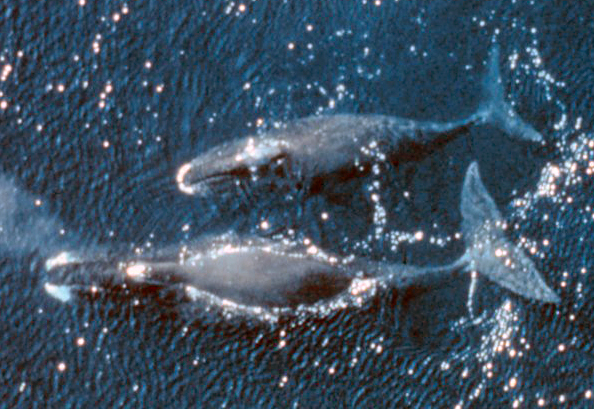 Bowhead WhaleBalaena mysticetus
Compare
Questions and answers
What is the scientific name of the Southern Right Whale?
The scientific name of the Southern Right Whale is Eubalaena australis. Written with its author, the full name is Eubalaena australis (Desmoulins, 1822).
Which family does the Southern Right Whale belong to?
Eubalaena australis belongs to the family Balaenidae, in the order Cetacea and the class Mammalia.
Where is the Southern Right Whale found?
Checklists and occurrence records place Eubalaena australis in 13 countries, including Australia, Argentina, South Africa, New Zealand, French Southern Territories and Brazil.
What is the conservation status of the Southern Right Whale?
The IUCN Red List category recorded for Eubalaena australis is Least Concern (LC).
Sources
Passages the profile rests on
- The species has two blowholes that produce a distinctive V-shaped spout. Source passage: “they have two blowholes, which create a distinctive V-shaped spout when they breathe.” — connected.pmhc.nsw.gov.au
- The whale has large, rectangular pectoral fins. Source passage: “they have large, rectangular pectoral fins.” — connected.pmhc.nsw.gov.au
- Mature southern right whales average between 16 and 18 metres in length. Source passage: “Eubalaena australis is on average between 16 and 18 meters long at maturity” — animaldiversity.org
- The largest recorded individuals measure 17–18 metres in length and weigh up to 80 tonnes. Source passage: “17–18 m (56–59 ft) in length and up to 80 tonnes” — English Wikipedia
- Newborn calves measure between 4.5 and 6 metres in length. Source passage: “At birth, calves are between 4.5 and 6 metres long.” — connected.pmhc.nsw.gov.au
- The baleen plates on each side of the upper jaw can reach approximately 3 metres in length. Source passage: “These are narrow and approximately 3 m (9.8 ft) long” — English Wikipedia
- The species inhabits the Southern Ocean and sub-Antarctic waters. Source passage: “The Southern Right Whale inhabits the southern and sub-antarctic oceans for most of the year.” — connected.pmhc.nsw.gov.au
- The species occurs throughout the Southern Hemisphere between approximately 20° and 60° south latitude. Source passage: “it inhabits oceans between the latitudes of 20° and 60° south.” — English Wikipedia
- Southern right whales use protected bays as mating and calving habitats. Source passage: “Southern right whales mate and calve between 20 and 30° S and mostly in protected bays” — animaldiversity.org
- Australian southern right whales show a preference for calving grounds along coastlines with high wave energy. Source passage: “southern right whales have shown a preference for calving grounds along coastlines with high wave energy” — English Wikipedia
- Deep water adjacent to shallow calving grounds may provide training areas for calves. Source passage: “Deep waters alongside shallower calving grounds may serve as training grounds for calves” — English Wikipedia
- The species feeds primarily on zooplankton, particularly krill. Source passage: “southern right whales feed almost exclusively on zooplankton, particularly krill.” — English Wikipedia
- Southern right whales consume copepods and krill in high-latitude feeding grounds. Source passage: “where they use their baleen to “skim” copepods and krill from the water.” — fisheries.noaa.gov
- Their diet includes krill, plankton, copepods and other small crustaceans. Source passage: “Their diet mainly consists of krill, plankton, copepods, and other tiny crustaceans.” — connected.pmhc.nsw.gov.au
- Southern right whales are generally slow swimmers. Source passage: “but are generally slow swimmers.” — animaldiversity.org
- Cow and calf pairs migrate at approximately 2.7 to 4.2 kilometres per hour over a 24-hour period. Source passage: “They do so at a rate of 2.7 to 4.2 kilometers/hour over a 24-hour period for cow and calf pairs.” — animaldiversity.org
- Southern right whales produce short, low-frequency moans and pulses. Source passage: “Eubalaena australis produce short, low frequency moans and pulses.” — animaldiversity.org
- The species sometimes adopts a vertical headstanding position with its flukes extended above the water. Source passage: “they assume a vertical position and extend the flukes into the air, often rocking back and forth” — animaldiversity.org
- Females generally give birth to their first calf between eight and ten years of age. Source passage: “Females usually give birth to their first calf between eight and ten years old” — fisheries.noaa.gov
- Gestation lasts approximately one year. Source passage: “gestation takes approximately one year.” — fisheries.noaa.gov
- Females typically reproduce every three to five years. Source passage: “females reproduce every three to five years.” — fisheries.noaa.gov
- Calves generally remain with their mothers during their first year. Source passage: “The calf usually remains with its mother during the first year of its life” — English Wikipedia
- Southern right whales are polygamous, with as many as seven males associated with one female. Source passage: “Southern right whales are polygamous, having up to seven males per one female.” — animaldiversity.org
- The species is listed as endangered under the United States Endangered Species Act. Source passage: “The Southern right whale is listed as endangered under the Endangered Species Act” — fisheries.noaa.gov
- Southern right whales are protected throughout their range under the Marine Mammal Protection Act. Source passage: “The Southern right whale is protected throughout its range under the Marine Mammal Protection Act.” — fisheries.noaa.gov
- The species is listed in Appendix I of CITES. Source passage: “Appendix I of the Convention on International Trade in Endangered Species of Wild Fauna and Flora (CITES)” — fisheries.noaa.gov
- Entanglement in fishing gear and collisions with vessels are ongoing threats to the species. Source passage: “Current threats to southern right whales include entanglement in fishing gear, vessel strikes” — fisheries.noaa.gov
- Industrialization of coastal and marine habitats can cause habitat degradation affecting southern right whales. Source passage: “industrialization of coastal and marine habitats that can result in habitat degradation” — fisheries.noaa.gov
- Climate change can threaten the species through changes in ocean conditions and dynamics. Source passage: “changes in water conditions and dynamics due to climate change.” — fisheries.noaa.gov
- The Chile-Peru population remains small and has not shown signs of recovery from whaling. Source passage: “the Chile-Peru population, which remains small and has not shown signs of recovery.” — fisheries.noaa.gov
- Southern right whales support coastal economies through whale-watching tourism. Source passage: “the increasing popularity of whale watching and coastal tourism has led to the whales having a positive economic impact on humans.” — animaldiversity.org
- Historically, southern right whales were hunted for their oil and meat. Source passage: “They were extensively hunted for oil and meat before becoming protected.” — animaldiversity.org
Data
- Catalogue of Life, 2026-10-16 XR cc by
- Global Biodiversity Information Facility CC BY 4.0
- Wikidata CC0
- GeoNames CC BY 4.0
- Wikimedia Commons per image; credit shown with each image
- Within the Catalogue of Life, this name comes from The Integrated Taxonomic Information System cc0
References
- In Bory de Saint-Vincent (ed.), Dict. Class. Hist. Nat. Paris vol.2 p.161, pl. where the name was published
- Wilson, Don E., and DeeAnn M. Reeder, eds. (1993). Mammal Species of the World: A Taxonomic and Geographic Reference, 2nd Ed., 3rd Printing.
- Wilson, Don E., and F. Russell Cole. (2000). Common Names of Mammals of the World.
- Mead, James G., and Robert L. Brownell, Jr. / Wilson, Don E., and DeeAnn M. Reeder, eds. (2005). Order Cetacea. Mammal Species of the World: A Taxonomic and Geographic Reference, 3rd Ed., Vol. 1.
- Würsig, Bernd, J. G. M. Thewissen, and Kit M. Kovacs, eds. (2018). Encyclopedia of Marine Mammals, 3rd Edition.
This species in other databases
Page built on 27 November 2026. See how the catalog is made and all sources and licences.
Cite this page
ScientificNames.org. (2026). Eubalaena australis (Southern Right Whale). Retrieved November 27, 2026, from https://scientificnames.org/species/eubalaena-australis
“Eubalaena australis (Southern Right Whale).” ScientificNames.org, 2026, scientificnames.org/species/eubalaena-australis. Accessed 27 Nov. 2026.
ScientificNames.org. “Eubalaena australis (Southern Right Whale).” Accessed November 27, 2026. https://scientificnames.org/species/eubalaena-australis.
@misc{scientificnames_eubalaena_australis_southern_right_whale,
  author = {{ScientificNames.org}},
  title = {Eubalaena australis (Southern Right Whale)},
  year = {2026},
  url = {https://scientificnames.org/species/eubalaena-australis},
  note = {Accessed 2026-11-27}
}