Species · Mammals
North Atlantic Right Whale Eubalaena glacialis
The scientific name of the North Atlantic Right Whale is Eubalaena glacialis. It is a species of mammal in the family Balaenidae (right whales), order Cetacea. The name dates from 1776.
- Scientific name
- Eubalaena glacialis (Müller, 1776)
- Common name
- North Atlantic Right Whale
- Genus
- Eubalaena
- Family
- Balaenidae (Right Whales)
- Order
- Cetacea
- Class
- Mammalia
- Red List category
- CR Critically Endangered
- Environment
- marine
- Recorded in
- 3 countries
- Name status
- accepted in the Catalogue of Life

Overview
Eubalaena glacialis occurs almost exclusively along the eastern coasts of the United States and Canada. It is distinguished by rough, white patches of keratinized skin called callosities on its head.
Written 26 November 2026 from the sources listed below. Each statement was checked against the passage it cites; statements that could not be supported were removed.
Appearance
The North Atlantic Right Whale has a broad back without a dorsal fin, short paddle-shaped pectoral flippers, and a long arching mouth. Its coloration ranges from dark grey to black, and some individuals have white patches on their stomachs or throats.[1][2]
Its head accounts for approximately one-quarter of its total body length. The V-shaped blowhole produces a heart-shaped blow, and the head bears distinctive rough, white patches of keratinized skin called callosities.[3][4][5]
Colonies of whale lice inhabit the callosities on its head. Its body contains a high proportion of blubber, reaching up to 45 percent of its body weight.[6][7]
Habitat
Its winter nursery grounds include warm, shallow coastal waters off the southeastern United States. Its winter migration includes coastal waters of South Carolina, Georgia, and Florida.[8][9]
Its feeding grounds include productive waters of the Gulf of Maine and northern waters off the northeastern United States and Canada. The Gulf of St. Lawrence has become an increasingly important feeding area.[10][11][12]
Nantucket Shoals has become an important habitat where whales are present nearly year-round. Some individuals have been observed entering the Gulf of Mexico and crossing the Atlantic into European waters.[13][14]
Diet
Calanoid copepods, particularly Calanus finmarchicus, are its primary food source. Its diet also includes copepods, krill, pteropods, and larval barnacles.[15][16]
Behaviour
The North Atlantic Right Whale feeds by slowly skimming through concentrated patches of prey near or below the ocean surface. It uses low-frequency sounds for navigation, food location, and communication.[17][18]
It interacts with other baleen whales, particularly humpback whales, and with bottlenose dolphins. Groups consisting of one female and several males participate in surface-active mating activities.[19][20]
Calves tend to be more curious and playful than adults.[21]
Reproduction and life cycle
North Atlantic Right Whales are promiscuous breeders. Females first give birth at approximately nine or ten years of age, and gestation lasts approximately one year.[22][23][24]
The average interval between births is currently three to six years. Calves measure approximately 4.0–4.6 metres at birth and weigh approximately 1,400 kilograms.[25][26][27]
Conservation
The species is protected under the United States Endangered Species Act and Marine Mammal Protection Act. International protection banning the hunting of right whales came into effect in 1937.[28][29]
Vessel strikes and entanglement in fishing gear are major threats to the species' recovery. An unusual mortality event investigation was declared following elevated mortality and serious injury levels beginning in June 2017.[30][31]
The 2023 population estimate was 372 individuals, with a 95 percent credible interval of 360–383 individuals.[32][33]
Similar species
The North Atlantic Right Whale is one of three species in the genus Eubalaena. It is slightly smaller on average than the North Pacific right whale.[34][35]
Classification of the North Atlantic Right Whale
| Kingdom | Animalia |
|---|---|
| Phylum | Chordata |
| Subphylum | Vertebrata |
| Infraphylum | Gnathostomata |
| Parvphylum | Osteichthyes |
| Megaclass | Tetrapoda |
| Class | Mammalia (Mammal) |
| Subclass | Theria |
| Infraclass | Eutheria |
| Order | Cetacea (Cetacean) |
| Suborder | Mysticeti (Baleen Whales) |
| Family | Balaenidae (Right Whales) |
| Genus | Eubalaena (Right Whale) |
| Species | Eubalaena glacialis (Müller, 1776) |
Where the North Atlantic Right Whale is found
Checklists and occurrence records place Eubalaena glacialis in 3 countries. GBIF holds 21,361 georeferenced records of it.
Countries
Regions and cities with the most records
- Duxbury, United States 141
- Hanover, United States 104
- Barnstable, United States 69
- Yarmouth, United States 61
- Florida, United States 59
- Massachusetts, United States 57
- Palm Coast, United States 57
- Gloucester, United States 48
- Marblehead, United States 43
- Winthrop, United States 41
- Lynn, United States 40
- Orient Heights, United States 40
- Weymouth, United States 38
- Revere, United States 36
- Salem, United States 35
- South Peabody, United States 35
- Beverly Cove, United States 32
- Saugus, United States 32
- Port Orange, United States 30
- Chelsea, United States 29
- Peabody, United States 27
- Beverly, United States 26
- Quincy, United States 26
- Daytona Beach, United States 25
- Ormond Beach, United States 25
- East Boston, United States 24
- Palm Valley, United States 24
- Danvers, United States 23
- Jacksonville Beach, United States 23
- Narragansett, United States 23
- Ponte Vedra Beach, United States 23
- Boston, United States 22
- Everett, United States 22
- Charlestown, United States 21
- Newport, United States 21
- St. Marys, United States 21
15 more countries have a few records outside this range
These countries hold a few records of Eubalaena glacialis but lie outside the range the checklists give for it. Such records are often zoo or garden specimens, museum material or vagrants, so the species is not counted as occurring there.
Range as the checklists state it
Eastern Atlantic Ocean
Western Atlantic Ocean
A number beside a place is its count of GBIF occurrence records. A place without a number comes from a checklist alone. Records show where a species has been observed or collected, which can include escapes and vagrants.
Common names
English
- North Atlantic Right Whale
- Biscayan Right Whale
- Northern Right Whale
- Black Right Whale
- Nordcaper
Names in 22 other languages
- Basque
- sardaco-baleac
- Bulgarian
- yuzhen kit, Южен кит
- Catalan
- balena basca
- Czech
- veloryba biskeyská, velryba černá
- Danish
- biscayrhval, svarthval
- Dutch
- Atlantische noordkaper, noordkaper
- French
- baleine d'Islande, baleine de Biscaye, baleine des Basques, baleine franche de Biscaye, baleine franche noire, baleine noire, sarde
- German
- Atlantischer Nordkaper, Biskayerwal, Eiswalfisch, Nordatlantische Glattwal, Nordatlantischer Glattwal, Nordkaper
- Greek
- Νότια σωστή φάλαινα
- Icelandic
- Sléttbakur, hafurkitti, sljettbakur
- Italian
- balena dei Baschi, balena franca, balena franca nordatlantica, balena nera
- Lithuanian
- pietinis banginis
- Norwegian
- id, liljehval, nordhval, nordkarper, sildual
- Polish
- wieloryb biskajski
- Portuguese
- baleia franca negra
- Russian
- biskai kit, iuzhnyi kit, nastoiashchii Atlanticheskii kit, кит южный
- Slovenian
- Biskajski kit
- Spanish
- Ballena Franca del Norte, Ballena franca, ballena con bonete, ballena de los vascos, ballena vasca, ballena vizcaya, vallena
- Swedish
- ishafs hvalfisk, nordcapere, nordkapare
- Turkish
- buzul balinası
- Ukrainian
- Кит південний, Південний кит
- Welsh
- Morfilod y Basgiaid, morfil y basgiaid
Synonyms
21 other scientific names have been used for this species and are now treated as synonyms of Eubalaena glacialis.
- Balaena biscayensis Eschricht, 1860
- Balaena britannica Gray, 1870
- Balaena cisarctica Cope, 1865
- Balaena eubalaena Gray, 1871
- Balaena euskariensis Real, 1890
- Balaena glacialis Müller, 1776
- Balaena glacialis Bonnaterre, 1789
- Balaena glacialis Borowski, 1781
- Balaena glacialis glacialis Müller, 1776
- Balaena glacialis glacialis Scheffer & Rice, 1963
- Balaena islandica Gmelin, 1788
- Balaena mediterranea Gray, 1870
- Balaena mysticetus islandica Kerr, 1792
- Balaena nordcaper Lacépède, 1804
- Balaena tarentina Capellini, 1877
- Balaena vanbenedeniana Fischer, 1881
- Balaena vanbenediana Capellini, 1873
- Baloena glacialis Robineau, 1989
- Eubalaena glacialis glacialis Tomilin, 1957
- Hunterius swedenborgii Lilljeborg, 1867
- Macleayius britannicus Gray, 1870
Related species
-
 Southern Right WhaleEubalaena australis
-
 North Pacific Right WhaleEubalaena japonica
-
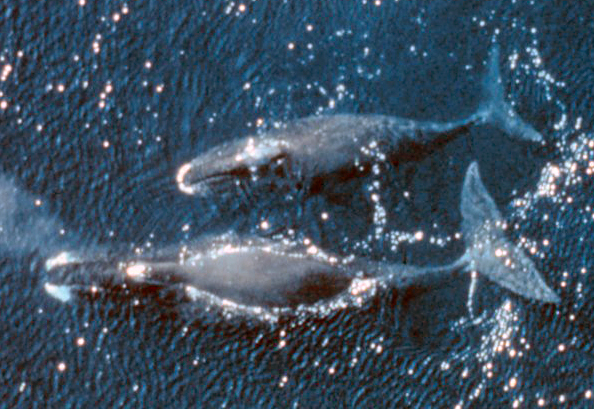 Bowhead WhaleBalaena mysticetus
Compare
Questions and answers
What is the scientific name of the North Atlantic Right Whale?
The scientific name of the North Atlantic Right Whale is Eubalaena glacialis. Written with its author, the full name is Eubalaena glacialis (Müller, 1776).
Which family does the North Atlantic Right Whale belong to?
Eubalaena glacialis belongs to the family Balaenidae, in the order Cetacea and the class Mammalia.
Where is the North Atlantic Right Whale found?
Checklists and occurrence records place Eubalaena glacialis in 3 countries: United States, Canada and Saint Pierre and Miquelon.
What is the conservation status of the North Atlantic Right Whale?
The IUCN Red List category recorded for Eubalaena glacialis is Critically Endangered (CR).
What other names does the North Atlantic Right Whale have?
Eubalaena glacialis is also known in English as Biscayan Right Whale, Northern Right Whale, Black Right Whale and Nordcaper.
What do North Atlantic right whales eat?
Their primary food source is calanoid copepods, particularly Calanus finmarchicus. Their diet also includes krill, pteropods, and larval barnacles.[15][16]
Where is the North Atlantic right whale habitat located?
The species occurs almost exclusively along the eastern coasts of the United States and Canada. Its winter nursery grounds include warm, shallow coastal waters off the southeastern United States, while its feeding areas include the Gulf of Maine, the Gulf of St. Lawrence, and Nantucket Shoals.[8][10][11][13][36]
Sources
Passages the profile rests on
- The North Atlantic right whale has a broad back without a dorsal fin, short paddle-shaped pectoral flippers, and a long arching mouth. Source passage: “the absence of a dorsal fin on its broad back, short, paddle-like pectoral flippers and a long arching mouth” — English Wikipedia
- Its coloration ranges from dark grey to black, and some individuals have white patches on their stomachs or throats. Source passage: “Its coloration is dark grey to black, with some individuals occasionally having white patches on their stomachs or throats.” — English Wikipedia
- Its head accounts for approximately one-quarter of its total body length. Source passage: “a large head, which makes up a quarter of its total body length” — English Wikipedia
- Its V-shaped blowhole produces a heart-shaped blow. Source passage: “v-shaped blowhole which produces a heart-shaped blow.” — English Wikipedia
- Its head bears distinctive rough, white patches of keratinized skin called callosities. Source passage: “rough, white patches of keratinized skin found on their heads.” — English Wikipedia
- Colonies of whale lice inhabit the callosities on its head. Source passage: “The right whale's callosities provide habitat for large colonies of cyamids or whale lice” — English Wikipedia
- Its body contains a high proportion of blubber, reaching up to 45 percent of its body weight. Source passage: “Up to forty-five percent of a right whale's body weight is blubber.” — English Wikipedia
- Its winter nursery grounds include warm, shallow coastal waters off the southeastern United States. Source passage: “The warm, shallow waters off the southeast U.S. coast serve as winter nursery grounds for the whales.” — mmc.gov
- Its winter migration includes coastal waters of South Carolina, Georgia, and Florida. Source passage: “down to coastal waters of South Carolina, Georgia, and Florida in winter” — mmc.gov
- Its feeding grounds include productive waters of the Gulf of Maine. Source passage: “moving into productive waters of the Gulf of Maine” — mmc.gov
- The Gulf of St. Lawrence has become an increasingly important feeding area. Source passage: “and in more recent years, the Gulf of St. Lawrence.” — mmc.gov
- Its northern feeding areas include waters off the northeastern United States and Canada. Source passage: “their feeding grounds off the coast of the northeastern United States and Canada” — mmc.gov
- Nantucket Shoals has become an important habitat where whales are present nearly year-round. Source passage: “the waters around Nantucket Shoals have been an important area with whales present nearly year-round.” — mmc.gov
- Some individuals have been observed entering the Gulf of Mexico and crossing the Atlantic into European waters. Source passage: “a few individuals have been observed entering the Gulf of Mexico and venturing across the Atlantic to European waters.” — mmc.gov
- Calanoid copepods, particularly Calanus finmarchicus, are its primary food source. Source passage: “they rely on a calanoid copepod, Calanus finmarchicus, as their primary food source.” — mmc.gov
- Its diet includes copepods, krill, pteropods, and larval barnacles. Source passage: “Right whales feed mainly on copepods and other small invertebrates such as krill, pteropods, and larval barnacles” — English Wikipedia
- It feeds by slowly skimming through concentrated patches of prey near or below the ocean surface. Source passage: “generally by slowly skimming through patches of concentrated prey at or below the ocean surface.” — English Wikipedia
- It uses low-frequency sounds for navigation, food location, and communication. Source passage: “Right whales use low frequency sounds to navigate, locate food, and communicate.” — English Wikipedia
- It interacts with other baleen whales, particularly humpback whales, and with bottlenose dolphins. Source passage: “They are also known to interact with other baleen whales especially with humpback whales or bottlenose dolphins.” — English Wikipedia
- Groups consisting of one female and several males participate in surface-active mating activities. Source passage: “groups of single female and several males, so called SAG (Surface Active Group)” — English Wikipedia
- Calves tend to be more curious and playful than adults. Source passage: “calves that tend to be more curious and playful than adults” — English Wikipedia
- North Atlantic right whales are promiscuous breeders. Source passage: “North Atlantic right whales are promiscuous breeders.” — English Wikipedia
- Females first give birth at approximately nine or ten years of age. Source passage: “They first give birth at age nine or ten” — English Wikipedia
- Gestation lasts approximately one year. Source passage: “after a year-long gestation” — English Wikipedia
- The average interval between births is currently three to six years. Source passage: “now averages three to six years.” — English Wikipedia
- Calves measure approximately 4.0–4.6 metres at birth. Source passage: “Calves are 13–15 feet (4.0–4.6 m) long at birth” — English Wikipedia
- Newborn calves weigh approximately 1,400 kilograms. Source passage: “weigh approximately 3,000 pounds (1,400 kg).” — English Wikipedia
- The species is protected under the United States Endangered Species Act and Marine Mammal Protection Act. Source passage: “they are protected under the U.S. Endangered Species Act and Marine Mammal Protection Act” — English Wikipedia
- International protection banning the hunting of right whales came into effect in 1937. Source passage: “international protection for right whales came into effect, as the practice was banned globally in 1937.” — English Wikipedia
- Vessel strikes and entanglement in fishing gear are major threats to the species' recovery. Source passage: “Human-caused mortality and serious injury, particularly entanglements and vessel strikes, is the greatest threat to recovery of the species.” — mmc.gov
- An unusual mortality event investigation was declared following elevated mortality and serious injury levels beginning in June 2017. Source passage: “Elevated mortality and serious injury levels since June 2017 led NMFS to declare an Unusual Mortality Event (UME) for North Atlantic right whales” — mmc.gov
- The 2023 population estimate was 372 individuals. Source passage: “the North Atlantic right whale population estimate for 2023 was 372” — mmc.gov
- The 2023 population estimate had a 95 percent credible interval of 360–383 individuals. Source passage: “(95% credible interval ranging from 360 to 383) individuals.” — mmc.gov
- The North Atlantic right whale is one of three species in the genus Eubalaena. Source passage: “one of three right whale species belonging to the genus Eubalaena” — English Wikipedia
- The North Atlantic right whale is slightly smaller on average than the North Pacific right whale. Source passage: “they are slightly smaller on average than the North Pacific species.” — English Wikipedia
- The species occurs almost exclusively along the eastern coasts of the United States and Canada. Source passage: “North Atlantic right whales now occur almost exclusively along the east coasts of the United States and Canada” — mmc.gov
Data
- Catalogue of Life, 2026-10-16 XR cc by
- Global Biodiversity Information Facility CC BY 4.0
- Wikidata CC0
- GeoNames CC BY 4.0
- Wikimedia Commons per image; credit shown with each image
- Within the Catalogue of Life, this name comes from The Integrated Taxonomic Information System cc0
References
- Müller, O.F. (1776). Zoologiae Danicae Prodromus, seu Animalium Daniae et Norvegiae Indigenarum characters, nomina, et synonyma imprimis popularium. [Prodromus of Danish Zoology, or the characters, names, and synonyms of the indigenous animals of Denmark and Norway, especially of the popular ones.]. Typis Hallageriis, Havniae. 32: 1-282. where the name was published
- Hershkovitz, & Philip. (1966). Catalog of Living Whales. United States National Museum Bulletin, No. 246.
- Wilson, Don E., and DeeAnn M. Reeder, eds. (1993). Mammal Species of the World: A Taxonomic and Geographic Reference, 2nd Ed., 3rd Printing.
- Wilson, Don E., and Sue Ruff, eds. (1999). The Smithsonian Book of North American Mammals.
- Wilson, Don E., and F. Russell Cole. (2000). Common Names of Mammals of the World.
- Mead, James G., and Robert L. Brownell, Jr. / Wilson, Don E., and DeeAnn M. Reeder, eds. (2005). Order Cetacea. Mammal Species of the World: A Taxonomic and Geographic Reference, 3rd Ed., Vol. 1.
- Würsig, Bernd, J. G. M. Thewissen, and Kit M. Kovacs, eds. (2018). Encyclopedia of Marine Mammals, 3rd Edition.
This species in other databases
Page built on 28 November 2026. See how the catalog is made and all sources and licences.
Cite this page
ScientificNames.org. (2026). Eubalaena glacialis (North Atlantic Right Whale). Retrieved November 28, 2026, from https://scientificnames.org/species/eubalaena-glacialis
“Eubalaena glacialis (North Atlantic Right Whale).” ScientificNames.org, 2026, scientificnames.org/species/eubalaena-glacialis. Accessed 28 Nov. 2026.
ScientificNames.org. “Eubalaena glacialis (North Atlantic Right Whale).” Accessed November 28, 2026. https://scientificnames.org/species/eubalaena-glacialis.
@misc{scientificnames_eubalaena_glacialis_north_atlantic_right_whale,
  author = {{ScientificNames.org}},
  title = {Eubalaena glacialis (North Atlantic Right Whale)},
  year = {2026},
  url = {https://scientificnames.org/species/eubalaena-glacialis},
  note = {Accessed 2026-11-28}
}