Species · Birds
Rufous-rumped Antwren Euchrepomis callinota
The scientific name of the Rufous-rumped Antwren is Euchrepomis callinota. It is a species of bird in the family Thamnophilidae (antbird), order Passeriformes. The name dates from 1855.
- Scientific name
- Euchrepomis callinota (P. L. Sclater, 1855)
- Common name
- Rufous-rumped Antwren
- Genus
- Euchrepomis
- Family
- Thamnophilidae (Antbird)
- Order
- Passeriformes
- Class
- Aves
- Red List category
- LC Least Concern
- Recorded in
- 9 countries
- Name status
- accepted in the Catalogue of Life

Overview
The Rufous-rumped Antwren is a bird in the family Thamnophilidae, order Passeriformes, and class Aves, with four recognized subspecies. It occurs in Colombia, Costa Rica, Ecuador, French Guiana, Guyana, Panama, Peru, Suriname, and Venezuela. It has a small, slender body, a relatively long tail, and different plumage in males and females.
Written 27 November 2026 from the sources listed below. Each statement was checked against the passage it cites; statements that could not be supported were removed.
Appearance
The Rufous-rumped Antwren measures 10–12 cm in length and weighs approximately 7–9.5 g. It has a small, slender body and a relatively long tail.[1][2][3]
Adult males of the nominate subspecies have black crowns and napes, olive upper backs, and bright rufous or orange-brown lower backs and rumps. Their faces are pale gray, with blackish lores and a dark line extending through the eye.[4][5]
Adult males have slate-gray wing coverts with pale yellow tips that form two bars when the wings are closed. Their throats and breasts are pale gray, while their bellies and undertail coverts are pale yellow-green.[6][7]
Adult females have brownish olive crowns and grayish olive sides of the head. Both sexes have brown or dark brown irises, black maxillae, gray mandibles with black tips, and bluish-gray or gray legs and feet.[8][9][10][11]
The peruviana subspecies has a yellowish-green tinge on the lower breast. The venezuelana subspecies has a darker nape and upper back, a whiter throat, and a paler yellow belly than the nominate subspecies.[12][13]
The guianensis subspecies has a darker, richer olive back and brighter yellow wing coverts than the nominate subspecies.[14]
Habitat
The Rufous-rumped Antwren inhabits the interior and edges of humid foothill and montane forests.[15]
In Costa Rica, it occurs at elevations of 700–1,200 m. In Colombia, it occurs at elevations of 700–2,500 m.[16][17]
In Ecuador, it occurs at elevations of 900–1,800 m. In most of Peru, it occurs at elevations of 1,050–2,000 m, while in Cuzco it occurs at elevations of 750–1,000 m.[18][19][20]
Diet
The Rufous-rumped Antwren feeds on arthropods.[21]
Behaviour
The Rufous-rumped Antwren is a year-round resident throughout its geographic range. It typically forages in pairs that usually join mixed-species feeding flocks.[22][23]
It forages almost entirely in the forest canopy, obtaining prey by acrobatically gleaning it from leaves and sticks.[24][25]
Reproduction and life cycle
In Costa Rica, the breeding season appears to extend from February through May.[26]
Conservation
The IUCN classifies the Rufous-rumped Antwren as Least Concern. It has a very large geographic range, and its estimated population comprises at least 50,000 mature individuals.[27][28][29]
The population is believed to be decreasing. No immediate threats to the species have been identified.[30][31]
The species is considered rare in Costa Rica and uncommon in Colombia, Ecuador, and Peru.[32][33]
The species is vulnerable to habitat loss or degradation caused by human activities such as agricultural forest clearing.[34]
Classification of the Rufous-rumped Antwren
| Kingdom | Animalia |
|---|---|
| Phylum | Chordata |
| Subphylum | Vertebrata |
| Infraphylum | Gnathostomata |
| Parvphylum | Osteichthyes |
| Megaclass | Tetrapoda |
| Class | Aves (Bird) |
| Order | Passeriformes (Passerine) |
| Family | Thamnophilidae (Antbird) |
| Genus | Euchrepomis (Canopy Antwrens) |
| Species | Euchrepomis callinota (P. L. Sclater, 1855) |
Where the Rufous-rumped Antwren is found
Checklists and occurrence records place Euchrepomis callinota in 9 countries across North America and South America. GBIF holds 4,872 georeferenced records of it.
Countries
- Colombia 2,127
- Costa Rica 223
- Ecuador 2,068
- French Guiana 13
- Guyana 8
- Panama 109
- Peru 309
- Suriname 9
- Venezuela 6
Regions and cities with the most records
- Pichincha, Ecuador 1,493
- Risaralda Department, Colombia 763
- Chocó, Colombia 347
- Ciudad Bolívar, Colombia 330
- Nariño, Colombia 301
- Napo, Ecuador 258
- Valle del Cauca Department, Colombia 213
- Cartago Province, Costa Rica 206
- Turrialba, Costa Rica 188
- San Martín Department, Peru 162
- Santander Department, Colombia 159
- Darien, Colombia 133
- Antioquia, Colombia 129
- Belén de Umbría, Colombia 106
- Anserma, Colombia 96
- Zamora Chinchipe, Ecuador 90
- Quinchía, Colombia 88
- Huila Department, Colombia 75
- Darién, Panama 66
- Paraíso, Costa Rica 60
- Amazonas, Peru 56
- Cartago, Costa Rica 55
- Morona-Santiago Province, Ecuador 47
- Imbabura, Ecuador 42
- Cali, Colombia 37
- Caquetá, Colombia 35
- Putumayo Department, Colombia 35
- El Oro, Ecuador 33
- Cauca Department, Colombia 32
- Piñas, Ecuador 31
- Carchi, Ecuador 29
- Junin, Peru 27
- Mocoa, Colombia 23
- Garzón, Colombia 22
- Cajamarca Department, Peru 16
- Cuzco Department, Peru 15
Range as the checklists state it
Middle America
South America
A number beside a place is its count of GBIF occurrence records. A place without a number comes from a checklist alone. Records show where a species has been observed or collected, which can include escapes and vagrants.
Common names
English
- Rufous-rumped Antwren
Names in 23 other languages
- Catalan
- formigueret de carpó carbassa
- Chinese
- 棕腰蚁鹩, 棕腰蟻鷯
- Croatian
- maslinastoleđa mravarica
- Czech
- mravenčík tyrančíkovitý
- Danish
- Brungumpet Myresmutte
- Dutch
- Grijswangmiersluiper
- Esperanto
- rufpuga formikulo
- Finnish
- punaperämuura
- French
- Euchrépome à croupion roux, Grisin à croupion roux
- German
- Rostbürzel-Ameisenfänger
- Italian
- Scricciolo formichiero gropparossiccia
- Japanese
- コシアカアリサザイ
- Lithuanian
- rusvasturplė terenura
- Norwegian
- rustgumpmaursmett
- Polish
- mrówkowiec rdzaworzytny
- Portuguese
- formigueirinho-d'uropígio-ruivo, zidedê-de-crisso-ruivo
- Russian
- Рыжегузый тилучи, Рыжепоясничная теренура
- Serbian
- Planinski riđoleđi mravlji carić
- Slovak
- hmyzolapka sivolíca
- Spanish
- Hormiguerito Lomirrufo, Tiluchí lomirrufo
- Swedish
- rostgumpad flamrygg, rostgumpad myrsmyg
- Turkish
- Kızıl Sırtlı Karıncabülbülü
- Ukrainian
- мурахолюб рудогузий
Synonyms
5 other scientific names have been used for this species and are now treated as synonyms of Euchrepomis callinota.
- Euchrepomis callinota puella Mees, GF, 1974
- Euchrepornis callinota Sclater, PL, 1855
- Formicivora callinota P. L. Sclater, 1855
- Hylophilus puella Mees, GF, 1974
- Terenura callinota (P. L. Sclater, 1855)
Subspecies and varieties
- Euchrepomis callinota callinota subspecies
- Euchrepomis callinota guianensis subspecies
- Euchrepomis callinota peruviana subspecies
- Euchrepomis callinota venezuelana subspecies
Related species
-
 Ash-winged AntwrenEuchrepomis spodioptila
-
 Chestnut-shouldered AntwrenEuchrepomis humeralis
-
 Yellow-rumped AntwrenEuchrepomis sharpei
-
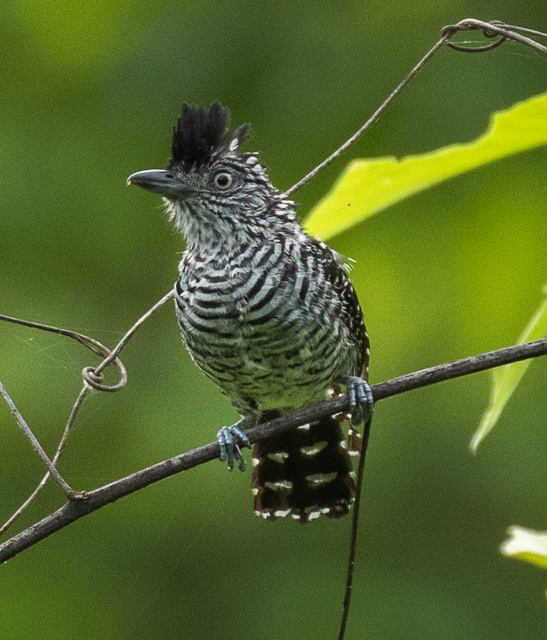 Barred AntshrikeThamnophilus doliatus
-
 Great AntshrikeTaraba major
-
 Black-crowned AntshrikeThamnophilus atrinucha
-
 Ocellated AntbirdPhaenostictus mcleannani
-
 Bicolored AntbirdGymnopithys bicolor
Compare
Questions and answers
What is the scientific name of the Rufous-rumped Antwren?
The scientific name of the Rufous-rumped Antwren is Euchrepomis callinota. Written with its author, the full name is Euchrepomis callinota (P. L. Sclater, 1855).
Which family does the Rufous-rumped Antwren belong to?
Euchrepomis callinota belongs to the family Thamnophilidae, in the order Passeriformes and the class Aves.
Where is the Rufous-rumped Antwren found?
Checklists and occurrence records place Euchrepomis callinota in 9 countries, including Colombia, Ecuador, Peru, Costa Rica, Panama and French Guiana.
What is the conservation status of the Rufous-rumped Antwren?
The IUCN Red List category recorded for Euchrepomis callinota is Least Concern (LC).
Where does the Rufous-rumped Antwren occur?
It occurs in Colombia, Costa Rica, Ecuador, French Guiana, Guyana, Panama, Peru, Suriname, and Venezuela.[35]
How many subspecies of Rufous-rumped Antwren are recognized?
Four subspecies are recognized.[36]
How large is the Rufous-rumped Antwren?
It measures 10–12 cm in length and weighs approximately 7–9.5 g.[1][2]
What does the Rufous-rumped Antwren eat?
It feeds on arthropods.[21]
How does the Rufous-rumped Antwren forage?
It typically forages in pairs that usually join mixed-species feeding flocks. It forages almost entirely in the forest canopy, acrobatically gleaning prey from leaves and sticks.[23][24][25]
When does the Rufous-rumped Antwren breed?
In Costa Rica, its breeding season appears to extend from February through May.[26]
What is the conservation status of the Rufous-rumped Antwren?
The IUCN classifies it as Least Concern. Its population is estimated at at least 50,000 mature individuals and is believed to be decreasing.[27][29][30]
When was the Rufous-rumped Antwren described?
Philip Sclater described the species in 1855 under the scientific name Formicivora callinota.[37]
What is the taxonomic history of the Rufous-rumped Antwren?
The species was transferred to the genus Terenura in 1885 and has been classified in the genus Euchrepomis since that genus was established in 2012. It was previously listed under the scientific name Terenura callinota in a taxonomic source.[38][39][40]
When was the Rufous-rumped Antwren last assessed for the IUCN Red List?
It was most recently assessed in 2022.[41]
Sources
Passages the profile rests on
- The species measures 10–12 cm in length. Source passage: “The rufous-rumped antwren is 10 to 12 cm (3.9 to 4.7 in) long” — English Wikipedia
- The species weighs approximately 7–9.5 g. Source passage: “weighs about 7 to 9.5 g (0.25 to 0.34 oz).” — English Wikipedia
- The species has a small, slender body and a relatively long tail. Source passage: “It is small, slender, and long-tailed” — English Wikipedia
- Adult males of the nominate subspecies have black crowns and napes, olive upper backs, and bright rufous or orange-brown lower backs and rumps. Source passage: “Their crown and nape are black, their upper back olive, their lower back and rump bright rufous or orange brown” — English Wikipedia
- Adult males of the nominate subspecies have pale gray faces with blackish lores and a dark line extending through the eye. Source passage: “Adult males of the nominate subspecies E. c. callinota have blackish lores and line through the eye on an otherwise pale gray face.” — English Wikipedia
- Adult males have slate-gray wing coverts with pale yellow tips that form two bars when the wings are closed. Source passage: “Their wing coverts are slate gray with pale yellow tips that form two bars on the closed wing” — English Wikipedia
- Adult males have pale gray throats and breasts and pale yellow-green bellies and undertail coverts. Source passage: “Their throat and breast are pale gray and their belly and undertail coverts are pale yellow-green.” — English Wikipedia
- Adult females have brownish olive crowns and grayish olive sides of the head. Source passage: “Adult females have a brownish olive crown and grayish olive sides of their head.” — English Wikipedia
- Both sexes have brown or dark brown irises. Source passage: “In both sexes, their iris is brown or dark brown” — English Wikipedia
- Both sexes have black maxillae and gray mandibles with black tips. Source passage: “their maxilla black, their mandible shades of gray with a black tip” — English Wikipedia
- Both sexes have bluish-gray or gray legs and feet. Source passage: “their legs and feet bluish gray or gray.” — English Wikipedia
- The peruviana subspecies has a yellowish-green tinge on the lower breast. Source passage: “their lower breast has a yellowish green tinge giving a gradual transition from the gray breast to the yellow-green belly.” — English Wikipedia
- The venezuelana subspecies has a darker nape and upper back, a whiter throat, and a paler yellow belly than the nominate subspecies. Source passage: “Its nape and upper back are darker than the nominate's, its throat whiter, and its belly a paler yellow.” — English Wikipedia
- The guianensis subspecies has a darker, richer olive back and brighter yellow wing coverts than the nominate subspecies. Source passage: “E. c. guianensis has a darker and richer olive back than the nominate, with brighter yellow on the wing coverts.” — English Wikipedia
- The species inhabits the interior and edges of humid foothill and montane forests. Source passage: “The rufous-rumped antwren inhabits the interior and edges of humid foothill and montane forest.” — English Wikipedia
- In Costa Rica, the species occurs at elevations of 700–1,200 m. Source passage: “between 700 and 1,200 m (2,300 and 3,900 ft) in Costa Rica” — English Wikipedia
- In Colombia, the species occurs at elevations of 700–2,500 m. Source passage: “between 700 and 2,500 m (2,300 and 8,200 ft) in Colombia” — English Wikipedia
- In Ecuador, the species occurs at elevations of 900–1,800 m. Source passage: “between 900 and 1,800 m (3,000 and 5,900 ft) in Ecuador.” — English Wikipedia
- In most of Peru, the species occurs at elevations of 1,050–2,000 m. Source passage: “In most of Peru it ranges between 1,050 and 2,000 m (3,400 and 6,600 ft)” — English Wikipedia
- In Cuzco, the species occurs at elevations of 750–1,000 m. Source passage: “but occurs between 750 and 1,000 m (2,500 and 3,300 ft) in Cuzco.” — English Wikipedia
- The species feeds on arthropods. Source passage: “The rufous-rumped antwren feeds on arthropods” — English Wikipedia
- The species is a year-round resident throughout its geographic range. Source passage: “The rufous-rumped antwren is a year-round resident throughout its range.” — English Wikipedia
- The species typically forages in pairs that usually join mixed-species feeding flocks. Source passage: “It typically forages in pairs that usually join mixed-species feeding flocks.” — English Wikipedia
- The species forages almost entirely in the forest canopy. Source passage: “It forages almost entirely in the forest canopy” — English Wikipedia
- The species obtains prey by acrobatically gleaning it from leaves and sticks. Source passage: “acrobatically gleaning prey from leaves and sticks.” — English Wikipedia
- The breeding season in Costa Rica appears to extend from February through May. Source passage: “The rufous-rumped antwren's breeding season in Costa Rica appears to be from February through May.” — English Wikipedia
- The IUCN classifies the species as Least Concern. Source passage: “The IUCN has assessed the rufous-rumped antwren as being of Least Concern.” — English Wikipedia
- The species has a very large geographic range. Source passage: “It has a very large range” — English Wikipedia
- The estimated population comprises at least 50,000 mature individuals. Source passage: “an estimated population of at least 50,000 mature individuals” — English Wikipedia
- The species' population is believed to be decreasing. Source passage: “though the latter is believed to be decreasing.” — English Wikipedia
- No immediate threats to the species have been identified. Source passage: “No immediate threats have been identified.” — English Wikipedia
- The species is considered rare in Costa Rica. Source passage: “It is considered rare in Costa Rica” — English Wikipedia
- The species is considered uncommon in Colombia, Ecuador, and Peru. Source passage: “and uncommon in Colombia, Ecuador, and Peru.” — English Wikipedia
- The species is vulnerable to habitat loss or degradation caused by human activities such as agricultural forest clearing. Source passage: “it is vulnerable to habitat loss or degradation by human activities such as forest clearing for agriculture.” — English Wikipedia
- The species occurs in Colombia, Costa Rica, Ecuador, French Guiana, Guyana, Panama, Peru, Suriname, and Venezuela. Source passage: “It is found in Colombia, Costa Rica, Ecuador, French Guiana, Guyana, Panama, Peru, Suriname, and Venezuela.” — English Wikipedia
- The species has four recognized subspecies. Source passage: “The rufous-rumped antwren has these four subspecies:” — English Wikipedia
- The species was described by Philip Sclater in 1855 under the scientific name Formicivora callinota. Source passage: “The rufous-rumped antwren was described by the English zoologist Philip Sclater in 1855 and given the binomial name Formicivora callinota.” — English Wikipedia
- The species was transferred to the genus Terenura in 1885. Source passage: “It was transferred to genus Terenura in 1885.” — English Wikipedia
- The species has been classified in the genus Euchrepomis since that genus was established in 2012. Source passage: “There it remained until the current genus Euchrepomis was created in 2012 following phylogenetic analysis.” — English Wikipedia
- The species was previously listed under the scientific name Terenura callinota in a taxonomic source. Source passage: “Euchrepomis callinota (del Hoyo and Collar 2016) was previously listed as Terenura callinota.” — datazone.birdlife.org
- The species was most recently assessed for the IUCN Red List in 2022. Source passage: “Rufous-rumped Antwren Euchrepomis callinota has most recently been assessed for The IUCN Red List of Threatened Species in 2022.” — iucnredlist.org
Data
- Catalogue of Life, 2026-10-16 XR cc by
- Global Biodiversity Information Facility CC BY 4.0
- Wikidata CC0
- GeoNames CC BY 4.0
- Wikimedia Commons per image; credit shown with each image
- Within the Catalogue of Life, this name comes from The Integrated Taxonomic Information System cc0
This species in other databases
Page built on 27 November 2026. See how the catalog is made and all sources and licences.
Cite this page
ScientificNames.org. (2026). Euchrepomis callinota (Rufous-rumped Antwren). Retrieved November 27, 2026, from https://scientificnames.org/species/euchrepomis-callinota
“Euchrepomis callinota (Rufous-rumped Antwren).” ScientificNames.org, 2026, scientificnames.org/species/euchrepomis-callinota. Accessed 27 Nov. 2026.
ScientificNames.org. “Euchrepomis callinota (Rufous-rumped Antwren).” Accessed November 27, 2026. https://scientificnames.org/species/euchrepomis-callinota.
@misc{scientificnames_euchrepomis_callinota_rufous_rumped_antwren,
  author = {{ScientificNames.org}},
  title = {Euchrepomis callinota (Rufous-rumped Antwren)},
  year = {2026},
  url = {https://scientificnames.org/species/euchrepomis-callinota},
  note = {Accessed 2026-11-27}
}