Species · Birds
Bicolored Antbird Gymnopithys bicolor
The scientific name of the Bicolored Antbird is Gymnopithys bicolor. It is a species of bird in the family Thamnophilidae (antbird), order Passeriformes. The name dates from 1863.
- Scientific name
- Gymnopithys bicolor (Lawrence, 1863)
- Common name
- Bicolored Antbird
- Genus
- Gymnopithys
- Family
- Thamnophilidae (Antbird)
- Order
- Passeriformes
- Class
- Aves
- Red List category
- LC Least Concern
- Recorded in
- 6 countries
- Name status
- accepted in the Catalogue of Life

Overview
The Bicolored Antbird is one of three members of the genus Gymnopithys and has five recognized subspecies. It occurs in Colombia, Costa Rica, Ecuador, Honduras, Nicaragua, and Panama. It is an obligate army-ant follower that feeds on arthropods fleeing foraging army-ant swarms.
Written 26 November 2026 from the sources listed below. Each statement was checked against the passage it cites; statements that could not be supported were removed.
Appearance
Male and female Bicolored Antbirds have the same described appearance. Adults of the nominate subspecies have a brownish chestnut crown and nape, bare blue-gray skin around the eye, a gray forehead, and a broad gray band behind the eye.[1][2][3][4]
The back, rump, wings, and tail of the nominate subspecies are brownish chestnut. Its throat and breast are white, and a brown band extends from the cheek along the flanks.[5][6][7]
The olivascens subspecies has dull brown coloration behind the eye rather than gray. The daguae subspecies resembles olivascens but has darker coloration.[8][9]
The aequatorialis subspecies has a darker appearance, a rufous forehead, and blacker sides than the preceding described subspecies. The ruficeps subspecies has a brighter rufous forehead and crown than aequatorialis, blacker coloration behind the eye, a darker reddish back, and redder sides.[10][11][12]
The Bicolored Antbird has a pale blue eyering and snowy white underparts.[13]
The Bicolored Antbird measures 13.5–15 cm in length and weighs between 28 and 37 g.[14][15]
Habitat
The Bicolored Antbird primarily inhabits lowland and foothill terra firme evergreen forests. It also inhabits mature secondary forests near its primary forest habitat and spends almost all its time in forest undergrowth.[16][17][18]
In parts of Central America, the species occurs at elevations up to 1,750 m. In Costa Rica, it occurs at elevations up to 1,600 m, and in Panama, up to 1,500 m.[19][20][21]
In Colombia, the species occurs below 1,000 m elevation. In Ecuador, it occurs below 750 m elevation.[22][23]
The olivascens subspecies occurs from the Caribbean slope of Honduras and Nicaragua through Costa Rica to western Panama. The nominate bicolor subspecies occurs in central and eastern Panama and extends into the Pacific slope of northwestern Colombia's Chocó Department.[24][25]
The daguae subspecies occurs on the Pacific slope of western Colombia from Chocó to Cauca Department. The aequatorialis subspecies occurs from extreme southwestern Colombia into western Ecuador as far as Azuay Province.[26][27]
The ruficeps subspecies occurs in the Andes of northern Colombia between Antioquia and Cesar departments and south through the Magdalena Valley to Boyacá Department.[28]
Diet
The Bicolored Antbird is an obligate army-ant follower. It feeds on arthropods fleeing foraging army-ant swarms.[29]
Behaviour
The Bicolored Antbird is not known to migrate. It typically forages alone, in pairs, or in family groups.[30][31]
While foraging, the species usually perches within approximately 1 m of the ground but may perch as high as 5 m. It captures prey by sallying or pouncing to the ground.[32][33]
As many as twelve Bicolored Antbirds have been observed at a single army-ant swarm. The species dominates smaller antbirds but is subordinate to larger birds from other families, including woodcreepers.[34][35]
Reproduction and life cycle
The Bicolored Antbird breeds mainly from April through September in Costa Rica. In Panama, the main breeding season extends from April through December.[36][37]
The species is monogamous. Its known nests are cup-shaped and constructed from dead palm leaves and other leaves, often with a lining of fungal rhizomorphs.[38][39][40]
The nest is often placed in a cavity at the top of a stump. The typical clutch consists of two eggs, which are streaked reddish brown against a white or creamy background.[41][42][43]
Females incubate alone at night, while both parents incubate during the day. The incubation period lasts approximately 15–16 days.[44][45]
Young birds fledge approximately 13–15 days after hatching.[46]
Conservation
The Bicolored Antbird was first assessed by the IUCN in 2016 and was assessed as Least Concern. The IUCN Red List record gives 25 October 2023 as the assessment date.[47][48][49]
The species has a very large geographic range and is considered fairly common throughout its range. Its population size is unknown, and its population is believed to be decreasing.[50][51][52][53]
No immediate threats to the species have been identified. It occurs in numerous governmental and private protected areas.[54][55]
Some populations in Honduras, Nicaragua, Costa Rica, and Panama have declined or disappeared following extensive land clearing for settlements and agriculture.[56]
Similar species
The Bicolored Antbird was formerly grouped with the White-cheeked Antbird under the name Myrmeciza leucaspis. Genetic research published in 2007 supported separating the Bicolored Antbird from the White-cheeked Antbird.[57][58]
The Bicolored Antbird, White-cheeked Antbird, and Rufous-throated Antbird are the only three members of the genus Gymnopithys.[59]
Classification of the Bicolored Antbird
| Kingdom | Animalia |
|---|---|
| Phylum | Chordata |
| Subphylum | Vertebrata |
| Infraphylum | Gnathostomata |
| Parvphylum | Osteichthyes |
| Megaclass | Tetrapoda |
| Class | Aves (Bird) |
| Order | Passeriformes (Passerine) |
| Family | Thamnophilidae (Antbird) |
| Genus | Gymnopithys (Bicolored Antbirds) |
| Species | Gymnopithys bicolor (Lawrence, 1863) |
Where the Bicolored Antbird is found
Checklists and occurrence records place Gymnopithys bicolor in 6 countries across North America and South America. GBIF holds 25,086 georeferenced records of it.
Countries
Regions and cities with the most records
- Alcalde Díaz, Panama 5,939
- Chilibre, Panama 5,828
- Colón, Panama 5,005
- Puntarenas Province, Costa Rica 4,517
- Alajuela Province, Costa Rica 3,444
- Panamá, Panama 1,593
- Limón Province, Costa Rica 1,119
- Panama City, Panama 1,016
- Arraiján, Panama 954
- Curundú, Panama 938
- Ancón, Panama 936
- Heredia Province, Costa Rica 926
- Pichincha, Ecuador 898
- Valle del Cauca Department, Colombia 799
- Turrialba, Costa Rica 781
- Guápiles, Costa Rica 695
- San Miguelito, Panama 688
- Cartago Province, Costa Rica 684
- Darién, Panama 670
- Panamá Oeste Province, Panama 612
- San José, Costa Rica 571
- Antioquia, Colombia 539
- Buenaventura, Colombia 539
- San Isidro, Costa Rica 496
- Esmeraldas, Ecuador 479
- Guanacaste Province, Costa Rica 459
- Quesada, Costa Rica 452
- Coclé, Panama 440
- Tocumen, Panama 419
- Paraíso, Costa Rica 403
- Chocó, Colombia 349
- Juan Díaz, Panama 284
- Buenaventura, Colombia 214
- Boyacá, Colombia 185
- Manabí, Ecuador 165
- Siquirres, Costa Rica 165
Range as the checklists state it
Middle America
South America
A number beside a place is its count of GBIF occurrence records. A place without a number comes from a checklist alone. Records show where a species has been observed or collected, which can include escapes and vagrants.
Common names
English
- Bicolored Antbird
- Bicoloured Antbird
Names in 21 other languages
- Catalan
- Formiguer bicolor
- Chinese
- 双色蚁鸟, 雙色蟻鳥〔白頰蟻鳥〕
- Croatian
- smeđoboka mravarica
- Danish
- Lysmasket Myrefugl, Tofarvet Myrefugl
- Dutch
- Tweekleurige Miervogel
- Esperanto
- dukolora formikulo
- Finnish
- harmaakorvamuura
- French
- Batara bicolore, Fourmilier bicolore
- German
- Weißkehl-Ameisenvogel, Weißohr-Ameisenvogel, Weißohrameisenvogel
- Italian
- Mangiaformiche bicolore
- Japanese
- ニショクアリドリ
- Lithuanian
- Dvispalvė kanapėtoji skruzdinukė
- Norwegian
- brunflankemaurvokter
- Polish
- mrówczyk dwubarwny
- Portuguese
- formigueiro-bicolor, mãe-de-taoca-bicolor
- Russian
- Двухцветная гологлазка, Двуцветная пёстрая муравьянка
- Slovak
- mravcosled dvojfarebný
- Spanish
- Hormiguero bicolor
- Swedish
- tvåfärgad myrfågel
- Turkish
- İki Renkli Karıncakuşu
- Ukrainian
- мурав’янка строката
Synonyms
One other scientific name has been used for this species and is now treated as a synonym of Gymnopithys bicolor.
- Pithys bicolor Lawrence, 1863
Subspecies and varieties
- Gymnopithys bicolor aequatorialis subspecies
- Gymnopithys bicolor bicolor subspecies
- Gymnopithys bicolor daguae subspecies
- Gymnopithys bicolor olivascens subspecies
- Gymnopithys bicolor ruficeps subspecies
Related species
-
 White-cheeked AntbirdGymnopithys leucaspis
-
 Rufous-throated AntbirdGymnopithys rufigula
-
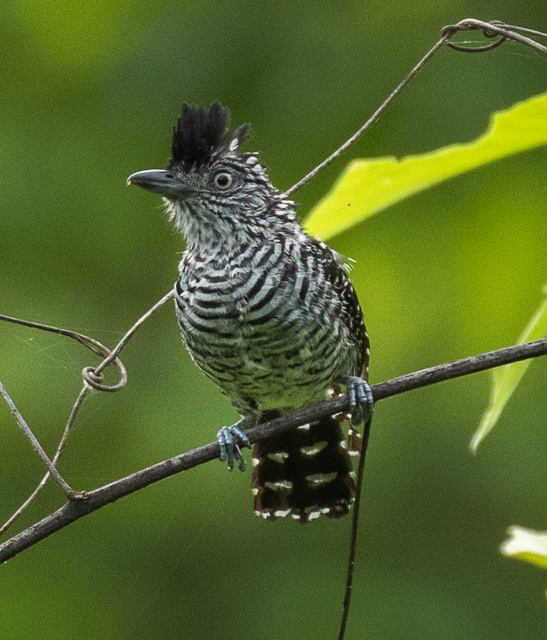 Barred AntshrikeThamnophilus doliatus
-
 Great AntshrikeTaraba major
-
 Black-crowned AntshrikeThamnophilus atrinucha
-
 Ocellated AntbirdPhaenostictus mcleannani
-
 Fasciated AntshrikeCymbilaimus lineatus
-
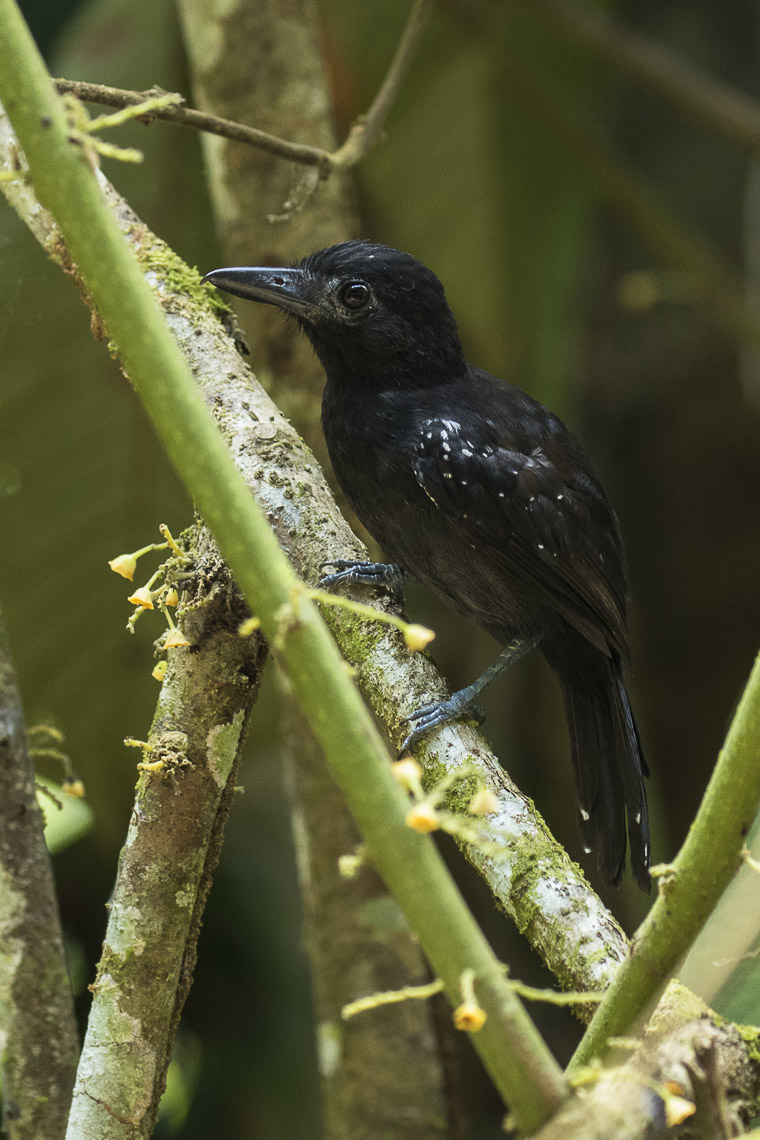 Black-hooded AntshrikeThamnophilus bridgesi
Compare
Questions and answers
What is the scientific name of the Bicolored Antbird?
The scientific name of the Bicolored Antbird is Gymnopithys bicolor. Written with its author, the full name is Gymnopithys bicolor (Lawrence, 1863).
Which family does the Bicolored Antbird belong to?
Gymnopithys bicolor belongs to the family Thamnophilidae, in the order Passeriformes and the class Aves.
Where is the Bicolored Antbird found?
Checklists and occurrence records place Gymnopithys bicolor in 6 countries: Costa Rica, Panama, Colombia, Ecuador, Nicaragua and Honduras.
What is the conservation status of the Bicolored Antbird?
The IUCN Red List category recorded for Gymnopithys bicolor is Least Concern (LC).
What other names does the Bicolored Antbird have?
Gymnopithys bicolor is also known in English as Bicoloured Antbird.
Sources
Passages the profile rests on
- Male and female Bicolored Antbirds have the same described appearance. Source passage: “The sexes are the same.” — English Wikipedia
- Adults of the nominate subspecies have a brownish chestnut crown and nape. Source passage: “Adults of the nominate subspecies G. b. bicolor have a brownish chestnut crown and nape.” — English Wikipedia
- Adults of the nominate subspecies have bare blue-gray skin around the eye. Source passage: “They have bare blue-gray skin around the eye” — English Wikipedia
- Adults of the nominate subspecies have a gray forehead and a broad gray band behind the eye. Source passage: “a gray forehead, a broad gray band behind the eye” — English Wikipedia
- The back, rump, wings, and tail of the nominate subspecies are brownish chestnut. Source passage: “Their back, rump, wings, and tail are brownish chestnut.” — English Wikipedia
- The nominate subspecies has a white throat and breast. Source passage: “Their throat and breast are white” — English Wikipedia
- The nominate subspecies has a brown band extending from the cheek along the flanks. Source passage: “with a brown band from their cheek along their flanks.” — English Wikipedia
- The olivascens subspecies has dull brown coloration behind the eye rather than gray. Source passage: “G. b. olivascens of the bicolored antbird is much like the nominate but is dull brown behind the eye rather than gray.” — English Wikipedia
- The daguae subspecies resembles olivascens but has darker coloration. Source passage: “G. b. daguae is like a darker olivascens.” — English Wikipedia
- The aequatorialis subspecies has a darker appearance, a rufous forehead, and blacker sides than the preceding described subspecies. Source passage: “G. b. aequatorialis is darker still, with a rufous forehead and blacker sides.” — English Wikipedia
- The ruficeps subspecies has a brighter rufous forehead and crown than aequatorialis. Source passage: “G. b. ruficeps has a brighter rufous forehead and crown than aequatorialis” — English Wikipedia
- The ruficeps subspecies has blacker coloration behind the eye, a darker reddish back, and redder sides than aequatorialis. Source passage: “is blacker behind the eye, and has a darker reddish back and redder sides.” — English Wikipedia
- The Bicolored Antbird has a pale blue eyering and snowy white underparts. Source passage: “Distinctive antbird with pale blue eyering and snowy white underparts.” — ebird.org
- The Bicolored Antbird measures 13.5–15 cm in length. Source passage: “The bicolored antbird is 13.5 to 15 cm (5.3 to 5.9 in) long” — English Wikipedia
- The Bicolored Antbird weighs between 28 and 37 g. Source passage: “weighs 28 to 37 g (0.99 to 1.3 oz).” — English Wikipedia
- The Bicolored Antbird primarily inhabits lowland and foothill terra firme evergreen forests. Source passage: “The bicolored antbird primarily inhabits lowland and foothill terra firme evergreen forest” — English Wikipedia
- The species also inhabits mature secondary forests near its primary forest habitat. Source passage: “and nearby mature secondary forest.” — English Wikipedia
- The Bicolored Antbird spends almost all its time in forest undergrowth. Source passage: “It almost entirely remains in the forest undergrowth.” — English Wikipedia
- In parts of Central America, the species occurs at elevations up to 1,750 m. Source passage: “In elevation it reaches 1,750 m (5,700 ft) in parts of Central America” — English Wikipedia
- In Costa Rica, the species occurs at elevations up to 1,600 m. Source passage: “only 1,600 m (5,200 ft) in Costa Rica” — English Wikipedia
- In Panama, the species occurs at elevations up to 1,500 m. Source passage: “and 1,500 m (4,900 ft) in Panama.” — English Wikipedia
- In Colombia, the species occurs below 1,000 m elevation. Source passage: “In Colombia it occurs below 1,000 m (3,300 ft)” — English Wikipedia
- In Ecuador, the species occurs below 750 m elevation. Source passage: “and in Ecuador below 750 m (2,500 ft).” — English Wikipedia
- The olivascens subspecies occurs from the Caribbean slope of Honduras and Nicaragua through Costa Rica to western Panama. Source passage: “Caribbean slope of Honduras and Nicaragua through Costa Rica on the Caribbean and Pacific slopes into western Panama” — English Wikipedia
- The nominate bicolor subspecies occurs in central and eastern Panama and extends into the Pacific slope of northwestern Colombia's Chocó Department. Source passage: “central and eastern Panama into the Pacific slope of northwestern Colombia's Chocó Department” — English Wikipedia
- The daguae subspecies occurs on the Pacific slope of western Colombia from Chocó to Cauca Department. Source passage: “Pacific slope of western Colombia from Chocó south to Cauca Department” — English Wikipedia
- The aequatorialis subspecies occurs from extreme southwestern Colombia into western Ecuador as far as Azuay Province. Source passage: “Pacific slope of extreme southwestern Colombia into western Ecuador as far as Azuay Province” — English Wikipedia
- The ruficeps subspecies occurs in the Andes of northern Colombia between Antioquia and Cesar departments and south through the Magdalena Valley to Boyacá Department. Source passage: “Andes of northern Colombia between Antioquia and Cesar departments and south in the Magdalena Valley to Boyacá Department” — English Wikipedia
- The Bicolored Antbird is an obligate army-ant follower that feeds on arthropods fleeing foraging army-ant swarms. Source passage: “The bicolored antbird is an obligate ant follower that feeds on a wide variety of arthropods that flee foraging army ant swarms.” — English Wikipedia
- The Bicolored Antbird is not known to migrate. Source passage: “The bicolored antbird is not known to migrate.” — English Wikipedia
- The species typically forages alone, in pairs, or in family groups. Source passage: “It typically forages individually, in pairs, and in family groups” — English Wikipedia
- While foraging, the species usually perches within approximately 1 m of the ground but may perch as high as 5 m. Source passage: “perching within about 1 m (3 ft) of the ground though as high as 5 m (16 ft)” — English Wikipedia
- The Bicolored Antbird captures prey by sallying or pouncing to the ground. Source passage: “and sallying or pouncing to the ground after prey.” — English Wikipedia
- As many as twelve Bicolored Antbirds have been observed at a single army-ant swarm. Source passage: “Up to a dozen birds have been noted at a swarm.” — English Wikipedia
- The species dominates smaller antbirds but is subordinate to larger birds from other families, including woodcreepers. Source passage: “It is dominant over smaller antbirds but subordinate to larger species of other families such as woodcreepers.” — English Wikipedia
- The Bicolored Antbird breeds mainly from April through September in Costa Rica. Source passage: “The bicolored antbird breeds mostly between April and September in Costa Rica” — English Wikipedia
- In Panama, the main breeding season extends from April through December. Source passage: “and from April to December in Panama” — English Wikipedia
- The species is monogamous. Source passage: “The species is monogamous.” — English Wikipedia
- The known nests are cup-shaped and constructed from dead palm leaves and other leaves. Source passage: “Its known nests are cups made from dead palm and other leaves” — English Wikipedia
- The nests often contain a lining of fungal rhizomorphs. Source passage: “often with a lining of fungal rhizomorphs.” — English Wikipedia
- The nest is often placed in a cavity at the top of a stump. Source passage: “The nest is often placed into a cavity in the top of a stump.” — English Wikipedia
- The typical clutch consists of two eggs. Source passage: “The clutch is usually two eggs” — English Wikipedia
- The eggs are streaked reddish brown against a white or creamy background. Source passage: “that are streaked reddish brown on a white or creamy background.” — English Wikipedia
- Females incubate alone at night, while both parents incubate during the day. Source passage: “Females alone incubate at night and both parents during the day.” — English Wikipedia
- The incubation period lasts approximately 15–16 days. Source passage: “The incubation period is about 15 to 16 days” — English Wikipedia
- Young birds fledge approximately 13–15 days after hatching. Source passage: “and fledging occurs 13 to 15 days after hatch.” — English Wikipedia
- The Bicolored Antbird was first assessed by the IUCN in 2016. Source passage: “The IUCN did not recognize the bicolored antbird until 2016” — English Wikipedia
- The species was assessed as Least Concern. Source passage: “when it was assessed as being of Least Concern.” — English Wikipedia
- The IUCN Red List record gives 25 October 2023 as the assessment date. Source passage: “Date assessed. 25 October 2023” — iucnredlist.org
- The Bicolored Antbird has a very large geographic range. Source passage: “It has a very large range” — English Wikipedia
- The population size of the Bicolored Antbird is unknown. Source passage: “its population size is not known” — English Wikipedia
- The species' population is believed to be decreasing. Source passage: “and is believed to be decreasing.” — English Wikipedia
- The species is considered fairly common throughout its range. Source passage: “It is considered fairly common across its range.” — English Wikipedia
- No immediate threats to the species have been identified. Source passage: “No immediate threats have been identified.” — English Wikipedia
- The Bicolored Antbird occurs in numerous governmental and private protected areas. Source passage: “It occurs in many protected areas, both governmental and private” — English Wikipedia
- Some populations in Honduras, Nicaragua, Costa Rica, and Panama have declined or disappeared following extensive land clearing for settlements and agriculture. Source passage: “local populations in Honduras, Nicaragua and parts of Costa Rica and Panama have declined or disappeared as entire regions have been cleared for human settlement and agriculture” — English Wikipedia
- The Bicolored Antbird was formerly grouped with the White-cheeked Antbird under the name Myrmeciza leucaspis. Source passage: “What is now the bicolored antbird was originally described as Myrmeciza leucaspis and included what is now the white-cheeked antbird” — English Wikipedia
- Genetic research published in 2007 supported separating the Bicolored Antbird from the White-cheeked Antbird. Source passage: “The two were split into separate species based on the results of a genetic study published in 2007” — English Wikipedia
- The Bicolored Antbird, White-cheeked Antbird, and Rufous-throated Antbird are the only three members of the genus Gymnopithys. Source passage: “These three antbirds are the only members of genus Gymnopithys.” — English Wikipedia
Data
- Catalogue of Life, 2026-10-16 XR cc by
- Global Biodiversity Information Facility CC BY 4.0
- Wikidata CC0
- GeoNames CC BY 4.0
- Wikimedia Commons per image; credit shown with each image
- Within the Catalogue of Life, this name comes from The Integrated Taxonomic Information System cc0
References
- American Ornithologists’ Union. (1983). Check-List of North American Birds, 6th Edition.
This species in other databases
Page built on 29 November 2026. See how the catalog is made and all sources and licences.
Cite this page
ScientificNames.org. (2026). Gymnopithys bicolor (Bicolored Antbird). Retrieved November 29, 2026, from https://scientificnames.org/species/gymnopithys-bicolor
“Gymnopithys bicolor (Bicolored Antbird).” ScientificNames.org, 2026, scientificnames.org/species/gymnopithys-bicolor. Accessed 29 Nov. 2026.
ScientificNames.org. “Gymnopithys bicolor (Bicolored Antbird).” Accessed November 29, 2026. https://scientificnames.org/species/gymnopithys-bicolor.
@misc{scientificnames_gymnopithys_bicolor_bicolored_antbird,
  author = {{ScientificNames.org}},
  title = {Gymnopithys bicolor (Bicolored Antbird)},
  year = {2026},
  url = {https://scientificnames.org/species/gymnopithys-bicolor},
  note = {Accessed 2026-11-29}
}