Species · Fishes
Carpathian Brook Lamprey Eudontomyzon danfordi
The scientific name of the Carpathian Brook Lamprey is Eudontomyzon danfordi. It is a species of fish in the family Petromyzontidae (lamprey), order Petromyzontiformes. The name dates from 1911.
- Scientific name
- Eudontomyzon danfordi Regan, 1911
- Common name
- Carpathian Brook Lamprey
- Genus
- Eudontomyzon
- Family
- Petromyzontidae (Lamprey)
- Order
- Petromyzontiformes
- Class
- Petromyzonti
- Red List category
- LC Least Concern
- Environment
- freshwater
- Recorded in
- 5 countries
- Name status
- accepted in the Catalogue of Life

Overview
Eudontomyzon danfordi inhabits freshwater environments in the Danube River basin, particularly the Tisza and Timiș tributaries. It is distinguished from other lamprey species by a central lingual plate bearing nine to thirteen teeth.
Written 26 November 2026 from the sources listed below. Each statement was checked against the passage it cites; statements that could not be supported were removed.
Appearance
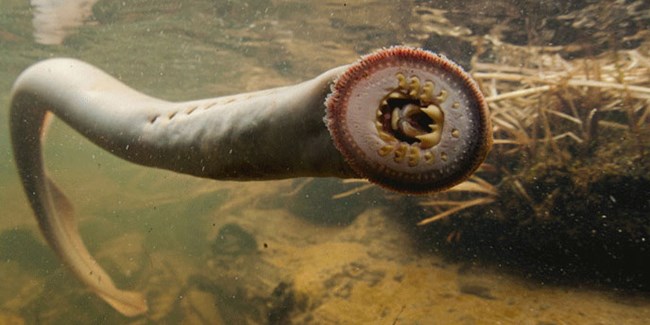
The Carpathian brook lamprey has an elongated, eel-like body with its greatest girth around the middle and a uniform silvery-olive coloration. It lacks jaws and has an oral plate surrounded by numerous small, blunt teeth.[1][2][3]
Its central lingual plate bears nine to thirteen teeth, distinguishing it from other lamprey species. It has a single nostril between its eyes and seven exposed gill pores behind them.[4][5]
Its fins consist of two dorsal fins extending along most of the spine and a small, diamond-shaped tail fin. Its maximum recorded length is 35 centimetres.[6][7]
Habitat
The Carpathian brook lamprey inhabits entirely freshwater environments. It occurs in the Danube River basin, particularly in the Tisza and Timiș tributaries.[8][9]
It reproduces in small brooks and streams.[10]
Diet
Larvae consume detritus, insect larvae and small crustaceans filtered from stream sediment.[11]
Adults feed on living fish and dead sharks. They use small rasping teeth to attach to their food and swallow smaller food items whole.[12][13]
Behaviour
Unlike other brook lampreys, the Carpathian brook lamprey has a parasitic lifestyle. It is non-migratory.[14][15]
Reproduction and life cycle
Reproduction generally occurs during winter and March. Adults die after reproduction.[16][17]
Larvae initially develop among sand and gravel on stream beds. They undergo metamorphosis at approximately four years of age.[18][19]
Conservation
The Carpathian brook lamprey is classified as Least Concern on the IUCN Red List. It was assessed on 3 February 2023.[20][21]
Habitat degradation and reduced spawning capabilities are identified as threats associated with pollution and dams.[22]
Classification of the Carpathian Brook Lamprey
| Kingdom | Animalia |
|---|---|
| Phylum | Chordata |
| Subphylum | Vertebrata |
| Infraphylum | Agnatha |
| Superclass | Cyclostomi |
| Class | Petromyzonti |
| Order | Petromyzontiformes (Lamprey) |
| Family | Petromyzontidae (Lamprey) |
| Subfamily | Lampetrinae |
| Genus | Eudontomyzon |
| Species | Eudontomyzon danfordi Regan, 1911 |
Where the Carpathian Brook Lamprey is found
Checklists and occurrence records place Eudontomyzon danfordi in 5 countries. GBIF holds 117 georeferenced records of it.
Countries
Regions and cities with the most records
- Zakarpattia, Ukraine 39
- Mureș County, Romania 15
- Svalyava, Ukraine 8
- Bavaria, Germany 7
- Caraș-Severin County, Romania 7
- Rakhiv, Ukraine 7
- Sighetu Marmaţiei, Romania 7
- Caransebeş, Romania 6
- Cluj County, Romania 5
- Bardejov, Slovakia 3
- Khust, Ukraine 3
- Maramureş, Romania 3
A number beside a place is its count of GBIF occurrence records. A place without a number comes from a checklist alone. Records show where a species has been observed or collected, which can include escapes and vagrants.
Common names
English
- Carpathian Brook Lamprey
- Carpathian Lamprey
Names in 11 other languages
- Czech
- mihule karpatská
- Finnish
- karpaattiennahkiainen
- French
- lamproie carpathique
- German
- Donau-Neunauge, Donauneunauge
- Hungarian
- Tiszai ingola
- Korean
- 카르파티아칠성장어
- Romanian
- Chișcar
- Russian
- Венгерская минога
- Serbian
- Дунавска паклара
- Slovak
- Mihuľa potiská
- Ukrainian
- Мінога карпатська, Мінога угорська
Synonyms
6 other scientific names have been used for this species and are now treated as synonyms of Eudontomyzon danfordi.
- Eudontomyzon gracilis (Kux, 1965)
- Lampetra bergi Vladykov, 1925
- Lampetra danfordi (Regan, 1911)
- Lampetra gracilis Kux, 1965
- Lampetra minor Grossinger, 1794
- Petromyzon danfordi (Regan, 1911)
Related species
-
 Ukrainian Brook LampreyEudontomyzon mariae
-
 Vladykov's LampreyEudontomyzon vladykovi
-
Drin Brook LampreyEudontomyzon stankokaramani
- Korean LampreyEudontomyzon morii
-
 Sea LampreyPetromyzon marinus
-
 European River LampreyLampetra fluviatilis
-
 Pacific LampreyEntosphenus tridentatus
-
 Brook LampreyLampetra planeri
Compare
Questions and answers
What is the scientific name of the Carpathian Brook Lamprey?
The scientific name of the Carpathian Brook Lamprey is Eudontomyzon danfordi. Written with its author, the full name is Eudontomyzon danfordi Regan, 1911.
Which family does the Carpathian Brook Lamprey belong to?
Eudontomyzon danfordi belongs to the family Petromyzontidae, in the order Petromyzontiformes and the class Petromyzonti.
Where is the Carpathian Brook Lamprey found?
Checklists and occurrence records place Eudontomyzon danfordi in 5 countries: Ukraine, Romania, Slovakia, Germany and Serbia.
What is the conservation status of the Carpathian Brook Lamprey?
The IUCN Red List category recorded for Eudontomyzon danfordi is Least Concern (LC).
What other names does the Carpathian Brook Lamprey have?
Eudontomyzon danfordi is also known in English as Carpathian Lamprey.
What is the diet of a lamprey?
Carpathian brook lamprey larvae consume detritus, insect larvae and small crustaceans filtered from stream sediment. Adults feed on living fish and dead sharks, using small rasping teeth to attach to their food and swallowing smaller food items whole.[11][12][13]
What are the defining characteristics of lamprey fish?
The Carpathian brook lamprey has an elongated, eel-like body, uniform silvery-olive coloration and no jaws. Its oral plate has numerous small, blunt teeth, while its central lingual plate bears nine to thirteen teeth. It also has one nostril between its eyes and seven exposed gill pores behind them.[1][2][3][4][5]
Sources
Passages the profile rests on
- The species has an elongated, eel-like body with its greatest girth around the middle. Source passage: “It is a long eel-like fish and its girth is greatest in the middle.” — English Wikipedia
- The species has a uniform silvery-olive coloration. Source passage: “It is a uniform silvery-olive colour.” — English Wikipedia
- The species lacks jaws and has an oral plate surrounded by numerous small, blunt teeth. Source passage: “It has no jaws and the mouth is surrounded by an oral plate with many small blunt teeth.” — English Wikipedia
- Its central lingual plate bears nine to thirteen teeth, distinguishing it from other lamprey species. Source passage: “the central, lingual plate has nine to thirteen teeth, a fact that distinguishes it from other lamprey species.” — English Wikipedia
- The species has a single nostril positioned between its eyes and seven exposed gill pores behind them. Source passage: “The single nostril is between the eyes and seven naked gill pores are behind them.” — English Wikipedia
- Its fins consist of two dorsal fins extending along most of the spine and a small, diamond-shaped tail fin. Source passage: “The only fins are two dorsal fins that run most of the way along the spine, and a small diamond-shaped tail fin.” — English Wikipedia
- The species reaches a maximum recorded length of 35 centimetres. Source passage: “The Carpathian brook lamprey grows to a maximum length of 35 centimetres (14 in).” — English Wikipedia
- The species inhabits entirely freshwater environments. Source passage: “It is a non-migratory, entirely freshwater species.” — English Wikipedia
- The species occurs in the Danube River basin, particularly in the Tisza and Timiș tributaries. Source passage: “The Carpathian brook lamprey is found in the Danube river basin, particularly in its tributaries the Tisza and the Timiș.” — English Wikipedia
- The species reproduces in small brooks and streams. Source passage: “Reproduction usually takes place in the winter and march in small brooks and streams.” — English Wikipedia
- Larvae consume detritus, insect larvae and small crustaceans filtered from stream sediment. Source passage: “They feed on detritus, insect larvae and small crustaceans that they filter out of the sediment.” — English Wikipedia
- Adults feed on living fish and dead sharks. Source passage: “As adults, they feed on living fish or dead sharks” — English Wikipedia
- Adults use small rasping teeth to attach to their food and swallow smaller food items whole. Source passage: “gripping them with their small rasping teeth and swallowing smaller food items whole.” — English Wikipedia
- Unlike other brook lampreys, this species has a parasitic lifestyle. Source passage: “Unlike other brook lampreys, this fish is parasitic.” — English Wikipedia
- The species is non-migratory. Source passage: “It is a non-migratory, entirely freshwater species.” — English Wikipedia
- Reproduction generally occurs during winter and March. Source passage: “Reproduction usually takes place in the winter and march” — English Wikipedia
- Adults die after reproduction. Source passage: “The adults afterwards die.” — English Wikipedia
- Larvae initially develop among sand and gravel on stream beds. Source passage: “The larvae are called ammocoetes and at first develop among the sand and gravel on the bed of the stream.” — English Wikipedia
- The larvae undergo metamorphosis at approximately four years of age. Source passage: “They undergo metamorphosis when about four years old.” — English Wikipedia
- The species is classified as Least Concern on the IUCN Red List. Source passage: “The Carpathian brook lamprey is currently listed as "Least Concern" in the IUCN Red List of Threatened Species.” — English Wikipedia
- The species was assessed on 3 February 2023. Source passage: “Date assessed. 03 February 2023” — iucnredlist.org
- Habitat degradation and reduced spawning capabilities are identified as threats associated with pollution and dams. Source passage: “The species faces habitat degradation and lower spawning capabilities due to pollution and dams in their habitat” — English Wikipedia
Data
- Catalogue of Life, 2026-10-16 XR cc by
- Global Biodiversity Information Facility CC BY 4.0
- Wikidata CC0
- GeoNames CC BY 4.0
- Wikimedia Commons per image; credit shown with each image
- Within the Catalogue of Life, this name comes from World Register of Marine Species cc by
References
- Regan, C. T. (2009). A synopsis of the Marsipobranchs of the order Hyperoartii. Annals and Magazine of Natural History, 7. https://doi.org/10.1080/00222931108692921 Link where the name was published
This species in other databases
- Catalogue of Life 3C2LN
- Wikidata Q955097
- iNaturalist 100691
- WoRMS urn:lsid:marinespecies.org:taxname:1017700
- ITIS 159734
Page built on 28 November 2026. See how the catalog is made and all sources and licences.
Cite this page
ScientificNames.org. (2026). Eudontomyzon danfordi (Carpathian Brook Lamprey). Retrieved November 28, 2026, from https://scientificnames.org/species/eudontomyzon-danfordi
“Eudontomyzon danfordi (Carpathian Brook Lamprey).” ScientificNames.org, 2026, scientificnames.org/species/eudontomyzon-danfordi. Accessed 28 Nov. 2026.
ScientificNames.org. “Eudontomyzon danfordi (Carpathian Brook Lamprey).” Accessed November 28, 2026. https://scientificnames.org/species/eudontomyzon-danfordi.
@misc{scientificnames_eudontomyzon_danfordi_carpathian_brook_lamprey,
  author = {{ScientificNames.org}},
  title = {Eudontomyzon danfordi (Carpathian Brook Lamprey)},
  year = {2026},
  url = {https://scientificnames.org/species/eudontomyzon-danfordi},
  note = {Accessed 2026-11-28}
}