Species · Reptiles
Anchieta's Snake Skink Eumecia anchietae
The scientific name of the Anchieta's Snake Skink is Eumecia anchietae. It is a species of reptile in the family Scincidae (skink), order Squamata. The name dates from 1870.
- Scientific name
- Eumecia anchietae Bocage, 1870
- Common name
- Anchieta's Snake Skink
- Genus
- Eumecia
- Family
- Scincidae (Skink)
- Order
- Squamata
- Class
- Reptilia
- Red List category
- LC Least Concern
- Recorded in
- 9 countries
- Name status
- accepted in the Catalogue of Life
Overview
Eumecia anchietae inhabits grasslands and savannas at elevations between 1,000 and 2,000 metres. It has an elongated, subcylindrical body and tail, with strongly reduced limbs.
Written 27 November 2026 from the sources listed below. Each statement was checked against the passage it cites; statements that could not be supported were removed.
Appearance
The species has an elongated body and tail with a subcylindrical shape. Its forelimbs are minute and each has two toes, while its hindlimbs are twice the size of its forelimbs and each has three toes.[1][2][3]
The species has strongly reduced limbs.[4]
Habitat
The species inhabits grasslands and savannas at elevations between 1,000 and 2,000 metres.[5][6]
It is endemic to Africa and occurs in Angola, the Democratic Republic of the Congo, Kenya, Tanzania, and Zambia.[7][8]
Behaviour
The species is active during daylight hours. It lives and moves on land.[9][10]
Reproduction and life cycle
The species gives birth to live young.[11]
Classification of the Anchieta's Snake Skink
| Kingdom | Animalia |
|---|---|
| Phylum | Chordata |
| Subphylum | Vertebrata |
| Infraphylum | Gnathostomata |
| Parvphylum | Osteichthyes |
| Megaclass | Tetrapoda |
| Class | Reptilia (Reptile) |
| Order | Squamata (Snakes) |
| Suborder | Autarchoglossa |
| Family | Scincidae (Skink) |
| Subfamily | Mabuyinae |
| Genus | Eumecia |
| Species | Eumecia anchietae Bocage, 1870 |
Where the Anchieta's Snake Skink is found
Checklists and occurrence records place Eumecia anchietae in 9 countries across Africa. GBIF holds 179 georeferenced records of it.
Countries
- Angola 18
- Democratic Republic of the Congo 50
- Kenya 64
- Malawi
- Republic of the Congo 5
- South Sudan
- Tanzania 8
- Zambia 28
- Zimbabwe 6
Regions and cities with the most records
- Kakamega County, Kenya 26
- Khwisero, Kenya 24
- Mumias, Kenya 23
- Mbale, Kenya 13
- Haut-Katanga, Democratic Republic of the Congo 12
- Vihiga County, Kenya 12
- Narok County, Kenya 10
- Central Province, Zambia 6
- Northern Province, Zambia 6
- Lubango, Angola 5
- Lusaka Province, Zambia 5
- North-Western, Zambia 5
- Huíla, Angola 4
- Madido, Zambia 4
- Mporokoso, Zambia 4
- Moxico, Angola 3
- Namibe, Angola 3
- Ntandabale, Zambia 3
- Western Province, Zambia 3
Range as the checklists state it
Angola, S Democratic Republic of the Congo (Zaire), Kenya, Tanzania, Zambia, Republic of South Sudan (RSS), Malawi
A number beside a place is its count of GBIF occurrence records. A place without a number comes from a checklist alone. Records show where a species has been observed or collected, which can include escapes and vagrants.
Common names
English
- Anchieta's Snake Skink
- Anchieta’s Snake Skink
- Western Serpentiform Skink
Names in 3 other languages
- Danish
- Vestlig Kortbenet Skink
- Russian
- Западная эумеция
- Spanish
- Eslizón Serpiente de Anchieta
Subspecies and varieties
- Eumecia anchietae anchietae (Western Serpentiform Skink) subspecies
- Eumecia anchietae major (Lunda Western Snake Skink) subspecies
- Eumecia anchietae wittei subspecies
Related species
- Malawi Serpentiform SkinkEumecia johnstoni
-
 ShinglebackTiliqua rugosa
-
 Five-lined SkinkPlestiodon fasciatus
- Common Garden SkinkLampropholis guichenoti
-
 Blue-tailed SkinkCryptoblepharus egeriae
-
 Red-eyed Crocodile SkinkTribolonotus gracilis
-
 Common Blue-tongued SkinkTiliqua scincoides
-
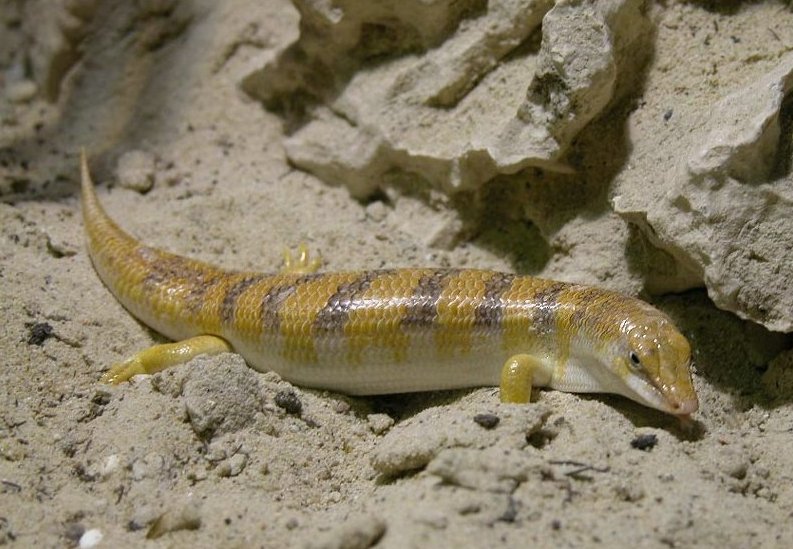 Sandfish SkinkScincus scincus
Compare
Questions and answers
What is the scientific name of the Anchieta's Snake Skink?
The scientific name of the Anchieta's Snake Skink is Eumecia anchietae. Written with its author, the full name is Eumecia anchietae Bocage, 1870.
Which family does the Anchieta's Snake Skink belong to?
Eumecia anchietae belongs to the family Scincidae, in the order Squamata and the class Reptilia.
Where is the Anchieta's Snake Skink found?
Checklists and occurrence records place Eumecia anchietae in 9 countries, including Kenya, Democratic Republic of the Congo, Zambia, Angola, Tanzania and Zimbabwe.
What is the conservation status of the Anchieta's Snake Skink?
The IUCN Red List category recorded for Eumecia anchietae is Least Concern (LC).
What other names does the Anchieta's Snake Skink have?
Eumecia anchietae is also known in English as Anchieta’s Snake Skink and Western Serpentiform Skink.
Sources
Passages the profile rests on
- The species has an elongated body and tail with a subcylindrical shape. Source passage: “The body and tail are subcylindrical and elongate.” — English Wikipedia
- The forelimbs are minute and each has two toes. Source passage: “The front legs are minute, each with two toes.” — English Wikipedia
- The hindlimbs are twice the size of the forelimbs and each has three toes. Source passage: “The hind legs are twice as large (but still very small), each with three toes.” — English Wikipedia
- The species has strongly reduced limbs. Source passage: “The limbs of E. anchietae are very reduced.” — English Wikipedia
- The species inhabits grasslands and savannas. Source passage: “The preferred natural habitats of E. anchietae are grassland and savanna” — English Wikipedia
- The species occurs at elevations between 1,000 and 2,000 metres. Source passage: “at altitudes of 1,000–2,000 m (3,300–6,600 ft).” — English Wikipedia
- The species is endemic to Africa. Source passage: “The species is endemic to Africa.” — English Wikipedia
- The species occurs in Angola, the Democratic Republic of the Congo, Kenya, Tanzania, and Zambia. Source passage: “E. anchietae is found in Angola, the Democratic Republic of the Congo, Kenya, Tanzania, and Zambia.” — English Wikipedia
- The species is active during daylight hours. Source passage: “E. anchietae is diurnal and terrestrial.” — English Wikipedia
- The species lives and moves on land. Source passage: “E. anchietae is diurnal and terrestrial.” — English Wikipedia
- The species gives birth to live young. Source passage: “E. anchietae is viviparous.” — English Wikipedia
Data
- Catalogue of Life, 2026-10-16 XR cc by
- Global Biodiversity Information Facility CC BY 4.0
- Wikidata CC0
- GeoNames CC BY 4.0
- Within the Catalogue of Life, this name comes from The Reptile Database cc by
References
- Bocage JVB (1870) Description d'un Saurien nouveau de l'Afrique occidentale. Jornal de Sciencias Mathematicas, Physicas e Naturaes, Serie 1, 3: 66 - 68. where the name was published
- Bocage,J.V. du B. (1866). Lista dos reptis das possessões portuguezas d’Africa occidental que existem no Museu Lisboa. Jorn. Sci. Math. Phys. Nat. Lisboa 1: 37-56.
- Bocage, & du, J. V. B. (1870). Description d’un “Saurien” nouveau de l’Afrique occidentale. J. Sci. Lisboa 3: 66-68.
- Sternfeld, Richard, Nieden, & Fritz. (1911). Zoologische Ergebnisse der Expedition des Herrn Hauptmann a.D. Fromm 1908/09 nach Deutsch-Ostafrika, III. Reptilia, Amphibia. Mitteilungen Aus Dem Zoologischen Museum in Berlin (Berlin), 5 (3): 383-385.
- Witte, & de, G. F. (1933). Reptiles récoltés au Conge Belge par le Dr. H. Schouteden et par M. G.-F. Witte. Ann. Mus. Conge Belge Zool. Ser. 1 Tome III: 53-100.
- Smith, M. A. (1937). A review of the genus Lygosoma (Scincidae: Reptilia) and its allies. Records of the Indian Museum 39 (3): 213-234.
- Laurent, R. F. (1964). Reptiles et batraciens de l’Angola (troisième contribution). Companhia de Di Amantes de Angola (Diamang), Serviços Culturais, Museu Do Dundo (Angola), No. 67, 165 Pp.
- Greer, A. E. (1967). The generic relationships of the African scincid genus Eumecia. Breviora (276): 1-9.
- Broadley, D. G., & HOWELL, K. M. (1991). A check list of the reptiles of Tanzania, with synoptic keys. Syntarsus 1: 1—70.
- Broadley, D. G. (1991). The Herpetofauna of Northern Mwinilunga Distr., Northw. Zambia. Arnoldia Zimbabwe 9 (37): 519-538.
- Spawls, S., & Rotich, D. (1997). An annotated checklist of the lizards of Kenya. J. East African Nat. Hist. 86: 61-83.
- Broadley, D. G. (1998). The reptilian fauna of the Democratic Republic of the Congo (Congo-Kinshasa). In: Schmidt, K.P. and Noble, G.K., Contributions to the Herpetology of the Belgian Congo... [reprint of the 1919 and 1923 papers]. SSAR Facsimile Reprints in Herpetology, 780 Pp.
- Haagner,G.V.; Branch,W.R. & Haagner,A.J.F. (2000). Notes on a collection of reptiles from Zambia and adjacent areas of the Democratic Republic of the Congo. Annals of the Eastern Cape Museum 1: 1 – 25.
- Spawls, S.; Howell, K.; Drewes, R.C. & Ashe, J. (2002). A field guide to the reptiles of East Africa. Academic Press, 543 Pp. [Reviews in HR 34: 396 and Afr. J. Herp. 51; 147].
- Beolens, B., & Michael Watkins, a. M. G. (2011). The Eponym Dictionary of Reptiles. Johns Hopkins University Press, Baltimore, USA.
- Böhme, & Wolfgang. (2014). Herpetology in Bonn. Mertensiella 21. Vi + 256 Pp.
- Stanley, Shane G.; Rachel M. Liniewski & Philip J. Senter. (2016). Appendicular skeleton of the vestigial-limbed African skink Eumecia anchietae. African Journal of Herpetology 65 (2): 99-114 | DOI: 10.1080/21564574.2016.1258012.
- Conradie W and Branch WR. (2016). The herpetofauna of the Cubango, Cuito, and lower Cuando river catchments of south-eastern Angola. Amphibian & Reptile Conservation 10 (2) [Special Section]: 6–36.
- Spawls, S. (2017). A Guide to Amphibians and Reptiles of the Maasai Mara Ecosystem. Norwich City College Print Room.
- Marques, Mariana P.; Luis M. P. Ceríaco , David C. Blackburn , and Aaron M. Bauer. (2018). Diversity and Distribution of the Amphibians and Terrestrial Reptiles of Angola -- Atlas of Historical and Bibliographic Records (1840–2017). Proc. Cal. Acad. Sci. (Ser. 4) 65: 1-501 (Supplement II).
- Spawls, Steve; Kim Howell, Harald Hinkel, Michele Menegon. (2018). Field Guide to East African Reptiles. Bloomsbury, 624 Pp.
- Butler, B O; Ceríaco, L M P; Marques, M P; Bandeira, S; Júlio, T; Heinicke, M P & Bauer, A M; (2019). Herpetological survey of Huíla Province, Southwest Angola, including first records of Bicuar National Park. Herpetological Review 50 (2): 225-240.
- Ceríaco, Luis M. P.; Mariana P. Marques, Ilunga André, Esteves Afonso, David C. Blackburn & Aaron M. Bauer. (2020). ILLUSTRATED TYPE CATALOGUE OF THE “LOST” HERPETOLOGICAL COLLECTIONS OF MUSEU DO DUNDO, ANGOLA. Bulletin of the Museum of Comparative Zoology 162 (7): 379-440.
- Pietersen, Darren, Verburgt, Luke, Davies, & John. (2021). Snakes and other reptiles of Zambia and Malawi. Struik Nature / Penguin Random House South Africa, 376 Pp., ISBN 9781775847373.
- Conradie W, Keates C, Verburgt L, Baptista NL, Harvey J, Júlio T, Neef G. (2022). Contributions to the herpetofauna of the Angolan Okavango-Cuando-Zambezi River drainages. Part 2: Lizards (Sauria), chelonians, and crocodiles. Amphibian & Reptile Conservation 16(2): 181–214 (E322).
This species in other databases
Page built on 28 November 2026. See how the catalog is made and all sources and licences.
Cite this page
ScientificNames.org. (2026). Eumecia anchietae (Anchieta's Snake Skink). Retrieved November 28, 2026, from https://scientificnames.org/species/eumecia-anchietae
“Eumecia anchietae (Anchieta's Snake Skink).” ScientificNames.org, 2026, scientificnames.org/species/eumecia-anchietae. Accessed 28 Nov. 2026.
ScientificNames.org. “Eumecia anchietae (Anchieta's Snake Skink).” Accessed November 28, 2026. https://scientificnames.org/species/eumecia-anchietae.
@misc{scientificnames_eumecia_anchietae_anchietas_snake_skink,
  author = {{ScientificNames.org}},
  title = {Eumecia anchietae (Anchieta's Snake Skink)},
  year = {2026},
  url = {https://scientificnames.org/species/eumecia-anchietae},
  note = {Accessed 2026-11-28}
}