Species · Birds
Indian Silverbill Euodice malabarica
The scientific name of the Indian Silverbill is Euodice malabarica. It is a species of bird in the family Estrildidae (munias), order Passeriformes. The name dates from 1758.
- Scientific name
- Euodice malabarica (Linnaeus, 1758)
- Common name
- Indian Silverbill
- Genus
- Euodice
- Family
- Estrildidae (Munias)
- Order
- Passeriformes
- Class
- Aves
- Red List category
- LC Least Concern
- Recorded in
- 26 countries
- Name status
- accepted in the Catalogue of Life

Overview
The Indian Silverbill is a common resident breeding bird in the drier regions of the Middle East and Indian subcontinent. It occurs in Pakistan, Nepal, Bangladesh, India, Sri Lanka, Iran and Israel. It is distinguished by its silver-grey bill, white rump, dark wings and black tail.
Written 26 November 2026 from the sources listed below. Each statement was checked against the passage it cites; statements that could not be supported were removed.
Appearance
Adult birds have a conical silver-grey bill, buff-brown upperparts, white underparts, buffy flanks and dark wings. Their black tail contrasts with a white rump.[1][2]
Males and females have similar plumage, while immature birds have buff underparts and shorter tails. The tail appears pointed because its feathers decrease in length from the centre outwards.[3][4]
The species has a chunky body, a short stout bill and a long tail. Adult Indian Silverbills measure 11–11.5 cm in length.[5][6]
Habitat
The Indian Silverbill inhabits dry open scrub, fallow land and cultivated areas, sometimes near water. It forages in grassland and scrub habitats.[7][8]
The species occurs mainly on plains but can reach elevations of approximately 1,200 m in some sub-Himalayan regions.[9]
Diet
The Indian Silverbill feeds mainly on seeds but also consumes insects. Its diet includes a wide range of grass seeds and cultivated crop species.[10][11]
The species sometimes visits nectar-bearing flowers, including those of Erythrina trees.[12]
Behaviour
Indian Silverbills are gregarious and form flocks containing as many as 60 birds. They feed on the ground, low shrubs and grass stalks.[13][14]
Foraging birds continuously produce low cheeping or chirping contact calls. They drink water using a rapid sip-and-swallow action.[15][16]
The species is largely sedentary, although some populations undertake seasonal movements. Old nests are used as roosting dormitories throughout the year.[17][18]
Reproduction and life cycle
The breeding season varies geographically, with nesting occurring in winter in southern India and after summer in northern India. The species constructs untidy, ball-shaped grass nests with side openings.[19][20]
Nests are placed in low shrubs, frequently on thorny Acacia. The species sometimes reuses abandoned baya weaver nests and may visit nests occupied by weavers.[21][22]
The species sometimes builds nests beneath the platform nests of vultures or storks. Females sometimes lay eggs in nests belonging to other breeding pairs.[23][24]
Clutches contain between four and eight white eggs. Both parents incubate the eggs for approximately 11 days.[25][26]
Additional helpers sometimes participate in breeding, with more than two birds observed at a nest.[27]
Conservation
The Indian Silverbill is classified as a non-migrant species in the BirdLife DataZone factsheet.[28]
The species has an estimated resident and breeding extent of occurrence of 11,300,000 km².[29]
Classification of the Indian Silverbill
| Kingdom | Animalia |
|---|---|
| Phylum | Chordata |
| Subphylum | Vertebrata |
| Infraphylum | Gnathostomata |
| Parvphylum | Osteichthyes |
| Megaclass | Tetrapoda |
| Class | Aves (Bird) |
| Order | Passeriformes (Passerine) |
| Family | Estrildidae (Munias) |
| Genus | Euodice (Silverbills) |
| Species | Euodice malabarica (Linnaeus, 1758) |
Where the Indian Silverbill is found
Checklists and occurrence records place Euodice malabarica in 26 countries across Asia, North America and Oceania. GBIF holds 237,088 georeferenced records of it.
Countries
- Bahrain 348
- Bangladesh 1,860
- Egypt 645
- France 10,718
- Greece 3
- India 176,900
- Iran 552
- Israel 6,009
- Italy 11
- Jordan 267
- Kuwait 338
- Monaco 12
- Nepal 325
- Oman 2,601
- Pakistan 876
- Palestinian Territory 337
- Puerto Rico 1,267
- Qatar 3,078
- Saudi Arabia 1,441
- Singapore 14
- Spain 3
- Sri Lanka 888
- Taiwan 6,664
- United Arab Emirates 21,813
- United States 104
- Yemen 14
Regions and cities with the most records
- Maharashtra, India 29,521
- Karnataka, India 29,034
- Gujarat, India 23,558
- Tamil Nadu, India 17,817
- Rajasthan, India 17,651
- Telangana, India 11,121
- Abu Dhabi, United Arab Emirates 9,630
- Chhattisgarh, India 9,163
- Madhya Pradesh, India 8,210
- Cagnes-sur-Mer, France 7,966
- Saint-Laurent-du-Var, France 7,898
- Vence, France 7,863
- Antibes, France 7,828
- Gurugram, India 7,787
- Provence-Alpes-Côte d'Azur, France 7,667
- Dubai, United Arab Emirates 7,468
- Juan-les-Pins, France 7,418
- Nice, France 7,353
- Uttar Pradesh, India 7,250
- Rijokri, India 7,180
- Haryana, India 7,007
- Kāpas Herd, India 6,707
- Kukatpally, India 6,643
- Samālka, India 6,643
- Roshanpura, India 6,459
- Aya Nagar, India 6,288
- Malakpur Kohi Rangpur, India 6,190
- Najafgarh, India 6,016
- Bādshāhpur, India 5,933
- Electronic City Phase I, India 5,615
- Sultan Pur, India 5,608
- koppana Agrahara, India 5,604
- Quthbullapur, India 5,603
- Hebbagodi, India 5,497
- Bommasandra Industrial Area, India 5,482
- Pul Pehlad, India 5,477
5 more countries have a few records outside this range
These countries hold a few records of Euodice malabarica but lie outside the range the checklists give for it. Such records are often zoo or garden specimens, museum material or vagrants, so the species is not counted as occurring there.
Range as the checklists state it
Europe & Northern Asia (excluding China)
Southern Asia
Caribbean
Oceania
A number beside a place is its count of GBIF occurrence records. A place without a number comes from a checklist alone. Records show where a species has been observed or collected, which can include escapes and vagrants.
Common names
English
- Indian Silverbill
- Warbling Silverbill
- White-throated Munia
Names in 38 other languages
- Arabic
- فضي المنقار, فضي المنقار هندي
- Bengali
- দেশি চাঁদিঠোট
- Bulgarian
- Индийска сивоклюна амадина
- Catalan
- maniquí bec de plom
- Chinese
- 印度銀嘴文鳥, 白喉文鳥, 白喉文鸟
- Croatian
- smeđa amadina
- Czech
- stříbrozobka indická, stříbrozobka malabarská
- Danish
- Indisk Sølvnæb
- Dutch
- Loodbekje
- Esperanto
- plumbobeka estrildo
- Estonian
- india leetamadiin
- Finnish
- idänhopeanokka
- French
- Capucin bec-de-plomb
- German
- Indiensilberschnabel, Malabarfasänchen
- Hebrew
- כסוף-מקור הודי
- Hungarian
- indiai ezüstcsőrűpinty
- Icelandic
- Silfurstrildi
- Irish
- Gealghob Indiach
- Italian
- Becco di piombo
- Japanese
- ギンバシ
- Latvian
- Indijas sudrabknābītis
- Lithuanian
- indinė munija
- Malayalam
- വയലാറ്റ
- Marathi
- शुभ्रकंठी
- Northern Sami
- Indiasilbanjunni
- Norwegian
- indiasølvnebb
- Persian
- سهره ریزهندی
- Polish
- srebrnodziobek indyjski
- Portuguese
- bico-de-chumbo-indiano
- Russian
- Малабарская амадина
- Serbian
- Azijska srebrnokljuna zeba
- Slovak
- mníška striebrozobka
- Slovenian
- indijski srebrnokljunček
- Spanish
- Capuchino picoplata indio, Pico de plata indio
- Swedish
- indisk silvernäbb
- Turkish
- Hint Gümüşgagası
- Ukrainian
- сріблодзьоб індійський
- Welsh
- arianbig India
Synonyms
6 other scientific names have been used for this species and are now treated as synonyms of Euodice malabarica.
- Euodice malabarica AERC TAC (2003)
- Euodice malabarica malabarica Cramp & Simmons (1977-1994)
- Lonchura cheet Sykes, WH, 1832
- Lonchura malabarica (Linnaeus, 1758)
- Lonchura malabarica malabarica Linnaeus, C, 1758
- Loxia malabarica Linnaeus, C, 1758
Related species
-
 African SilverbillEuodice cantans
-
 Scaly-breasted MuniaLonchura punctulata
-
 Red AvadavatAmandava amandava
-
 Common WaxbillEstrilda astrild
-
 Red-browed FinchNeochmia temporalis
-
 White-rumped MuniaLonchura striata
-
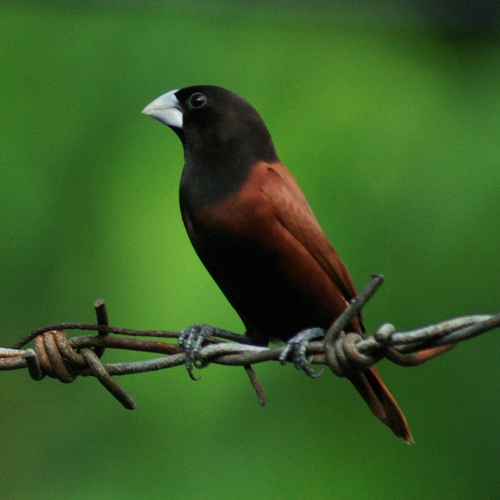 Chestnut MuniaLonchura atricapilla
-
 Double-barred FinchTaeniopygia bichenovii
Compare
Questions and answers
What is the scientific name of the Indian Silverbill?
The scientific name of the Indian Silverbill is Euodice malabarica. Written with its author, the full name is Euodice malabarica (Linnaeus, 1758).
Which family does the Indian Silverbill belong to?
Euodice malabarica belongs to the family Estrildidae, in the order Passeriformes and the class Aves.
Where is the Indian Silverbill found?
Checklists and occurrence records place Euodice malabarica in 26 countries, including India, United Arab Emirates, France, Taiwan, Israel and Qatar.
What is the conservation status of the Indian Silverbill?
The IUCN Red List category recorded for Euodice malabarica is Least Concern (LC).
What other names does the Indian Silverbill have?
Euodice malabarica is also known in English as Warbling Silverbill and White-throated Munia.
Sources
Passages the profile rests on
- Adult birds have a conical silver-grey bill, buff-brown upperparts, white underparts, buffy flanks and dark wings. Source passage: “The adult Indian silverbill is 11–11.5 cm long and has a conical silver-grey bill, buff-brown upperparts, white underparts, buffy flanks and dark wings.” — English Wikipedia
- The species has a black tail and a white rump contrasting with its dark wings. Source passage: “The tail is black and the wings are dark contrasting with a white rump.” — English Wikipedia
- Males and females have similar plumage, while immature birds have buff underparts and shorter tails. Source passage: “The sexes are similar, but immatures have buff underparts and a shorter tail.” — English Wikipedia
- The tail appears pointed because its feathers decrease in length from the centre outwards. Source passage: “The tail appears pointed as the length of the feathers reduces from the centre outwards.” — English Wikipedia
- The species has a chunky body, a short stout bill and a long tail. Source passage: “Small, long-tailed finch with a chunky body and short, stout bill.” — ebird.org
- Adult Indian silverbills measure 11–11.5 cm in length. Source passage: “The adult Indian silverbill is 11–11.5 cm long” — English Wikipedia
- The species inhabits dry open scrub, fallow land and cultivated areas, sometimes near water. Source passage: “It frequents dry open scrub, fallow land and cultivation, sometimes near water.” — English Wikipedia
- The species forages in grassland and scrub habitats. Source passage: “They forage in small flocks in grassland and scrub habitats.” — English Wikipedia
- The species occurs mainly on plains but can reach elevations of approximately 1,200 m in some sub-Himalayan regions. Source passage: “Although mainly found on the plains, they can be found up to about 1200 m in some sub-Himalayan regions.” — English Wikipedia
- The species feeds mainly on seeds but also consumes insects. Source passage: “It feeds mainly on seeds, but also takes insects” — English Wikipedia
- Its diet includes a wide range of grass seeds and cultivated crop species. Source passage: “Their feed on a wide range of grass seeds and will also make use of crop species.” — English Wikipedia
- The species sometimes visits nectar-bearing flowers, including those of Erythrina trees. Source passage: “has been known to visit nectar bearing flowers, such as those of Erythrina trees.” — English Wikipedia
- Indian silverbills are gregarious and form flocks containing as many as 60 birds. Source passage: “These birds are gregarious and are found in flocks of as many as 60 birds.” — English Wikipedia
- The birds feed on the ground, low shrubs and grass stalks. Source passage: “They feed on the ground or on low shrubs and grass stalks.” — English Wikipedia
- Foraging birds continuously produce low cheeping or chirping contact calls. Source passage: “They constantly utter a low cheeping or chirping contact call as they forage.” — English Wikipedia
- The birds drink water using a rapid sip-and-swallow action. Source passage: “They visit water and drink with a rapid sip and swallow action.” — English Wikipedia
- The species is largely sedentary, although some populations undertake seasonal movements. Source passage: “Although largely sedentary, some populations make seasonal movements.” — English Wikipedia
- Old nests are used as roosting dormitories throughout the year. Source passage: “Old nests are used as dormitories through the year for roosting.” — English Wikipedia
- The breeding season varies geographically, with nesting occurring in winter in southern India and after summer in northern India. Source passage: “They nest in winter in southern India and after summer in northern India.” — English Wikipedia
- The species constructs untidy, ball-shaped grass nests with side openings. Source passage: “The nest, an untidy ball of grasses with an opening on the side” — English Wikipedia
- Nests are placed in low shrubs, frequently on thorny Acacia. Source passage: “is placed in low shrubs, often on thorny Acacia.” — English Wikipedia
- Indian silverbills sometimes reuse abandoned baya weaver nests and may visit nests occupied by weavers. Source passage: “They are also known to make use of the old nests of baya weaver sometimes even visiting those that are occupied by the weaver birds.” — English Wikipedia
- The species sometimes builds nests beneath the platform nests of vultures or storks. Source passage: “They will sometimes build their nest below the platform nests of vultures or storks.” — English Wikipedia
- Females sometimes lay eggs in nests belonging to other breeding pairs. Source passage: “Females are known to lay their eggs in the nests of other pairs.” — English Wikipedia
- Clutches contain between four and eight white eggs. Source passage: “The clutch varies from 4 to 8 white eggs” — English Wikipedia
- Both parents incubate the eggs for approximately 11 days. Source passage: “these are incubated by both parents for about 11 days.” — English Wikipedia
- Additional helpers sometimes participate in breeding, with more than two birds observed at a nest. Source passage: “Helpers may be involved in breeding as more than a pair are sometimes seen at a nest.” — English Wikipedia
- The Indian silverbill is classified as a non-migrant species in the BirdLife DataZone factsheet. Source passage: “Migratory status Not a Migrant” — datazone.birdlife.org
- The species has an estimated resident and breeding extent of occurrence of 11,300,000 km². Source passage: “Extent of Occurrence (resident/breeding) 11,300,000 km²” — datazone.birdlife.org
Data
- Catalogue of Life, 2026-10-16 XR cc by
- Global Biodiversity Information Facility CC BY 4.0
- Wikidata CC0
- GeoNames CC BY 4.0
- Wikimedia Commons per image; credit shown with each image
- Within the Catalogue of Life, this name comes from The Integrated Taxonomic Information System cc0
References
- Berger, Andrew J. (1975). The Warbling Silverbill, A New Nesting Bird in Hawaii. Pacific Science, Vol. 29, No.1.
This species in other databases
Page built on 28 November 2026. See how the catalog is made and all sources and licences.
Cite this page
ScientificNames.org. (2026). Euodice malabarica (Indian Silverbill). Retrieved November 28, 2026, from https://scientificnames.org/species/euodice-malabarica
“Euodice malabarica (Indian Silverbill).” ScientificNames.org, 2026, scientificnames.org/species/euodice-malabarica. Accessed 28 Nov. 2026.
ScientificNames.org. “Euodice malabarica (Indian Silverbill).” Accessed November 28, 2026. https://scientificnames.org/species/euodice-malabarica.
@misc{scientificnames_euodice_malabarica_indian_silverbill,
  author = {{ScientificNames.org}},
  title = {Euodice malabarica (Indian Silverbill)},
  year = {2026},
  url = {https://scientificnames.org/species/euodice-malabarica},
  note = {Accessed 2026-11-28}
}